How New Albany began
New Albany was platted in May 1837 by Daniel Landon and William Yantis on land in Plain Township first settled by Euro-Americans around 1801, replacing at least two earlier villages nearby that had failed. It incorporated in 1856 as a small farm-country crossroads and stayed one, with barely 400 residents as late as 1980. Starting in the 1990s, driven first by Leslie Wexner's Limited-brand business empire and his estate nearby, then by explosive twenty-first century growth culminating in Intel's 2022 announcement of what it called the world's largest semiconductor fabrication plant on annexed New Albany land, the village became one of the fastest-growing cities in Ohio, passing 11,000 residents. The name most likely honors Albany, New York, home to some of the area's early settlers, though no source confirms this beyond calling it 'one theory.'
Settled 1801-1802, platted 1837, incorporated 1856, by Daniel Landon and William Yantis, who each owned half the platted land (Wikipedia gives the name as 'Nobel Landon'; the 1880 county history, closer to the event and internally consistent with Landon's later role as New Albany's first postmaster, gives 'Daniel Landon').
Where the name comes from
No primary source found explains the name directly. Wikipedia offers 'one theory... that some of the original settlers migrated from the Albany, New York, area' and named the new village for their former home. The 1880 county history does not address the question at all.
Before the town
No source found records anything specific to Native people or sites at New Albany or in this part of Plain Township; unlike some neighboring townships' chapters, the 1880 county history's Plain Township chapter has no separate discussion of the subject. This land lay south and east of the Greenville Treaty Line and so was ceded to the United States by the 1795 Treaty of Greenville, six years before the first recorded Euro-American settlers arrived. Broader county-level context, including the historic nations who lived in, hunted, or traveled this part of the county, will be in the Franklin County file.
Timeline
- — The Treaty of Greenville cedes this part of Ohio, lying south and east of the treaty line, to the United States.
- — The southwest quarter of the township (section three) is patented to Dudley Woodbridge in 1800 and sold two years later to John Huffman for a price recorded as one gallon of whiskey per acre, some 4,000 gallons, to be delivered at Marietta.
- — Plain Township receives its first Euro-American settlers; local tradition names Joseph Scott, whose farm gave the name 'Scott's Plains,' though some credited a settler named Morrison, after whom 'Morrison's Prairie' was named, with arriving just before him.
- — George Baughman's barn, the township's first, is raised with help from neighbors traveling in from Plain, Blendon, Mifflin, Jefferson, and Truro townships.
- — Plain Township is formally organized, at the time including the territory of what later became Blendon and Jefferson townships as well.
- — The township's first burial ground is set apart on land donated by John Smith, who becomes the first person buried in it.
- — Loren Hills and Lester Humphrey plat a village called Lafayetteville on the Granville road near the future site of New Albany; no buildings are ever put up, and the land returns to farming.
- — Francis Clymer plats a village called Mount Pleasant on his own farm; it too fails and is abandoned, though a church built later nearby keeps the name.
- — In May, Daniel Landon and William Yantis lay out the village of New Albany, a little south and east of the township's center.
- — New Albany's post office, named Hope, is established on May 15 with Daniel Landon as its first postmaster.
- — New Albany incorporates as a village; its first charter election that April chooses S. Ogden as mayor, with a reported population of 50.
- — A two-story brick schoolhouse, costing $3,000, is built in New Albany, replacing earlier arrangements.
- — New Albany's population grows from 414 (1980) to 1,621 (1990) to 3,711 (2000), driven in large part by Leslie Wexner's Limited-brand business empire and his estate in the area.
- — In January, Intel announces plans to build what it describes as the world's largest semiconductor fabrication plant on 926 acres annexed into New Albany; construction begins that September.
Stories
Two villages that failed before New Albany succeeded
New Albany was not the first attempt to build a town on this stretch of the Granville road. In 1826, Loren Hills and Lester Humphrey platted a village nearby and named it Lafayetteville, presumably for the Marquis de Lafayette, whose triumphant American tour was then recent memory. Nothing was ever built on it, and within a few years the lots reverted to farmland. In 1835, Francis Clymer tried again on his own farm, naming his village Mount Pleasant; it failed too, though a United Brethren church built there in 1857 kept the name alive as 'Mount Pleasant chapel' long after the village itself was gone. Two years after Clymer's failure, Daniel Landon and William Yantis platted New Albany, on a different site, and this time the town took.
Landon and Yantis lay out New Albany
In May 1837, Daniel Landon and William Yantis, each holding half the land, laid out the lots of New Albany a little south and east of the center of Plain Township. The village's post office opened the following year under an entirely different name, Hope, with Landon himself as the first postmaster, a post he held by repeated reappointment until 1853. New Albany grew slowly but steadily as a farm-country crossroads: it incorporated in 1856 with about fifty residents, and by 1880 supported two hotels, three general stores, a wagon shop, a blacksmith, and a two-story brick schoolhouse built in 1872 for $3,000. It stayed a village of a few hundred people for more than a century afterward.
A gallon of whiskey an acre
The land under the southwest quarter of Plain Township, including ground near New Albany, was patented to Dudley Woodbridge in 1800. Two years later he sold it to John Huffman, a Pennsylvania settler who would go on to become a prominent early citizen of Franklin County, and the 1880 county history records the price with a specificity that outlasted the transaction by eighty years: one gallon of whiskey per acre, some four thousand gallons in all, to be delivered at Marietta. Huffman divided the land among his children in 1822. It is a small story, but a telling one, about how land, credit, and whiskey substituted for cash on the Ohio frontier in the years right after the Treaty of Greenville opened the country to settlement.
From farm crossroads to chip hub
For its first century and a half, New Albany changed very little: 414 people lived there in 1980, not many more than in the 1870s. That changed fast starting in the 1990s, as retail executive Leslie Wexner, who built his fortune on The Limited and built his own estate nearby, backed the village's transformation into a master-planned community of Georgian-style brick homes and corporate campuses; population passed 1,600 by 1990 and more than tripled again by 2000. The scale of change reached a new order of magnitude in January 2022, when Intel announced it would build what it called the world's largest semiconductor fabrication plant on 926 acres annexed into the city, with construction beginning that September alongside new data centers from Facebook and Google. A village platted for fifty settlers in 1837 is, in the twenty-first century, ground zero for American computer-chip manufacturing.
Photographs
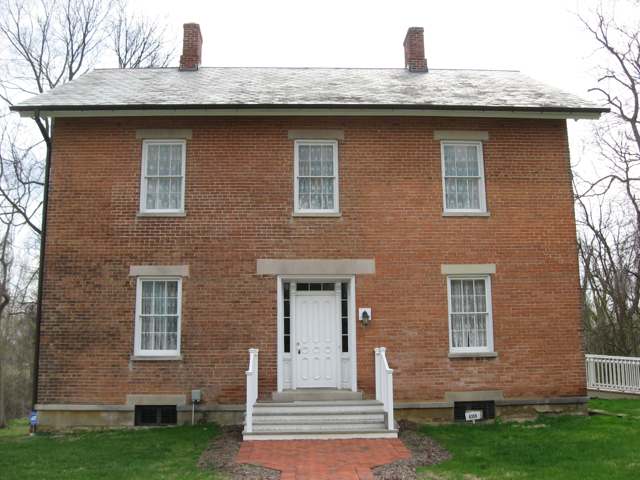
Photo: Nyttend, public domain · Wikimedia Commons
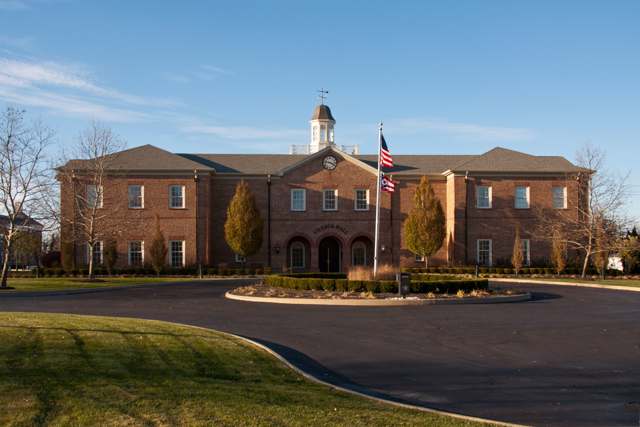
Photo: Sixflashphoto, CC BY-SA 4.0 · Wikimedia Commons
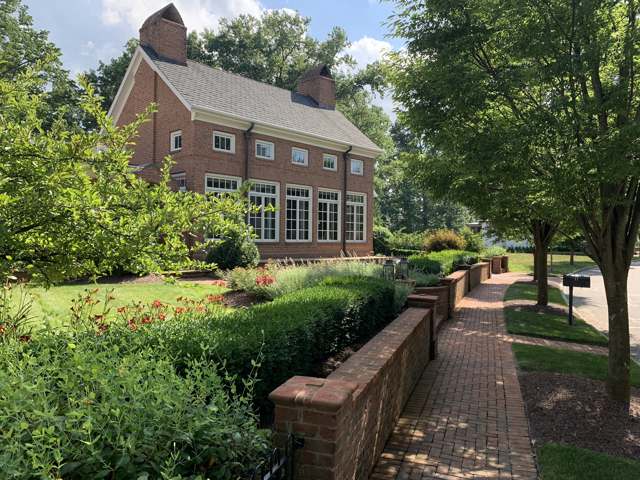
Photo: Lisa Hinson, courtesy of the New Albany Community Foundation, CC BY-SA 4.0 · Wikimedia Commons
Local history sources: archive.org · en.wikipedia.org · en.wikipedia.org · commons.wikimedia.org · commons.wikimedia.org · commons.wikimedia.org
Water
Big Walnut Creek at the plant's low-head dam and screen house on Morse Rd, below Hoover Dam The water here
- Columbus Public Water System91% of residentsScioto River (Griggs & O'Shaughnessy), Hoover Reservoir on Big Walnut Ck, plus wells
- Gahanna City8% of residentsScioto River (Griggs & O'Shaughnessy), Hoover Reservoir on Big Walnut Ck, plus wells
- Johnstown City1% of residentsGroundwater wells (3 wells)
- Del-co Water Company, Inc.0% of residentsOlentangy River, O'Shaughnessy and Alum Creek reservoirs, plus Knox County wells
- Green Meadows MHP0% of residentsGroundwater wells (2 wells)
Its ZIP codes
Each ZIP code that touches New Albany, with the share of its residents who live here and the same headline figures as the ZIP page.
| ZIP | Share | Water | Radon | Home value | Schools | Flood |
|---|---|---|---|---|---|---|
| 43054 Columbus and New Albany | 39% | Big Walnut Creek at the plant's low-head dam and screen house on Morse Rd, below Hoover Dam | 4.6 pCi/L average radon | Median year built 2003 | New Albany-Plain Local · 5 stars overall | 3.1% of residents in the 1% floodplain |
| 43031 Johnstown | 3% | Mostly private wells | 5.7 pCi/L average radon | Median year built 1991 | Johnstown-Monroe Local · 3.5 stars overall | 0.2% of residents in the 1% floodplain |
The county
Franklin County: 45 ZIP codes, 42 cities, villages and townships, 1,356,733 people.
Nearby places
Cite this page
Cite this page as:
Cracked Buckeye (Open Shower Co), "New Albany, Franklin County", https://crackedbuckeye.com/place/new-albany/, built 2026-09-16, accessed [date].
Machine-readable: /api/place/new-albany.json (open JSON, CC BY 4.0 for the compilation; the underlying records keep their own terms) · How to cite · Report a correction · Built 2026-09-16