How Plain Township, Franklin County began
Plain Township was organized in 1810, originally including the territory that later became Blendon and Jefferson townships, and settled beginning in 1801 or 1802 by Joseph Scott and other Pennsylvania emigrants. Its southeast quarter was surveyed in 100-acre lots set aside for Revolutionary War veterans holding land warrants. New Albany was laid out within the township in 1837; more than a century later, in the Westerville area the township's zip codes now reach, the Hanby House preserves the home of composer Benjamin Hanby, writer of 'Up on the Housetop' and the abolitionist ballad 'Darling Nelly Gray.' Today the township includes part of New Albany, remade since the 1990s into a planned corporate community, and part of Westerville near Otterbein University.
Settled 1801-1802, incorporated 1810.
Where the name comes from
No source consulted explains why the township is called Plain. The 1880 county history states only that it 'was organized in 1810, and originally included the territory now embraced in Blendon and Jefferson,' without giving a reason for the name; it may simply describe the character of the land.
Before the town
The 1880 county history's Plain Township chapter records no ancient mounds, earthworks, or Native American villages, trails, or camps within the township. It does describe the township's unusual internal survey: the north half was laid out in standard mile-square sections and quarter sections, but the southeast quarter was surveyed in one-hundred-acre lots 'for the benefit of the Revolutionary soldiers, who held one hundred acre warrants' — bounty-land warrants issued for Revolutionary War service, of the kind used across the U.S. Military District, which also covers neighboring Blendon Township (organized from the same original township as Plain in 1810). The land was opened to settlement by the Treaty of Greenville, signed August 3, 1795, in which the Wyandot, Shawnee, Lenape (Delaware), Miami, Ottawa and other nations ceded most of what is now Ohio to the United States. No source consulted names a specific Native nation, village, or trail within Plain Township's own boundaries.
Nations recorded here: Wyandot, Shawnee, Lenape (Delaware), Miami, Ottawa.
Timeline
- — The Treaty of Greenville cedes most of what becomes Ohio, including the future Plain Township, to the United States.
- — Joseph Scott, from Pennsylvania, becomes the township's first settler, followed soon after by a settler remembered only as Morrison.
- — Adam and Priscilla Baughman and Henry Hoffman settle in the township.
- — George Baughman settles in the township.
- — Plain Township is organized, originally including the territory that later becomes Blendon and Jefferson townships.
- — A United Brethren congregation organizes in the township, followed over time by Methodist and Congregational churches.
- — Daniel Kramer builds the township's first sawmill, on Rocky Fork; the 1880 history notes the township never has a gristmill of its own.
- — Archibald Smith builds a second sawmill in the township.
- — New Albany is laid out in May, subdivided into 50-by-100-foot lots for sale to settlers; sources disagree on the first name of one founder, giving either Daniel Landon (1880 county history) or Nobel Landon (Wikipedia), alongside William Yantis.
- — Benjamin Hanby enrolls at Otterbein University in Westerville; he later lives in the house on West Main Street now preserved as the Hanby House museum.
- — New Albany is incorporated with a population of 50; S. Ogden is elected its first mayor.
- — Benjamin Hanby, running a singing school in New Paris, Ohio, composes the Christmas song 'Up on the Housetop.'
- — Benjamin Hanby dies in Chicago on March 16, at age 33, of tuberculosis; he is buried in Otterbein Cemetery in Westerville.
- — Mrs. Edward Babbitt is elected New Albany's first female mayor.
- — Rapid growth transforms New Albany into a planned corporate community, driven in part by Les Wexner's investment and construction of his estate there.
Stories
The Composer of Christmas
Benjamin Hanby enrolled at Otterbein University in Westerville in 1849, the son of a United Brethren bishop and, like his father, an active participant in the Underground Railroad. One night a runaway slave from Kentucky named Joseph Selby took shelter in the Hanby family home and died there; the encounter moved Benjamin to write 'Darling Nelly Gray' in 1856, an anti-slavery ballad that became one of the most popular songs in the country before the Civil War. Eight years later, running a singing school in New Paris, Ohio, he wrote something lighter for a Christmas singalong: 'Up on the Housetop,' still sung today. Hanby died in Chicago in 1867 at just thirty-three, and is buried back in Westerville's Otterbein Cemetery. His home on West Main Street is preserved today as the Hanby House museum, owned by the Ohio History Connection and operated by the Westerville Historical Society.
A Township Surveyed for Veterans
Plain Township's land was not divided all one way. The 1880 county history explains that while the north half was surveyed in ordinary mile-square sections and quarter sections, the southeast quarter was laid out differently, in one-hundred-acre lots set aside specifically for Revolutionary War veterans who held land warrants of that size. Into this mixed landscape came the township's first settlers: Joseph Scott from Pennsylvania around 1801 or 1802, then Adam and Priscilla Baughman and Henry Hoffman in 1805, and George Baughman in 1807 — families whose land, in at least part of the township, may have come by way of a soldier's war-service claim rather than an ordinary purchase.
New Albany's Two Foundings
New Albany has effectively been founded twice. The first time was in May 1837, when a village of small fifty-by-one-hundred-foot lots was laid out for sale to settlers; it incorporated in 1856 with just 50 residents and grew slowly for well over a century, still counting only 414 people as late as 1980. The second founding came in the 1990s, when businessman Les Wexner built his own estate there and backed the rapid development of New Albany into a planned corporate and residential community, aided by improved access from State Route 161. The nineteenth-century village and the modern planned community share a name, a location, and little else.
No Gristmill in the Township
The 1880 county history makes a point of noting what Plain Township lacked: 'There is, and has been, no grist-mill in the township.' Sawmills came early enough — Daniel Kramer built one on Rocky Fork in 1827, and Archibald Smith built a second in 1834 — but anyone who wanted their wheat or corn ground into flour or meal had to haul it to a mill in another township entirely. It is a small detail, but a telling one, about how unevenly basic infrastructure reached rural Ohio even fifty years after the first settlers arrived.
Photographs
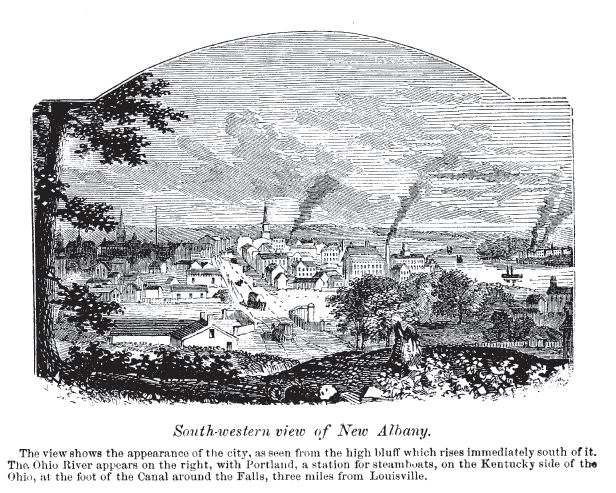
Photo: John W. Barber and Henry Howe, F. A. Howe Publishing, Cincinnati, public domain · Wikimedia Commons
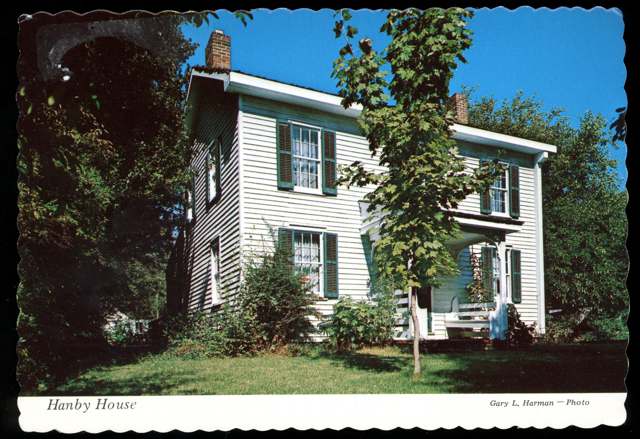
Photo: Columbus Metropolitan Library postcard collection, via DPLA/Ohio Digital Network, no known copyright restrictions · Wikimedia Commons
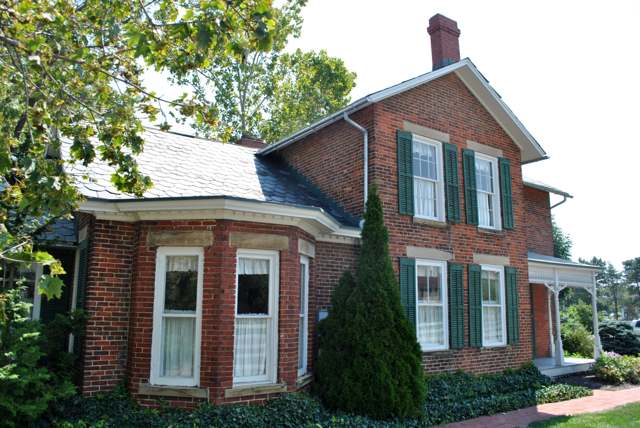
Photo: Wdzinc, via Wikimedia Commons, CC BY-SA 4.0 · Wikimedia Commons
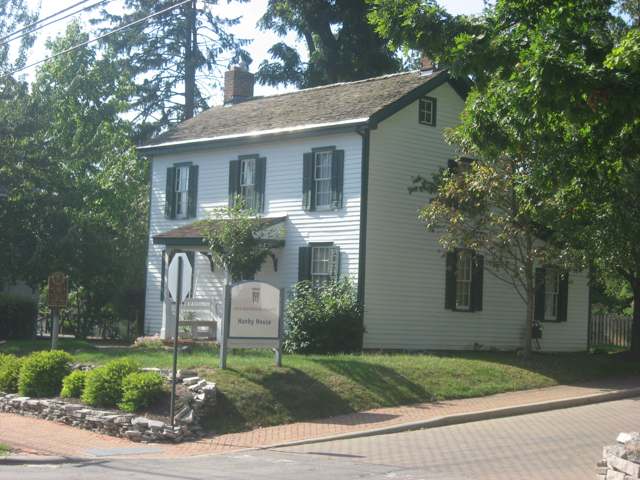
Photo: Nyttend, public domain · Wikimedia Commons
Local history sources: ohiogenealogyexpress.com · en.wikipedia.org · en.wikipedia.org · en.wikipedia.org · en.wikipedia.org · commons.wikimedia.org · commons.wikimedia.org · commons.wikimedia.org · commons.wikimedia.org
Water
Big Walnut Creek at the plant's low-head dam and screen house on Morse Rd, below Hoover Dam The water here
- Columbus Public Water System67% of residentsScioto River (Griggs & O'Shaughnessy), Hoover Reservoir on Big Walnut Ck, plus wells
- Westerville City23% of residentsAlum Creek + wells
- Aqua Ohio - Huber Ridge5% of residentsGroundwater wells (7 wells)
- Gahanna City4% of residentsScioto River (Griggs & O'Shaughnessy), Hoover Reservoir on Big Walnut Ck, plus wells
- Del-co Water Company, Inc.1% of residentsOlentangy River, O'Shaughnessy and Alum Creek reservoirs, plus Knox County wells
Its ZIP codes
Each ZIP code that touches Plain Township, Franklin County, with the share of its residents who live here and the same headline figures as the ZIP page.
| ZIP | Share | Water | Radon | Home value | Schools | Flood |
|---|---|---|---|---|---|---|
| 43054 Columbus and New Albany | 4% | Big Walnut Creek at the plant's low-head dam and screen house on Morse Rd, below Hoover Dam | 4.6 pCi/L average radon | Median year built 2003 | New Albany-Plain Local · 5 stars overall | 3.1% of residents in the 1% floodplain |
| 43081 Westerville | 1% | Alum Creek, drawn just north of Main Street at the treatment plant, supplemented by 3 active groundwater wells | 5.4 pCi/L average radon | Median year built 1986 | Westerville City · 3.5 stars overall | 1.5% of residents in the 1% floodplain |
The county
Franklin County: 45 ZIP codes, 42 cities, villages and townships, 1,356,733 people.
Nearby places
Cite this page
Cite this page as:
Cracked Buckeye (Open Shower Co), "Plain Township, Franklin County", https://crackedbuckeye.com/place/plain-township-franklin-county/, built 2026-09-16, accessed [date].
Machine-readable: /api/place/plain-township-franklin-county.json (open JSON, CC BY 4.0 for the compilation; the underlying records keep their own terms) · How to cite · Report a correction · Built 2026-09-16