How Monroe Township, Licking County began
Monroe Township organized in 1812 as a large square block filling the county's northwest corner, embracing what later became Liberty, Bennington and Hartford townships as well; it reached its present shape only after Bennington split off in 1815 and Liberty in 1827. Before white settlement the Wyandot kept a village, Raccoon Town, on Raccoon Creek a mile above the future Johnstown, until Charles and George Green bought out their improvements in 1807. Johnstown itself grew from a 4,000-acre Revolutionary War land grant to John Brown, sold in 1810 to Dr. Oliver Bigelow, who platted the town in 1813 around a public square he donated to the community. The village never grew to its founders' expectations, but in 1926 a Johnstown farmer's discovery of a nearly complete mastodon skeleton under the town gave it an unexpected claim to fame.
Settled 1806 (Washington Evans and wife Lucy), platted 1813 (Johnstown, by Dr. Oliver Bigelow), incorporated 1812 (Monroe Township organized), by Dr. Oliver Bigelow platted Johnstown on land purchased from John Brown.
Where the name comes from
No source consulted states directly why the township was named Monroe; Ohio organized many townships under this name in the early republic, generally in honor of President James Monroe. Johnstown, the township's principal village, takes its name instead from an earlier owner or founder rather than the township.
Before the town
Monroe Township holds one of the county's better-documented Native villages. The 1881 county history states plainly that 'the Wyandot Indians once lived here in considerable numbers,' having built a town called Raccoon Town on Raccoon Creek, a mile or more above the future Johnstown; the county's general Indians chapter confirms it as a Wyandot village whose residents remained until 1807, when Charles and George Green purchased their possessions and began farming the land themselves. A smaller number of Indians, the same chapter records, kept a few huts nearby on the Brushy Fork, close to the McKean-Granville township line, remaining there until after the outbreak of the War of 1812. Colonel Charles Whittlesey's map of Ohio's Native peoples assigned this part of the county generally to Delaware territory, though the 1881 history notes it 'does not appear... that the Delawares occupied it to any great extent,' since it was used mainly as hunting ground by the Wyandot and Shawnee. The land itself had been ceded to the United States by the 1785 Treaty of Fort McIntosh, whose boundary ran from the mouth of the Cuyahoga River to the Tuscarawas and on to the Maumee, and again, more completely, by the 1795 Treaty of Greenville.
Nations recorded here: Wyandot, Shawnee, Lenape (Delaware).
- Raccoon Town (village) — on Raccoon Creek, a mile or more above Johnstown, Monroe Township, occupied until 1807 (archive.org)
Timeline
- — The Treaty of Fort McIntosh sets a boundary ceding this part of Ohio to the United States, though Native use of the land continues for years afterward.
- — Washington Evans and his wife Lucy, from Greene County, Pennsylvania, become the township's first white settlers.
- — Charles and George Green purchase the possessions of the Wyandot at Raccoon Town and begin farming the land; George and Diana Green's daughter Mahala, born that autumn, is the first white child born in the township.
- — John Brown, a Revolutionary War veteran who had received the surrounding 4,000-acre tract from President John Adams in 1800, sells the land for $2.50 an acre, or $10,000 total, to Dr. Oliver Bigelow.
- — Monroe Township is organized, embracing a square block in the county's northwest corner that includes the future Liberty, Bennington and Hartford townships; Moses Foster becomes its first justice of the peace.
- — Dr. Oliver Bigelow lays out the town of Johnstown in the township's southwest quarter, donating its streets, alleys and public square to the community.
- — A line drawn east and west through Monroe Township separates its north half as the new Bennington Township.
- — The Monroe Baptist church organizes one mile north of Johnstown under Rev. George Evans.
- — Johnstown's Methodist Episcopal church, among the township's oldest, organizes under the well-known preacher Russel Bigelow at the home of settler George Green.
- — Liberty Township is created out of Monroe's east half, leaving Monroe in its present shape.
- — The first Presbyterian church of Johnstown organizes on July 15 under Joseph Matthews.
- — A railroad reaches Johnstown for the first time in September, more than seventy years after the town's founding, with a depot building under construction.
- — Farmer James Bailey finds a nearly complete mastodon skeleton beneath Johnstown; it is later sold to the Cleveland Museum of Natural History.
Stories
Raccoon Town
A mile or more above the future site of Johnstown, on Raccoon Creek, the Wyandot maintained a village the 1881 county history calls Raccoon Town, home to 'considerable numbers' of people. In 1807, Charles and George Green purchased the Wyandot residents' improvements outright and began occupying and cultivating the same land themselves; the following autumn, George Green's wife Diana gave birth to Mahala Green, remembered as the first white child born in the township. Mrs. George Green herself was still living in Monroe Township at ninety-two years old when the county history was compiled, the mother of seventeen children, grandmother of one hundred, and great-grandmother of seventy more — a single family's fortunes standing in, in the record the county chose to keep, for what became of the village they had bought out.
A Soldier's Land Becomes a Town
Johnstown's ground began as a Revolutionary War pension. John Brown, a veteran of the war, received a 4,000-acre tract here from President John Adams in 1800 for his military service, then sold the whole parcel in 1810 for $2.50 an acre, ten thousand dollars in all, to Dr. Oliver Bigelow, a settler from New York State. Bigelow laid the town out in 1813 in a square, with a large public square donated at its center, in the pattern common to the county's other planned towns. Growth never matched what its founders hoped for: the 1881 county history notes dryly that the town 'never grew, however, up to the expectation of its founders,' and that its population in 1880 was probably little more than in 1830, fifty years earlier, even after a railroad finally reached it that same year.
The Mastodon Under Main Street
In 1926, a Johnstown farmer named James Bailey unearthed something considerably older than the town itself: a nearly complete mastodon skeleton, buried in the ground his family worked. The find was significant enough that the skeleton was sold to the Cleveland Museum of Natural History, where it remains part of the scientific record of Ice Age Ohio. More than a century after Dr. Bigelow platted his town square, it was this discovery, rather than anything from the town's own commercial or civic history, that Johnstown became best known for.
Photographs
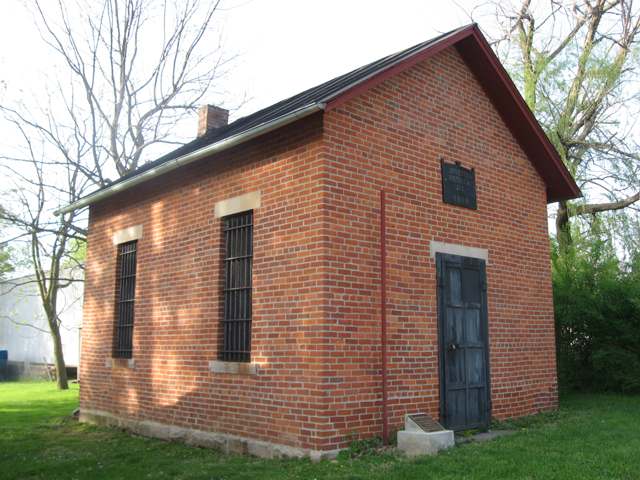
Photo: Nyttend, via Wikimedia Commons, public domain · Wikimedia Commons
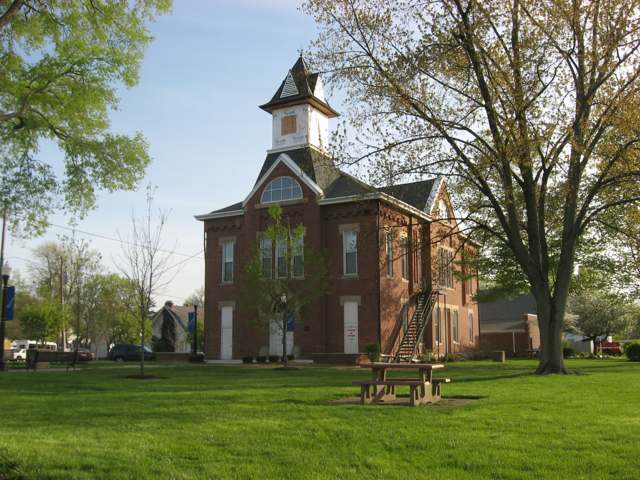
Photo: Nyttend, via Wikimedia Commons, public domain · Wikimedia Commons
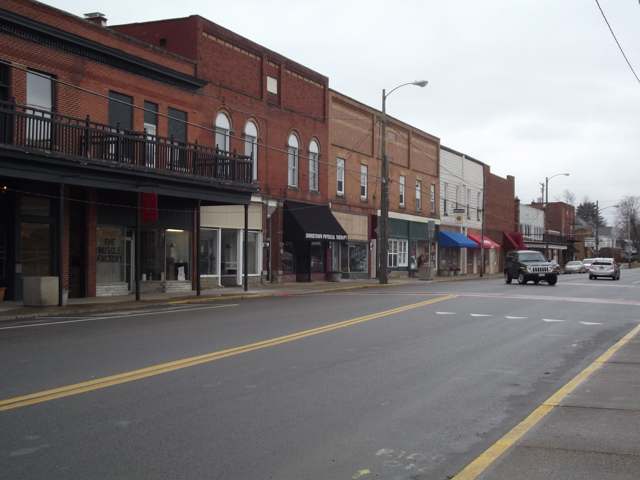
Photo: Central Avenue, via Wikimedia Commons, CC BY 4.0 · Wikimedia Commons
Local history sources: archive.org · en.wikipedia.org · en.wikipedia.org · en.wikipedia.org · en.wikipedia.org · commons.wikimedia.org · commons.wikimedia.org · commons.wikimedia.org · commons.wikimedia.org
Water
Mostly private wells The water here
- Johnstown City89% of residentsGroundwater wells (3 wells)
- Del-co Water Company, Inc.8% of residentsOlentangy River, O'Shaughnessy and Alum Creek reservoirs, plus Knox County wells
- Columbus Public Water System3% of residentsScioto River (Griggs & O'Shaughnessy), Hoover Reservoir on Big Walnut Ck, plus wells
- Green Meadows MHP0% of residentsGroundwater wells (2 wells)
Its ZIP codes
Each ZIP code that touches Monroe Township, Licking County, with the share of its residents who live here and the same headline figures as the ZIP page.
| ZIP | Share | Water | Radon | Home value | Schools | Flood |
|---|---|---|---|---|---|---|
| 43031 Johnstown | 18% | Mostly private wells | 5.7 pCi/L average radon | Median year built 1991 | Johnstown-Monroe Local · 3.5 stars overall | 0.2% of residents in the 1% floodplain |
The county
Licking County: 17 ZIP codes, 38 cities, villages and townships, 160,939 people.
Nearby places
Cite this page
Cite this page as:
Cracked Buckeye (Open Shower Co), "Monroe Township, Licking County", https://crackedbuckeye.com/place/monroe-township-licking-county/, built 2026-09-16, accessed [date].
Machine-readable: /api/place/monroe-township-licking-county.json (open JSON, CC BY 4.0 for the compilation; the underlying records keep their own terms) · How to cite · Report a correction · Built 2026-09-16