How Jefferson Township, Franklin County began
Jefferson Township, on Franklin County's northeast edge along Blacklick Creek, was settled beginning in 1802-1803 by New Jersey families and organized as township number one, range sixteen, of the U.S. Military Lands in 1816. It stayed a landscape of mills, small crossroads hamlets — Black Lick Station, Taylorstown — and scattered churches and schools through the nineteenth century, never growing a real town of its own. Its best-known resident was Alexander W. Livingston, whose farm on Graham Road became the birthplace of the modern cultivated tomato in the 1870s. The township only got its own water and sewer utility in 1987, and today mixes farmland with the Columbus suburbs of Blacklick, Reynoldsburg, Gahanna and New Albany that have grown up along its edges.
Settled 1802-1803, incorporated 1816.
Where the name comes from
No source found gives a specific account of why this township was named for Thomas Jefferson; it is one of twenty-four Ohio townships carrying the name, a common choice across the state's U.S. Military Lands in the early republic. Before receiving its permanent name and boundaries in 1816, the area had been organized as township number one, range sixteen, and had at different times been attached to Liberty and Plain townships.
Before the town
Wikipedia's article on the township states that Adena people inhabited the region more than 2,000 years ago and left earthworks, including two mounds documented within Jefferson Township, with further discoveries reported in the surrounding area over time — but it does not name or locate those two mounds, and no other source checked in this research (including the Ohio History Connection's county-wide summary of Adena archaeology, which counts roughly 132 mounds and 28 earthen enclosures across all of Franklin County as recorded by former state archaeology curator William C. Mills) identifies a specific named site within the township's boundaries. No source found documents a historic-era Wyandot, Shawnee, Lenape (Delaware) or other nation's village, camp or trail here specifically. See the Franklin County file for the fuller county-level record of prehistoric cultures, historic nations, treaties and removal.
Nations recorded here: Adena culture.
Timeline
- — New Jersey families — Daniel Dagoe, Moses Ogden, Peter Francisco, William Headily, Michael and Abraham Stagg, and Jacob Tharp among them — settle along Blacklick Creek; about twenty settlers are in the township by 1812.
- — Jacob Tharp builds the township's first mill, a combined grist- and saw-mill on Blacklick Creek, before later becoming a Baptist preacher.
- — Jefferson Township is organized under its permanent name and boundaries on September 6, having previously been part of Liberty and then Plain townships.
- — Joseph Edgar teaches the township's earliest documented classes.
- — Worthy Mitchem begins more than twenty-five years as the township's best-remembered teacher, in a log schoolhouse furnished with benches made from split log slabs.
- — The Ovid post office opens at Headley's Corners under first postmaster Dr. Ezekiel Whitehead.
- — William A. Smith establishes Black Lick Station (formerly called Smithville); a Black Lick post office opens the same year.
- — Eight founding couples organize Taylor Station Methodist Episcopal Church; David Taylor lays out the small hamlet of Taylorstown around a warehouse and saw-mill.
- — Taylor Station Methodist Episcopal Church erects a frame building at a cost of about $600.
- — The house later known as the George and Christina Ealy House is built in the township's New Albany-area section.
- — Alexander W. Livingston builds his house on Graham Road, near Reynoldsburg.
- — Livingston introduces the Paragon tomato, the first of the roughly seventeen varieties he develops, beginning large-scale tomato seed cultivation in the township.
- — Christian Union Church is built at Haven's Corners for about $900.
- — The Jefferson Water and Sewer District is established, making the township independent of Franklin County, Columbus and Gahanna for water and sewer service.
- — The Alexander W. Livingston House is listed on the National Register of Historic Places.
Stories
New Jersey Families on the Blacklick
Jefferson Township's first settlers came not from New England or Pennsylvania, like so much of the rest of Franklin County, but from New Jersey, arriving along Blacklick Creek around 1802 and 1803: Daniel Dagoe, Moses Ogden, Peter Francisco, William Headily, the brothers Michael and Abraham Stagg, and Jacob Tharp. By 1812 the township held only about twenty settlers, isolated enough that Tharp's mill — a combined grist- and saw-mill he built on the Blacklick around 1809 or 1810 — served as one of the only places to get grain ground for miles. Tharp himself later left milling to become a Baptist preacher, one of the small township's early combinations of practical trade and calling.
The Schoolmaster of Twenty-Five Years
After Joseph Edgar taught the township's first documented classes around 1816, it was Worthy Mitchem who left the deeper mark: beginning in 1824, he taught in the township for more than twenty-five years, remembered in the 1880 county history as its 'most noted, and most valuable teacher.' His schoolhouse was built the way most rural Ohio schools of the period were — a log building furnished with benches made from split log slabs, supported on wooden pins driven into the wall. A quarter-century in one township, teaching generations of the same families, was long enough that by the time the county history was compiled, Mitchem's name had outlasted most of his students'.
The Father of the Modern Tomato
Alexander W. Livingston built his house on Graham Road near Reynoldsburg in 1865, and within a few years turned his farm into one of the most consequential tomato operations in American agricultural history. In 1870 he introduced the Paragon, a variety he had bred for smoothness, size and uniform ripening — traits the small, ribbed, irregular tomatoes of the time generally lacked — and followed it with roughly sixteen more varieties over his career. Livingston is credited as the first person to systematically breed and stabilize the tomato from a wild, unreliable garden curiosity into something close to the uniform, market-ready fruit sold today. His Livingston Seed Company grew large enough that many Jefferson Township families worked its fields, either directly for Livingston or growing his seed varieties on their own land under contract. His house became a museum and was added to the National Register of Historic Places in 1994.
Mills on the Blacklick
For most of the nineteenth century, Jefferson Township's economy ran on its handful of water-powered mills rather than any town. After Jacob Tharp's pioneering mill came others: James Alexander and Andrew Allison built one on Rocky Fork, later run by Peter Early; Isaac Baldwin and John Havens each put up mills on the Blacklick, though one burned down before the century's end. By 1880 the county history could count only two mills still working in the township — one run by Kitzmiller and Benedict, and a newer one Isaac Souder had built in 1874 — a steady thinning-out as steam and, later, larger centralized mills elsewhere made the small local grist-mill increasingly unnecessary.
Photographs
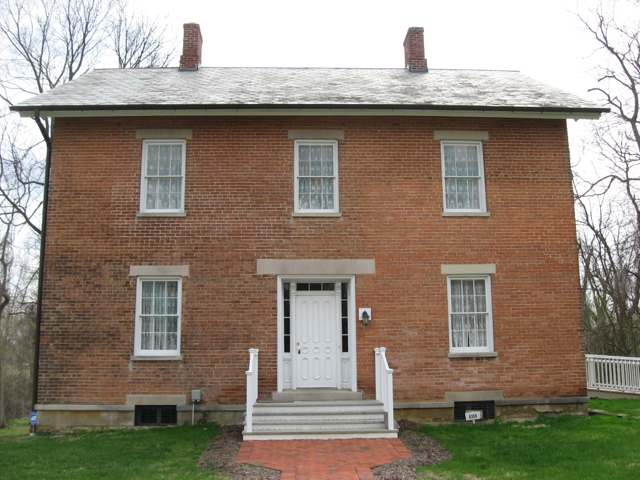
Photo: Nyttend, public domain · Wikimedia Commons
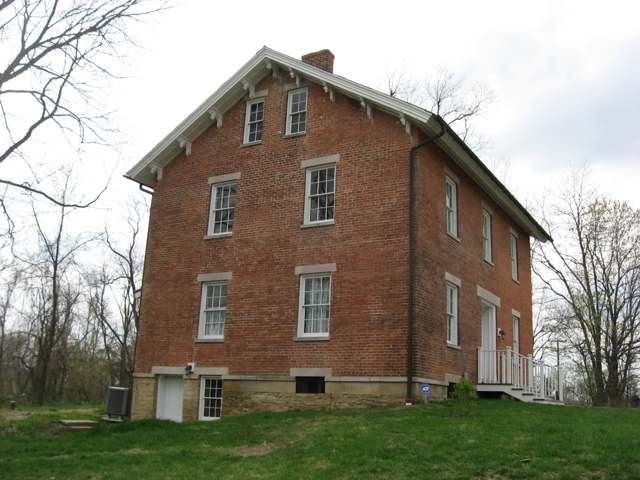
Photo: Nyttend, public domain · Wikimedia Commons
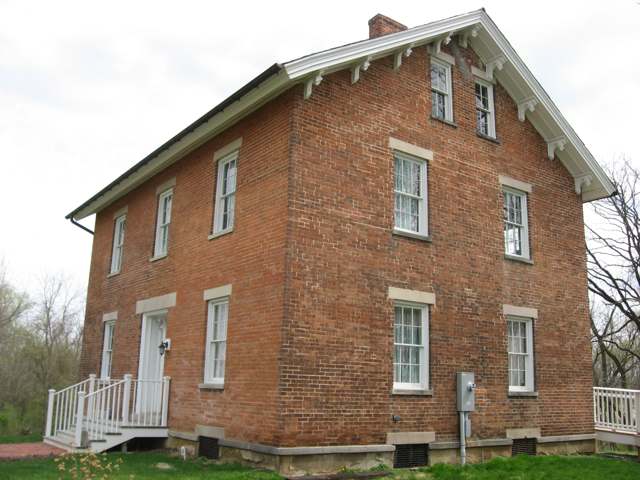
Photo: Nyttend, public domain · Wikimedia Commons
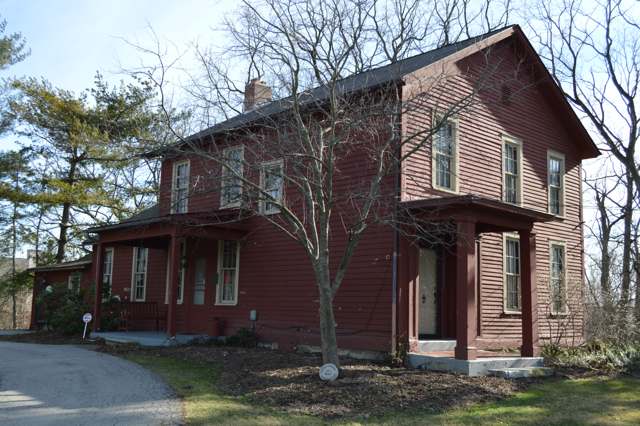
Photo: Nyttend, public domain · Wikimedia Commons
Local history sources: en.wikipedia.org · genealogybug.net · ohiohistory.org · commons.wikimedia.org · commons.wikimedia.org · craiglehoullier.com · jeffersontownship.org
Water
Big Walnut Creek at the plant's low-head dam and screen house on Morse Rd, below Hoover Dam The water here
- Columbus Public Water System92% of residentsScioto River (Griggs & O'Shaughnessy), Hoover Reservoir on Big Walnut Ck, plus wells
- Gahanna City4% of residentsScioto River (Griggs & O'Shaughnessy), Hoover Reservoir on Big Walnut Ck, plus wells
- Jefferson Water and Sewer District2% of residentsLocal groundwater wells (Blacklick/eastern Franklin Co.)
- Reynoldsburg City1% of residentsScioto River (Griggs & O'Shaughnessy), Hoover Reservoir on Big Walnut Ck, plus wells
- Licking Regional Water District0% of residentsRaccoon Creek Valley aquifer (local wells)
- Del-co Water Company, Inc.0% of residentsOlentangy River, O'Shaughnessy and Alum Creek reservoirs, plus Knox County wells
Its ZIP codes
Each ZIP code that touches Jefferson Township, Franklin County, with the share of its residents who live here and the same headline figures as the ZIP page.
| ZIP | Share | Water | Radon | Home value | Schools | Flood |
|---|---|---|---|---|---|---|
| 43004 Columbus and Blacklick | 40% | Big Walnut Creek at the plant's low-head dam and screen house on Morse Rd, below Hoover Dam | 6.0 pCi/L average radon | Median year built 2003 | Licking Heights Local · 4 stars overall | 1.2% of residents in the 1% floodplain |
| 43054 Columbus and New Albany | 2% | Big Walnut Creek at the plant's low-head dam and screen house on Morse Rd, below Hoover Dam | 4.6 pCi/L average radon | Median year built 2003 | New Albany-Plain Local · 5 stars overall | 3.1% of residents in the 1% floodplain |
| 43230 Gahanna and Columbus | 2% | Big Walnut Creek at the plant's low-head dam and screen house on Morse Rd, below Hoover Dam | 8.0 pCi/L average radon | Median year built 1989 | Gahanna-Jefferson City · 4 stars overall | 1.7% of residents in the 1% floodplain |
The county
Franklin County: 45 ZIP codes, 42 cities, villages and townships, 1,356,733 people.
Nearby places
Cite this page
Cite this page as:
Cracked Buckeye (Open Shower Co), "Jefferson Township, Franklin County", https://crackedbuckeye.com/place/jefferson-township-franklin-county/, built 2026-09-16, accessed [date].
Machine-readable: /api/place/jefferson-township-franklin-county.json (open JSON, CC BY 4.0 for the compilation; the underlying records keep their own terms) · How to cite · Report a correction · Built 2026-09-16