How Mary Ann Township, Licking County began
Mary Ann Township passed from Madison to Newton to Newark townships before finally organizing on its own in 1817, the same year David Moore's iron furnace on Rocky Fork went into blast; the township took its name from the furnace, which Moore had named for his wife, Mary Ann. Its rugged, boulder-strewn hills, hunted long after white settlement by Indian and white hunters alike, supported sawmills, gristmills and a brief iron industry rather than any real town, and the furnace's stone stack still stands as a ruin along Rocky Fork. Today, in the county's northeast corner, it holds no incorporated municipality of its own.
Settled 1809 (a settler named Bush, from Hardy County, Virginia), incorporated 1817.
Where the name comes from
The township takes its name from the Mary Ann furnace, an iron-smelting works completed in early 1817 by pioneer David Moore, who named it for his wife, Mary Ann Moore. At the furnace's dedication, neighbors gathered to celebrate its completion, and Abraham C. Wilson christened it by hurling a flask of whiskey against the stone stack. The township organized later the same year and took its name from the furnace rather than the other way around.
Before the town
In its 'primitive condition,' the 1881 county history says, Mary Ann Township's deep ravines, rocky hills and thickets sheltered every kind of wild animal known in Ohio, and 'was roamed over by the Indians and white men on hunting expeditions, long after its first settlement, and after game had largely disappeared from other portions of the county.' The same source states directly that 'no Indian history has been preserved, except the fact that this territory was extensively used by the Indians on the Bowling Green as a hunting ground' — meaning hunting parties working out from a Native village recorded some miles away along the Licking River at Bowling Green, not any settlement within Mary Ann Township's own bounds. One of the township's earliest settlers, Charles Barnes, carried a personal connection to the era's most famous piece of Native oratory: as a young man in Lord Dunmore's 1774 campaign, he traveled as far as the Shawnee town of Old Chillicothe on the Scioto and was present, the county history states, at 'the celebrated treaty where Logan made the speech familiar to every schoolboy' — the address remembered as Logan's Lament, attributed to the Mingo (Cayuga) leader Logan (Tah-gah-jute) at the close of Dunmore's War. No mound, earthwork, or Native village is recorded as standing within the township aside from a single plowed-down mound on the Fisk farm.
Nations recorded here: Wyandot, Shawnee, Mingo (Seneca-Cayuga).
- Mound on the Fisk farm (mound) — the Fisk farm (formerly Levi Miller's), Mary Ann Township, prehistoric (Mound Builder era, culture unspecified), reduced by plowing (archive.org)
Timeline
- — Settler Charles Barnes, serving under Lord Dunmore, travels as far as the Shawnee town of Old Chillicothe on the Scioto and is present at the council ending Dunmore's War, where the Mingo leader Logan delivers the speech remembered as Logan's Lament.
- — The Treaty of Greenville cedes most of what becomes Ohio, including the future Mary Ann Township, to the United States.
- — A settler named Bush, from Hardy County, Virginia, builds the township's first cabin on land later owned by Leonel Miller.
- — Bush dies, leaving a widow and five children; the same year Jacob Benner raises a field of corn on the Daniel Wilkins farm.
- — Pioneer David Moore erects a sawmill as the first step toward building an iron furnace, after discovering a deposit of quality iron ore in the township's southeast quarter.
- — The Mary Ann furnace is completed and dedicated early in the year, named for David Moore's wife; the township organizes later the same year and takes the furnace's name, with William Grey, Joseph Moore and James Giffin as its first trustees.
- — Henry Wilkins builds a gristmill on the main fork of Lost Run, near what becomes known as Wilkins' Corners.
- — James Randall establishes a store at Wilkins' Corners, at the crossing of two early roads.
- — A post office is established at Wilkins' Corners, called the Wilkins' Run post office.
- — The Davis Farm Covered Bridge is built across Rocky Fork in the township.
Stories
A Furnace Christened with Whiskey
David Moore, a Mary Ann Township pioneer with a large family, decided to turn a local discovery of good iron ore into a smelting furnace, starting with a sawmill in 1815 and pushing the larger project forward under the supervision of Stephen Cooper and Lilburn Wilson. When the furnace was finished early in 1817, neighbors from the sparsely settled region gathered for a dedication, and the proprietor chose to name it for his wife: 'they wisely concluded to bestow that honor upon that noble matron, Mary Ann, wife of David Moore.' Abraham C. Wilson performed the actual christening by hurling a flask of whiskey against the furnace's stone stack. The township organized later that same year and simply took the furnace's name, and the stack itself, a rough pyramid of cut sandstone some twenty feet square at the base, still stood as a ruin along Rocky Fork when the county history was written more than sixty years later.
Present at Logan's Lament
Charles Barnes, one of Mary Ann Township's earliest settlers, had seen the Ohio frontier at its most consequential moment before he ever built a cabin here. As a young man serving under Lord Dunmore in 1774, he traveled as far as the Shawnee town of Old Chillicothe on the Scioto River, birthplace of Tecumseh a few years later, and was present at the council that ended Lord Dunmore's War — the same gathering, the 1881 county history notes, where the Mingo leader Logan delivered the address still remembered as Logan's Lament, mourning the murder of his family and famously asking, 'who is there to mourn for Logan?' Barnes carried that memory with him into the rocky hills of what became Mary Ann Township, where he died in 1815, one of the first white deaths recorded in the township.
Counterfeiters in the Rugged Hills
Before Mary Ann Township had a single settler, its hills already had a use: hiding fugitives from the law. The 1881 county history preserves an account from just after Muskingum County organized (Licking County not yet existing separately), when two men were arrested for counterfeiting silver dollars and there was no jail within sixty miles to hold them. Two local men, McIntire and Daniel Converse, volunteered to guard the prisoners themselves in a cabin, McIntire warning them plainly that he would kill them if they tried to escape. The arrangement held until court convened; one prisoner confessed and led officers to tools hidden on the Rocky Fork, and both men were sentenced to a public whipping — twenty-nine and thirty-nine lashes respectively — before vanishing for parts unknown.
The Hermit of the School Lands
Robert Concley settled on the school lands in the township's northeast corner alongside James Thompson and James Maxwell in 1814, but he lived apart from the ordinary run of pioneer life, the county history remembering him only as a man who 'lived the life of a hermit' and was 'unfortunately addicted to his cups.' The exact circumstances of his death were never established: his partially charred remains were found about a rod from the ruins of his own cabin, with no one left to say what had happened. It is one of the few pioneer stories in the township's record with no tidy ending at all.
Photographs
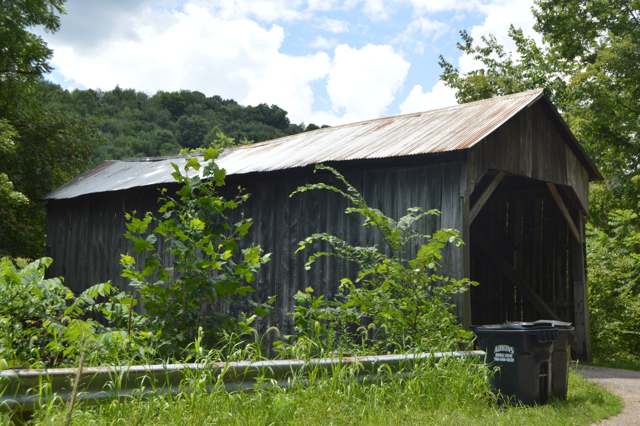
Photo: Nyttend, via Wikimedia Commons, public domain · Wikimedia Commons
Local history sources: archive.org · en.wikipedia.org · en.wikipedia.org · en.wikipedia.org · commons.wikimedia.org
Water
Mostly private wells The water here
- Newark City94% of residentsNorth Fork Licking River
- St. Louisville Village4% of residentsGroundwater wells (2 wells)
- Licking County Prescott Estates1% of residentsGroundwater wells (3 wells)
- Lakeshore Court Mobile Home1% of residentsGroundwater wells (1 wells)
- City of Heath0% of residentslocal wells
- Winding Creek Estates0% of residentsGroundwater wells (1 wells)
- Valley Mobile Home Park0% of residentsGroundwater wells (2 wells)
- Wilkins Mobile Home Park0% of residentsGroundwater wells (2 wells)
Its ZIP codes
Each ZIP code that touches Mary Ann Township, Licking County, with the share of its residents who live here and the same headline figures as the ZIP page.
| ZIP | Share | Water | Radon | Home value | Schools | Flood |
|---|---|---|---|---|---|---|
| 43071 Eden Township and Saint Louisville | 16% | Mostly private wells | 14.8 pCi/L average radon | Median year built 1974 | North Fork Local · 3 stars overall | 0.9% of residents in the 1% floodplain |
| 43055 Newark | 3% | North Fork of the Licking River, drawn directly at riverbank intake screens beside the plant at the north end of Newark | 11.5 pCi/L average radon | Median year built 1960 | Newark City · 2.5 stars overall | 6.1% of residents in the 1% floodplain |
The county
Licking County: 17 ZIP codes, 38 cities, villages and townships, 160,939 people.
Nearby places
Cite this page
Cite this page as:
Cracked Buckeye (Open Shower Co), "Mary Ann Township, Licking County", https://crackedbuckeye.com/place/mary-ann-township-licking-county/, built 2026-09-16, accessed [date].
Machine-readable: /api/place/mary-ann-township-licking-county.json (open JSON, CC BY 4.0 for the compilation; the underlying records keep their own terms) · How to cite · Report a correction · Built 2026-09-16