Water system
Newark City
EPA ID OH4502314 · Licking County · 49,934 people served · owned by a local government
Newark City treats its own water from North Fork Licking River.
The system's record
- Water bodies
- North Fork Licking River
- Raw intakes
- Fork Licking Reser
- Serves
- 49,934 people · Licking County
- EPA ID
- OH4502314
Raw water is withdrawn directly from the North Fork Licking River via bank intake screens (not a named reservoir despite SDWIS 'RESER' abbreviation); city also maintains a 100-acre wellfield near St. Louisville as backup when river levels are low.
About this area's water
Did you know
- In 1922 Newark became the first municipal waterworks anywhere to scrape settled sludge out of its basins by machine rather than by hand.
- Newark was the first water system in Ohio, and among the first in the country, to disinfect with ultraviolet light - a step it added in 2004.
- The plant deliberately drives its water to a pH of about 10.8 with lime to crash out hardness, then bubbles carbon dioxide back in to bring it down to about 8.8 before filtering.
- Only 16% of Newark's sewers are combined, but that sixth of the system still feeds 20 permitted overflow outfalls to the Licking River and Raccoon Creek.
History5
- 1886The privately owned Newark Water Company began operating a pumping station and distribution system.
- 1910City of Newark bought the private water company and merged it with the municipal plant it had built in 1905 on the North Fork.
- 1922Newark became the first municipal waterworks to remove settled sludge by mechanical means, adding softening and filtration at the same time.
- 2004Plant became the first in Ohio and one of the first in the United States to disinfect drinking water with ultraviolet light.
- 2016-2020Phase II Combined Sewer Overflow Long-Term Control Plan submitted Dec. 31, 2016, amended Feb. 21, 2020, and approved by Ohio EPA on March 27, 2020.
Treatment & pressure
How it is treated
Lime softening plant, 15 MGD design, drawing directly from the North Fork Licking River (~75 sq mi watershed) through riverbank mechanical screens. Pre-oxidation with permanganate, chlorine and powdered carbon; rapid mix with lime and ferric sulfate; flocculation; three sedimentation basins…
Water pressure
not published; a finished water pump station with four pumps supplies pressure to the distribution system, but no psi figure is given
What it costs
$6.35 per 1,000 gallons
Effective Jan. 1, 2026: $4.75 per 100 cubic feet for the first 350 units ($6.35 per 1,000 gal). Combined water and sewer minimum bill is $31.77 per month; sewer adds a $9.33…
Water quality & impurities8
| Contaminant | Level | Limit | Year |
|---|---|---|---|
| Total trihalomethanes (TTHM) Compliant on a running average, but single samples ranged as high as 106 ppb | 58.375 ppb | MCL 80 | 2025 |
| Haloacetic acids (HAA5) Range 5.8-55.0 | 27.65 ppb | MCL 60 | 2025 |
| Nitrate About 60% of the MCL; range 0.24-6.02, reflecting agricultural runoff to the river | 6.02 ppm | MCL 10 | 2025 |
| Atrazine Herbicide from row crops; range below detection to 0.59 | 0.23 ppb | MCL 3 | 2025 |
| Fluoride Added deliberately; the plant has fluoridated since 1956 | 1.00 ppm | MCL 4 | 2025 |
| Total chlorine Range 1.19-1.66 | 1.39 ppm | MRDL 4 | 2025 |
| Lead (90th percentile) Non-detect at the 90th percentile; 0 of 31 samples over the action level | ND ppb | AL 15 | 2023 |
| Copper (90th percentile) 0 of 31 samples over the action level | 0.021 ppm | AL 1.3 | 2023 |
EPA compliance record
Lead at the tap: 90th-percentile result 0 ppb in 2023 (action level 15 ppb).
EPA record: no health-based violations since 2015.
1 violation of any kind logged since 2020, 1 of them paperwork (monitoring, reporting, public notice or consumer report).
Projects & plans4
Recent and current work
- High rate treatment facility at Newark WWTP · completed
Ballasted flocculation adding 28 MGD of wet-weather solids removal and disinfection; Ohio EPA proposes reclassifying its Outfall 034 from a CSO to a bypass. - Newark WWTP re-rating to 9.0 MGD · 2026 · completed
Permit-to-Install DSWPTI-260365 issued April 7, 2026 raising average daily design flow from 8.0 to 9.0 MGD; plant last upgraded 2022. - CSO Long-Term Control Plan Bundle 1 · completed
Implemented over the last five years; an Oct. 24, 2025 programmatic review found the projects performed better than expected.
Planned or needed
- CSO Long-Term Control Plan Bundles 2 and 3 · planned
Separations, interceptor upsizing, relief sewers and headworks work targeting 11 overflow events per typical year and over 99% wet-weather capture; the 16…
Supply stress
A river-fed supply on a small ~75 sq mi agricultural watershed: nitrate reached 6.02 ppm against a 10 ppm MCL, atrazine is routinely detected, and Cryptosporidium turned up in 5 of 11 raw water samples in the CCR's cited monitoring. Individual TTHM samples ran to 106 ppb. Low river flow is the standing supply risk.
Sewers
Sanitary
City of Newark operates its own WWTP (built 1948, last upgraded 2022) discharging to the Licking River, then the Muskingum and Ohio. Average daily design flow was re-rated from 8.0 to 9.0 MGD in April 2026; peak secondary capacity is 20 MGD, with overflow to a 1.0-MG equalization basin and then a 28 MGD high rate treatment system. The…
Storm
Newark runs a separate stormwater utility under Ordinances 17-21 and 05-55, created for Clean Water Act Phase II compliance and billed per equivalent residential unit - $8.05/ERU/month effective Jan. 1, 2026, rising to $9.60 by 2030 under Resolution 25-69.
Sourcesverified
Compiled from the utility's own reports and public records, then independently re-checked against primary sources.
Main supplier in 1 ZIP code
Serves
Main water supplier in 1 ZIP code
- 43055 · Newark75% of residents
Population-weighted resident shares; a ZIP code can have more than one system on record. Recomputed from each ZIP's own system list, not from the map's cached footprint.
Buys from · Sells to
Newark City does not buy water from another system on record; it treats its own source water.
No other system is on record buying water from Newark City.
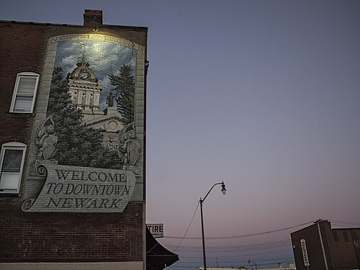
Photograph
On the map
Show this system's territory on the map — 1 ZIP code in all.
Sources
U.S. EPA SDWIS and Community Water System Service Area Boundaries (v3, 2026), Ohio EPA primacy data, 2020 census blocks: the system serving most residents, traced through purchases to the treating utility; Ohio EPA 2023 Sewer and Water Rate Survey (Ohio State, May 2025) for household bills; Ohio EPA DEFA loan awards since 2016 for the loans paragraph · EPA SDWIS · EPA service area boundaries · Ohio EPA drinking water · Ohio EPA rate survey
Newark City's own pages: newarkohio.gov