How Perry Township, Licking County began
Perry Township was set off from Hanover Township in 1818, once enough settlers had reached its rough, hilly ground -- including the barren "Bald Hills" in the south -- to justify a separate organization, and was named for Commodore Oliver Hazard Perry. Samuel Hickerson, who built a cabin in 1810, was its first settler and lived alone in the wilderness for ten months before others followed him to the Brushy Fork. Its one real village, Elizabethtown, was laid out in 1831 by Elizabeth Lemert and grew up around a post office called "Perryton," the name the settlement still goes by today; a plain iron bridge built in the township in 1872 later became one of only three surviving Post-truss bridges in the United States, though it was long ago moved elsewhere. The township's own 1881 county history chapter, unlike most others in Licking County, records no Mound Builder works or Indian villages within its borders, leaving Perry's deepest history a documented blank rather than a story.
Settled 1810 (Samuel Hickerson), incorporated 1818, organized from Hanover Township.
Where the name comes from
The 1881 county history states plainly that the township "was named in honor of Commodore Perry," almost certainly Oliver Hazard Perry, the naval officer who won the Battle of Lake Erie in the War of 1812 and whose victory was still recent and celebrated when the township organized in 1818. No source consulted gives further detail on the naming decision itself.
Before the town
Unlike the chapters on most other Licking County townships, the 1881 county history's chapter on Perry Township opens straight into topography and settlement, with no mention at all of Mound Builder earthworks or of any documented Indian village, camp, or trail inside the township. No other source consulted (the 1909 county history, Wikipedia, or the National Register list) supplies one either. The township's land, like the rest of Licking County, was ceded by the Treaty of Greenville of August 3, 1795, in which the Wyandot, Shawnee, Lenape (Delaware), Miami, Ottawa and other nations gave up most of what is now Ohio to the United States, but no source names a nation, village, or site specific to Perry Township itself. See the Licking County file for the wider county record.
Nations recorded here: Wyandot, Shawnee, Lenape (Delaware), Miami, Ottawa.
Timeline
- — The Treaty of Greenville cedes most of what becomes Ohio, including the future Perry Township, to the United States.
- — Samuel Hickerson builds a cabin and begins a clearing, becoming the township's first settler and its only inhabitant for more than ten months.
- — James Thrap and Allen Hall arrive; Rev. Joseph Thrap preaches the first sermon within the township's limits.
- — Rev. Michael Ellis, the first traveling minister to preach in Perry, forms a Methodist class at the house of James Thrap; separately, Phillip Denman builds the township's largest dwelling to that date, eighteen by twenty-eight feet, which becomes a preaching place.
- — Elizabeth Lemert lays out the village of Elizabethtown; a post office there is named "Perryton."
- — The Disciples congregation meeting at Elizabeth Lemert's house since 1829 or 1830 formally organizes, with John Dodson appointed elder, a position he holds for sixteen years.
- — The congregation that becomes the Perryton United Methodist Church, still standing on Licking Valley Road, is built.
- — John Fry, assisted by John Crabtree and Joseph Sperry, constitutes a Baptist church in the township with seven original members.
- — An iron Post-truss bridge -- later called the Falling Rock Camp Bridge -- is built over Brushy Fork Creek in Perry Township; it is relocated to Hebron in 1927 and again, in 1931, to Falling Rock Camp on the Rocky Fork in Eden Township, where it survives today as one of only three known Post trusses left in the United States.
Stories
The Third Angel
In 1813 Phillip Denman built the largest house yet seen in his part of Perry Township, eighteen by twenty-eight feet, and his neighbor John Livingston suggested that opening it for preaching would draw respectable settlers and raise land values. Livingston went looking for a minister on the road to Newark and found a man in unmistakable Methodist dress, who agreed to preach there once he returned from visiting his parents in Virginia, and asked Livingston to announce the meeting four weeks from the following Sunday. Livingston never learned the preacher's name, so he spread word that there would be preaching at Denman's new house by the "third angel" -- and the odd phrase drew a crowd, many of them curious to see who or what would show up. The preacher, John Cobler, the first minister the Methodist conference sent west of the Ohio River, satisfied his audience and made Denman's a regular preaching stop every two weeks until 1828.
The Hunter and the Panther
John Livingston, one of Perry Township's first settlers, was known through the neighborhood as its most successful hunter. Returning exhausted from one expedition, he was walking slowly through the woods when a panther dropped from a tree limb onto his back, tearing off two hunting shirts and raking him with its claws on the way to the ground. Livingston spun around and fired wildly, missing in his shock, then found himself facing the animal with an empty gun. Remembering that a steady stare could sometimes hold a wild beast at bay, he kept his eyes fixed on the crouching panther while he reloaded blind -- powder, then a bullet dropped in unpatched and unrammed -- and fired point-blank into its head from a foot away. The blast burst his gun barrel and mangled his hand, but it killed the panther outright. Bleeding and shaken, Livingston dragged himself to a neighbor's cabin and was a long time recovering; the county history calls it, of all his many encounters with wild game, the one that came nearest to costing him his life.
The Bear on the Chimney
One morning, with her husband Hathaway Denman away at work in the woods, Mrs. Denman was startled by her two-year-old son's screams and the savage bark of the family's dog. She ran outside to find her boy running toward her while a black bear, closely pursued by the dog, scrambled up onto the chimney's stone "bench" a few feet off the ground. The dog held the bear treed there while Mrs. Denman carried the child to where her husband was working; he came back with his gun and shot the bear off the chimney.
Photographs
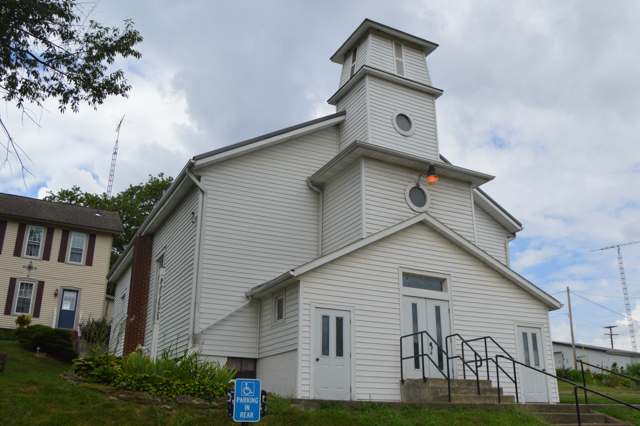
Photo: Nyttend, via Wikimedia Commons, public domain · Wikimedia Commons
Local history sources: archive.org · archive.org · en.wikipedia.org · en.wikipedia.org · oldohiobridges.com · commons.wikimedia.org
Water
Mostly private wells The water here
- Newark City70% of residentsNorth Fork Licking River
- Muskingum County Water - Se21% of residentsMuskingum River buried valley aquifer (wells near Duncan Falls)
- Frazeysburg7% of residentsGroundwater wells (2 wells)
- Licking County Prescott Estates1% of residentsGroundwater wells (3 wells)
- Lakeshore Court Mobile Home1% of residentsGroundwater wells (1 wells)
- St. Louisville Village0% of residentsGroundwater wells (2 wells)
- Country Hills MHP0% of residentsGroundwater wells (2 wells)
- City of Heath0% of residentslocal wells
- Winding Creek Estates0% of residentsGroundwater wells (1 wells)
- Valley Mobile Home Park0% of residentsGroundwater wells (2 wells)
- Wilkins Mobile Home Park0% of residentsGroundwater wells (2 wells)
Its ZIP codes
Each ZIP code that touches Perry Township, Licking County, with the share of its residents who live here and the same headline figures as the ZIP page.
| ZIP | Share | Water | Radon | Home value | Schools | Flood |
|---|---|---|---|---|---|---|
| 43830 Muskingum Township and Nashport | 8% | Mostly private wells | 7.1 pCi/L average radon | Appraisal records without year built | Tri-Valley Local · 4 stars overall | 1.2% of residents in the 1% floodplain |
| 43822 Frazeysburg | 6% | Mostly private wells | 9.2 pCi/L average radon | Appraisal records without year built | Tri-Valley Local · 4 stars overall | 5.6% of residents in the 1% floodplain |
| 43055 Newark | 1% | North Fork of the Licking River, drawn directly at riverbank intake screens beside the plant at the north end of Newark | 11.5 pCi/L average radon | Median year built 1960 | Newark City · 2.5 stars overall | 6.1% of residents in the 1% floodplain |
The county
Licking County: 17 ZIP codes, 38 cities, villages and townships, 160,939 people.
Nearby places
Cite this page
Cite this page as:
Cracked Buckeye (Open Shower Co), "Perry Township, Licking County", https://crackedbuckeye.com/place/perry-township-licking-county/, built 2026-09-16, accessed [date].
Machine-readable: /api/place/perry-township-licking-county.json (open JSON, CC BY 4.0 for the compilation; the underlying records keep their own terms) · How to cite · Report a correction · Built 2026-09-16