Deep dives · Hamilton County, Cuyahoga County, Marion County, Lake County, Stark County, Carroll County, Knox County, Franklin County, Fulton County, Shelby County, Montgomery County
Election Day and the Midterms
Why Election Day is a Tuesday, why the president's party loses ground in midterms, and how Ohio has voted in midterm years since statehood.
- Published , updated
At a glance
| Fact | Value |
|---|---|
| Election Day 2026 | Tuesday, November 3. Ohio's polls were open 6:30 a.m. to 7:30 p.m. (R.C. 3501.32) |
| 2026 results, unofficial | Governor: Amy Acton (D). U.S. Senate: Sherrod Brown (D). State Issue 3: passed (Ohio Secretary of State) |
| Why that date | A federal law of January 23, 1845 set "the Tuesday next after the first Monday in the month of November" (5 Stat. 721) |
| Who wrote it | Representative Alexander Duncan of Cincinnati (Congressional Globe) |
| The midterm rule | The president's party lost House seats in 36 of 40 midterms from 1862 to 2022 (House Historian) |
| Midterm turnout, U.S. | 41.6 percent of eligible voters on average, 1914-2022, against 57.8 percent in presidential years (U.S. Elections Project) |
| Ohio's biggest midterm | 2026: 4,658,250 ballots on the unofficial count (Ohio Secretary of State). The official record before it is 4,496,834 in 2018 (Ohio Secretary of State) |
| Ohio governors | Elected only in midterm years since 1958; from the party out of the White House in 13 of 17 races from 1958 to 2022 |
| When Ohio used to vote | The second Tuesday of October, for state offices through 1885 and for Congress through 1884 |
| Ohio's 2026 ballot | Governor, a U.S. Senate special election, four other statewide offices, two Supreme Court seats, all 15 U.S. House seats, the legislature and State Issue 3 |
Election Day 2026 in Ohio
Ohio voted on Tuesday, November 3, 2026. The polls were open from 6:30 a.m. to 7:30 p.m., and anyone in line at 7:30 p.m. could still vote (R.C. 3501.32).
The results so far
Every number in this section is unofficial. It is the election-night count that the 88 county boards of elections reported to the Ohio Secretary of State, with all 8,834 Election Day precincts in (Ohio Secretary of State, unofficial results). Ohio law lets the Secretary of State release results only twice: on election night and after the official count (Ohio Secretary of State, November 3, 2026). On election night 102,148 ballots were still to be checked: 98,369 provisional ballots and 3,779 from military and overseas voters.
| Race | Ahead on the unofficial count | Votes | Next | Votes |
|---|---|---|---|---|
| Governor and lieutenant governor | Amy Acton and David Pepper (D) | 2,404,178 (52.3%) | Vivek Ramaswamy and Robert McColley (R) | 2,039,730 (44.4%) |
| U.S. Senate, special election | Sherrod Brown (D) | 2,301,042 (50.0%) | Jon Husted (R) | 2,077,748 (45.1%) |
| Attorney general | John Kulewicz (D) | 2,285,117 (50.3%) | Keith Faber (R) | 2,256,710 (49.7%) |
| Secretary of state | Allison Russo (D) | 2,287,160 (50.3%) | Robert Sprague (R) | 2,129,981 (46.8%) |
| Treasurer | Seth Walsh (D) | 2,282,546 (50.6%) | Jay Edwards (R) | 2,232,758 (49.4%) |
| Auditor | Frank LaRose (R) | 2,310,105 (50.8%) | Annette Blackwell (D) | 2,237,955 (49.2%) |
| Ohio Supreme Court | Jennifer Brunner (D) | 2,324,212 (51.4%) | Colleen O'Donnell (R) | 2,200,021 (48.6%) |
| Ohio Supreme Court | Marilyn Zayas (D) | 2,307,346 (51.0%) | Daniel R. Hawkins (R) | 2,215,728 (49.0%) |
| State Issue 3, photo ID | Yes | 2,934,245 (65.3%) | No | 1,556,864 (34.7%) |
Source: Ohio Secretary of State, unofficial results, election night. Each percentage is a share of all votes in that race. Third-party candidates also ran for governor (Libertarians Don Kissick and James Mills, 3.3%), the Senate (Libertarian William Redpath, 2.8%, and Greg Levy, listed as an "other-party candidate," 2.1%) and secretary of state (Libertarian Tom Pruss, 2.9%). The Ohio Capital Journal reported the same counts from the Secretary of State's site for the attorney general and Supreme Court races.
- Governor. The Associated Press called the race for Acton shortly before 11 p.m., and Ramaswamy conceded that night (Ohio Capital Journal; Statehouse News Bureau). It was the first time in 20 years that Ohio voters chose a Democrat for governor.
- U.S. Senate. The Associated Press called the race for Brown at about 11:12 p.m. (Statehouse News Bureau). It was a special election for the rest of the term that ends on January 3, 2029. The seat opened when JD Vance resigned on January 10, 2025, to become vice president, and Governor Mike DeWine appointed Husted to fill it.
- Attorney general was the closest statewide race: 28,407 votes, or 0.6 percentage points. That is more than the quarter of a percent that sets off an automatic statewide recount (Ohio Secretary of State). Faber conceded on November 4 (WHIO; Ohio Capital Journal).
- State Issue 3 passed about two to one. It writes the photo-ID rule, in state law since April 2023, into the Ohio Constitution (Ohio Secretary of State, Issue 3 report). It was the only statewide issue.
- U.S. House. Democrats were ahead in 8 of Ohio's 15 districts and Republicans in 7, on a map the Ohio Redistricting Commission adopted on October 31, 2025. Republicans had held 10 of the seats and Democrats 5. Democrats led in three seats Republicans held: the 7th, where Brian Poindexter led Rep. Max Miller by 32,437 votes; the 10th, where Kristina Knickerbocker led Rep. Mike Turner by 4,938; and the 15th, where Don Leonard led Rep. Mike Carey by 19,062.
- Ohio General Assembly. All 99 Ohio House seats and 17 of the 33 Ohio Senate seats were on the ballot. Republicans led in 56 House races and Democrats in 43. Four House races were within half a percentage point, close enough for an automatic recount if the official count stays that close: District 29 (19 votes), District 44 (56), District 75 (126) and District 37 (134). Of the 17 Senate races, Republicans led in 9 and Democrats in 8.
Turnout. Ohio counted 4,658,250 ballots on election night, 58.1 percent of the 8,018,054 registered voters the Secretary of State listed that night (Ohio Secretary of State). That is already more ballots than any Ohio midterm before it. The record had been 4,496,834 in 2018. Early voting was a big part of it: when early voting closed on Sunday, November 1, 1,730,111 Ohioans had voted early in person or by mail (Statehouse News Bureau). That was more than the final count of absentee ballots in the 2022 midterm (1,473,983) or the 2018 midterm (1,379,020), which included mail ballots that arrived in the days after the election (Ohio Secretary of State absentee reports).
Your county's results, with local races and issues, are on the Secretary of State's results site and your county board of elections' website.
What comes next
- Photo ID. Voters at the polls had to show an unexpired photo ID (R.C. 3501.01). A voter without one could cast a provisional ballot, which is set aside until the board confirms the voter is eligible. That voter has until Saturday, November 7, to bring ID to the county board of elections for the ballot to count (R.C. 3505.181).
- Mailed ballots. This was the first November general election in which a mailed absentee ballot had to reach the board of elections by 7:30 p.m. on Election Day, whatever its postmark. The rule took effect on March 20, 2026 (R.C. 3509.05). Ballots from military and overseas voters still count if they were signed by Election Day and arrive by November 7 (R.C. 3511.11).
- The official count. Each county board must start its official count between Sunday, November 8, and Wednesday, November 18, and finish and certify it by Tuesday, November 24 (Secretary of State Directive 2026-48). The Secretary of State then reviews the county results and certifies the statewide results. As of November 5 his office had not announced that date. It certified the 2024 results on December 2, 2024 (Ohio Secretary of State).
A Senate special election on the same ballot as a governor's race was not new in Ohio. It also happened in 1928, 1930, 1946 and 1954. In 1946 Ohio held two Senate elections on the same day: John Bricker won the full six-year term, and Kingsley Taft won the last two months of an unexpired one (list of U.S. Senate elections in Ohio).
Nationally, all 435 seats in the U.S. House were on the ballot, along with 35 Senate seats (33 regular elections and specials in Ohio and Florida) and 36 governorships.
How Election Day got its date
The Constitution does not set an Election Day. It lets Congress choose when states pick presidential electors and lets states set the time of congressional elections unless Congress steps in (Congressional Research Service). For its first half-century the country voted on many different days. A 1792 law let each state choose its electors on any day in the 34 days before the first Wednesday in December, when the electors met (1 Stat. 239). In 1840 the voting for president ran from October 30 into late November.
Spreading the vote over weeks invited fraud. Party workers could move voters across a state line to vote again where the polls opened later, a practice called "pipe-laying." In an 1844 Senate debate, Ohio Senator William Allen, a Democrat, said frauds "almost without number" had been committed in Ohio in 1840 through the "transfer of voters from the adjoining States" (Morley, Washington and Lee Law Review).
The fix was written by an Ohioan. Representative Alexander Duncan, a Democrat from Cincinnati, pushed a bill for a single national day through the House in 1844, only to see the Senate shelve it by one vote, 26 to 25. He brought it back in December 1844. His new bill said "the first Tuesday in the month of November." In the debate on December 9, Lucius Elmer of New Jersey offered a substitute that read "the Tuesday next after the first Monday," and Duncan said he meant to make the same change himself. His reason, as the Congressional Globe reports it, was to avoid changing the law on when the electors met, "for the first Tuesday of November might, in some cases, be more than thirty days from the first Wednesday in December" (Congressional Globe, December 10, 1844). Elmer withdrew his version, and Duncan's became the law.
The arithmetic bears Duncan out. When November 1 is a Tuesday, the "first Tuesday" falls 36 days before the first Wednesday in December, past the 34-day window. The "Tuesday after the first Monday" always falls exactly 29 days before (our calculation). It also means Election Day can never be on November 1. As for which day of the week to choose, the Globe reports that Elmer regarded the particular day "as of no importance."
On December 16, 1844, the House voted 187 to 1 to advance the bill and then passed it without a recorded vote. After a small technical change in the Senate, President John Tyler signed it on January 23, 1845. It set the day for choosing presidential electors as "the Tuesday next after the first Monday in the month of November" (5 Stat. 721). The first presidential election held under it was on November 7, 1848. South Carolina was the exception: its legislature, not its voters, chose the state's electors until 1860.
Why Tuesday and why November? The usual explanation, repeated by the Pew Research Center and the Congressional Research Service, is that November came after the harvest and before winter roads, and that Tuesday gave rural voters a day to travel to the county seat without breaking the Sunday Sabbath or missing a Wednesday market day. The Research Service also mentions a story that the "after the first Monday" wording kept the vote off the first of the month, when merchants closed their books. These explanations may have been in members' minds, but the House debate of December 1844 does not mention farmers, market days or church. One member argued against a December election because cold weather would keep voters home. Most of the debate was about fraud, South Carolina, and the date the electors met.
Congress, the Senate, and the states that voted early
The 1845 law covered only the presidential vote. Congress put elections for the U.S. House on the same day in a law of February 2, 1872, starting in 1876 (17 Stat. 28). A law of 1875 let a state keep a different date if only a constitutional amendment could change it (2 U.S.C. 7 notes, Cornell). Ohio's constitution fixed an October date, and Ohio kept electing members of Congress in October through 1884, until its voters moved the fall election to November in 1885. In the 1860s and 1870s Ohio, Indiana and Pennsylvania, which all voted in October, were called "October states," and their results were read as a forecast of the November presidential vote (Indiana Magazine of History). Maine held out longest. It held its state and congressional elections in September until 1958, which gave rise to the saying "As Maine goes, so goes the nation" (U.S. Senate Historical Office).
U.S. senators were chosen by state legislatures until the 17th Amendment, ratified on April 8, 1913, when Connecticut's approval completed the three-fourths of states needed (U.S. Senate). The first regularly scheduled Senate elections under it were held on November 3, 1914, the first general election in which every Senate seat up that year was filled by the voters rather than a legislature. Ohio's winner that day was Warren G. Harding, six years before he was elected president (1914 U.S. Senate election in Ohio). Election Day 2026 fell on November 3 as well, the same date as the midterms of 1914, 1942, 1970 and 1998. Under the law it can land anywhere from November 2 to November 8.
Is Election Day a holiday?
Not federally. Election Day is not on the list of federal holidays in 5 U.S.C. 6103, and bills to add it, such as the bipartisan Election Day Act introduced in January 2025 (H.R. 154), have not passed. As of 2023, 12 states and Puerto Rico made Election Day a paid day off for state workers, and Kentucky did so in presidential years (Pew Research Center). Ohio is not one of them, and Ohio law does not require employers to give paid time to vote (Movement Advancement Project). It does forbid an employer to fire or threaten to fire a worker "for taking a reasonable amount of time to vote on election day," with a fine of $50 to $500 (R.C. 3599.06).
Ohio's polls are open 13 hours, from 6:30 a.m. to 7:30 p.m. (R.C. 3501.32), the most common length among the states. New York keeps its polls open 15 hours, and 19 states keep theirs open 12 (The Green Papers).
When Ohio voted in October
For most of the 1800s, Ohio's Election Day for its own offices was not in November at all. The 1802 constitution set state elections for the second Tuesday of October (Ohio Constitution of 1802, Art. I, Sec. 3, and Art. II, Sec. 2). Ohio chose its governor, legislature, county officers and members of Congress that day, and voted for president separately in November (Union County abstract of votes). Ohio's U.S. House elections were still held in October in 1878, 1880, 1882 and 1884.
Ohio voted in October for the last time on October 13, 1885, when voters approved three constitutional amendments that moved the election of legislators, state officers and county officers to "the first Tuesday after the first Monday in November." The vote on the first was 538,858 for and 53,177 against (amendment record, Cleveland State University law library). Every Ohio general election since 1886 has been held on that November Tuesday.
A second change came on November 7, 1905. Voters adopted a new Article XVII that put state and county elections in even-numbered years, 702,699 to 90,762 (amendment record). Until then Ohio had elected its governors in odd years. Today's wording, in Article XVII, Section 1, still says "the first Tuesday after the first Monday in November in even numbered years."
The last big change made Ohio a midterm state for governor. On November 2, 1954, voters gave the governor and the other statewide executive officers four-year terms, 1,165,650 to 933,716, and limited a governor to two terms in a row (State Democracy Research Initiative, University of Wisconsin; Ohio Constitution, Art. III, Sec. 2). The first four-year term began in January 1959. Since the 1958 election, every Ohio governor has been chosen in a midterm year, so a governor and a president are never on the same Ohio ballot.
Who could vote in Ohio
The right to vote in Ohio has been widened step by step, often after Ohio voters themselves said no.
- 1802. The first constitution gave the vote to white men 21 and older who had lived in the state a year and paid a state or county tax, or worked on the public roads (Art. IV). It also said "All elections shall be by ballot," meaning a paper ballot rather than a spoken vote. The convention came within a single vote of letting Black men vote, according to the State Court Report.
- 1851. The second constitution kept the vote for "every white male citizen of the United States, of the age of twenty-one years" (Art. V, Sec. 1 history).
- 1867. Ohio voters rejected an amendment that would have struck the word "white," 255,340 to 216,987 (list of Ohio ballot measures). They rejected striking it again in 1912.
- 1867-1870. The legislature ratified the 14th Amendment on January 11, 1867 and voted to withdraw that ratification on January 13, 1868. Congress counted Ohio anyway, and Ohio ratified it again on March 12, 2003 (U.S. House Manual). Ohio rejected the 15th Amendment, which barred racial limits on the vote, on April 30, 1869, then ratified it on January 27, 1870 (U.S. House Manual).
- 1912, 1914, 1917. Ohio voters turned down votes for women three times: a constitutional amendment on September 3, 1912 (336,875 to 249,420), an initiated amendment on November 3, 1914 (518,295 to 335,390), and, by referendum on November 6, 1917, a law signed earlier that year under Governor James Cox letting women vote for president (list of Ohio ballot measures).
- 1919-1920. The legislature ratified the 19th Amendment on June 16, 1919, the same day as Kansas and New York (U.S. House Manual). It became part of the Constitution on August 18, 1920 (National Archives).
- 1923. Ohio's own constitution still said "white male" until voters struck the words on November 6, 1923, 536,762 to 421,744, three years after the 19th Amendment (Art. V, Sec. 1 history).
- 1971. On the evening of June 30, 1971, Ohio's legislature ratified the 26th Amendment, which lowered the voting age to 18, and President Nixon announced that Ohio's vote had completed it. The official record dates the ratification to July 1, 1971 and lists North Carolina as the 38th state, with Ohio 37th (National Constitution Center).
- 2022. Voters made Ohio's constitution say that only U.S. citizens may vote, 3,099,868 to 931,205 (Art. V, Sec. 1; vote).
How Ohioans have cast a ballot
In the 1800s "by ballot" did not mean a secret ballot. Parties printed their own tickets in their own colors and handed them out at the polls, so anyone watching could see how a man voted. According to a history published by the Mahoning County Board of Elections, an 1854 Ohio law tried to stop fake tickets by requiring plain white paper of a set width, and Ohio's version of the government-printed, secret "Australian" ballot followed in 1891.
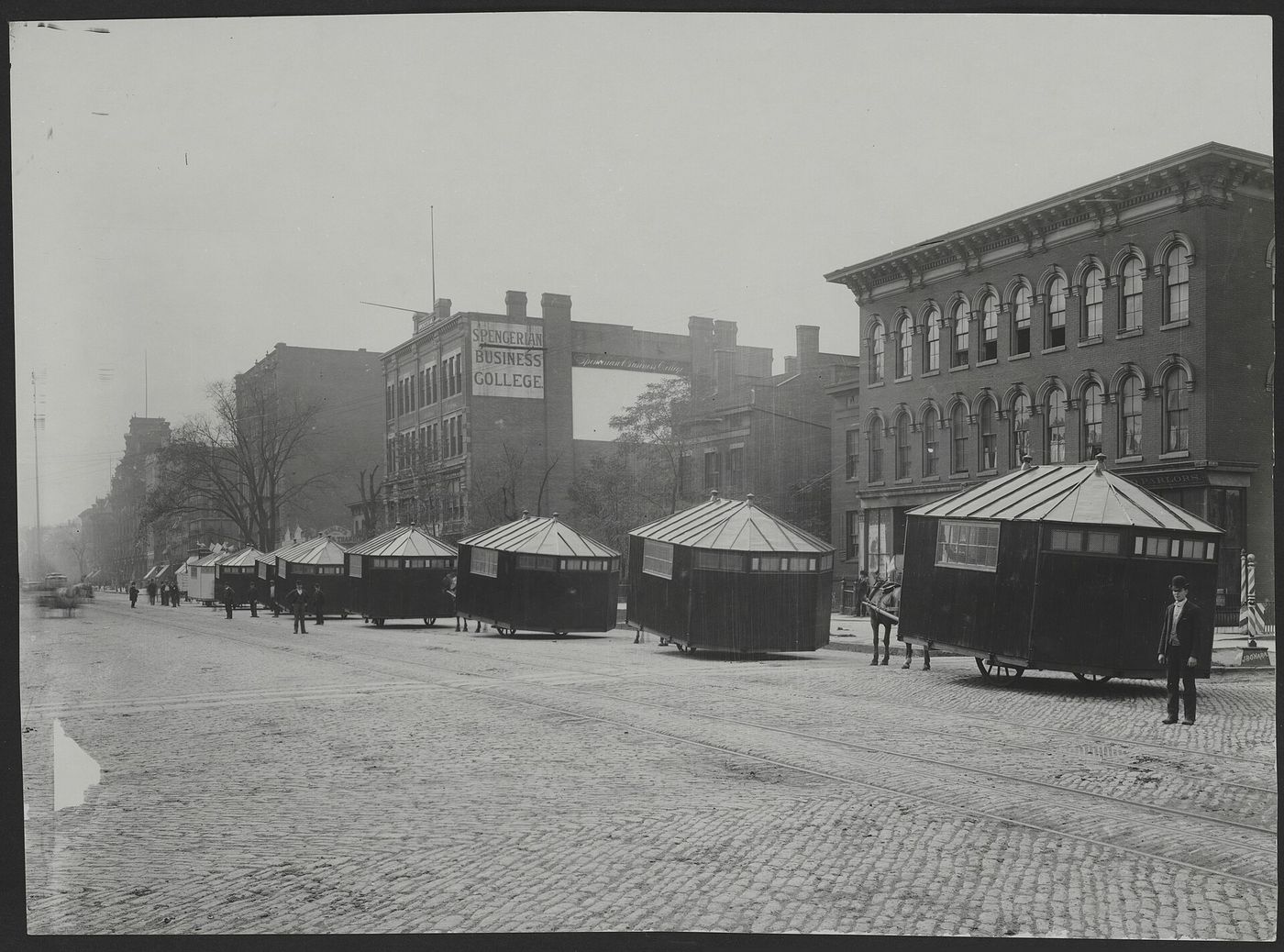
Voters needed places to mark their ballots. A Cleveland Public Library photograph dated 1890 shows wooden voting booths on wagon wheels being hauled by horse to the city's precincts.

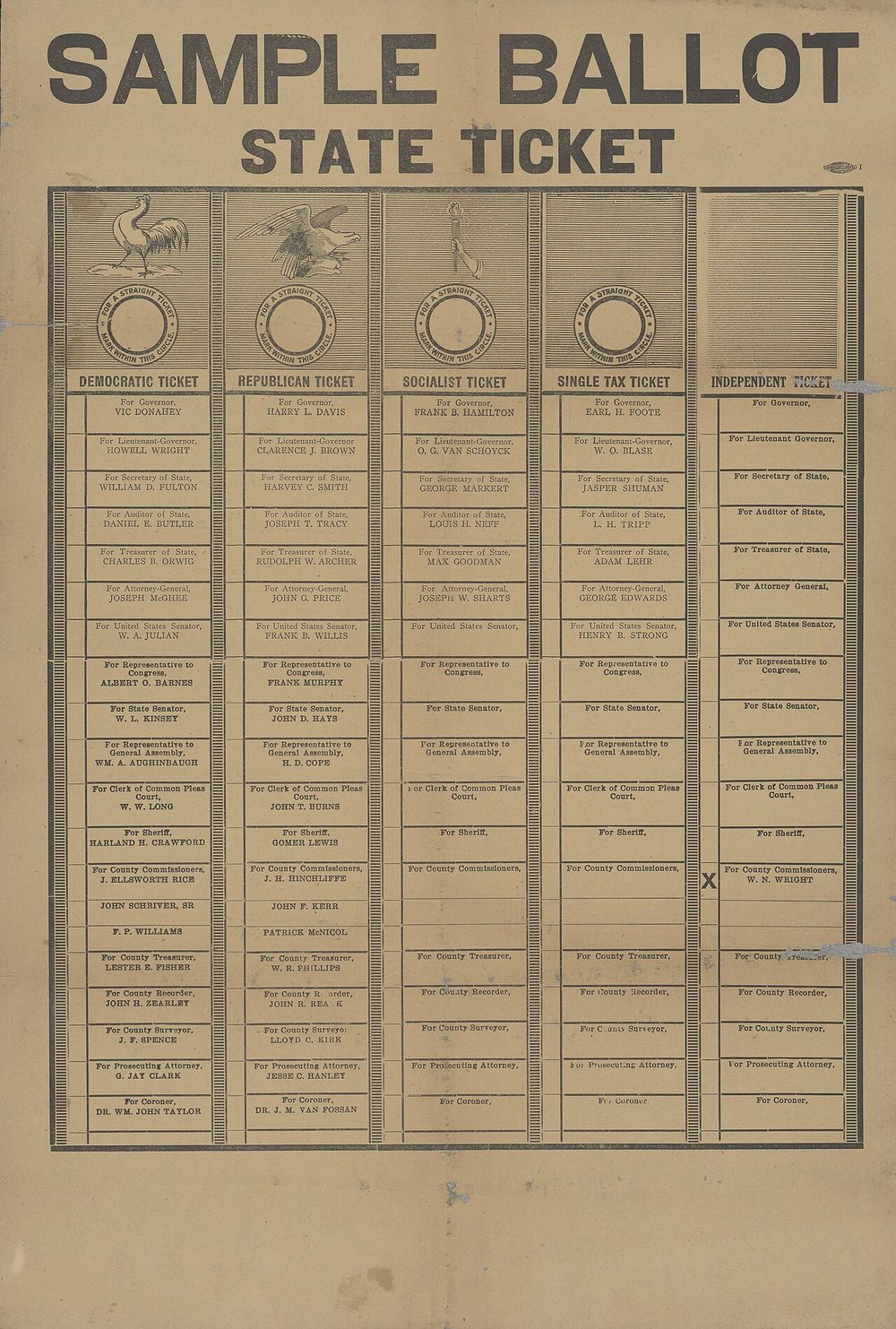
By about 1920 an Ohio ballot listed every party's candidates side by side in columns, the first three under their party's emblem: a rooster for the Democrats, an eagle for the Republicans, a torch for the Socialists. A voter could mark one circle to vote a "straight ticket."

Many of today's Ohio voting rules date from after 2004, when long lines made national news. NPR reported that some voters at Kenyon College in Gambier waited up to 12 hours (NPR, November 3, 2004). Franklin County used 2,866 voting machines that year when its own analysis said it needed about 5,000, The Washington Post reported (via NBC News). Since then the law has changed many times:
- 2006. Any Ohio voter may vote absentee without giving a reason (House Bill 234 of 2005).
- 2014. Senate Bill 238 ended "Golden Week," the days when Ohioans could register and vote early at the same visit, after a court fight.
- 2023. House Bill 458 required photo identification to vote in person, ended early voting on the Monday before Election Day, and allowed one ballot drop box per county, at the board of elections. It also cut the time a mailed ballot could arrive after Election Day from 10 days to 4 (Legislative Service Commission analysis).
- 2026. Senate Bill 293 ended the grace period for mailed ballots. Since March 20, 2026, an absentee ballot must reach the board of elections by the close of the polls on Election Day (R.C. 3509.05). Ballots from military and overseas voters may still arrive by November 7 (R.C. 3511.11).
Who runs an Ohio election
Each of Ohio's 88 counties has a board of elections with four members, two from each of the two parties that drew the most votes for governor, appointed by the Secretary of State to four-year terms (R.C. 3501.06). In the 2024 general election Ohio had 3,267 voting locations and 40,084 poll workers (U.S. Election Assistance Commission). Its official 2024 results list 8,878 precincts, from 967 in Cuyahoga County to 13 in Morgan County (our count from the Ohio Secretary of State's official canvass).
Election Day is no longer the only day most Ohioans vote. In 2024, 53.5 percent of Ohio ballots were cast on Election Day, 26.3 percent early in person, 18.1 percent by mail and 2.1 percent in other ways (Election Assistance Commission).
The numbers on election night are unofficial. County boards count provisional ballots and late-arriving military ballots afterward and begin their official canvass between 5 and 15 days after the election. It must be finished by the 21st day (R.C. 3505.32), which for the 2026 election is November 24 (Directive 2026-48). The Secretary of State then reviews the county results and certifies the statewide results. For 2024 that was on December 2 (Ohio Secretary of State). A recount is automatic when a race is decided by half a percent or less, or a quarter of a percent for a statewide race (Legislative Service Commission).
The midterm rule: the president's party loses ground
A midterm is the federal election held halfway through a president's four-year term. Every House seat is on the ballot, along with about a third of the Senate and, in 2026, 36 governorships (NCSL). The president is not on the ballot, yet the result is usually read as a verdict on the president.
The pattern is one of the steadiest in American politics. From 1862 through 2022 there were 41 midterms. Setting aside 1866, when President Andrew Johnson had broken with the party that elected him, the president's party lost House seats in 36 of 40 (Office of the House Historian, party divisions).
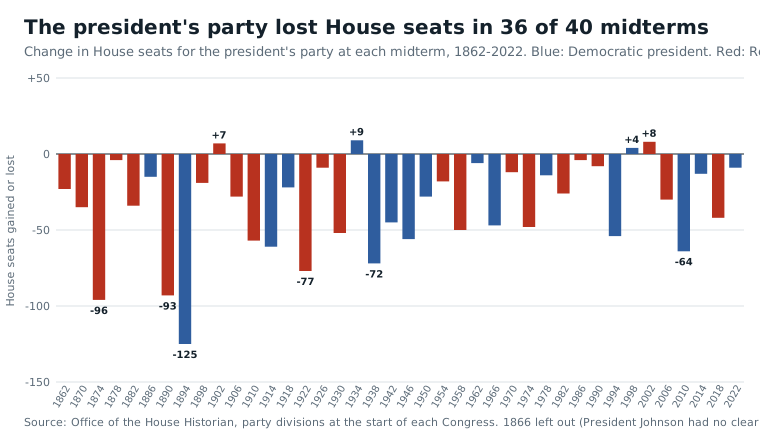
The four exceptions:
- 1902. Theodore Roosevelt's Republicans went from 200 seats to 207, but only because the House grew from 357 to 386 members after the 1900 census. Their share of the House fell from 56 to 54 percent.
- 1934. Franklin Roosevelt's Democrats gained 9 House seats and 9 Senate seats in the depth of the Depression. It is one of only two midterms since 1934, with 2002, in which the president's party gained seats in both chambers (American Presidency Project, UC Santa Barbara).
- 1998. Bill Clinton's Democrats gained 4 seats, less than a month after the House voted to open an impeachment inquiry into the president.
- 2002. George W. Bush's Republicans gained 8 seats in the first midterm after the September 11 attacks.
Since 1934 the president's party has lost an average of 27 House seats and between 3 and 4 Senate seats at the midterm (our calculation from the American Presidency Project table). The Senate pattern is weaker, partly because only a third of its seats are on the ballot in any one election. The president's party gained Senate seats in 7 of the 23 midterms from 1934 to 2022.
Some of the biggest midterm losses:
| Midterm | President | House seats lost by his party | What happened |
|---|---|---|---|
| 1874 | Ulysses S. Grant (R) | 96 | Democrats won the House for the first time since before the Civil War |
| 1890 | Benjamin Harrison (R) | 93 | Ohio-born Harrison's party lost more than half its seats |
| 1894 | Grover Cleveland (D) | 125 | The largest midterm loss on record, after the Panic of 1893 |
| 1910 | William Howard Taft (R) | 57 | Democrats took the House |
| 1914 | Woodrow Wilson (D) | 61 | Democrats kept the House with a smaller majority |
| 1922 | Warren G. Harding (R) | 77 | Ohio's Harding kept the House, but his party's seats fell from 302 to 225, against the Democrats' 207 |
| 1938 | Franklin D. Roosevelt (D) | 72 | Republicans gained 81 seats as third parties also lost ground |
| 1946 | Harry S. Truman (D) | 56 | Republicans won the House for the first time since 1928 |
| 1994 | Bill Clinton (D) | 54 | Republicans took the House for the first time since the 1952 election |
| 2010 | Barack Obama (D) | 64 | The largest midterm loss since 1938 |
Counts are from the House Historian's party divisions, which compare the opening day of each Congress. Other tallies, such as the American Presidency Project's, differ by one or two seats in some years (2010 is 63 there, 2018 is 41, 1958 is 48) because of vacancies, members who were not Democrats or Republicans, and seats still undecided when a Congress opened. The approval chart below uses the American Presidency Project's counts.
Losing seats is not the same as losing the House. Control of the House changed hands at 14 of the 41 midterms from 1862 to 2022, about one in three (House Historian, majority changes). The strangest was 1930. Republicans won 218 seats to the Democrats' 216 on Election Day, but 14 members-elect died before the new Congress met in December 1931, and the special elections to replace them gave Democrats the majority, 219 to 213 (House Historian).
Every Ohio-born president who faced a midterm saw his party lose House seats: Grant in 1870 and 1874, Rutherford B. Hayes in 1878 (4 seats), Benjamin Harrison in 1890, William McKinley in 1898 (19), William Howard Taft in 1910 (57, and the House), and Harding in 1922. James Garfield died in 1881 before his first midterm.
Why the president's party loses
Political scientists have argued over the cause for more than 60 years. The main explanations, none of which has settled the question alone:
- Surge and decline. Angus Campbell argued in 1960 that a presidential election brings out extra voters and swings who drift back to their usual habits two years later, so the winning party's gains fade (Public Opinion Quarterly).
- A referendum on the president. Edward Tufte wrote in 1975 that midterms are "a referendum on the performance of the President and his administration's management of the economy" (American Political Science Review). Samuel Kernell found in 1977 that voters unhappy with the president punish his party more than satisfied voters reward it, which he called "negative voting" (APSR).
- Balancing. Alberto Alesina and Howard Rosenthal argued in 1989 that some voters use the midterm on purpose to check the president by strengthening the other party in Congress (APSR).
- Exposure. The more seats a party holds beyond what its normal strength would win, the more it has to lose (Oppenheimer, Stimson and Waterman, 1986). Later studies have questioned how much this adds.
One measure lines up clearly with the size of the loss: how popular the president is going into the vote. Across the 20 midterms from 1946 to 2022, when the president's approval in Gallup's last poll before the election was below 50 percent, his party lost an average of about 35 House seats (11 midterms). When it was 50 percent or higher, the average loss was about 15 (9 midterms). The only two gains came with approval at 63 percent or more: 66 percent for Clinton in 1998 and 63 percent for Bush in 2002 (Gallup; American Presidency Project).
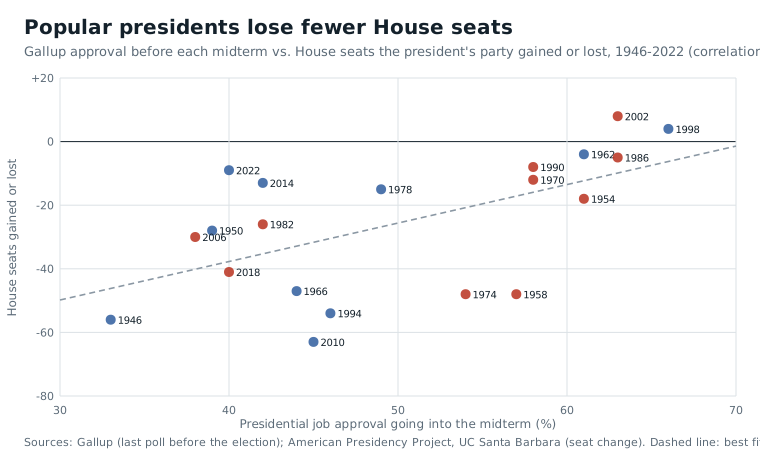
The link is real but loose. The correlation is 0.57, meaning approval lines up with about a third of the variation in seat losses from one midterm to the next (our calculation). Some years break the pattern badly. Obama's party lost 63 seats in 2010 (64 on the House Historian's count) with approval at 45 percent, while Joe Biden's lost 9 in 2022 with approval at 40. Dwight Eisenhower was at 57 percent in 1958 and his party still lost 48 seats at the tail of a recession. Gallup's own figure for the 1946-2014 midterms is a correlation of 0.66 (Gallup). A correlation like this shows that the two move together. It does not prove that approval is the cause, since a bad economy or an unpopular war can drag down both.
Fewer voters every other November
Midterms draw far fewer voters than presidential elections. From 1914 to 2022, an average of 41.6 percent of eligible Americans voted in midterms, against 57.8 percent in presidential years (U.S. Elections Project, Michael McDonald). Put another way, about one eligible American in six votes for president but sits out the midterm.
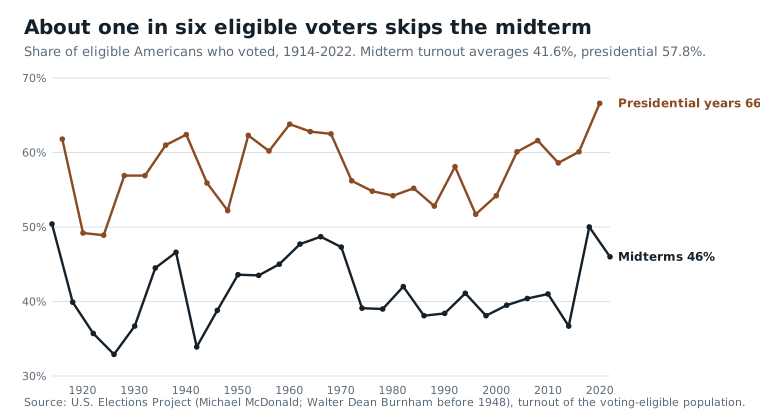
Three midterms stand out:
- 2018 drew 50.0 percent of eligible voters, the highest midterm turnout since 1914, when it was 50.4 percent.
- 2014 drew about 36.7 percent, the lowest since 1942 (33.9 percent), when millions of voters were away at war (PBS NewsHour).
- 2022 drew about 46 percent, higher than any midterm from 1974 through 2014 (U.S. Elections Project).
It was not always this way. In the 1830s and 1840s, midterm turnout often ran above 60 percent. In 1838 it reached about 71 percent, higher than in the presidential election two years before. Those early figures are estimates (U.S. Elections Project).
Ohio's midterm record
Ohio turns out a larger share of its voters than the nation does
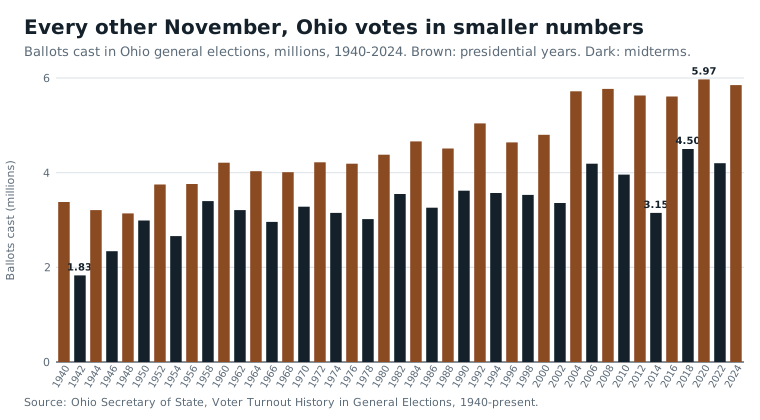
Ohio follows the national rhythm: big presidential years, smaller midterms. Before 2026, the most ballots cast in an Ohio midterm was 4,496,834 in 2018. The unofficial election-night count for 2026 was already higher: 4,658,250 ballots (Ohio Secretary of State). Since 1978, the first year the state could count turnout against full voter rolls, the highest share of registered voters in a midterm was 62.4 percent in 1982 and the lowest was 40.7 percent in 2014. From 1978 to 2022, Ohio midterms averaged 53.5 percent of registered voters, against 71.4 percent in the presidential years 1980 to 2024 (Ohio Secretary of State, turnout history).
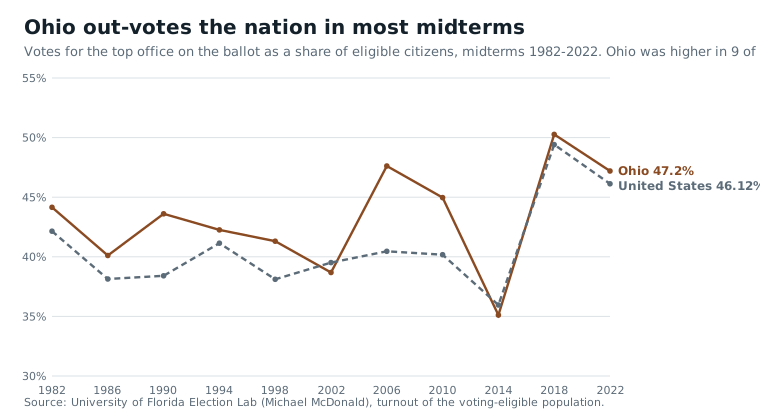
Ohio's share of registered voters is not the best way to compare with other states, because voter rolls hold people who have moved or died. Measured against eligible citizens instead, by votes cast for the top office on the ballot (all ballots in 2022), Ohio out-voted the nation in 9 of the 11 midterms from 1982 to 2022. The exceptions were 2002 and 2014. The widest gap was 2006, when votes for the top office on the ballot equaled 47.6 percent of eligible Ohioans against 40.5 percent nationally (our calculation from [University of Florida Election Lab] data(https://election.lab.ufl.edu/data-downloads/turnoutdata/Turnout_1980_2022_v1.2.csv)).
Ohio's governors usually come from the party out of the White House
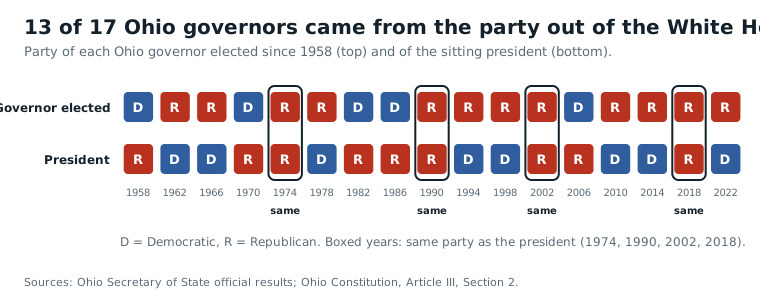
From the 1958 election, when four-year terms began, through 2022, Ohio held 17 elections for governor, all in midterm years, won by nine different people. In 13 of the 17, the winner came from the party that did not hold the White House (Ohio Secretary of State results). The four exceptions were 1974, 1990, 2002 and 2018. Over the same years Republicans won 12 governor's races and Democrats 5. The 2026 race fit the pattern: on the unofficial count, Democrat Amy Acton won with a Republican president, Donald Trump, in the White House (Ohio Secretary of State).
The close ones and the landslides:
- 1974. Republican Jim Rhodes beat Democratic Governor John Gilligan by 11,488 votes out of about 3.1 million after a recount, 1,493,679 to 1,482,191. It was the closest Ohio governor's race since 1916, when Democrat James Cox beat Republican Frank Willis by 6,616 votes (1916 Ohio governor election). The closest of all came in October 1873, when William Allen won by 817 (1873 Ohio governor election).
- 1994. Republican George Voinovich won 71.8 percent of the vote and a 1,565,723-vote margin, the largest of any Ohio governor's race.
- 2010. Republican John Kasich beat Democratic Governor Ted Strickland by 77,127 votes, 49.0 percent to 47.0.
- 2014. Kasich won re-election with 63.6 percent, on the lowest midterm turnout since Ohio began counting it against registered voters in 1978.
Ohio's U.S. Senate midterms have had close calls too. In a 1954 special election, Republican George Bender beat Democrat Thomas Burke by 2,970 votes after a recount, 1,257,874 to 1,254,904. In 1970, Republican Robert Taft Jr. beat Democrat Howard Metzenbaum by 70,420 (Ohio Secretary of State results).
One Ohio official outlasted every wave. Republican Ted W. Brown won the Secretary of State's office in nine straight elections, 1950 through 1974, seven of them midterms, and held it even in 1958, when Democrats took the governor's office and a Senate seat. He lost in 1978 by 8,260 votes after a recount to Democrat Anthony Celebrezze Jr.
Ohio's House vote
Ohio's vote for the U.S. House has leaned more Republican than the nation's in every midterm from 1946 to 2022. In 9 of those 20 midterms, Ohio's House vote went Republican while the nation's went Democratic. It never happened the other way. Ohio's House vote went Democratic in only four midterms in that time: 1958, 1982, 1990 and 2006 (Clerk of the U.S. House, election statistics).
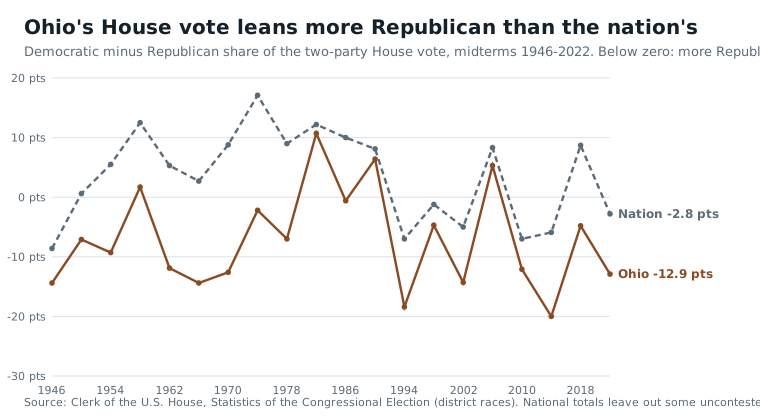
That makes the old saying "As Ohio goes, so goes the nation" a presidential saying, not a midterm one. In presidential elections, Ohio voted for the winner in every election from 1964 through 2016 and in 30 of 33 elections from 1896 through 2024. The misses were 1944, 1960 and 2020.
Ohio's House delegation in the big national waves:
| Midterm | Ohio delegation before | Ohio delegation after | Seats |
|---|---|---|---|
| 1974 | 15 R, 8 D | 15 R, 8 D | 23 |
| 1994 | 9 R, 10 D | 13 R, 6 D | 19 |
| 2006 | 12 R, 6 D | 11 R, 7 D | 18 |
| 2010 | 8 R, 10 D | 13 R, 5 D | 18 |
| 2018 | 12 R, 4 D | 12 R, 4 D | 16 |
| 2022 | 12 R, 4 D | 10 R, 5 D | 15 |
| 2026 | 10 R, 5 D | 7 R, 8 D, unofficial | 15 |
Sources: Ohio Secretary of State and Clerk of the House results for each year; for 2026, the unofficial election-night count. In 1974 two Ohio seats changed hands in opposite directions, so the totals did not move. Republicans gained four Ohio seats in 1994 and five in 2010, when five Democratic members lost re-election. Ohio's delegation has shrunk at every census since 1970, from a peak of 24 seats (held in the 1930s and again in the 1960s) to 15 today (Census Bureau apportionment, Table C1).
The questions on Ohio's midterm ballots
Statewide issues often share the midterm ballot, and some drew more attention than the candidates:
- 1958. A proposed right-to-work amendment lost, 2,001,512 to 1,160,324. Turnout jumped 27.5 percent over 1954, and Democrats won the governor's office and unseated U.S. Senator John Bricker the same day (Ohio Secretary of State).
- 2006. Voters raised the minimum wage (Issue 2) and banned smoking in most workplaces and restaurants (Issue 5). They turned down a slot-machine amendment (Issue 3) and a rival, weaker smoking amendment (Issue 4).
- 2018. Issue 1, which would have reduced many drug-possession crimes to misdemeanors, failed with 63 percent voting no.
- 2022. Issue 1 (judges to weigh public safety in setting bail) and Issue 2 (only citizens may vote) each passed with more than three-quarters of the vote.
Election Day as Ohioans lived it
A rowdy day at the polls
Mid-nineteenth-century polling places were crowded, loud and sometimes violent. Party workers met voters with whiskey and pressed their party's ticket into their hands, as historian Richard Bensel describes in The American Ballot Box in the Mid-Nineteenth Century (Cambridge University Press, 2004; review). For decades Ohio law also banned retail liquor sales during polling hours on election days. In 1967 the Ohio Attorney General confirmed that the ban applied on the November general-election Tuesday in any area holding an election (Opinion 67-046). It is no longer in the law (R.C. 4301.22).
Some customs Americans think of as Election Day traditions began elsewhere or later. "Election cake," a rich fruit cake, comes from Connecticut, where recipes date to 1771 and Hartford's Election Day celebrations made it famous (Connecticut Historical Society). No one agrees who first made an "I Voted" sticker. Reports go back decades, including a 1950 mention of an "I Have Voted" sticker at the polls in Miami, and the familiar oval flag design dates to 1987 (Hyperallergic; AARP).
Election nights in Ohio
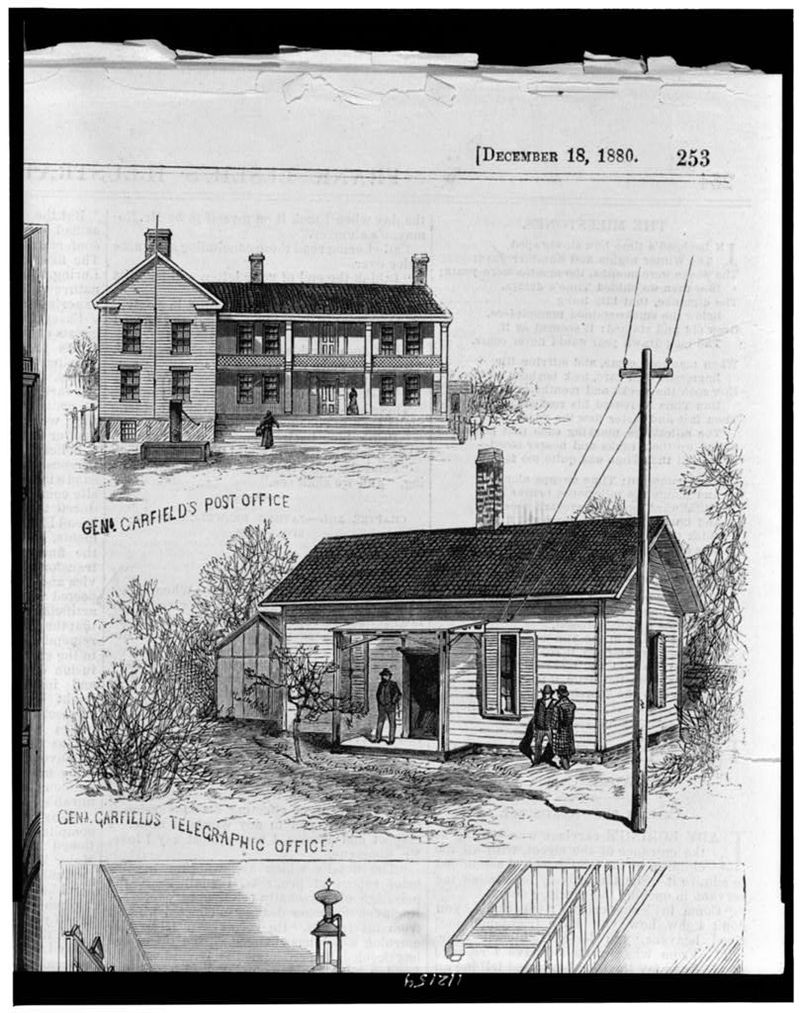
Before radio, results arrived by telegraph, and candidates waited by the wire. In 1880 James Garfield, at his farm in Mentor, had a telegraph office with two sets, both watched by one clerk, O. L. Judd. Around 11 p.m. on election night he learned he had carried New York (National Park Service). That settled it: Garfield won 214 electoral votes to Winfield Hancock's 155, and without New York's 35 he would have lost (National Archives).
Concessions came by telegram too. William Jennings Bryan wired William McKinley in Canton on November 5, 1896, two days after the vote, that "the returns indicate your election" (American Presidency Project). Twelve years later, again two days after the election, Bryan sent his congratulations to William Howard Taft in Cincinnati (American Presidency Project).
In 1920 both major candidates for president were Ohio newspapermen: Republican Warren G. Harding, owner of the Marion Star, and Democrat James M. Cox, owner of the Dayton Daily News. Election Day, November 2, was also Harding's 55th birthday. He and Florence Harding voted at a garage on South Greenwood Street in Marion. It was her first vote, in the first presidential election after the 19th Amendment. He played a round of golf at Scioto Country Club near Columbus and came home to a birthday dinner. That evening a lantern projector at the Marion Star's office on East Center Street flashed election bulletins onto a canvas on the building across the street for the crowd below (Ohio History Connection). Harding won 404 electoral votes to Cox's 127 (National Archives).
That same night, Westinghouse station KDKA in Pittsburgh began its scheduled programming by reading the Harding-Cox returns over the air, phoned in from the newsroom of the Pittsburgh Post (IEEE milestone). The man often named as the announcer, Harold Arlin, joined KDKA as its first full-time announcer in January 1921, by most accounts. The IEEE record names Leo H. Rosenburg, spelled Rosenberg in other sources.
When an Ohio race ends in a tie
Ohio settles a tied candidate race by chance. The law says the tie "shall be resolved by lot by the chairperson of the board in the presence of a majority of the members of the board" (R.C. 3505.33). A tied ballot issue simply fails, because it needs a majority. After the November 2021 election, Ohio's official canvass found 18 tied races: 12 between candidates and 6 on local issues. Boards broke the candidate ties with coin flips, except in Metamora in Fulton County and Jackson Center in Shelby County, which drew names (Ohio Secretary of State). In 2019 the mayor's race in the village of Magnolia, which straddles Stark and Carroll counties, ended 127 to 127, and Travis Boyd won the coin toss. The outgoing mayor, Bob Leach, had first won the office by a coin toss in 1979 (News 5 Cleveland; WKSU).
How the rest of the world votes
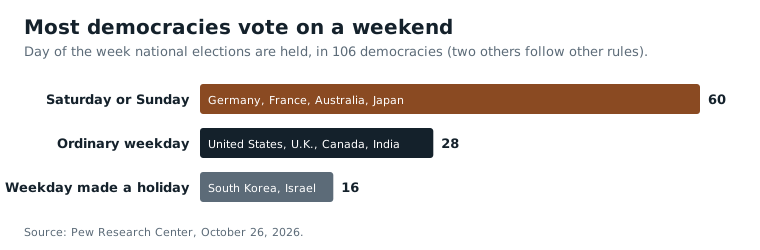
The United States is unusual in voting on a working day. In a Pew Research Center count of 106 democracies, 60 hold national elections on a Saturday or Sunday, 16 on a weekday declared a holiday, and 28, the United States among them, on an ordinary weekday. The other two, the Czech Republic and Suriname, follow other rules (Pew Research Center).
- Germany requires its federal election to be held on a Sunday or a public holiday (Federal Elections Act, Sec. 16).
- Australia votes on a Saturday (Commonwealth Electoral Act, Sec. 158), and voting is compulsory. About 91 percent of enrolled Australians voted in its May 3, 2025 election (Australian Electoral Commission).
- The United Kingdom votes on Thursdays by custom, and polling day cannot be a weekend (House of Commons Library).
- Canada sets its fixed election date on a Monday, the third Monday of October every four years, though early elections are common (Canada Elections Act).
Turnout is hard to compare across countries because each counts its voters differently. On one common measure, the share of all voting-age residents who voted, the United States ranked 31st among 50 countries in its 2020 presidential election, at 62.8 percent, compared with each other country's most recent national election. Four of the top five countries have and enforce laws making voting compulsory (Pew Research Center). An American midterm draws fewer: even in 2018, an unusually busy midterm, about 47.5 percent of voting-age residents voted, by the same Pew count.
Myths corrected
- "Election Day is a Tuesday because of farmers and market day." That is the common explanation, but the House debate on the 1845 law gives a different reason for the exact wording: keeping the vote inside the 34-day window before the electors met. See the section on how Election Day got its date, above.
- "The president's party always loses seats in a midterm." Not always. It gained House seats in 1902, 1934, 1998 and 2002.
- "2018 had the highest midterm turnout ever." It was the highest since 1914. Midterm turnout in the 1830s and 1840s was higher still, though those figures are estimates.
- "As Ohio goes, so goes the nation" in midterms. Ohio's House vote went the other way from the nation's in 9 of the 20 midterms from 1946 to 2022. The saying fits presidential elections, where Ohio picked the winner in every election from 1964 through 2016.
- "Ohio has always voted in November." Ohio chose its state officers in October through 1885 and its members of Congress in October through 1884.
- "Ohio voters gave women the vote." Ohio voters turned it down three times, in 1912, 1914 and 1917. Women won the vote through the 19th Amendment in 1920, and Ohio's own constitution kept the words "white male" until voters removed them in 1923.
- "A tied election goes to a runoff." Not in Ohio. A tied candidate race is settled by lot, and a tied issue fails.
- "Election night results are final." They are unofficial. Ohio's official count is finished up to three weeks later.
Sources
The main sources for this page, beyond the links in each section:
- U.S. law: the Statutes at Large for 1792, 1845 and 1872; the Congressional Globe for December 1844; the Congressional Research Service report on the timing of federal elections.
- Congress: the House Historian's party divisions and majority changes; the Clerk of the House's election statistics; the American Presidency Project's midterm seat table.
- Turnout: the U.S. Elections Project and the University of Florida Election Lab.
- Approval: Gallup.
- Ohio: the Ohio Constitution and Revised Code; the Ohio Secretary of State's election results and turnout history and unofficial 2026 results; the Cleveland State University law library's record of Ohio constitutional amendments; the U.S. Election Assistance Commission.
- Pictures: the Cleveland Public Library photograph collection and the Library of Congress, all public domain or with no known restrictions.
Towns and ZIP codes
Water, health, jobs and history for the places on the shores and just downstream.
Towns
ZIP codes
Questions
Who won Ohio's 2026 election?
The results are unofficial until the official count is finished. On the election-night count reported by the Ohio Secretary of State, Democrats Amy Acton and David Pepper won governor and lieutenant governor with 52.3 percent, against 44.4 percent for Republicans Vivek Ramaswamy and Robert McColley. Democrat Sherrod Brown won the U.S. Senate seat with 50.0 percent, against 45.1 percent for Republican Jon Husted. Democrats also led for attorney general, secretary of state, treasurer and both Ohio Supreme Court seats, and Republican Frank LaRose led for auditor. State Issue 3, which puts the photo-ID rule in the Ohio Constitution, passed with 65.3 percent.
Why is Election Day on the Tuesday after the first Monday in November?
Congress set the date in a law of January 23, 1845, written by Representative Alexander Duncan of Cincinnati to stop voters being moved between states that voted on different days. Duncan told the House why it says 'after the first Monday': a plain 'first Tuesday' could fall too long before the electors met in December, outside the 34-day window an older 1792 law allowed. The popular story about farmers, Sunday travel and market days is a later explanation that the debate does not mention.
Does the president's party always lose seats in a midterm election?
Almost always. From 1862 through 2022 the president's party lost House seats in 36 of 40 midterms (1866 set aside). The exceptions were 1902, 1934, 1998 and 2002, and the 1902 gain came only because the House grew. Since 1934 the average loss has been 27 House seats. Losses tend to be larger when the president's approval rating is below 50 percent.
How many Ohioans vote in a midterm election?
The most is the 2026 midterm. Ohio counted 4,658,250 ballots on election night, before about 102,000 provisional, military and overseas ballots were checked, and that count is unofficial until the canvass is finished. The official record before it was 4,496,834 in 2018, or 55.7 percent of registered voters. The lowest share since 1978, when Ohio began counting turnout against full voter rolls, was 40.7 percent in 2014. Ohio midterms averaged 53.5 percent of registered voters from 1978 to 2022, against 71.4 percent in presidential years. Measured against eligible citizens, Ohio out-voted the nation in 9 of the 11 midterms from 1982 to 2022.
Why does Ohio elect its governor in midterm years?
Ohio voters approved four-year terms for governor on November 2, 1954, and the first four-year governor was elected in 1958. Since then every Ohio governor's race has been held in a midterm year. In 13 of the 17 races from 1958 to 2022, Ohio elected a governor from the party that did not hold the White House. In 2026, on the unofficial count, Democrat Amy Acton won with a Republican president in office.
What happens if an Ohio election ends in a tie?
A tied candidate race is resolved by lot by the chair of the county board of elections, in front of a majority of the board (R.C. 3505.33). Boards usually flip a coin. A tied ballot issue fails, because it needs a majority. After the November 2021 election Ohio had 18 tied races.
Is Election Day a holiday in Ohio?
No. Election Day is not a federal holiday or one of Ohio's legal holidays. Ohio law does make it illegal for an employer to fire or threaten to fire a worker for taking a reasonable amount of time to vote on Election Day (R.C. 3599.06), but it does not say the time must be paid.
When will Ohio's 2026 election results be official?
Each county board of elections starts its official count between November 8 and November 18 and must finish and certify it by Tuesday, November 24, 2026 (Secretary of State Directive 2026-48). The Secretary of State then reviews the county results and certifies the statewide results. As of November 5 his office had not announced that date. It certified the 2024 results on December 2, 2024.
More deep dives
- Brian PoindexterCuyahoga, Medina, Wayne, Ashland · topic
- Columbus Day in OhioFranklin, Muskingum, Cuyahoga, Summit, Hamilton, Lorain, Mahoning, Putnam, Wood · topic
- Crew Stadium Site and the Hollywood Casino VoteFranklin · topic
- Flock Cameras in OhioCuyahoga, Franklin, Hamilton, Summit, Montgomery, Lucas, Butler, Lorain, Warren, Stark, Clark, Greene · topic
- Landfills, dumps and injection wellsJefferson, Perry, Seneca, Mahoning, Hamilton, Washington, Tuscarawas, Guernsey, Trumbull, Portage, Ashtabula, Belmont, Monroe, Noble · topic
- Ohio data centersFranklin, Licking, Cuyahoga, Hamilton, Summit, Butler, Montgomery, Delaware · topic