How Pleasant Township, Fairfield County began
Pleasant Township, northeast of Lancaster and named for the fertility of its soil, was settled as early as 1798 and grew slowly around Zane's Trace, which crossed its southern part and later became the Zanesville and Maysville Turnpike. Its village, Pleasantville, was laid out in 1828 by John Boston astride the Pleasant-Walnut township line and grew into a market town with its own academy, bank and newspaper. The Fairfield County Infirmary has stood in the township since 1828, and the Pleasant Run Baptist Church, organized about 1806, was among the first regular church congregations anywhere in the county. In the twentieth century the township also became home to the Mudhouse Mansion, a farmhouse whose real nineteenth-century owners were eclipsed in local memory by decades of ghost stories before its demolition in 2015.
Settled 1798 (William Green among the first settlers; died 1799).
Where the name comes from
Both the 1883 and 1912 county histories state plainly that Pleasant Township 'was so called, because of the extent of the fertile land found within its borders.'
Before the town
The 1883 county history records that at the township's first settlement, 'squads of Delaware and Wyandotte Indians frequently camped in various parts of Pleasant township, remaining for several weeks at a time,' hunting game and trading venison to settlers for cornmeal and bread. The same source preserves one specific, tense episode: David Ewing, out hunting with other settlers, fired at what he took for a bear in the brush and instead wounded a Native woman; fearing reprisal, the hunters fled to a neighbor's cabin, where an armed party of Indians who had tracked them was talked out of taking revenge by one of their own number, who pushed aside another's raised rifle. There was also a fort at the house of Judge Burton in the township, used by area settlers during War of 1812 alarms. No source consulted names a specific village, mound or trail within Pleasant Township, and the area had already been ceded at the 1795 Treaty of Greenville by the time these camps are recorded.
Nations recorded here: Lenape (Delaware), Wyandot.
- Pleasant Township camps (camp) — various parts of Pleasant Township, early settlement, before 1812 (archive.org)
Timeline
- — The Treaty of Greenville cedes most of Ohio, including the future Pleasant Township, to the United States.
- — William Green, among the township's first settlers, dies in 1799 and is buried in a coffin made from hickory bark, no other material being available.
- — David, Thomas and Matthew Ewing settle near the stream later called Ewing's Run; David and Thomas both serve in a company of riflemen in the War of 1812.
- — The Pleasant Run Baptist Church is organized, probably the first regular church organization in the county; by 1809 it was one of the most prosperous rural Baptist congregations in Ohio.
- — John Hampson builds the first grist mill near the future village of Pleasantville, operated by horse power.
- — John Boston lays out the village of Pleasantville, building its first house; the same year the Fairfield County Infirmary's first brick building is erected in the township.
- — Zane's Trace through the township's southern part is turned into the Zanesville and Maysville Turnpike.
- — The Pleasantville Academy is built, with two large brick buildings and courses in classical, scientific and English study.
- — The Ohio Central Railroad reaches Pleasantville; the village's population roughly doubles in the years that follow.
- — The farmhouse later known as the Mudhouse Mansion is built east of Lancaster in the township, its Second Empire style suggesting this decade though sources give dates as early as the 1840s.
- — Henry and Martha Hartman buy the farmhouse later called Mudhouse Mansion; it passes to their daughter Lulu, later Lulu Mast, on Henry's death in 1930.
- — Mudhouse Mansion is demolished by descendants of the Mast family on September 21, ending decades of local ghost stories about the house.
Stories
A Bear That Wasn't
In the early years of settlement, David Ewing was out hunting with several neighbors when they spotted movement in the brush and took it for a bear. Ewing fired, and the cry that answered him was not an animal's but a woman's: he had shot a Native woman, wounding her severely. Knowing what might follow, the hunters ran for the cabin of a settler named Arnold, arriving to find Mrs. Arnold alone with a young child. The Indians who had tracked the hunters there were close behind, and one raised his rifle at Mrs. Arnold before another member of the party shoved the gun aside, saving her life. Mrs. Arnold pleaded that her husband had not been hunting that day, and when Arnold himself arrived with neighbors soon after, the Indians were persuaded of his innocence and left peaceably -- a close call the 1883 county history preserved as evidence of how easily the peace between two communities could have broken.
The House That Outgrew Its Owners
The farmhouse east of Lancaster that generations of local teenagers came to know as the Mudhouse Mansion was, for most of its documented life, simply a family home. Christian and Eleanor Rugh owned the property from the 1830s or 1850s (sources differ); Henry and Martha Hartman bought it in 1919, and their daughter Lulu inherited it on her father's death in 1930, living there for decades after her marriage to Oren Mast. Somewhere along the way the house's real history was overtaken by invented ones -- stories of a slaveholder chaining captives in the basement, of a murder-suicide, of a curse -- repeated by generations of visitors despite Ohio never having been a slave state and no such crime ever being documented there. The Mast family's descendants had the house torn down on September 21, 2015, closing out a legend built almost entirely on rumor rather than on the ordinary Rugh, Hartman and Mast families who actually lived in it.
A Bank Becomes a Police Station
By 1912 Pleasantville supported its own bank, the Pleasantville Bank, capitalized at twenty-five thousand dollars with Arthur Kinsel as president and E. C. Sawyer as cashier, doing business in a Greek Revival building on South Main Street. Banks in small Ohio villages rarely lasted as banks forever, and Pleasantville's building eventually passed into public use: the same structure at 101 South Main Street serves today as the village police station, its columned front little changed from the days when it handled deposits rather than dispatch calls.
Photographs
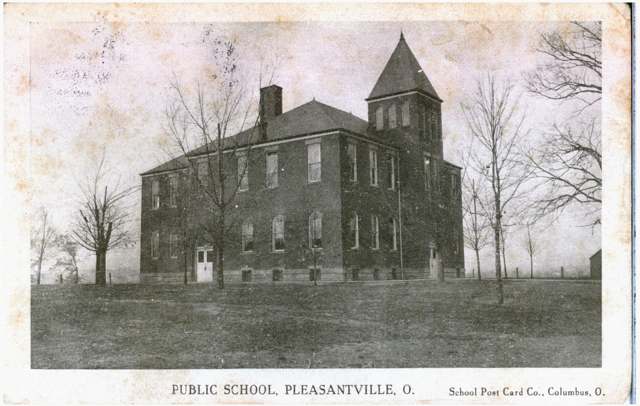
Photo: Columbus Metropolitan Library, via DPLA/Ohio Digital Network, public domain · Wikimedia Commons
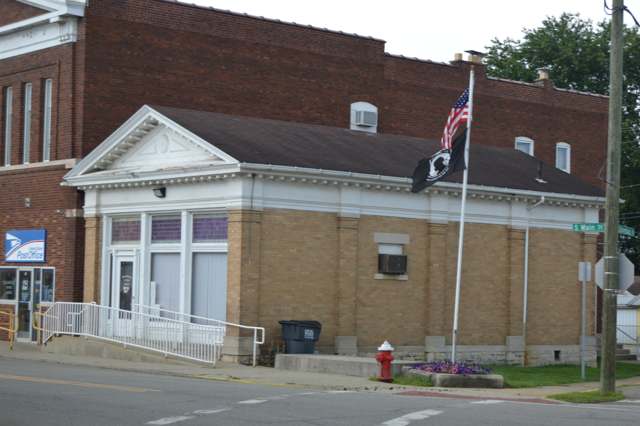
Photo: Nyttend, via Wikimedia Commons, public domain · Wikimedia Commons
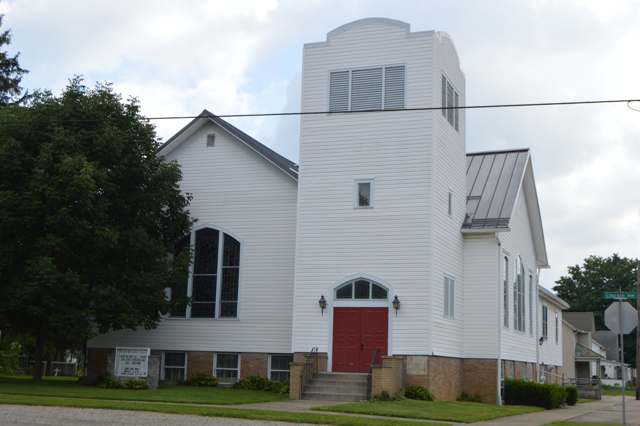
Photo: Nyttend, via Wikimedia Commons, public domain · Wikimedia Commons
Local history sources: archive.org · archive.org · en.wikipedia.org · en.wikipedia.org · en.wikipedia.org · en.wikipedia.org · commons.wikimedia.org · commons.wikimedia.org · commons.wikimedia.org
Water
Mostly private wells The water here
- Lancaster City92% of residentsHocking River Valley Aquifer (wells)
- Pleasantville Village5% of residentsGroundwater wells (3 wells)
- Greenfield Twp Water District3% of residentsGroundwater wells (2 wells)
- Sugar Grove Village0% of residentsGroundwater wells (2 wells)
- Brookdale Mobile Home Park0% of residentsGroundwater wells (2 wells)
- Colony Village MHP0% of residentsGroundwater wells (1 wells)
- Fairfield County Utilities0% of residentsLocal groundwater wells (central Ohio, aquifer undocumented)
Its ZIP codes
Each ZIP code that touches Pleasant Township, Fairfield County, with the share of its residents who live here and the same headline figures as the ZIP page.
| ZIP | Share | Water | Radon | Home value | Schools | Flood |
|---|---|---|---|---|---|---|
| 43148 Pleasantville | 19% | Mostly private wells | 7.0 pCi/L average radon | Median year built 1969 | Fairfield Union Local · 4 stars overall | 2.0% of residents in the 1% floodplain |
| 43130 Lancaster | 8% | Miller Park well field (12 wells) drawing groundwater from the Hocking River Valley Aquifer, in Miller Park along N. Memorial Drive north of downtown Lancaster | 8.5 pCi/L average radon | Median year built 1963 | Lancaster City · 3.5 stars overall | 6.2% of residents in the 1% floodplain |
The county
Fairfield County: 13 ZIP codes, 27 cities, villages and townships, 144,692 people.
Nearby places
Cite this page
Cite this page as:
Cracked Buckeye (Open Shower Co), "Pleasant Township, Fairfield County", https://crackedbuckeye.com/place/pleasant-township-fairfield-county/, built 2026-09-16, accessed [date].
Machine-readable: /api/place/pleasant-township-fairfield-county.json (open JSON, CC BY 4.0 for the compilation; the underlying records keep their own terms) · How to cite · Report a correction · Built 2026-09-16