How Madison Township, Fairfield County began
Madison Township, in the southern tier of Fairfield County, was organized in 1812 out of territory formerly part of Clear Creek Township, after the Shaeffer, Landis and Ream families scouted the area in 1798 and settled it later that year. It never gained a railroad or a traction line, and by 1912 its only settlements were the crossroads hamlets of Clearport, Revenge and Drinkle, so that its nineteenth-century economy ran instead on water power along Clear Creek: gristmills, sawmills, a powder mill and, for a time, more still-houses than almost any other township in the county. What survives most visibly from that era are three covered bridges built in the 1880s, Johnston, Hannaway and Mink Hollow, still standing over Clear Creek and Arney Run. Madison remains the county's most thinly documented township covered so far in this atlas, and among its smallest in population.
Settled 1798 (Shaeffer, Landis and Ream families, who scouted the ground that spring and returned to settle it that fall), incorporated 1812 (organized as a township, having formerly been part of Clear Creek Township).
Where the name comes from
Neither the 1883 nor the 1912 county history gives a reason for the name Madison; both open their Madison Township chapters directly with the 1812 organization date and the township's first families. The organization date falls within the presidency of James Madison (1809-1817), a period in which many Ohio townships were named for the sitting president, but no source consulted makes this connection explicitly for Madison Township, Fairfield County, so it is offered here only as an unconfirmed possibility.
Before the town
No source consulted names a specific Native village, camp, mound or trail within Madison Township itself, and neither the 1883 nor the 1912 county history's township chapter includes the kind of Native-history paragraph found in some neighboring townships' chapters (Liberty and Pleasant among them). The area was ceded, along with virtually all of the rest of Fairfield County, at the 1795 Treaty of Greenville, and lay within the broader hunting range of the Wyandot of the Hocking Valley, whose main town, Tarhetown, stood at Lancaster a few miles north until most of its people left for the Sandusky country after 1795. This is a genuine gap in the documentary record rather than an oversight: the county's own 1883 Archaeology chapter, which lists Greenfield, Bloom, Clear Creek, Hocking, Berne, Walnut, Rush Creek and Richland as the townships holding known mound-builder works, does not include Madison among them.
Nations recorded here: Wyandot.
Timeline
- — The Treaty of Greenville cedes most of Ohio, including the future Madison Township, to the United States.
- — The Shaeffer, Landis and Ream families, from Lancaster County, Pennsylvania, scout the area in the spring and return to settle it that fall, landing at Hunter's Crossing on the Hocking River.
- — Isaac Shaeffer builds a mill that becomes known as the Defenbaugh Mill, the most noted of the township's early mills.
- — Madison Township is organized, formerly having been part of Clear Creek Township.
- — Mr. Akers operates a sickle factory at the Defenbaugh Mill, its grindstone turned by water power, part of a cluster of small water-powered manufactories including a woolen mill and a spinning-bowl shop.
- — St. John's Lutheran Church is built on the Sweyer farm, the township's first regular place of worship.
- — The Methodist congregation builds the first Hopewell church; a second building replaces it in 1844.
- — Mt. Carmel, a German Reformed church, is built in the township.
- — Clearport is established as a business point, with Orin Abbott keeping the first store.
- — The Johnston and Mink Hollow covered bridges are built, spanning Clear Creek near Clearport and Arney Run to the northeast.
- — The Hannaway Covered Bridge is built in the township.
- — The county history reports that Madison Township has 'no large villages, as neither railroads nor traction roads traverse it,' naming only Clearport, Revenge and Drinkle as its settlements.
- — The census records Madison Township's population at 1,770, one of the smallest in the county.
Stories
Powder and Whiskey on Clear Creek
Before railroads or turnpikes reached Madison Township, its economy ran on Clear Creek's water power, and on what its settlers could not easily haul to market. Because farmers could not float grain downstream to sell, the 1883 county history reports, 'they had to make their corn into whiskey and drink it,' and nearly every section of the township had its own still-house at one time or another -- Samuel Shaeffer's copper still, brought from Pennsylvania in 1802, was said to be the first, turning out about eighteen gallons a week. Sebastian Carpenter ran something rarer still: a powder mill on the millrace near Clearport, making rifle powder from sumac charcoal, saltpeter dug from under the local rocks, and sulphur shipped in from the east, the ingredients ground together by a water-powered mortar and the finished powder combed out by hand onto a board. A second powder mill, built by Jacob Bixler, stood not far off. Between the stills, the powder mill, a sickle factory, a woolen mill and a spinning-bowl shop that gave its hollow the name 'Spinning-bowl Hollow,' Madison Township carried on more small manufacturing in its first decades than its handful of crossroads hamlets would ever suggest.
Three Bridges and No Railroad
By the county historian's own admission in 1912, Madison Township had no railroad and no electric traction line, and its business was confined to three named places: Clearport in the north, Revenge in the center, and Drinkle in the southwest, none of them large enough to call a village. What the township got instead of rail lines were bridges over its two principal streams, and three of them, all built within a decade and a half of one another, still stand: the Johnston Covered Bridge, spanning Clear Creek southeast of Clearport, and the Mink Hollow Covered Bridge, over Arney Run to the northeast, both raised in 1887, and the Hannaway Covered Bridge, built in 1901. In a county that lost most of its nineteenth-century covered bridges to floods, fire and replacement, Madison Township's trio -- unglamorous, rural, still carrying local traffic -- are as much a monument to the township's isolation as to its carpenters.
Photographs
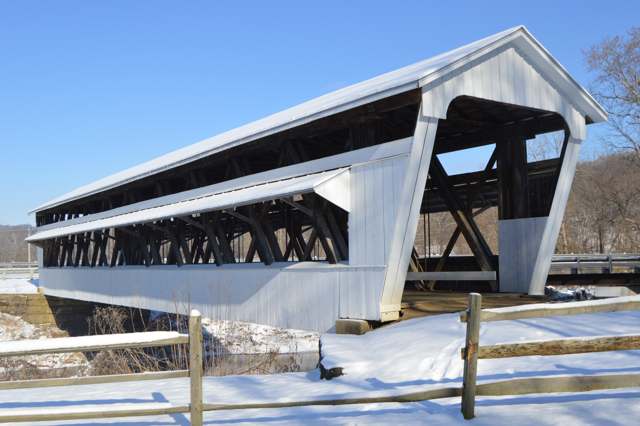
Photo: Nyttend, via Wikimedia Commons, public domain · Wikimedia Commons
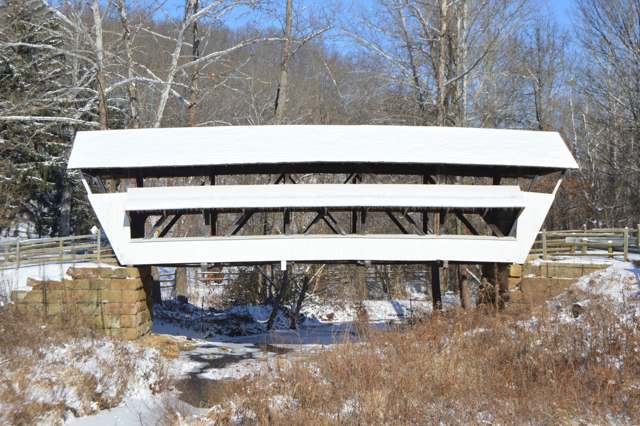
Photo: Nyttend, via Wikimedia Commons, public domain · Wikimedia Commons
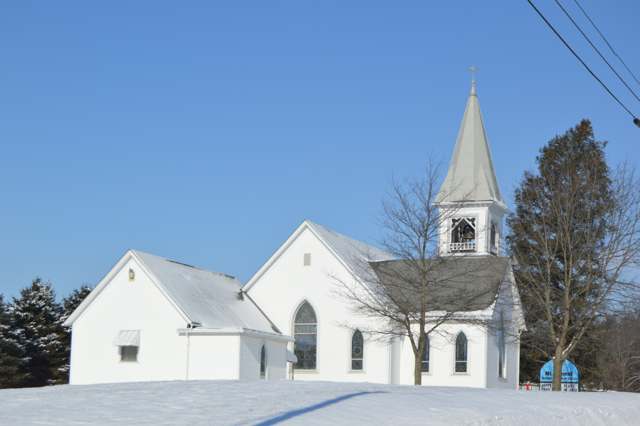
Photo: Nyttend, via Wikimedia Commons, public domain · Wikimedia Commons
Local history sources: archive.org · archive.org · en.wikipedia.org · en.wikipedia.org · en.wikipedia.org · commons.wikimedia.org · commons.wikimedia.org · commons.wikimedia.org
Water
Mostly private wells The water here
- Lancaster City89% of residentsHocking River Valley Aquifer (wells)
- Amanda Village8% of residentsGroundwater wells (3 wells)
- Greenfield Twp Water District3% of residentsGroundwater wells (2 wells)
- Sugar Grove Village0% of residentsGroundwater wells (2 wells)
- Brookdale Mobile Home Park0% of residentsGroundwater wells (2 wells)
- Colony Village MHP0% of residentsGroundwater wells (1 wells)
- Fairfield County Utilities0% of residentsLocal groundwater wells (central Ohio, aquifer undocumented)
Its ZIP codes
Each ZIP code that touches Madison Township, Fairfield County, with the share of its residents who live here and the same headline figures as the ZIP page.
| ZIP | Share | Water | Radon | Home value | Schools | Flood |
|---|---|---|---|---|---|---|
| 43102 Clearcreek Township and Amanda | 11% | Mostly private wells | 6.5 pCi/L average radon | Median year built 1979 | Amanda-Clearcreek Local · 3 stars overall | 1.4% of residents in the 1% floodplain |
| 43130 Lancaster | 2% | Miller Park well field (12 wells) drawing groundwater from the Hocking River Valley Aquifer, in Miller Park along N. Memorial Drive north of downtown Lancaster | 8.5 pCi/L average radon | Median year built 1963 | Lancaster City · 3.5 stars overall | 6.2% of residents in the 1% floodplain |
The county
Fairfield County: 13 ZIP codes, 27 cities, villages and townships, 144,692 people.
Nearby places
Cite this page
Cite this page as:
Cracked Buckeye (Open Shower Co), "Madison Township, Fairfield County", https://crackedbuckeye.com/place/madison-township-fairfield-county/, built 2026-09-16, accessed [date].
Machine-readable: /api/place/madison-township-fairfield-county.json (open JSON, CC BY 4.0 for the compilation; the underlying records keep their own terms) · How to cite · Report a correction · Built 2026-09-16