How Hocking Township, Fairfield County began
Hocking Township, immediately southwest of Lancaster, holds the site of Fairfield County's very first white settlement: Captain Joseph Hunter's cabin on Zane's Trace, built in April 1798 when he was reportedly the only white man known to be in the county. The Shaefer and Ream families followed within weeks, and their children's births are both claimed, in different sources, as the first white birth in the county. In 1857-58 the state legislature, acting on Cincinnati reformer Charles Remelin's proposal, opened Ohio's first reform school for boys on a former tobacco farm in the township's southeast corner; the institution has operated on the same ground ever since, renamed the Fairfield School for Boys in 1964 and converted to the adult Southeastern Correctional Institution in 1980. The township's only village, Hamburg, once a stagecoach stop on Zane's Trace, is now little more than a crossroads.
Settled April 1798, by Captain Joseph Hunter.
Where the name comes from
The township is named for the Hocking River, which the 1883 county history says the township was settled along first because, like the rest of Ohio, the earliest emigration followed the streams. No source consulted gives the origin of the river's own name.
Before the town
The 1883 county history's Hocking Township chapter itself names no specific Native village, mound or trail within the township, though it records that in 1801 the settlers gathered at James Converse's house, the township's first store, over a rumored Indian attack that never came, ending instead in a fistfight among the settlers themselves. Fairfield County lay within the 1795 Treaty of Greenville cession, and the county's own Indian Tribes chapter records that the Wyandot held a town called Tarhetown (or Cranetown), after their chief Tarhe, on the north bank of the Hocking at the southeast edge of Lancaster until the treaty, with hunting parties returning to the valley as late as 1812; the county's Archaeology chapter separately places one of the county's roughly twenty known ancient mounds in "Tarhill hollow," one or two miles northeast of the State Reform Farm and near the east line of Hocking Township, describing a single handsome conical mound standing alone. No source consulted gives this mound a name, a builder culture, or a modern status. See the Fairfield County file for the wider Wyandot and treaty history.
Nations recorded here: Wyandot.
- Conical mound, Tarhill hollow (mound) — one to two miles northeast of the State Reform Farm (now Southeastern Correctional Institution), near the east line of Hocking Township, precontact, mound-builder culture not specified by the source (archive.org)
Timeline
- — The Treaty of Greenville cedes most of what becomes Ohio, including the future Hocking Township, to the United States.
- — In April, Captain Joseph Hunter settles on Zane's Trace with his family, becoming, by the 1883 county history's account, the only white man then known to be in the county; William Green also arrives and dies soon after, the township's first recorded death.
- — Isaac Shaefer, from Lancaster County, Pennsylvania, and the Abraham Ream family, from Reamstown, Pennsylvania, arrive within weeks of Hunter and build early mills; Shaefer marries Julia Ream in 1799.
- — Delilah Shaefer, daughter of Isaac and Julia Shaefer, is born in 1800 and is sometimes credited as the first white child born in the county; the honor is more often given to Hocking H. Hunter, born August 1, 1801, who becomes a leading Ohio lawyer.
- — Settlers gather at storekeeper James Converse's house on a rumored Indian attack that fails to materialize, and the meeting devolves into a fight among the settlers.
- — William Medill lays out the village of Hamburg on the old Chillicothe road soon after the War of 1812; the house he builds still stands in 1883 and had served for years as a hotel visited by General William Henry Harrison.
- — Cincinnati reformer Charles Remelin persuades the Ohio Legislature to establish a reform school for boys on the former Reber-Meyers tobacco farm in the township's southeast corner; the first ten boys arrive from Cincinnati on January 30, 1858, with Remelin as first superintendent.
- — The Ohio Reform Farm's buildings are estimated to be worth $200,000, with 538 boys resident of 3,586 admitted since 1858.
- — The institution is renamed the Fairfield School for Boys.
- — The facility is converted to the Southeastern Correctional Institution, an adult prison, ending its 123-year history as a juvenile reformatory.
Stories
The County's First Cabin
In April 1798, Captain Joseph Hunter came from Kentucky with his family and felled trees for a cabin about a hundred and fifty yards northwest of what became the turnpike crossing on Zane's Trace, in what the 1883 county history calls the first white settlement in Fairfield County, with Hunter himself, for a short time, the only white man known to be living there. Other families reached the Hocking by an indirect route common to the era: wagon to Pittsburgh, flatboat down the Ohio to the Hocking's mouth, then dugout canoe upriver to Hunter's settlement or the fledgling town of New Lancaster. Hunter lived on his claim until his death in 1846; his son Hocking H. Hunter, born in 1801 and sometimes credited as the first white child born in the county, grew up to become one of Ohio's leading lawyers.
A Curiosity Called Christmas Rock
Just north of the old State Reform Farm, on a hill some hundred and fifty feet high near the Lancaster and State Farm road, the 1883 county history describes a natural attraction it calls Christmas Rock: an acre-wide outcrop, forty to seventy-five feet high, split by more than a dozen deep fissures the writer speculated, only half seriously, might date to the earthquake at the Crucifixion. Some of the cracks ran only a foot wide, others four or five feet, rising sixty or seventy feet and extending as far as three hundred feet in length; from the top, Lancaster was visible six miles away. It was, by the historian's account, worth every visit made to see it.
From Reform School to Prison
In 1857-58, the Cincinnati reformer Charles Remelin persuaded the state legislature to open Ohio's first reform school for unruly boys, choosing a former tobacco farm in Hocking Township once owned by a Mr. Reber and later Henry Meyers, who sold the land to the state for about fifteen dollars an acre. The first ten boys arrived from Cincinnati on January 30, 1858, and Remelin himself served as the institution's first superintendent; by 1876 the campus, worth an estimated $200,000, had taken in 3,586 boys in all. The institution kept training juvenile offenders in trades for over a century, renamed the Fairfield School for Boys in 1964, before the state converted the campus in 1980 into the Southeastern Correctional Institution, an adult prison that still occupies the same ground today.
Photographs
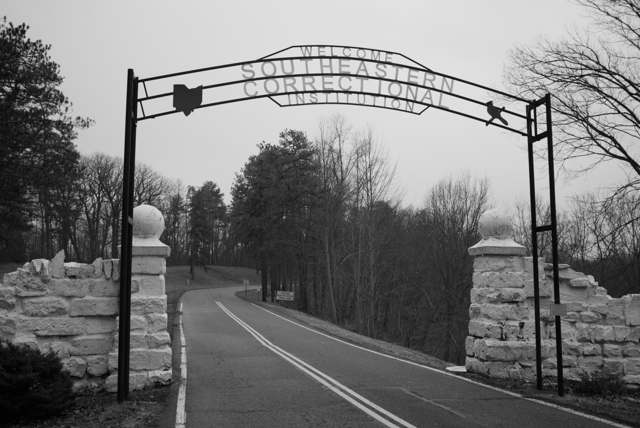
Photo: Brian Flanagan, via Wikimedia Commons, CC BY-SA 3.0 · Wikimedia Commons
Local history sources: archive.org · en.wikipedia.org · en.wikipedia.org · en.wikipedia.org · en.wikipedia.org · commons.wikimedia.org · commons.wikimedia.org
Water
Miller Park well field (12 wells) drawing groundwater from the Hocking River Valley Aquifer, in Miller Park along N. Memorial Drive north of downtown Lancaster The water here
- Lancaster City97% of residentsHocking River Valley Aquifer (wells)
- Greenfield Twp Water District3% of residentsGroundwater wells (2 wells)
- Sugar Grove Village0% of residentsGroundwater wells (2 wells)
- Amanda Village0% of residentsGroundwater wells (3 wells)
- Brookdale Mobile Home Park0% of residentsGroundwater wells (2 wells)
- Colony Village MHP0% of residentsGroundwater wells (1 wells)
- Fairfield County Utilities0% of residentsLocal groundwater wells (central Ohio, aquifer undocumented)
Its ZIP codes
Each ZIP code that touches Hocking Township, Fairfield County, with the share of its residents who live here and the same headline figures as the ZIP page.
| ZIP | Share | Water | Radon | Home value | Schools | Flood |
|---|---|---|---|---|---|---|
| 43130 Lancaster | 8% | Miller Park well field (12 wells) drawing groundwater from the Hocking River Valley Aquifer, in Miller Park along N. Memorial Drive north of downtown Lancaster | 8.5 pCi/L average radon | Median year built 1963 | Lancaster City · 3.5 stars overall | 6.2% of residents in the 1% floodplain |
| 43102 Clearcreek Township and Amanda | 1% | Mostly private wells | 6.5 pCi/L average radon | Median year built 1979 | Amanda-Clearcreek Local · 3 stars overall | 1.4% of residents in the 1% floodplain |
The county
Fairfield County: 13 ZIP codes, 27 cities, villages and townships, 144,692 people.
Nearby places
Cite this page
Cite this page as:
Cracked Buckeye (Open Shower Co), "Hocking Township, Fairfield County", https://crackedbuckeye.com/place/hocking-township-fairfield-county/, built 2026-09-16, accessed [date].
Machine-readable: /api/place/hocking-township-fairfield-county.json (open JSON, CC BY 4.0 for the compilation; the underlying records keep their own terms) · How to cite · Report a correction · Built 2026-09-16