How Amanda Township, Fairfield County began
Amanda Township, in the southwest corner of Fairfield County, was settled beginning about 1800 by Frederick Leathers, a Virginian who kept the township's first tavern, and by a colony of forty Vermonters under Dr. Silas Allen who had originally set out for Mississippi but stopped short and founded Royalton in 1810. The village of Amanda itself was laid out about 1830 by Samuel Kessler and grew into the township's main shipping point after the Zanesville and Cincinnati Railroad arrived in the 1850s, at times moving 400,000 bushels of grain a year. A mile northwest of Royalton stood Tobytown, a small Lenape (Delaware) village named for a chief called Toby, abandoned not long after the 1795 Treaty of Greenville; the stream beside it, once called Toby Creek, is now Little Walnut Creek. Today the township remains an agricultural community anchored by the village of Amanda.
Settled c. 1800 (Frederick Leathers, near the future village of Amanda).
Where the name comes from
No source consulted gives a documented origin for the township's own name. Ohio has two other Amanda Townships, in Allen and Hancock counties; the village of Amanda within this township was named by William Hamilton, Fairfield County's first surveyor, according to the 1912 county history, which does not explain his reason for the choice.
Before the town
A named Native village stood within Amanda Township: Tobytown, a mile northwest of Royalton, inhabited by Lenape (Delaware) people under a chief of lesser rank called Toby, for whom the village and the adjoining stream (then Toby Creek, now Little Walnut Creek) were named. County historian A. A. Graham, drawing on General Sanderson's 1852 notes on the county's early settlement, records that the Indians had already abandoned Tobytown, apparently soon after the 1795 Treaty of Greenville, leaving it in a dilapidated state by the time white settlers arrived; earlier tradition had mistakenly placed 'another village of the tribe' on the actual site of Royalton itself, a mile away. The Clark family, who settled at Tobytown in 1799, recalled friendly relations with Delaware who continued to revisit the area to hunt until about 1812, though they grew unpredictable when they had obtained whiskey. Years later a settler named William Clark, digging a mortar hole on the old village site, turned up silver rings and brooches mixed with the bones of what appeared to be a Delaware chief. No pottery or other worked art was ever found at either Tobytown or Tarhetown (the Wyandot town near Lancaster), leading Graham to conclude both peoples lived chiefly by hunting rather than farming in this part of the county.
Nations recorded here: Lenape (Delaware), Wyandot.
- Tobytown (village) — one mile northwest of Royalton, Amanda Township, 18th century, abandoned soon after 1795 (archive.org)
Timeline
- — The Treaty of Greenville cedes most of what becomes Ohio to the United States; Tobytown, the Delaware village a mile northwest of the future Royalton, is abandoned around this time.
- — The Clark family settles at the old Tobytown site, recalling friendly if sometimes tense dealings with Delaware who continued to visit.
- — Frederick Leathers, a Virginian, settles near the future village of Amanda and opens the township's first tavern on the old Chillicothe road.
- — Andrew Barr and his five sons arrive from Chester County, Pennsylvania, and settle two miles west of Amanda.
- — A colony of forty settlers led by Dr. Silas Allen, originally bound for Mississippi from Royalton, Vermont, stops in Fairfield County and settles what becomes Section 3 of Amanda Township.
- — Lemuel and Jedediah Allen lay out the village of Royalton, named for their home county in Vermont, with William Hamilton as surveyor.
- — Samuel Kessler (recorded elsewhere as Kester) lays out the village of Amanda; its first three houses belong to a shoemaker, a cooper and a blacksmith.
- — The Presbyterian Church at Amanda organizes with thirteen original members, growing to ninety within a year.
- — The Zanesville and Cincinnati Railroad is completed through Amanda village, spurring its growth as a grain-shipping point handling as much as 400,000 bushels a year.
- — Central Valley Lodge, I.O.O.F. No. 548, is instituted at Amanda on July 10.
- — A bank is organized in Amanda village to meet the growing needs of local business.
Stories
Tobytown, and the Chief It Was Named For
A mile northwest of Royalton, on both banks of a small stream, once stood Tobytown, a Delaware village governed by a chief of lesser rank named Toby. General Sanderson's 1852 notes on the county's early settlement mistakenly placed the site directly on Royalton itself, but Graham's history corrects the record: the actual village stood a mile away, on the creek then called Toby Creek and known today as Little Walnut Creek. By the time the Clark family settled on the old village ground in 1799, the Delaware had mostly moved on, apparently not long after the 1795 Treaty of Greenville, leaving their bark wigwams in a dilapidated state. Years afterward, a settler named William Clark, digging a mortar hole on the site, uncovered silver rings and brooches mixed among a set of bones that appeared to belong to a chief — a small, startling reminder of who had lived there first.
A Carriage That Became a Turkey Roost
When Dr. Silas Allen's party of forty Vermonters left Royalton, Vermont, in 1800, they were bound for distant Mississippi and had brought along a fine carriage for the women of the group. They got only as far as Lancaster before deciding the surrounding country suited them well enough to stop, and settled instead in what became Section 3 of Amanda Township, near an old Delaware encampment site the settlers called Tobytown. There was, at that time, not a single tree cut between Lancaster and the new settlement, so the men had to hew a road through the forest to bring the carriage the rest of the way. It never once served as a pleasure vehicle in its new home; instead it was stowed away and, in time, became nothing more than a roost for turkeys.
A Village Built for Convenience
Royalton, the township's first village, was not laid out to serve travelers or trade but so that its founders, Lemuel and Jedediah Allen, could have a blacksmith and other tradesmen close at hand without a trip to Lancaster. Laid out in 1810 and named for the Vermont county the Allen family had left, it grew only modestly over the following century. Amanda, platted two decades later by Samuel Kessler, took the opposite path: once the Zanesville and Cincinnati Railroad reached it in 1850, farmers from as far as nine miles away hauled their grain to Amanda's elevators, and by the late 1870s the village was shipping some 400,000 bushels a year, eclipsing the older village entirely as the township's commercial center.
Photographs
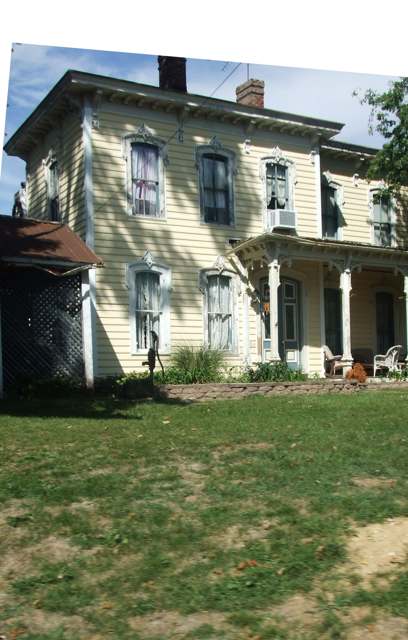
Photo: Sadpine, via Wikimedia Commons, CC BY-SA 3.0 · Wikimedia Commons
Local history sources: archive.org · archive.org · en.wikipedia.org · en.wikipedia.org · commons.wikimedia.org
Water
Mostly private wells The water here
- Lancaster City71% of residentsHocking River Valley Aquifer (wells)
- Amanda Village27% of residentsGroundwater wells (3 wells)
- Greenfield Twp Water District2% of residentsGroundwater wells (2 wells)
- Sugar Grove Village0% of residentsGroundwater wells (2 wells)
- Brookdale Mobile Home Park0% of residentsGroundwater wells (2 wells)
- Colony Village MHP0% of residentsGroundwater wells (1 wells)
- Fairfield County Utilities0% of residentsLocal groundwater wells (central Ohio, aquifer undocumented)
Its ZIP codes
Each ZIP code that touches Amanda Township, Fairfield County, with the share of its residents who live here and the same headline figures as the ZIP page.
| ZIP | Share | Water | Radon | Home value | Schools | Flood |
|---|---|---|---|---|---|---|
| 43102 Clearcreek Township and Amanda | 24% | Mostly private wells | 6.5 pCi/L average radon | Median year built 1979 | Amanda-Clearcreek Local · 3 stars overall | 1.4% of residents in the 1% floodplain |
| 43154 Clearcreek Township and Stoutsville | 5% | Mostly private wells | 6.7 pCi/L average radon | Median year built 1984 | Amanda-Clearcreek Local · 3 stars overall | 0.0% of residents in the 1% floodplain |
| 43130 Lancaster | 1% | Miller Park well field (12 wells) drawing groundwater from the Hocking River Valley Aquifer, in Miller Park along N. Memorial Drive north of downtown Lancaster | 8.5 pCi/L average radon | Median year built 1963 | Lancaster City · 3.5 stars overall | 6.2% of residents in the 1% floodplain |
The county
Fairfield County: 13 ZIP codes, 27 cities, villages and townships, 144,692 people.
Nearby places
Cite this page
Cite this page as:
Cracked Buckeye (Open Shower Co), "Amanda Township, Fairfield County", https://crackedbuckeye.com/place/amanda-township-fairfield-county/, built 2026-09-16, accessed [date].
Machine-readable: /api/place/amanda-township-fairfield-county.json (open JSON, CC BY 4.0 for the compilation; the underlying records keep their own terms) · How to cite · Report a correction · Built 2026-09-16