How Pleasantville began
Pleasantville was laid out in 1828 by John Boston on ground first granted to Jacob Lamb in 1808, and carried two other names, Vicksburg and then New Boston, before settling on Pleasantville, after its township and the stream Pleasant Run. It grew as the trading and educational center of Pleasant Township, home from 1860 to 1903 to the Fairfield Union Academy, a boarding school whose teachers and students went on to wider fame, before the Toledo & Ohio Central Railroad's arrival in 1879 pulled new growth east of the old town center. The village incorporated in 1886 with David Pence as its first mayor, and remains today a farm-country village of a few hundred people just north of the Pleasant Township line.
Settled 1798 or earlier (one of the first settlements in Fairfield County; William Green, an early arrival, died within weeks of reaching the township and was buried near Fetter's Run), platted 1828, by John Boston, surveyed by Ewel Jefferies; the ground had been granted to Jacob Lamb on November 21, 1808, and sold to James Rogers and Nancy Rogers in 1821, incorporated 1886, with David Pence as first mayor, by John Boston.
Where the name comes from
Pleasantville went by two earlier names before its own stuck: laid out in 1828, it was first called Vicksburg, then New Boston (for founder John Boston), before finally taking the name Pleasantville, after Pleasant Township and the local stream, Pleasant Run. Neither Graham's 1883 nor Scott's 1877 county history explains the two name changes; the sequence comes from the village's own history page.
Before the town
Pleasantville's own village history page states plainly that the area was "initially inhabited by Wyandot and Delaware Indians" before white settlement, and Graham's 1883 county history supplies the detail behind that claim: at Pleasant Township's first settlement, squads of Delaware and Wyandot camped in various parts of the township for weeks at a time, hunting game in the surrounding woods and trading venison to the settlers for corn meal and bread. Graham also preserves one specific and nearly disastrous encounter from the township's earliest years, recounted below under Stories: the settler David Ewing mistook an Indian woman for a bear while hunting and wounded her, and her band tracked the fleeing hunters to a neighbor's cabin before the crisis was defused. No source names a specific village, trail, or burial ground inside the village of Pleasantville itself; see the county file for the wider record of Wyandot and Delaware presence across Fairfield County.
Nations recorded here: Wyandot, Lenape (Delaware).
Timeline
- — One of the first settlements in Fairfield County is made in what becomes Pleasant Township; William Green dies within weeks of arriving and is buried near Fetter's Run in a coffin made of hickory bark, there being no other material to hand.
- — The section that becomes the original town of Pleasantville is granted to Jacob Lamb.
- — Jacob Lamb's land is sold to James Rogers and Nancy Rogers.
- — John Boston, with surveyor Ewel Jefferies, lays out the village; lots go to auction on October 6, seventeen of twenty-five selling for $2 to $26 each.
- — Pleasantville's post office opens.
- — The Fairfield Union Academy opens at Pleasantville in the Odd Fellows' building, with Prof. George Fleming as principal; a dedicated brick building is ready by spring 1861.
- — The Toledo & Ohio Central Railroad is built through the village, drawing new commercial growth east of the original town plat.
- — Pleasantville incorporates as a village, with David Pence elected its first mayor.
- — The Fairfield Union Academy closes after more than four decades, its buildings left to fall into ruin.
Stories
A Bear That Wasn't
In Pleasant Township's early years, bands of Delaware and Wyandot people still camped in the woods for weeks at a stretch, hunting and trading game to the new settlers for corn meal and bread. The peace nearly broke one day when David Ewing, out hunting with several neighbors, fired into the brush at what he took for a bear -- and instead badly wounded an Indian woman. The hunters, certain they would be blamed, fled for home; the woman's band tracked them by their trail straight to the cabin of a settler named Arnold, where Mrs. Arnold sat with a small child in her arms. One of the Indians raised his rifle to shoot her before another knocked the gun aside, and she pleaded that her husband had not been out hunting that day. Arnold and his neighbors arrived soon after and finally convinced the band of his innocence, and the Indians withdrew without further violence.
The Academy That Rose and Crumbled
The Fairfield Union Academy opened at Pleasantville in 1860 in the local Odd Fellows' hall, and by the next spring had its own brick building, with a chapel, recitation rooms, a boarding hall, and a reading room. For more than forty years it drew boarding students from well outside the township and built a reputation well beyond Fairfield County, until it finally closed in the summer of 1903. Among its teachers was a Prof. Knabenshue, later sent abroad by the President of the United States to represent the country at a foreign court -- almost certainly Samuel S. Knabenshue, who did go on to serve as a U.S. consul overseas, and whose son, born in nearby Lancaster, grew up to become the aviator A. Roy Knabenshue, the first person to fly a powered airship on a controlled, round-trip flight in the United States. By the time Fairfield County's 1912 history was written, the academy's abandoned buildings stood crumbling, and a former pupil's elegy for the vanished schoolhouse was preserved alongside the school's own record.
Photographs
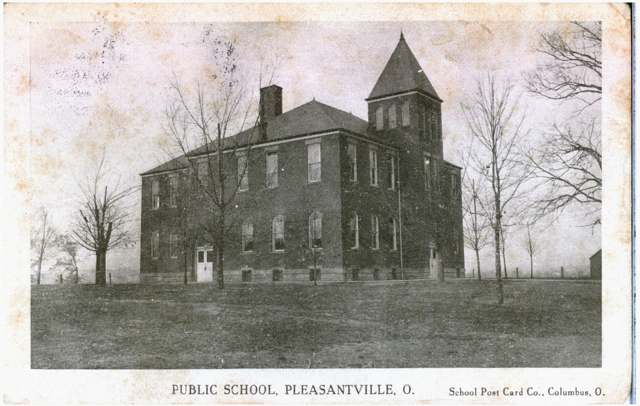
Photo: School Post Card Co., Columbus, Ohio; Columbus Metropolitan Library, via the Digital Public Library of America, public domain · Wikimedia Commons
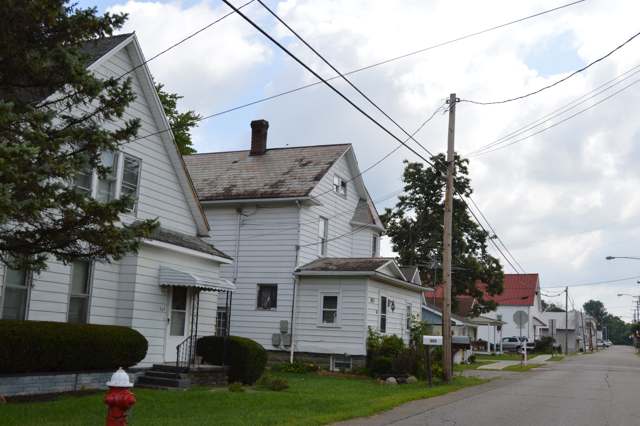
Photo: Nyttend, via Wikimedia Commons, public domain · Wikimedia Commons
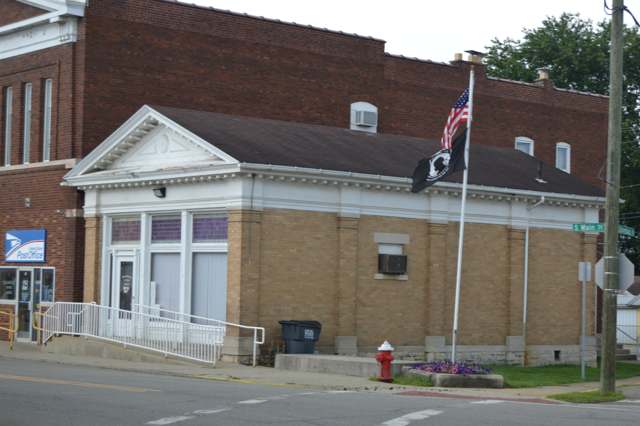
Photo: Nyttend, via Wikimedia Commons, public domain · Wikimedia Commons
Local history sources: villageofpleasantville.com · archive.org · archive.org · archive.org · en.wikipedia.org · en.wikipedia.org · commons.wikimedia.org · commons.wikimedia.org · commons.wikimedia.org
Water
Mostly private wells The water here
- Pleasantville Village100% of residentsGroundwater wells (3 wells)
Its ZIP codes
Each ZIP code that touches Pleasantville, with the share of its residents who live here and the same headline figures as the ZIP page.
| ZIP | Share | Water | Radon | Home value | Schools | Flood |
|---|---|---|---|---|---|---|
| 43148 Pleasantville | 36% | Mostly private wells | 7.0 pCi/L average radon | Median year built 1969 | Fairfield Union Local · 4 stars overall | 2.0% of residents in the 1% floodplain |
The county
Fairfield County: 13 ZIP codes, 27 cities, villages and townships, 144,692 people.
Nearby places
Cite this page
Cite this page as:
Cracked Buckeye (Open Shower Co), "Pleasantville, Fairfield County", https://crackedbuckeye.com/place/pleasantville/, built 2026-09-16, accessed [date].
Machine-readable: /api/place/pleasantville.json (open JSON, CC BY 4.0 for the compilation; the underlying records keep their own terms) · How to cite · Report a correction · Built 2026-09-16