How Orange Township, Delaware County began
Orange Township was surveyed as part of the United States Military District and settled beginning in 1807 by Joab Norton, then still counted as part of Liberty Township. Organized as a separate township on September 3, 1816 under the classical name Virgil, it was renamed Orange only six days later for reasons no source explains. Villages rose and mostly faded here -- Williamsville, platted in 1836, is a ghost town today -- except for Lewis Center, which took root with the railroad in 1850 and became the birthplace of Ohio Governor Frank B. Willis. The township today holds parts of Columbus and Westerville along with Lewis Center and the historic Gooding House and Tavern.
Settled 1807, incorporated 1816 (organized as Virgil on September 3; renamed Orange on September 9), by Joab Norton (first settler); Alpha Frisbey (petitioner for township organization).
Where the name comes from
On September 3, 1816, a petition headed by Alpha Frisbey asked that the township be set off from the surrounding survey under the name Virgil; the Commissioners' Court granted it. That 'severely classical name,' as the 1880 county history puts it, lasted just six days before a second petition changed it to the plainer Orange on September 9, 1816. No source consulted explains why Orange was chosen.
Before the town
The 1880 county history states plainly that 'there is but little to be said' of Native people in connection with Orange Township specifically: the Treaty of Greenville had pushed Native settlement north of the county line before the first settlers arrived around 1807, and no village, disagreement, or war-time incident involving Native people is recorded within the township after that date. Wyandot hunting parties continued to pass through and camp seasonally, drawn by abundant game, until as late as 1812; children of the settlers remembered watching Wyandot dances by moonlight from a safe distance. Indian trails, predating any road, ran along the line the turnpike later followed and along Alum Creek, and emigrants used these same paths to enter the township. Separately, and more substantially, Orange Township holds one of the largest unexcavated earthworks the 1880 historians knew of in the county: a roughly ten-acre enclosure on the Olentangy River bluff, on land then owned by A. J. Goodrich, just across the river from the southeast corner of Liberty Township. Formed by an earthen wall five to eight feet high in a quadrant against the river and a ravine, with gateways guarded by interior mounds, it bore 'all the marks of having been a fort' but had never been scientifically examined as of 1880; the source does not attribute it to a specific culture or period, and no more recent survey was located in this pass.
Nations recorded here: Wyandot.
- Goodrich earthwork (unnamed fort/enclosure) (earthwork) — Orange Township, on the Olentangy River bluff on the land of A. J. Goodrich, opposite the southeast corner of Liberty Township, unknown; unexcavated and unattributed to a specific culture as of 1880 (archive.org)
Timeline
- — Joab Norton, moving west from Worthington with his wife and three small children, builds the first cabin in what becomes Orange Township, in Section 2, then still reckoned part of Liberty Township.
- — Eliaphlet Ludington arrives from Connecticut and buys land in Section 3 from Dr. Delano, who had hoped to name the area Woodstock after his own Vermont hometown; William and Joseph Higgins and their family also arrive this year.
- — The township organizes on September 3 under the name Virgil; a second petition renames it Orange just six days later, on September 9.
- — John Nettleton builds the township's first mill, a sawmill in the southeast part of the township, converted to a gristmill about fifteen years later.
- — George Gooding builds a brick hotel on the Columbus-Sandusky pike, later known as the Gooding House and Tavern, which becomes the area's main stagecoach stop.
- — A Methodist settlement organizes east of Alum Creek, the earliest recorded church influence in the township.
- — Anson Williams, who bought 1,000 acres from De Wolf the year before, lays out the village of Williamsville in December.
- — A post office named Williamsville opens to serve the new village.
- — A split over slavery in the Methodist church nationally leads local antislavery members to organize the separate Wesleyan Church in Orange Township.
- — The railroad reaches the point that becomes Lewis Center, named for landowner William L. Lewis, whose wife donated land for the depot while he was away in California.
- — The Williamsville post office is renamed Orange Station.
- — Frank B. Willis, later a two-term governor of Ohio (1915-1917) and U.S. Senator, is born in Lewis Center.
- — The Orange Station post office closes.
- — A post office called Goodingdale operates near the old Gooding tavern site until 1904.
- — The Gooding House and Tavern, owned by the Gooding family for 175 years, is added to the National Register of Historic Places on July 27.
Stories
Six Days as Virgil
For less than a week in September 1816, Orange Township was called Virgil. A petition headed by settler Alpha Frisbey asked the Delaware County commissioners to set off the original military survey of Township 3, Range 18 as its own township under that classical name, and the request was granted. It did not last: a second petition, filed just six days later on September 9, asked for the plainer name Orange instead, and this one stuck. The 1880 county history calls Virgil a 'severely classical name' that the 'plain settlers' endured only briefly -- and offers no explanation at all for why Orange replaced it.
The Name Africa
East of Alum Creek, where the road narrows between hill and stream, sat a small post office the 1880 county history calls East Orange, but which everyone actually knew as Africa. The name came from an early settler, Lee Hurlbut, a good hunter with strong proslavery views who was 'passively opposed to the operations of his neighbors in forwarding runaway slaves.' Hurlbut gave the cluster of houses the name Africa specifically because of its opposite, antislavery sympathies -- intending it, it seems, as something between a jab and a label. The 1880 historian predicted the name was 'likely to endure as long as any other,' and the settlement's Underground Railroad associations are consistent with the antislavery Wesleyan Church that organized in the township in 1843.
A Village That Didn't Take
In 1835 Anson Williams bought a thousand acres from a man named De Wolf and, the following December, platted a village he was confident would soon thrive: Williamsville, complete with a hotel, a store, and a manufactory turning out grain cradles under prison-authorized patent. It never caught on. A better-established hotel and stage stop already existed a short distance north, built in brick by George Gooding in 1827, and it kept the bulk of the tavern trade. The post office at Williamsville was renamed Orange Station in 1860 and closed for good in 1879; by 1880 nothing remained of the village but a church building, built by the Methodists and by then occupied by the United Brethren. Lewis Center, platted only after the railroad arrived in 1850, succeeded where Williamsville failed and grew into the township's lasting village center -- and, in 1871, the birthplace of a future Ohio governor, Frank B. Willis.
Photographs
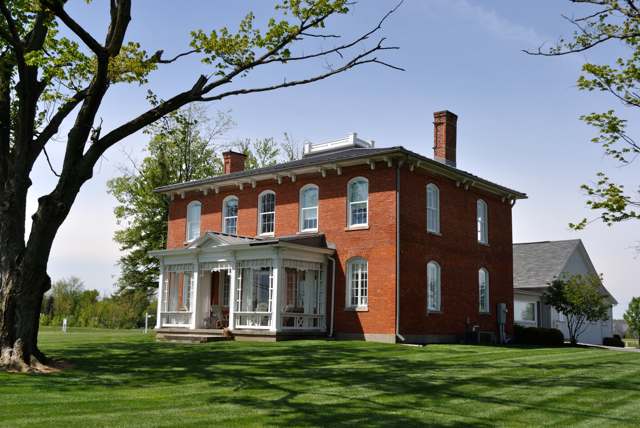
Photo: Wdzinc, via Wikimedia Commons, CC BY-SA 3.0 · Wikimedia Commons
Local history sources: archive.org · en.wikipedia.org · en.wikipedia.org · en.wikipedia.org · en.wikipedia.org · commons.wikimedia.org
Water
Del-Co's own raw-water intake on O'Shaughnessy Reservoir (Scioto River) near Rathbone, Concord Township The water here
- Del-co Water Company, Inc.77% of residentsOlentangy River, O'Shaughnessy and Alum Creek reservoirs, plus Knox County wells
- Columbus Public Water System17% of residentsScioto River (Griggs & O'Shaughnessy), Hoover Reservoir on Big Walnut Ck, plus wells
- Delaware City4% of residentsOlentangy River (blended with deep wells)
- Westerville City1% of residentsAlum Creek + wells
- Marysville City0% of residentsMill Creek via Marysville Reservoir (Raymond Rd) + wells
Its ZIP codes
Each ZIP code that touches Orange Township, Delaware County, with the share of its residents who live here and the same headline figures as the ZIP page.
The county
Delaware County: 11 ZIP codes, 26 cities, villages and townships, 214,126 people.
Nearby places
Cite this page
Cite this page as:
Cracked Buckeye (Open Shower Co), "Orange Township, Delaware County", https://crackedbuckeye.com/place/orange-township-delaware-county/, built 2026-09-16, accessed [date].
Machine-readable: /api/place/orange-township-delaware-county.json (open JSON, CC BY 4.0 for the compilation; the underlying records keep their own terms) · How to cite · Report a correction · Built 2026-09-16