How Berlin Township, Delaware County began
Berlin Township was carved out of parts of Berkshire, Delaware and Liberty Townships and organized under its present bounds on January 8, 1820, on petition of Asa Scott, who also suggested its name. Settlement began in November 1805, when George Cowgill located a mile north of the Delaware and Sunbury Pike; families from Waterbury, Connecticut and Berkshire County, Massachusetts followed, clearing land along Alum Creek and living for years alongside Native neighbors before the War of 1812 unsettled relations. Cheshire, laid out on a barren clay knoll that pioneer Jesse Hultz nicknamed 'Peth,' became the township's principal settlement and a stop on the Underground Railroad. Today Berlin Township is Delaware County's fastest-growing rural township, reaching into the northwestern edge of the city of Delaware and the Alum Creek Reservoir area.
Settled 1805, incorporated 1820-01-08, by Asa Scott, township treasurer under Berkshire Township, who petitioned the county commissioners and suggested the name.
Where the name comes from
No source consulted explains why the township took the name 'Berlin.' The 1908 county history says only that Asa Scott, the outgoing Berkshire Township treasurer, 'started the petition for the new township and suggested its present name' when the township organized in 1820; it gives no reason for the choice. This is unlike neighboring Berkshire Township, whose name for Berkshire County, Massachusetts is explicitly recorded.
Before the town
The 1880 and 1908 county histories describe Berlin's Native neighbors as recent, not ancient, history. Early settlers found Indians 'as thick as blackbirds,' generally on peaceable terms: they did not dispute the settlers' right to hunt and fish, though they felt entitled to a share of the corn and vegetables grown in the new gardens. In 1809 an Indian who had committed 'some depredation' on George Cowgill's family was seized by the settlers and taken prisoner to Berkshire; his own band visited the next morning with faces painted red for peace, then returned that afternoon painted black for war, telling the settlers, 'Kill him, we nothing say, but no keep him to torture.' The settlers released him on condition he never return, and he was not seen again. Two Indians named Joe and George Bigtree were 'familiarly known in the Berlin settlement' and, during the War of 1812, visited with faces painted red to signal peaceful intent. Jonathan Thompson's Indian neighbors camped near his cabin, shared venison when they killed a deer, and, asked why they did not hunt on Sundays, answered, 'No good Indian hunt Sunday; the Great Spirit see.' No source consulted names the nation any of these individuals belonged to, or identifies a village, mound or trail sited within the township's own boundaries. The land was opened to settlement by the 1795 Treaty of Greenville, in which the Wyandot, Shawnee, Lenape (Delaware), Miami, Ottawa and other nations ceded most of Ohio to the United States, and was surveyed and distributed as United States Military District bounty-land. For the county's documented Native villages, trails and burials, including sites recorded in neighboring Kingston Township, see the county file.
Nations recorded here: Wyandot, Shawnee, Lenape (Delaware), Miami, Ottawa.
Timeline
- — The Treaty of Greenville cedes most of what becomes Ohio, including the future Berlin Township, to the United States.
- — George Cowgill locates about a mile north of the Delaware and Sunbury Pike in November, becoming the township's first permanent settler.
- — Joseph Constant Lewis, son of David Lewis Jr., is born on September 29 on the west side of Alum Creek, the first white child born in the township.
- — An Indian accused of a 'depredation' on George Cowgill's family is briefly taken prisoner to Berkshire and then released after his band's mixed threats and appeals for mercy; he is not seen in the settlement again.
- — Amid War of 1812 fears of British-incited Indian attacks, settlers build a two-story, forty-foot-square hewn-log blockhouse on the west bank of Alum Creek near Cheshire; a night alarm sends families rushing to it after gunfire is heard near Scott's and Aye's cabins, though no attack follows.
- — Berlin Township organizes in its present form on January 8, combining the first and fourth sections of Berkshire, the second section of Delaware and the third section of Liberty Township.
- — Cheshire receives its first post office on August 10, with storekeeper L. R. Ryant as postmaster.
- — The Nettleton Grove Bank Cemetery Association organizes on October 10 and lays out a cemetery south of Cheshire.
Stories
Bear Tracks, Not Indians
During the War of 1812, Berlin Township's settlers lived under constant apprehension that the British would turn the Northwest's Native population against isolated frontier cabins. A party clearing land for a new arrival worked with rifles leaning against nearby trees while David Lewis Sr. stood scout, under an agreed code: if he spotted danger, he was to report 'bears' rather than alarm the group outright. When he returned that afternoon warning of fresh 'bear tracks,' the men understood at once and quietly armed themselves, sending the children home and shepherding nearby families into the newly built blockhouse by nightfall. That night, David Lewis Jr. and Philo Hoadley crept out to scout the crossing near the fort and spotted two figures vaulting a brush fence in a cornfield; Lewis fired, dropped one, and both men sprang for the blockhouse under a burst of return fire, Lewis sprawling over a stump along the way. By morning no bodies or further sign could be found beyond moccasin tracks and blood in the cornfield — leaving the identity and fate of the intruders 'the subject of considerable conjecture' that was never resolved.
A Neighborly Peace
For years before the War of 1812 curdled relations, Berlin's settlers and their Native neighbors shared the same creek bottoms on ordinary, even friendly, terms. Jonathan Thompson's cabin on the Constant tract stood near a camp whose occupants sent him venison when they killed a deer and helped him at odd tasks; when he noticed they never hunted on Sundays, they told him, 'No good Indian hunt Sunday; the Great Spirit see.' Visits to the sugar camps in maple season were a favorite pastime for both sides, and wrestling was the usual entertainment offered a guest — a hold the settlers called 'Indian hug' that old man Lewis, past his prime but still vigorous, once used to throw a young brave who had bantered several other men into refusing the match first. Two men named Joe and George Bigtree were well enough known in the settlement to be named individually in the record, and during the tense years of the War of 1812 they took care to visit with their faces painted red — the recognized sign of peaceful intent.
The Village Called Peth
Cheshire grew up on a barren clay knoll on Samuel Adams's farm, and pioneer Jesse Hultz supplied its unofficial nickname: he called it 'Peth,' explaining that 'what don't run away will starve to death.' L. R. Ryant kept the first store in a room seven feet by nine, later adding a second room to sell ready-made and made-to-order shoes, and became the settlement's first postmaster in 1851. From its earliest years the township held a strong pro-slavery sentiment in the surrounding countryside, which makes the other current running through Cheshire notable: the Underground Railroad passed through the village, and freedom seekers could only be moved under cover of night from Orange Township along Alum Creek to a Quaker settlement, and from there on to Oberlin or another outlet.
Photographs
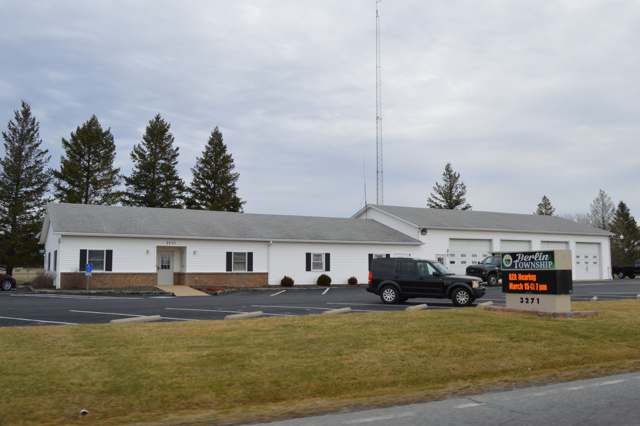
Photo: Nyttend, public domain · Wikimedia Commons
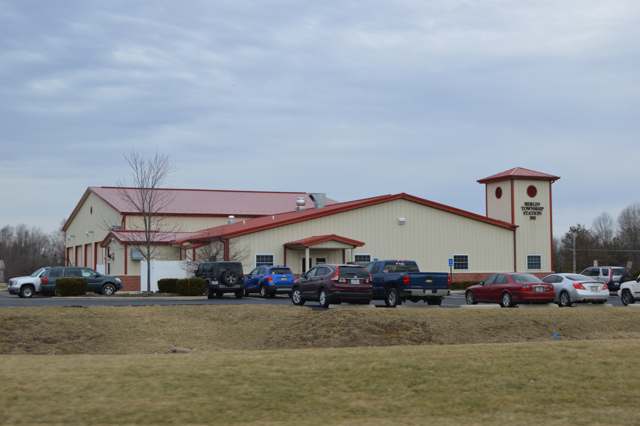
Photo: Nyttend, public domain · Wikimedia Commons
Local history sources: ohiogenealogyexpress.com · archive.org · en.wikipedia.org · en.wikipedia.org · en.wikipedia.org · commons.wikimedia.org · commons.wikimedia.org
Water
Alum Creek Reservoir intake at the Scott plant, Lewis Center Rd at Africa, Orange Township The water here
- Del-co Water Company, Inc.80% of residentsOlentangy River, O'Shaughnessy and Alum Creek reservoirs, plus Knox County wells
- Delaware City14% of residentsOlentangy River (blended with deep wells)
- Columbus Public Water System6% of residentsScioto River (Griggs & O'Shaughnessy), Hoover Reservoir on Big Walnut Ck, plus wells
- Marysville City0% of residentsMill Creek via Marysville Reservoir (Raymond Rd) + wells
Its ZIP codes
Each ZIP code that touches Berlin Township, Delaware County, with the share of its residents who live here and the same headline figures as the ZIP page.
The county
Delaware County: 11 ZIP codes, 26 cities, villages and townships, 214,126 people.
Nearby places
Cite this page
Cite this page as:
Cracked Buckeye (Open Shower Co), "Berlin Township, Delaware County", https://crackedbuckeye.com/place/berlin-township-delaware-county/, built 2026-09-16, accessed [date].
Machine-readable: /api/place/berlin-township-delaware-county.json (open JSON, CC BY 4.0 for the compilation; the underlying records keep their own terms) · How to cite · Report a correction · Built 2026-09-16