How Powell began
Powell began as a small settlement on land deeded to Thomas R. Hall around 1801, in the same wave of settlement that brought Nathan Carpenter to nearby Liberty Township. Known first as Middlebury and then, after Hall expanded his holdings and opened a store, as Hall's Corner, it took its permanent name in 1857 to honor Judge Thomas Watkins Powell of Delaware, who helped the settlement secure its own post office. A coal-hauling railroad reached the village in the 1870s, but Powell stayed small -- fewer than 400 people as late as the 1980s -- until it incorporated as a city in 2000 and grew rapidly into a Columbus-area suburb of more than 14,000.
Settled 1801, platted 1876 (as Powell and the adjoining Hyattsville), incorporated 1947 (village); 2000 (city), by Thomas R. Hall (original landholder).
Where the name comes from
The settlement was known first as Middlebury by 1813, likely for settlers who had come from Middlebury, Connecticut, then as Hall's Corner after 1850, when landowner Thomas R. Hall opened a general store at the crossroads that is now historic downtown Powell. In 1857 the community applied for its own post office, a request that needed the support of someone with standing; Judge Thomas Watkins Powell of Delaware provided that help, and in gratitude the village took his name.
Before the town
No source consulted names a specific Native village, mound, or trail located within the small area that became the village and later city of Powell itself. Powell sits within Liberty Township, whose 1880 county history records Wyandot, Seneca, Lenape (Delaware), Shawnee and Ottawa people camping and hunting through the wider area -- including a Wyandot camp remembered as belonging to 'Leather-lips' at Otter Spring on the Scioto -- and mounds on nearby farms; see the Liberty Township file for that detail and the county file for the fuller regional record of nations, treaties and removal.
Nations recorded here: Wyandot, Seneca (of Sandusky), Lenape (Delaware), Shawnee, Ottawa.
Timeline
- — Settlers arrive on land deeded to Thomas R. Hall, the beginning of the settlement that becomes Powell.
- — The settlement is known as Middlebury, likely named for settlers from Middlebury, Connecticut.
- — Thomas R. Hall opens a general store at the crossroads now known as historic downtown Powell; the settlement becomes known as Hall's Corner.
- — The village is renamed Powell to honor Judge Thomas Watkins Powell of Delaware, who helped secure its post office.
- — The Columbus and Toledo Railroad reaches the area, built to carry Appalachian coal north past Columbus.
- — The towns of Powell and the adjoining Hyattsville are formally platted.
- — The Martin-Perry House is built on Olentangy Street; it later becomes the headquarters and a rural-life museum of the Powell Liberty Historical Society.
- — The Columbus and Toledo Railroad merges with other lines to become part of the Hocking Valley Railway.
- — Powell incorporates as a municipality.
- — Liberty Township establishes a volunteer fire department, based at the Powell school.
- — Residents form the Powell Liberty Historical Society.
- — Powell reaches city status as its population passes 6,000, up from around 378 in the late 1980s.
- — The city's population reaches 14,163.
Stories
Three Names Before Powell
The settlement that became Powell wore three names before its present one stuck. Around 1813 it was Middlebury, likely for settlers from Middlebury, Connecticut. By 1850, after landowner Thomas R. Hall bought more property and opened a general store at the crossroads, people simply called it Hall's Corner. The final change came in 1857, and for a very practical reason: the village wanted its own post office, which required a sponsor with some standing to see the application through. That sponsor was Judge Thomas Watkins Powell of Delaware, and when the post office was approved, the village renamed itself in his honor rather than Hall's.
A Small Village for a Very Long Time
For most of its history Powell stayed exactly what its 1876 plat suggested: a small crossroads village. A coal-hauling railroad reached it in the 1870s and later became part of the Hocking Valley Railway, and the Martin-Perry House, built in 1889, is typical of the two-story homes that lined its streets. Powell did not even incorporate as a municipality until 1947, and as late as the 1980s it counted fewer than 400 residents. The change, when it came, was dramatic: by 2000 the population had passed 6,000 and Powell became a city, and by 2020 it had reached 14,163 -- a nearly 40-fold increase in three and a half decades, driven by Columbus's northward suburban growth.
Photographs
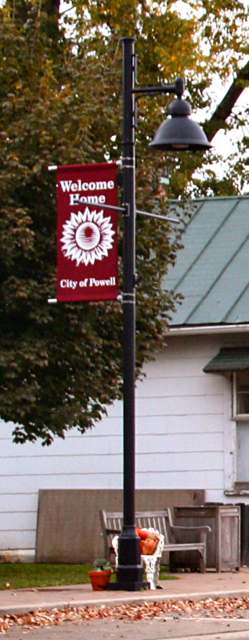
Photo: Tysto (Derek Jensen), public domain · Wikimedia Commons
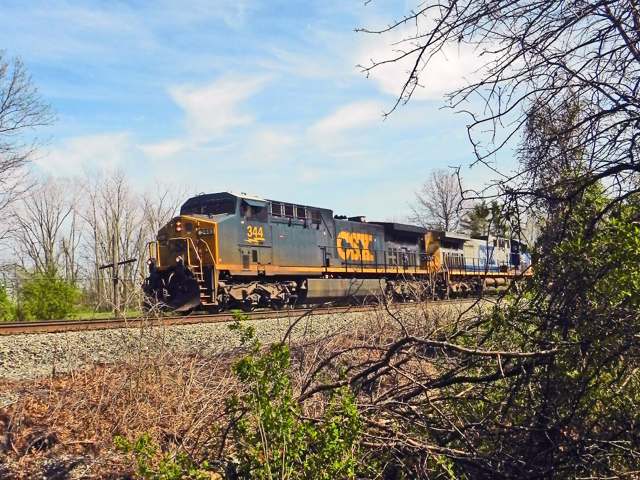
Photo: Tristantech, via Wikimedia Commons, CC BY-SA 3.0 · Wikimedia Commons
Local history sources: en.wikipedia.org · powellhistory.org · archive.org · commons.wikimedia.org · commons.wikimedia.org
Water
Del-Co's own raw-water intake on O'Shaughnessy Reservoir (Scioto River) near Rathbone, Concord Township The water here
- Del-co Water Company, Inc.84% of residentsOlentangy River, O'Shaughnessy and Alum Creek reservoirs, plus Knox County wells
- Columbus Public Water System16% of residentsScioto River (Griggs & O'Shaughnessy), Hoover Reservoir on Big Walnut Ck, plus wells
Its ZIP codes
Each ZIP code that touches Powell, with the share of its residents who live here and the same headline figures as the ZIP page.
| ZIP | Share | Water | Radon | Home value | Schools | Flood |
|---|---|---|---|---|---|---|
| 43065 Powell | 32% | Del-Co's own raw-water intake on O'Shaughnessy Reservoir (Scioto River) near Rathbone, Concord Township | 6.2 pCi/L average radon | Parcel list only | Olentangy Local · 5 stars overall | 0.3% of residents in the 1% floodplain |
The county
Delaware County: 11 ZIP codes, 26 cities, villages and townships, 214,126 people.
Nearby places
Cite this page
Cite this page as:
Cracked Buckeye (Open Shower Co), "Powell, Delaware County", https://crackedbuckeye.com/place/powell/, built 2026-09-16, accessed [date].
Machine-readable: /api/place/powell.json (open JSON, CC BY 4.0 for the compilation; the underlying records keep their own terms) · How to cite · Report a correction · Built 2026-09-16