How Liberty Township, Fairfield County began
Liberty Township, in the northern tier of Fairfield County, takes its name from Swiss immigrants who settled it before 1806 and wanted, in the words of the 1883 county history, to perpetuate in Ohio the freedom denied them in Europe. The Ohio and Erie Canal crossed its southwest corner and gave rise to twin villages a mile apart: Baltimore, laid out in 1824 by a settler from Virginia, and Basil, laid out in 1825 by Swiss and German settlers, whose rivalry -- rooted, residents said, in old-country quarrels between Germans and Swiss -- lasted more than a century. The two towns merged into one village on January 1, 1946, and then fought a nationally publicized battle over what to call the result, seriously considering the name 'Baseball, Ohio' before a judge ruled the signatures for it fell short and the village stayed Baltimore. The canal-era locks, warehouses and paper mills that once made Baltimore a shipping point are today recognized as part of the Ohio and Erie Canal Southern Descent Historic District.
Settled before 1806 (Nicholas Bader, Joseph Alt and Jacob Showley, Swiss settlers); David Brumback by 1803, incorporated township organized by the Swiss settlers' request; Baltimore incorporated February 19, 1833, Basil in 1905, the two merged into one village January 1, 1946.
Where the name comes from
The 1883 and 1912 county histories agree that Liberty Township was named at the request of its first settlers, emigrants from Switzerland who 'had emigrated from a land where their liberties had been much restricted' and wished, in settling Ohio, to perpetuate their new freedom -- hence Liberty.
Before the town
The 1883 county history records that 'various bands of Delaware, Wyandotte and other tribes of Indians, wandered about this and other townships, for several years after the first white settlements commenced,' and that the site of the present village of Basil is said to have been one of their meeting places, where white and Native boys and men wrestled, jumped and ran foot races together. The Indians in the area planted small corn patches, made maple sugar, and traded furs and peltry to settlers for flour, salt, lead and powder, and especially for whiskey. During the War of 1812 settlers in Liberty Township were repeatedly alarmed by reports of hostile Indians, and the township's fighting men would rendezvous at Lancaster until each scare subsided. No source consulted names a specific village, camp or mound within Liberty Township itself, and the whole area had already been ceded at the 1795 Treaty of Greenville by the time these bands were recorded passing through.
Nations recorded here: Lenape (Delaware), Wyandot.
- Basil meeting ground (camp) — site of the village of Basil, Liberty Township, early 1800s, before removal (archive.org)
Timeline
- — The Treaty of Greenville cedes most of Ohio, including the future Liberty Township, to the United States.
- — David Brumback settles in the southeastern part of the township, among its first arrivals.
- — Christian Gundy and family, Swiss emigrants by way of Lancaster County, Pennsylvania, settle on Walnut Creek in the southern part of the township.
- — Henry Hildebrand, a Virginian, lays out the village of New Market, later renamed Baltimore.
- — Jacob Goss lays out the village of Basil three-quarters of a mile west of Baltimore; the name is chosen over 'Geneva' by a one-vote margin cast by Sebastian Leonard.
- — The Ohio and Erie Canal is completed past Baltimore, opening the village to grain shipping.
- — Baltimore is incorporated by act of the Ohio legislature, February 19.
- — A post office is established at Basil after a petition to Washington; mail had previously been carried between Basil and Baltimore by a boy and, briefly, by a mail-carrying Newfoundland dog.
- — The Fairfield Paper Company builds a straw-paper mill at Baltimore, later converted to a wood-pulp and, by 1910, a corrugated-box factory.
- — Basil is incorporated as a village.
- — Basil and Baltimore merge into a single village, effective January 1, after a 1945 vote initiated by Basil's mayor.
- — Judge Earl D. Parker of Waverly, Ohio, rules on the merged village's name, November 12; a petition to call it 'Baseball, Ohio' falls short of the signatures required, and the name Baltimore stands.
- — The Ohio and Erie Canal Southern Descent Historic District, including canal-era resources at Baltimore, is listed on the National Register of Historic Places.
Stories
Baseball, Ohio
By 1945 the rival canal towns of Basil and Baltimore, a mile apart and increasingly redundant, agreed to merge -- but not on what to call themselves. Basil's mayor, Roy D. Orahood, pushed the annexation through over Baltimore's objections, and the combined village took effect January 1, 1946, leaving the harder question unresolved. In 1947 Bob Hooey, sports editor of the Ohio State Journal, proposed a solution: take the old Swiss spelling of Basil's name, Basel, and fuse it with Baltimore's own into 'Baseball, Ohio,' a novelty name on the model of Santa Claus, Indiana. The idea drew national attention and real institutional backing -- George Trautman, president of the National Association of Professional Baseball Leagues, and Warren Giles, president of the Cincinnati Baseball Club, both supported it, and Giles offered free Reds tickets if the vote passed. Residents collected 626 signatures, but Judge Earl D. Parker, brought in from Waverly to arbitrate, ruled that more than three-fourths of the population had to sign, and the petition fell short by nearly 200 names. On November 12, 1947, the merged village kept the name Baltimore, though Basil survives today in Basil Western Road, Basil Park and the Basil Joint Fire District.
The Dry Dock
For thirty years after the Ohio Canal's completion in 1829, one of Baltimore's more interesting businesses was not a store or a mill but a shipyard. James Thorn built the town's first Dry Dock in the early 1840s, launching the boat Truro as its first construction; by the account of one old employee, it was considered the best dry dock between Cleveland and Portsmouth, and in winter as many as fifty canal boats at a time would lie up there for painting and repair. Ownership passed from Thorn to a Mr. Beaty, then to J. W. Whitely, who ran it until about 1870, then to Samuel Rader and finally to R. C. Soliday, who still held it when the last boat ever passed through Baltimore's locks. From 1840 to 1875 the town's five grain warehouses did a brisk trade alongside the dock, wagons of wheat sometimes backed up for a quarter mile in every direction at sunrise, waiting to unload onto boats bound for Cleveland.
The Dog That Chased a Rabbit
Until 1857, Basil had no post office of its own, and residents got their mail at Baltimore. About 1850 the merchant Henry Leonard, known locally as 'the Fisherman,' paid a boy named Samuel Schaub to carry a mail pouch on foot between the two towns. After a couple of years Leonard decided to improve on the arrangement and fitted a large Newfoundland dog with saddlebags, intending the animal to learn the route and eventually run it alone. The training went well until, on the road near the canal, a rabbit crossed the dog's path; the dog gave chase, lost the rabbit at the water's edge, swam across after it, and swam back again empty-handed, leaving the mail thoroughly ruined. The enterprise was abandoned and the boy went back to carrying the pouch himself, at least until 1857, when a petition secured Basil its own post office, placed in Leonard's store with George Messerly as postmaster.
Photographs
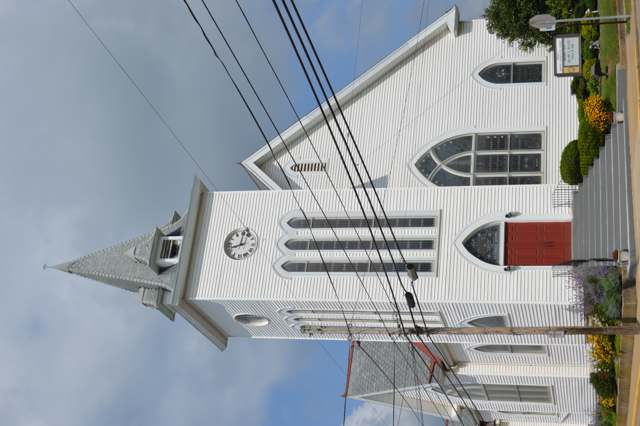
Photo: Nyttend, via Wikimedia Commons, public domain · Wikimedia Commons
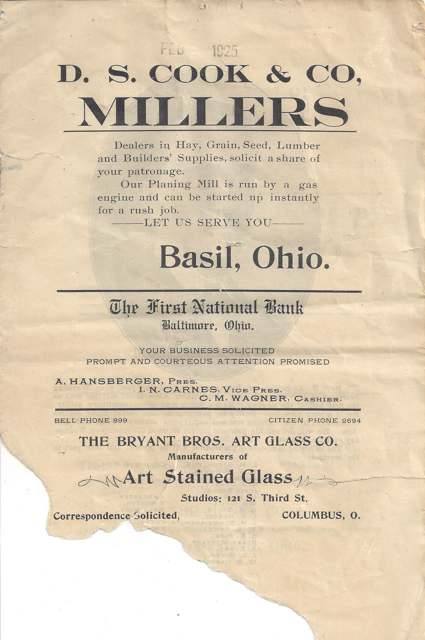
Photo: unknown publisher, February 1925, public domain · Wikimedia Commons
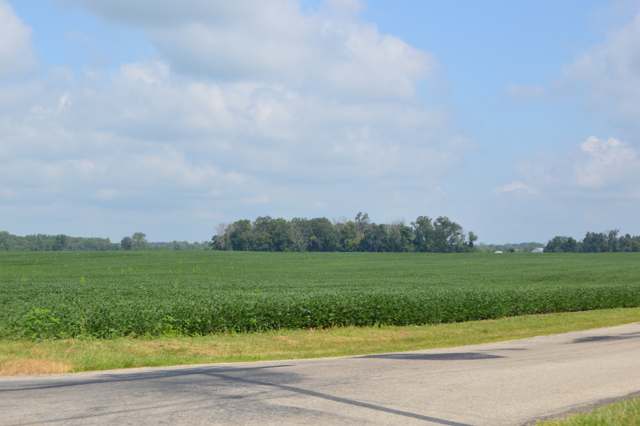
Photo: Nyttend, via Wikimedia Commons, public domain · Wikimedia Commons
Local history sources: archive.org · archive.org · en.wikipedia.org · en.wikipedia.org · en.wikipedia.org · en.wikipedia.org · en.wikipedia.org · baltimoreohio.org · baltimorehistory.org · buckeyelakebeacon.net · commons.wikimedia.org · commons.wikimedia.org · commons.wikimedia.org
Water
Mostly private wells The water here
- Baltimore Village72% of residentsGroundwater wells (3 wells)
- Pickerington City9% of residentslocal buried-valley aquifer (wells near Diley Road)
- Fairfield County Utilities8% of residentsLocal groundwater wells (central Ohio, aquifer undocumented)
- Licking Regional Water District4% of residentsRaccoon Creek Valley aquifer (local wells)
- Millersport Village2% of residentsGroundwater wells (4 wells)
- Columbus Public Water System2% of residentsScioto River (Griggs & O'Shaughnessy), Hoover Reservoir on Big Walnut Ck, plus wells
- Pataskala City1% of residentsSouth Fork Licking River Buried Valley Aquifer
- Carroll Village1% of residentsGroundwater wells (2 wells)
- Little Walnut Water Treatment Facility0% of residentsGroundwater wells (2 wells)
- Buckeye Lake, Village Of0% of residentsGroundwater wells (4 wells)
Its ZIP codes
Each ZIP code that touches Liberty Township, Fairfield County, with the share of its residents who live here and the same headline figures as the ZIP page.
The county
Fairfield County: 13 ZIP codes, 27 cities, villages and townships, 144,692 people.
Nearby places
Cite this page
Cite this page as:
Cracked Buckeye (Open Shower Co), "Liberty Township, Fairfield County", https://crackedbuckeye.com/place/liberty-township-fairfield-county/, built 2026-09-16, accessed [date].
Machine-readable: /api/place/liberty-township-fairfield-county.json (open JSON, CC BY 4.0 for the compilation; the underlying records keep their own terms) · How to cite · Report a correction · Built 2026-09-16