How Blendon Township, Franklin County began
Blendon Township was settled in 1806 by the families of Edward Phelps and Isaac Griswold, with Ethan Palmer, New Englanders who walked and rode two months from Windsor, Connecticut. Organized as Harrison Township in 1815, it was renamed Blendon in 1824 for reasons no source explains. Its principal town, Westerville, grew up around what became Otterbein University, founded in 1847 when the Church of the United Brethren in Christ took over a struggling Methodist seminary, and around the Hanby family, whose son Benjamin composed abolitionist songs and Christmas standards from a house still standing on Main Street. Westerville later earned fame as the 'dry capital of the world' when the national Anti-Saloon League moved its headquarters there in 1909, and it became a water-history pioneer in its own right, opening Ohio's first fluoridated municipal water supply in 1951. Today the township is a patchwork of unincorporated land largely surrounded by Westerville and Columbus.
Settled 1806, incorporated 1815 (organized as Harrison Township; renamed Blendon Township in 1824), by Edward Phelps and Isaac Griswold families, with Ethan Palmer, all of Windsor, Hartford County, Connecticut.
Where the name comes from
The 1880 county history records only that the township was 'originally organized in 1815, by the name of Harrison' (after an earlier Harrison Township whose territory had been transferred to Pickaway County in 1810), and that 'the name of the township was changed to Blendon on the 8th of December, 1824, by order of the county commissioners.' No source found explains why the commissioners chose the name Blendon specifically.
Before the town
No dedicated discussion of Native people or sites in Blendon Township was found; the township's chapter in the 1880 county history, unlike some neighboring townships' chapters, has no separate section on the subject. One detail survives in passing: describing the site of the township's first mill on Big Walnut Creek near Central College, about 1814, the historian notes 'the stream was then known as the Gahanna, or Big Belly, the latter being the name of an Indian well known in the country' -- an early, place-specific record of a Native name for the creek that the city of Gahanna, downstream, still carries. Wikipedia's article on the township separately names a 'Jackson Fort' as a prehistoric site within Blendon Township, but no further detail on its builders, date, or exact location was found in the sources checked, so nothing further can be said about it here. This land lay south and east of the Greenville Treaty Line and so was ceded to the United States by the 1795 Treaty of Greenville, eleven years before the Phelps and Griswold families arrived. Broader county-level context will be in the Franklin County file.
- Big Walnut Creek (recorded as 'Gahanna, or Big Belly' before c. 1814) (other) — Big Walnut Creek near Central College, Blendon Township, named before Euro-American settlement; recorded in local memory as of about 1814 (archive.org)
- Jackson Fort (other) — within Blendon Township, Franklin County (exact location not independently verified), unknown (en.wikipedia.org)
Timeline
- — The Treaty of Greenville cedes this part of Ohio, lying south and east of the treaty line, to the United States.
- — The families of Edward Phelps and Isaac Griswold, with Ethan Palmer, arrive from Windsor, Connecticut, after a two-month journey begun June 24 and finished August 24, becoming the township's first settlers.
- — Benjamin Moore, son of Simeon and Roxanna Moore, is born in the Phelps cabin, the first child born in the township.
- — Squire Timothy Lee builds the township's first saw- and grist-mill, near the future Central College on Big Walnut Creek, then locally known as the Gahanna or Big Belly.
- — On petition of Elisha Bidwell, John Matoon, John Cooper, and others, the township is organized on March 6 under the name Harrison; the first election is held that April at the house of Conger Wright.
- — The township's first church, a Presbyterian congregation called Lebanon Church after Lebanon, Virginia, is organized with 15 members, the fruit of missionary work begun in 1818 by Rev. Ebenezer Washburn.
- — On December 8, the county commissioners rename Harrison Township as Blendon Township.
- — In July, Matthew Westervelt lays out the village of Westerville, per the 1880 county history (Wikipedia instead describes gradual settlement from about 1818 and platting 'by 1856'; both accounts agree the village incorporated in 1858).
- — The Methodist Episcopal Blendon Young Men's Seminary is transferred to the Church of the United Brethren in Christ; its trustees meet for the first time on April 26, 1847, and the school is reorganized as Otterbein University.
- — The house on Main Street in Westerville later known as the Hanby House is built; the Hanby family moves to Westerville in 1849 so son Benjamin can attend Otterbein.
- — Benjamin Hanby composes the antislavery ballad 'Darling Nelly Gray.'
- — Westerville is incorporated as a village on July 19, after a petition signed by 87 residents; John Haywood is elected its first mayor that October.
- — The national Anti-Saloon League moves its headquarters to Westerville, which becomes known as the 'dry capital of the world.'
- — Westerville opens its first Alum Creek water treatment plant, ending the city's reliance on well water for its drinking supply.
- — Westerville becomes the first community in Ohio to fluoridate its drinking water.
Stories
New Englanders break ground on Alum Creek
In June 1806, the families of Edward Phelps and Isaac Griswold, joined by Ethan Palmer, set out from Windsor in Hartford County, Connecticut, for a stretch of Ohio wilderness neither had seen except on a brief scouting trip the year before. Two months and three hundred-some miles later, on August 24, they reached the site, camped on high ground east of Alum Creek, and began clearing land: the Phelps family, with more sons to swing an axe, cleared about seven acres that first season, the Griswolds about half as much. Isaac Griswold built the township's first cabin; Edward Phelps built the second a few days later. The first wheat went into the ground that same summer, and in 1808 Phelps planted an orchard with trees carried on horseback from Granville, some of which were still standing, a local landmark, when the county history was written in 1880.
From Harrison to Blendon
The township took its first name, Harrison, on March 6, 1815, when the county commissioners granted a petition from Elisha Bidwell, John Matoon, John Cooper, and other settlers to organize 'the second township in the seventeenth range of the United States military district.' The name recycled one already vacated: an earlier Harrison Township's territory had been handed to the new Pickaway County in 1810. The first township election that April chose Robert McCutcheon as clerk and set a tax, that December, of twenty-five cents per stud horse and six and a quarter cents per head of cattle, raising fourteen dollars and twelve and a half cents for the year's expenses. On December 8, 1824, the commissioners renamed the township Blendon, a name the surviving township records do not explain.
A failing seminary becomes a university
Otterbein University began as the Blendon Young Men's Seminary, a Methodist Episcopal school in Westerville that, by 1846, its own trustees wanted to be rid of. Meeting that year, Westerville residents voted to offer the property instead to the Church of the United Brethren in Christ, whose Scioto Conference took up the question that October at Bethlehem church in Pickaway County and voted to buy it. The new trustees met for the first time on April 26, 1847, the university's effective birthday, and renamed the school for Philip William Otterbein, the church's founder. The early years were lean: the 1880 county history recalls trustees meeting 'when debts were pressing them, without knowing which way to turn,' with most of the church itself skeptical of or openly hostile to the project. It survived anyway, and Otterbein remains Westerville's defining institution.
Benjamin Hanby's songs
Benjamin Hanby moved to Westerville with his family in 1849, at sixteen, to study at the young Otterbein University; his father, William Hanby, was a bishop of the United Brethren church and, like his son, an abolitionist. In 1856, moved by the story of a formerly enslaved man named Joseph Selby who had died at a Hanby family home, Benjamin wrote 'Darling Nelly Gray,' an antislavery ballad that became one of the best-known songs of its kind before the Civil War; he went on to write roughly eighty songs in a short life, including the Christmas favorite published in 1864 as 'Santa Claus' and known today as 'Up on the Housetop.' The house on West Main Street in Westerville associated with the family, built in 1853, was added to the National Register of Historic Places in 1970 and has operated as a museum, run by the Westerville Historical Society, since 1937.
The dry capital of the world
Westerville banned alcohol sales by town ordinance as early as 1859, decades before Prohibition, and the reputation stuck. In 1909 the Anti-Saloon League, the country's leading temperance organization, moved its national headquarters and printing operation to the small Otterbein University town, mailing out so much literature, more than forty tons a month at its peak, that Westerville needed a first-class post office despite being one of the smallest towns in the nation to have one. The same civic seriousness showed up in the town's water system: Westerville opened its first Alum Creek treatment plant in 1924, ending its dependence on private wells, and in 1951 became the first community in Ohio to add fluoride to its public water supply, a public-health milestone the Westerville Public Library and History Museum marked with an exhibit on the plant's centennial in 2024.
Photographs
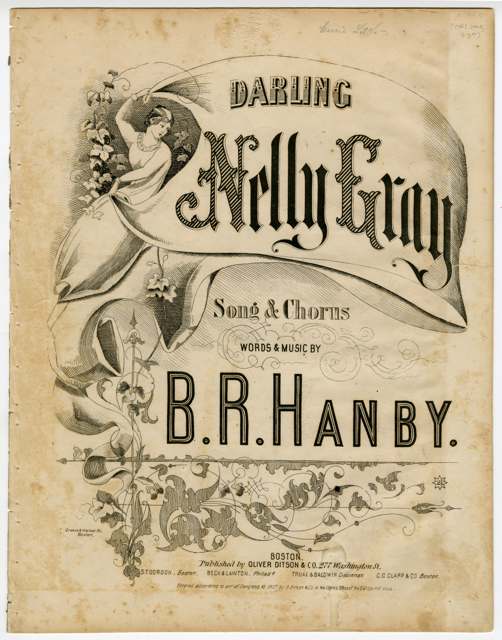
Photo: Ohio History Connection, public domain · Wikimedia Commons
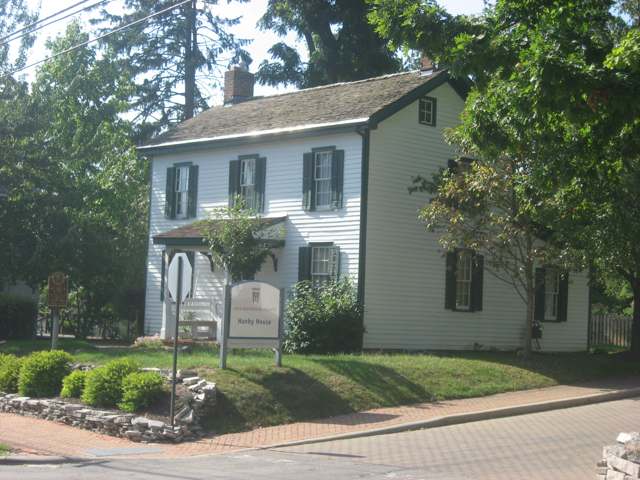
Photo: Nyttend, public domain · Wikimedia Commons
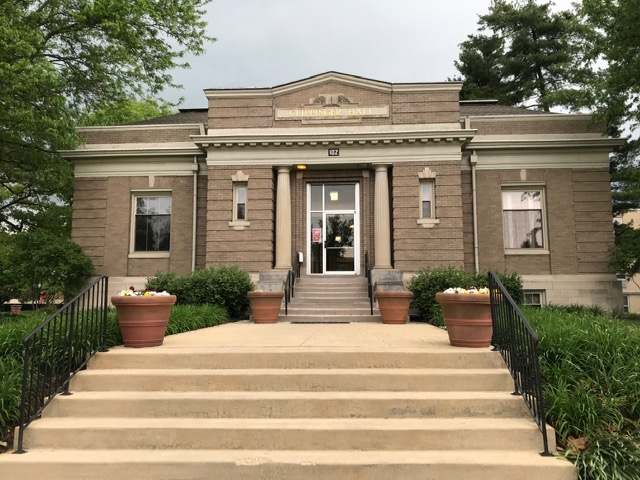
Photo: Mackinacbreezer, CC BY-SA 4.0 · Wikimedia Commons
Local history sources: archive.org · en.wikipedia.org · en.wikipedia.org · en.wikipedia.org · en.wikipedia.org · commons.wikimedia.org · commons.wikimedia.org · commons.wikimedia.org · commons.wikimedia.org
Water
Alum Creek, drawn just north of Main Street at the treatment plant, supplemented by 3 active groundwater wells The water here
- Columbus Public Water System45% of residentsScioto River (Griggs & O'Shaughnessy), Hoover Reservoir on Big Walnut Ck, plus wells
- Westerville City44% of residentsAlum Creek + wells
- Aqua Ohio - Huber Ridge10% of residentsGroundwater wells (7 wells)
- Del-co Water Company, Inc.1% of residentsOlentangy River, O'Shaughnessy and Alum Creek reservoirs, plus Knox County wells
Its ZIP codes
Each ZIP code that touches Blendon Township, Franklin County, with the share of its residents who live here and the same headline figures as the ZIP page.
| ZIP | Share | Water | Radon | Home value | Schools | Flood |
|---|---|---|---|---|---|---|
| 43081 Westerville | 11% | Alum Creek, drawn just north of Main Street at the treatment plant, supplemented by 3 active groundwater wells | 5.4 pCi/L average radon | Median year built 1986 | Westerville City · 3.5 stars overall | 1.5% of residents in the 1% floodplain |
| 43231 Columbus | 2% | Big Walnut Creek at the plant's low-head dam and screen house on Morse Rd, below Hoover Dam | 5.1 pCi/L average radon | Median year built 1980 | Westerville City · 3.5 stars overall | 2.3% of residents in the 1% floodplain |
The county
Franklin County: 45 ZIP codes, 42 cities, villages and townships, 1,356,733 people.
Nearby places
Cite this page
Cite this page as:
Cracked Buckeye (Open Shower Co), "Blendon Township, Franklin County", https://crackedbuckeye.com/place/blendon-township-franklin-county/, built 2026-09-16, accessed [date].
Machine-readable: /api/place/blendon-township-franklin-county.json (open JSON, CC BY 4.0 for the compilation; the underlying records keep their own terms) · How to cite · Report a correction · Built 2026-09-16