How Franklin Township, Licking County began
Franklin Township was surveyed entirely as United States Military District land, set aside under an act of Congress of June 1, 1796 to pay Revolutionary War officers and soldiers, and its first settlers, George Ernst and brothers John and Jacob Switzer, arrived in the spring of 1805. Settlers organized and named the township in 1812, for Benjamin Franklin. It has never held a real village beyond tiny Amsterdam, laid out on the National Road about 1830, and the 1881 county history holds it up as a model of quiet, church-going, almost defiantly unremarkable farm life. Today it sits in the county's southeast corner, bordering the city of Heath, still without a municipality of its own.
Settled spring 1805 (George Ernst; John and Jacob Switzer), incorporated 1812 (township organized and named), by George Ernst and John and Jacob Switzer, first settlers; organized by the township's settlers in 1812.
Where the name comes from
No source consulted explains why the township chose this name beyond the 1881 county history's own statement: it was 'organized and named, in honor of the great American philosopher, Benjamin Franklin,' in 1812, the year Isaiah Hoskinson, sr. and Moses Sutton, sr. were elected its first justices of the peace. Franklin is one of many Ohio townships named for him in this period.
Before the town
The 1881 county history's Franklin Township chapter is direct: 'There is very little, if any, reliable Indian history in any way identified with the territory embraced within Franklin township.' The land was surveyed under the act of June 1, 1796 as part of the United States Military District, set aside for Revolutionary War veterans; some of the surveyors sent out under that authority, including Elias Hughes and John Stadden, were among Licking County's earliest white residents. This tract had been opened to settlement by the Treaty of Greenville, signed August 3, 1795, in which the Wyandot, Shawnee, Lenape (Delaware), Miami, Ottawa and other nations ceded most of what is now Ohio to the United States. What the township does hold, in unusual abundance, are the works of the earlier Mound Builder culture: an eight-acre circular earthwork with three internal mounds on a high hill north of Amsterdam, the 75-foot 'Tippett mound' east of the Newark-Linnville road (opened to reveal a stone whistle and several skeletons), a large stone mound half a mile south of the township's center, and scattered smaller mounds on half a dozen named farms. No source consulted assigns these earthworks to a specific Native nation or ties any of them to the historic-era Wyandot, Shawnee, or Delaware.
Nations recorded here: Wyandot, Shawnee, Lenape (Delaware), Miami, Ottawa.
- Circular earthwork north of Amsterdam (earthwork) — a high hill a short distance north of Amsterdam, Franklin Township, prehistoric (Mound Builder era, culture unspecified) (archive.org)
- The Tippett mound (mound) — east of the road from Newark to Linnville, near the former Tippett farm, Franklin Township, prehistoric (Mound Builder era, culture unspecified) (archive.org)
Timeline
- — The Treaty of Greenville cedes most of what becomes Ohio, including the future Franklin Township, to the United States.
- — Congress authorizes the survey into ranges and townships of the United States Military District, the Revolutionary War bounty-land tract that includes all of Franklin Township.
- — George Ernst, from the Shenandoah Valley, and brothers John and Jacob Switzer, from the 'Glades' of Pennsylvania, settle in the township in the spring; John Feasel follows from the Shenandoah Valley that autumn.
- — William Siglar, then a boy, moves with his father John Siglar's family from neighboring Licking Township into Franklin Township on March 1.
- — A Methodist society, the township's first religious organization, is formed at the house of settler John Siglar.
- — Franklin Township is organized and named for Benjamin Franklin; Isaiah Hoskinson, sr. and Moses Sutton, sr. are elected its first justices of the peace.
- — Rev. Andrew Henkle organizes a Lutheran congregation in the township in the autumn, the first Lutheran church in Licking County, serving settlers from the Shenandoah Valley.
- — The Methodist society erects its first church building, a hewed-log structure.
- — Isaac Smucker, newly arrived in the county, attends a camp meeting in Franklin Township near the large stone mound, later recorded in his 'Recollections of 1825.'
- — Amsterdam, the township's only village, is laid out along the National Road; it is later also known by the post-office name Melgen.
- — The Methodist congregation completes a new church building, superseding the 1818 log church.
- — A post office named Melgen opens to serve Amsterdam; it closes in 1901.
Stories
A Township Surveyed for Soldiers
Every acre of Franklin Township was once Revolutionary War bounty land, laid off under Congress's 1796 act into the United States Military District. When the government surveyor Judge Elnathan Schofield ran the section lines through the township in the early 1800s, one line crossed a large stone mound half a mile south of the township's center; his field notes call it only 'a singular pile of stone,' the 1881 county history noting dryly that he 'probably understood little at that early day about the works of the Mound-Builders.' An earlier attempt to dig into the mound's center had already reduced its height by roughly ten feet and scattered stone across its sides. The mound stood, unexplained, on land that would soon be granted to men who had fought a war three decades before.
The Tippett Mound
Of all the earthworks scattered across Franklin Township, the 'Tippett' mound drew the most attention, standing seventy-five feet across and twenty-one feet high east of the road from Newark to Linnville, in plain view near the former home of James Tippett. When the Tippett family opened it with care, they found it built up in layers of earth, charcoal and ashes, and twenty feet down, just above the surrounding ground level, two well-preserved human skulls lying with other skeletons, along with a carved stone whistle. The 1881 county history calls it 'one of the most symmetrical and interesting of its class' among the county's mounds, though it offers no theory of who built it or why.
A Lutheran Church from the Shenandoah Valley
Franklin Township's Lutheran church, organized in the autumn of 1817, carried an entire regional religious tradition with it from Virginia. Its settlers, mostly from the Shenandoah Valley, had been raised in a Lutheran world shaped by the Rev. Peter Muhlenberg, who abandoned his own Woodstock, Virginia pulpit in 1776 to become a Revolutionary War officer, and by the Henkle and Schmucker families, who between them supplied a dozen Lutheran ministers to the valley's churches over two generations. Rev. Andrew Henkle, already pastor of a Somerset, Ohio congregation, organized Franklin's church and served as its first pastor until 1824; his brother Charles and Newark's Rev. Peter Schmucker filled the pulpit afterward. For families who recognized these names and voices from home, the 1881 history says, the arrangement 'brought vivid impressions of old-time religious services to their minds' and 'could not well have been otherwise than mutually interesting.'
Isaac Smucker's Camp Meeting
Isaac Smucker's 'Recollections of 1825' preserve a vivid eyewitness account of his first camp meeting, held in Franklin Township not far from the large stone mound, some eight miles from Newark. He remembered an elderly, silver-haired song leader named Siglar whose singing set the whole congregation ringing through the woods, and a sermon by Rev. Zerah H. Coston, whom Smucker had recently heard preach outside the county jail on behalf of a condemned man, Peter Dimond. The feast that followed was boiled venison and bear's meat, 'slightly tainted,' which polite guests learned to smuggle away rather than refuse outright. Smucker, writing decades later, confessed a lasting fondness for 'the old style of camp meeting oratory — the pulpit in the wilderness.'
Photographs
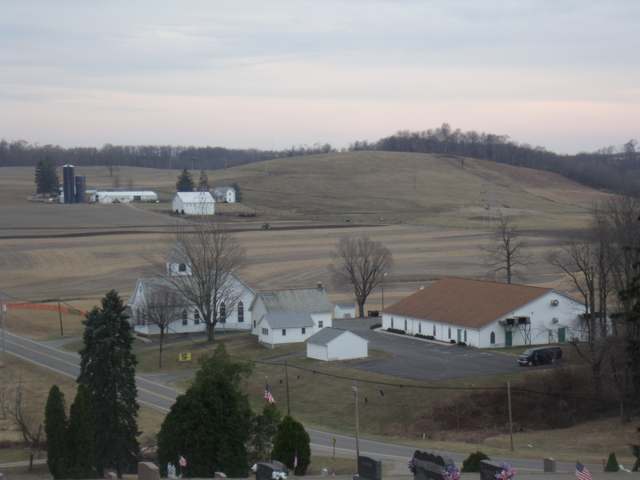
Photo: Ibagli, via Wikimedia Commons, public domain · Wikimedia Commons
Local history sources: archive.org · en.wikipedia.org · en.wikipedia.org · en.wikipedia.org · en.wikipedia.org · commons.wikimedia.org
Water
Mostly private wells The water here
- City of Heath95% of residentslocal wells
- Thornville, Village Of1% of residentsGroundwater wells (2 wells)
- Northern Perry Co.water #11% of residentsGroundwater wells (2 wells)
- Villa Vista Mobile Home1% of residentsGroundwater wells (2 wells)
- Buckeye Lake, Village Of1% of residentsGroundwater wells (4 wells)
- Licking County Harbor Hills0% of residentsGroundwater wells (4 wells)
- Muskingum County Water - Se0% of residentsMuskingum River buried valley aquifer (wells near Duncan Falls)
- Roberts Trailer Park0% of residentsGroundwater wells (1 wells)
Its ZIP codes
Each ZIP code that touches Franklin Township, Licking County, with the share of its residents who live here and the same headline figures as the ZIP page.
| ZIP | Share | Water | Radon | Home value | Schools | Flood |
|---|---|---|---|---|---|---|
| 43056 Heath | 11% | Mostly private wells | 8.8 pCi/L average radon | Median year built 1978 | Heath City · 4 stars overall | 5.8% of residents in the 1% floodplain |
| 43076 Thorn Township and Thornville | 1% | Mostly private wells | 7.3 pCi/L average radon | Median year built 1983 | Northern Local · 3 stars overall | 0.6% of residents in the 1% floodplain |
The county
Licking County: 17 ZIP codes, 38 cities, villages and townships, 160,939 people.
Nearby places
Cite this page
Cite this page as:
Cracked Buckeye (Open Shower Co), "Franklin Township, Licking County", https://crackedbuckeye.com/place/franklin-township-licking-county/, built 2026-09-16, accessed [date].
Machine-readable: /api/place/franklin-township-licking-county.json (open JSON, CC BY 4.0 for the compilation; the underlying records keep their own terms) · How to cite · Report a correction · Built 2026-09-16