How Bowling Green Township, Licking County began
Bowling Green Township, in the far southeast of Licking County within the Refugee Tract, takes its name from 'Little Bowling Green,' a small prairie a mile south of Linnville first cultivated in 1802 by Virginia frontiersmen Michael Thorn, Frederick Myers and Henry Neff. The name itself was borrowed by resemblance from an older, more famous 'Bowling Green,' a natural prairie on the Licking River where Elias Hughes and John Ratliff made the county's first permanent white settlement in 1798 and where an early Indian village once stood, a place that lies not here but in what is now Madison Township, five miles below Newark. Organized in 1808, the township grew up around the National Road, built through it between 1825 and 1833, which gave rise to the villages of Brownsville and Linnville and briefly, in 1836 and 1837, carried one of Ohio's earliest pony express routes. The 1881 county history calls the township's own Indian record no more than tradition and general hunting-ground use by the Delaware and other nations.
Settled 1802 (Michael Thorn, Frederick Myers and Henry Neff, at "Little Bowling Green"), incorporated 1808, the fourth township organized in the county.
Where the name comes from
The township takes its name from 'Little Bowling Green,' a small prairie a mile south of Linnville, first cultivated in 1802 and 'well known by the early settlers,' according to the 1881 county history, which states plainly: 'It gave name to the township in which it is situated.' The name was itself borrowed by resemblance: the source explains that the little prairie was called Little Bowling Green 'from its resemblance to the Bowling Green on the Licking, four miles below Newark,' a larger, older prairie that gave its name to nothing in this township. That original Bowling Green, where Elias Hughes and John Ratliff made Licking County's first permanent white settlement in 1798, lies within what the same history elsewhere identifies as Madison Township, not Bowling Green Township, a distinction easy to miss but explicit in the source.
Before the town
The 1881 county history is direct about the limits of the record for this specific township: 'The township has no authentic Indian history, but there is plenty of evidence that the Indians roamed freely over it in the pre-historic times, and probably had a more or less permanent occupancy of it... without doubt it was used extensively as a hunting ground by the Delawares and other nations and tribes.' This should not be confused with the much better documented 'Bowling Green' on the Licking River, five miles below Newark, where the same county history places an Indian village that persisted into the early 1800s and where the county's first white settlers, Elias Hughes and John Ratliff, arrived in 1798; that site lies in Madison Township, outside this township's own boundaries, and its history belongs to the county file rather than here. Within Bowling Green Township itself, only a handful of small Mound Builder works are recorded: a stone mound and an earth mound near the township's center, southeast of Linnville, a mound at Amsterdam, and an oblong earth mound eighty-five yards in circumference on the John Hamilton farm near Brownsville. The land was ceded by the Treaty of Greenville in 1795.
Nations recorded here: Lenape (Delaware).
- John Hamilton farm mound (mound) — adjoining Brownsville on the northeast, prehistoric (Mound Builder) (archive.org)
Timeline
- — The Treaty of Greenville cedes most of what becomes Ohio, including the future Bowling Green Township, to the United States.
- — Elias Hughes and John Ratliff make Licking County's first permanent white settlement at "the Bowling Green" on the Licking River, a site later in Madison Township, not in this Bowling Green Township.
- — Michael Thorn, Frederick Myers and Henry Neff, frontiersmen from western Virginia, make the first settlement within Bowling Green Township itself, at "Little Bowling Green" about a mile south of Linnville.
- — John Harris, Andrew Myers, William Harris, Moses Meeks, Adam and John Myers and Charles Howard, who taught the township's first school, settle in the township.
- — Bowling Green Township is organized, the fourth township formed in the county.
- — The National Road is surveyed, located and built through the township's northern edge.
- — Brownsville is laid out by Adam Brown, who names it for himself, and Linnville is laid out by Samuel Parr, who names it for Adam Linn, its first merchant.
- — A daily "Pony Express" line, established by Postmaster General Amos Kendall, runs along the National Road through Brownsville and Linnville, carrying urgent mail between Zanesville and Columbus at more than ten miles an hour.
- — A Methodist congregation builds the frame church adjoining Linnville that it still occupies as of 1881, after an earlier log church in the village was sold to the Catholics.
- — The Presbyterian church of Brownsville is organized by Rev. W. M. Robinson with eleven members.
Stories
Named for a Prairie, Twice Removed
Bowling Green Township's name traveled a strange, short distance to reach it. Five miles below Newark on the Licking River lay a natural prairie the earliest settlers simply called 'the Bowling Green'; it was there, in 1798, that Elias Hughes and John Ratliff built the first permanent white cabins in what became Licking County, on ground that had also held an Indian village. That original Bowling Green ended up, when townships were finally drawn, inside Madison Township. Meanwhile, a much smaller prairie a mile south of Linnville, first plowed in 1802, struck the settlers who found it as a miniature of the famous one downriver, and they called it 'Little Bowling Green.' When the county organized this stretch of the Refugee Tract into a township in 1808, it was the little prairie's borrowed name, not the original, that stuck. The result is a township named, at one remove, for ground it does not contain.
The Pony Express on the National Road
For about a year, in 1836 and 1837, Bowling Green Township's stretch of the National Road carried one of the country's earliest express mail routes. Postmaster General Amos Kendall set up the line to rush valuable letters, bank drafts and news slips between Zanesville and Columbus faster than the regular four-horse stage, with young riders galloping relays five miles apart. Isaac Smucker remembered receiving a slip carrying President Van Buren's inaugural address in March 1837, the postage on it thirty-seven times what a regular newspaper would have cost. A. B. Dumm, then a boy in Brownsville, rode the Zanesville-to-Etniers leg and once covered the whole fifty-four miles between Zanesville and Columbus, standing in for a sick fellow rider, in three hours and forty-five minutes. The line folded within the year as unprofitable, but Brownsville, Linnville and the other relay stations it briefly connected had, for a season, put Licking County on one of the fastest mail routes in Ohio.
Photographs
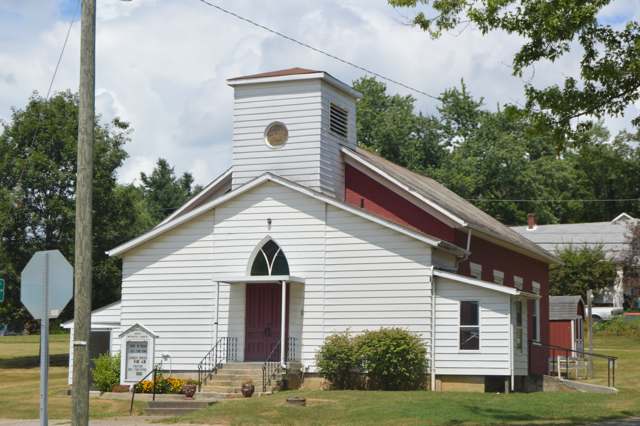
Photo: Nyttend, public domain · Wikimedia Commons
Local history sources: archive.org · en.wikipedia.org · en.wikipedia.org · en.wikipedia.org · en.wikipedia.org · commons.wikimedia.org
Water
Mostly private wells The water here
- Thornville, Village Of28% of residentsGroundwater wells (2 wells)
- Northern Perry Co.water #127% of residentsGroundwater wells (2 wells)
- Buckeye Lake, Village Of18% of residentsGroundwater wells (4 wells)
- Glenford Village18% of residentsGroundwater wells (2 wells)
- Licking County Harbor Hills8% of residentsGroundwater wells (4 wells)
- Roberts Trailer Park1% of residentsGroundwater wells (1 wells)
Its ZIP codes
Each ZIP code that touches Bowling Green Township, Licking County, with the share of its residents who live here and the same headline figures as the ZIP page.
| ZIP | Share | Water | Radon | Home value | Schools | Flood |
|---|---|---|---|---|---|---|
| 43721 Bowling Green Township and Brownsville | 100% | Mostly private wells | Too few radon tests | Median year built 1924 | Northern Local · 3 stars overall | 0.0% of residents in the 1% floodplain |
| 43739 Hopewell Township and Glenford | 23% | Mostly private wells | 9.0 pCi/L average radon | Median year built 1990 | Northern Local · 3 stars overall | 12% of residents in the 1% floodplain |
| 43076 Thorn Township and Thornville | 12% | Mostly private wells | 7.3 pCi/L average radon | Median year built 1983 | Northern Local · 3 stars overall | 0.6% of residents in the 1% floodplain |
The county
Perry County: 11 ZIP codes, 26 cities, villages and townships, 38,855 people.
Nearby places
Cite this page
Cite this page as:
Cracked Buckeye (Open Shower Co), "Bowling Green Township, Licking County", https://crackedbuckeye.com/place/bowling-green-township-licking-county/, built 2026-09-16, accessed [date].
Machine-readable: /api/place/bowling-green-township-licking-county.json (open JSON, CC BY 4.0 for the compilation; the underlying records keep their own terms) · How to cite · Report a correction · Built 2026-09-16