Bloominggrove Township, Richland County
Township · Richland County · 1,295 residents
Local events in Bloominggrove Township, Richland County
Nothing is posted for Bloominggrove Township itself yet; here is what is on within 10 miles. All local events in Bloominggrove Township, Richland County
Know a calendar we should watch? Send the link
Checked October 20; the events page is refreshed daily.
How Bloominggrove Township, Richland County began
Bloominggrove (Blooming Grove) Township was organized March 4, 1816, out of Madison Township, first as a tract eighteen miles by twelve covering most of northern Richland County; it reached six miles square in 1818 and four by six in 1849, when Butler Township took its two eastern tiers. The 1880 county history says it was named for its many sugar-maple groves, used by Wyandot and Lenape (Delaware) hunters and sugar makers. General Beall's army cut the first road through it in 1812 and camped at Camp Council, and the first settlers came along 'Beall's trail' from 1814. Three villages grew up: Trucksville (Ganges, laid out 1815), Rome (1832) and Shenandoah (1844); Trucksville prospered on the wagon road to Lake Erie until the railroad passed it by. It remains a rural township in northern Richland County.
Settled 1814 (Jacob and John Stoner and a Mr. McCart), incorporated March 4, 1816, by organized out of Madison Township.
Where the name comes from
Graham's 1880 county history says the name comes from the township's 'numerous and beautiful sugar-tree groves', which made it a favored spring and summer camping and hunting ground. It is the only township of that name in Ohio.
Before the town
Graham's 1880 county history says Native people had no permanent camp in the township but used it extensively as a hunting ground, the Wyandot and Lenape (Delaware) especially; small parties often camped in its sugar groves to hunt or make sugar. On William Guthrie's farm (Section 18) they kept an open-ended cabin in a sugar grove on high ground as a hunting headquarters, where, Guthrie's son recalled, they sang, danced and smoked in the evenings. The blacksmith Thomas Dickinson set up his shop on a trail from the head of the Black Fork to the head of the Huron River and made knives and tomahawks and mended guns for his Native neighbors. Two sisters of Mrs. Stoner, captured as children, grew up among Native people; George Foulks, of the family that founded Rome, was captured at eleven and lived with his captors until grown. During the War of 1812 a blockhouse stood on the site of Ganges. The county's record also includes the treaty cessions and the 1812 removal from Greentown.
Nations recorded here: Wyandot, Lenape (Delaware).
- Guthrie farm hunting camp (camp) — Sugar grove on high ground on William Guthrie's farm, Section 18, before and at settlement, about 1816 (archive.org)
- Trail from the Black Fork to the Huron River (trail) — Across the township, past Thomas Dickinson's blacksmith shop, early 19th century (archive.org)
- Blockhouse at Ganges (other) — Site of Ganges (Trucksville), 1812, built by settlers for defense (archive.org)
Timeline
- — Gen. Reasin Beall's army cuts the township's first road in the summer, entering at Shenandoah and passing northwest through the site of Rome toward Shiloh; it becomes known as Beall's trail.
- — Beall's army camps at Camp Council, about a mile west of Shenandoah and Rome; on October 22-23 Gen. William Henry Harrison arrives and speaks to the restless troops.
- — Jacob and John Stoner settle on Section 22 and a Mr. McCart on Section 30, following Beall's trail; McCart probably builds the first cabin.
- — William Trucks and Daniel Ayers lay out Trucksville (later Ganges) in the spring where the new road from Mount Vernon to the lake crosses the Black Fork; Wikipedia gives 1817 for the platting.
- — Bloominggrove Township is organized on March 4 from Madison Township; the first election, north of the site of Rome at Mr. Madden's house, polls twenty-one votes.
- — Trucks and Ayers build the township's first mill at Trucksville, with a sawmill and distillery beside it; it runs perhaps fifteen years.
- — Plymouth and Sandusky townships are created on February 2, leaving Bloominggrove six miles square.
- — A post office named Truxville is established at Trucksville; it is renamed Ganges in 1836 and closes in 1906.
- — The first school opens in December in William Guthrie's old cabin, a three-month subscription school taught by Robert Finney.
- — The Presbyterian society organized by Robert Lee about 1823 builds a log church on Snip's Run half a mile north of Rome, beside the township's first graveyard.
- — Alfred Foulks lays out Rome on May 9 on the northwest quarter of Section 8, on Beall's trail.
- — A post office named Rives is established at Rome; it operates until 1906.
- — William and George Altorfer, from the Shenandoah Valley of Virginia, lay out Shenandoah in June on Beall's trail in the southeast part of the township.
- — Butler Township is created February 5 and takes two tiers of sections from Bloominggrove's east side, leaving it four miles by six; the Union Church near Shenandoah is built about the same year.
- — On March 10 eight men in Loxley Devore's tavern at Rome form the Clear Grits temperance society; within a year 1,087 people of northern Richland County sign its pledge.
- — The Disciples' church of Shenandoah is organized in March and builds its own $3,000 frame church in 1879.
Stories
The rise and fall of Trucksville
In the spring of 1815 William Trucks and Daniel Ayers followed the new road from Mount Vernon to Lake Erie and laid out a town, with a public square, where it crossed the Black Fork. Trucks built a cabin and a mill, Ayers's brother James opened a hotel, and the two partners planted the township's first orchard with young trees from Johnny Appleseed. Hundreds of wagons of grain from the southern counties passed every week; a second hotel and four stores opened, the first post office in the township was kept there, and the town hoped to become the county seat. When the Sandusky, Mansfield and Newark Railroad came through the woods, the wagon trains stopped. By 1880 the county historian found about 100 people in unpainted houses, one or two small stores, and a silent mill.
Wolves on the path home
John Guthrie was riding home one night from a neighbor's in what is now Cass Township, with a half-wolf dog at his horse's feet, when horse and dog sensed danger and dark shapes crossed the narrow path ahead. A wolf sprang from the roadside, the horse shied, and Guthrie was thrown and attacked. His dog, frightened until then, fought the wolf off; Guthrie climbed a tree as the rest of the pack closed on the dog, which broke away and ran, drawing the whole pack after it. Guthrie climbed down and got home safely, and the dog came in soon after unhurt. His brother told the story to the 1880 county historian.
The Clear Grits of Rome
On March 10, 1873, the village postmaster, Nelson Ozier, and seven companions drinking in Loxley Devore's tavern at Rome agreed on the spot to give up alcohol for a year. They met every Saturday night in the town hall, signed a book, and printed pledge cards, calling themselves the Clear Grits because refusing a drink showed 'clear grit'. By the end of that summer 845 men, women and children of northern Richland County had signed, and 1,087 a year after the founding. The society held a picnic and ox roast attended by thousands, published a newspaper, the Ohio Clear Grit, and kept clear of party politics and churches; two and a half years in, Loxley Devore himself signed.
Photographs
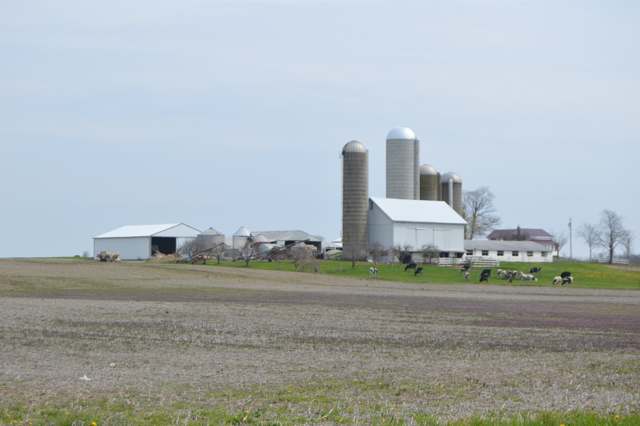
Photo: Nyttend / Wikimedia Commons, public domain · Wikimedia Commons
Local history sources: en.wikipedia.org · en.wikipedia.org · en.wikipedia.org · en.wikipedia.org · en.wikipedia.org · archive.org · archive.org · archive.org · archive.org · archive.org · archive.org · archive.org · archive.org · archive.org · archive.org · archive.org · archive.org · richlandcountyhistory.com · richlandcountyhistory.com · commons.wikimedia.org
Water
Mostly private wells The water here
- Shiloh Village60% of residentsGroundwater wells (2 wells)
- Shelby City25% of residentsCity reservoirs (Nos. 2 & 3) fed by Black Fork Mohican River/Marsh Run
- Greenwich Village12% of residentsGroundwater wells (6 wells)
- Rural Lorain Co. Water A2% of residentsMostly Lake Erie (bought from Avon Lake); some New London Reservoir and Ashland wells
- Northern Ohio Rural Water - SE District1% of residentsLake Erie
Hospitals, fire stations and more
Inside Bloominggrove Township, Richland County's boundary: 1 spill case. Press a pin or a name for its whole record and its source.
Spills reported since 2021 (1)
-
Fish Kill2024-10-31 · Bloominggrove Twp
- Reported
- 2024-10-31
- What spilled
- Fish Kill
- Where
- Bloominggrove Twp, Richland County
- Ohio EPA district office
- NWDO
- Ohio EPA case number
- 2410EPA0001821
Ohio EPA spill reports (source) ↗ Street map and directions ↗
Source: Ohio EPA emergency response spill reports, 2021 to September 2026, one point per case where Ohio EPA placed it. A report is what the caller or responder recorded; amounts are often blank or estimated.
Its ZIP codes
Each ZIP code that touches Bloominggrove Township, Richland County, with the share of its residents who live here and the same headline figures as the ZIP page.
| ZIP | Share | Water | Radon | Home value | Schools | Flood |
|---|---|---|---|---|---|---|
| 44878 Bloominggrove Township and Shiloh | 33% | Mostly private wells | 5.2 pCi/L average radon | Median year built 1952 | Plymouth-Shiloh Local · 4 stars overall | 3.6% of residents in the 1% floodplain |
| 44837 Greenwich | 3% | Mostly private wells | 4.1 pCi/L average radon | Median year built 1974 | South Central Local · 3.5 stars overall | 1.0% of residents in the 1% floodplain |
| 44875 Shelby | 1% | City reservoirs (Nos. 2 & 3) fed by Black Fork Mohican River/Marsh Run | 6.2 pCi/L average radon | Median year built 1951 | Shelby City · 4 stars overall | 4.6% of residents in the 1% floodplain |
Local government
Who holds office in Bloominggrove Township, Richland County, how its elections and ballot issues came out, and the state auditor's record.
Auditor of State record
- No fiscal caution, watch or emergency on the Auditor of State's lists.
- Basic Audit, 2024 to 2025, released 2026-09-01
- Basic Audit, 2022 to 2023, released 2024-07-16
The county
Richland County: 12 ZIP codes, 27 cities, villages and townships, 124,341 people.
Nearby places
Quick answers
What county is Bloominggrove Township, Ohio in?
Bloominggrove Township, Richland County is a township in Richland County, Ohio, with 1,295 residents.
When was Bloominggrove Township, Ohio founded?
Bloominggrove Township, Richland County was settled 1814 (Jacob and John Stoner and a Mr. McCart); incorporated March 4, 1816. Founders on record: organized out of Madison Township. Source
How did Bloominggrove Township, Ohio get its name?
Graham's 1880 county history says the name comes from the township's 'numerous and beautiful sugar-tree groves', which made it a favored spring and summer camping and hunting ground. Source
What ZIP code is Bloominggrove Township, Ohio?
Bloominggrove Township, Richland County is served by ZIP codes 44878 and 44837; 44878 holds the largest share of its residents.
Where does Bloominggrove Township, Ohio get its water?
The main water source for Bloominggrove Township, Richland County (Shiloh Village): Mostly private wells.
Cite this page
Cite this page as:
Cracked Buckeye, "Bloominggrove Township, Richland County", https://crackedbuckeye.com/place/bloominggrove-township-richland-county/, built 2026-10-31, accessed [date].
How to cite · Report a correction · Built 2026-10-31
