Local events in Salem Township, Highland County
Nothing is posted for Salem Township itself yet; here is what is on within 20 miles. All local events in Salem Township, Highland County
Know a calendar we should watch? Send the link
Checked October 20; the events page is refreshed daily.
How Salem Township, Highland County began
Salem Township sits in the western part of Highland County near the Brown County line, on the waters of White Oak Creek. It was set off on August 19, 1819, from what remained of New Market Township, and at first also covered present Hamer and Dodson townships, with Danville as its voting place. Its earliest settler was John Davidson, a shoemaker from Pennsylvania, and after 1813 the large Faris family bought about 1,000 acres here, built the township's first gristmill on White Oak Creek about 1824, and platted Pricetown in 1847. Its best-known landmark is Fort Salem, a circular Adena- or Hopewell-period earthwork now preserved by the Archaeological Conservancy. The township remains agricultural, with 782 residents in 2020.
Where the name comes from
No source specific to this township explains the choice of the name Salem; it is one of fourteen townships in Ohio named Salem, a name drawn from the Hebrew word for peace and common among Ohio's early religious communities.
Before the town
Fort Salem (also called the Workman Works), on Certier Road in the township near Pricetown, is a circular earthen enclosure about 450 feet across surrounding two conjoined mounds, built between roughly 800 BC and AD 500 with characteristics of both the Adena and Hopewell traditions; archaeologists now read it as a burial ground rather than a defensive fort, despite its name. It was first surveyed for the Smithsonian Institution by J. P. McLean in 1883, listed on the National Register of Historic Places in 1971, and purchased as a preserve by the Archaeological Conservancy in 2005. No excavation has recovered artifacts from the site. No historic-era Native village, trail or treaty site specific to the township is recorded; the land lay within the cession of the 1795 Treaty of Greenville. The 1902 county history notes that the people of the township called the enclosure Fort Salem, and that it was not on the Ohio Archaeological and Historical Society's list of the county's prehistoric sites at that time.
Nations recorded here: Adena culture, Hopewell culture, Shawnee, Wyandot.
- Fort Salem (Workman Works) (earthwork) — Certier Road, Salem Township, near Pricetown, Adena/Hopewell, c. 800 BC - AD 500 (thearchcons.org)
Timeline
- — Highland County, including the future Salem Township, is organized from parts of Ross, Adams and Clermont counties.
- — John and Jane Faris arrive from Virginia with thirteen children; after first buying land in New Market Township, John Faris buys about 1,000 acres in Salem Township, on which most of the children settle around the site of Pricetown.
- — On August 19 the greater part of what remained of New Market Township is set off as Salem Township, including present Salem, Hamer and Dodson, with Danville as the voting place.
- — About 1824 John B. Faris builds the first gristmill in Salem Township, on White Oak Creek, with a sawmill.
- — Dodson Township is set off from Union, Salem and New Market on June 7.
- — A Universalist church is organized near Pricetown, meeting at the house of William Davidson; the present congregation is formed at Pricetown in 1860 and soon builds a church.
- — April 13: Elijah, David and Jane Faris, with Alexander Murphy (the 1902 county history's list of town plats names Elijah and Daniel Faris and A. Murphy), plat Pricetown, naming it for Common Pleas Judge J. W. Price of Hillsboro.
- — On June 5 Hamer Township is formed, mainly from the original bounds of Salem.
- — A Church of Christ is organized at Pricetown, with John M. Smith among its leading members.
- — Harwood Chapel, a Methodist church in Salem Township, is founded.
- — J. P. McLean surveys and documents the Fort Salem earthwork for the Smithsonian Institution, recording its dimensions and reporting no relics found in partial excavation.
- — The first reunion of the Faris family is held; by 1902 as many as four hundred descendants of John and Jane Faris attend.
- — The census counts 869 people in Salem Township.
- — Fort Salem is listed on the National Register of Historic Places.
- — The Archaeological Conservancy purchases the 19-acre Fort Salem site for $100,000, its 300th preserve nationally.
- — Property owner William Bear, who restored the earthwork on his land, receives the Archaeological Conservancy's Outstanding Volunteer Award.
Stories
Fort Salem: a burial ground mistaken for a fort
On the southwest edge of Pricetown, a circular wall of earth about 450 feet across still rings two low, conjoined mounds. Early settlers, seeing the wall and its outer ditch, took it for a military stockade and named it Fort Salem, but archaeologists who have since studied the site believe it was never a fort at all. Its layout — a burial mound enclosed by a ditched wall — has features of both the Adena people, who built such circle-and-mound earthworks between about 800 BC and 100 BC, and the later Hopewell culture, whose larger-scale geometric earthworks appear across the Scioto and Little Miami valleys between 100 BC and AD 500. J. P. McLean surveyed the site for the Smithsonian in 1883 and found no artifacts in the ground he opened. No professional excavation has taken place since. In 2005 the Archaeological Conservancy bought the property, its 300th preserve, and later owner William Bear spent years clearing brush and restoring the earthwork before his death, work the Conservancy honored with its Outstanding Volunteer Award in 2008. The site is now a small public park, open daily from dawn to dusk.
The Faris mill on White Oak Creek
John B. Faris, born in Virginia in 1802, came to Highland County with his parents about 1813. In 1823 he married Catherine Welty, the seventeen-year-old daughter of a Kentucky pioneer, and settled on the Bowyer Survey north of Pricetown. About 1824 he built on White Oak Creek the first gristmill in Salem Township and ran it with a sawmill, the most important business in the township in his day. He died in 1837 at thirty-five, and Catherine carried on the farm, the mill and the other enterprises herself while raising their eight children. She remarried, was widowed again within a year, and lived until 1889. In 1902 a John B. Faris of the next generation was president and historian of the Faris family reunion, first held in 1889.
Photographs
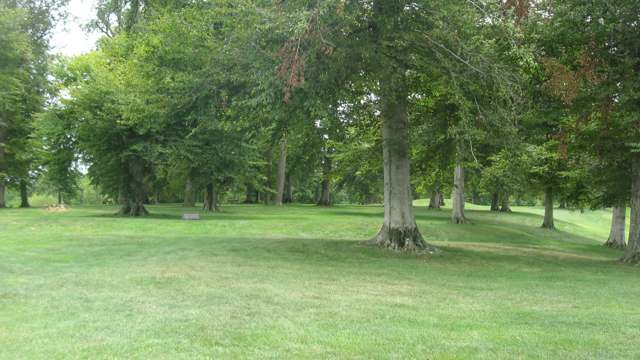
Photo: Nyttend, via Wikimedia Commons, public domain · Wikimedia Commons
Photo: Aesopposea, via Wikimedia Commons, CC BY-SA 3.0 · Wikimedia Commons
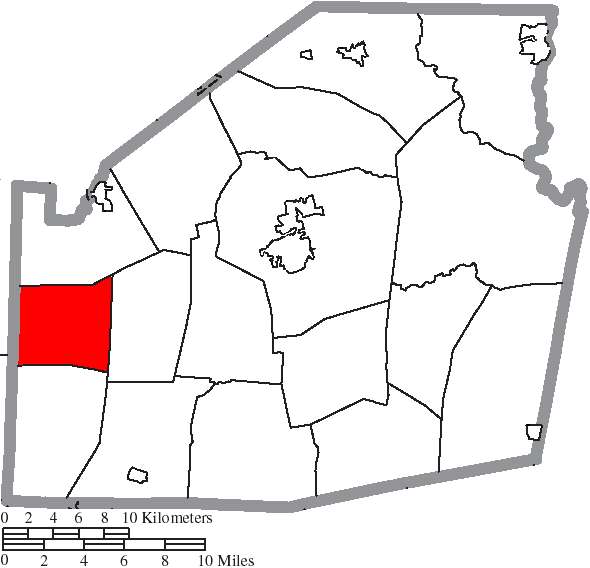
Photo: Ruhrfisch and Nyttend, via Wikimedia Commons, CC BY-SA 3.0 · Wikimedia Commons
Local history sources: en.wikipedia.org · en.wikipedia.org · en.wikipedia.org · thearchcons.org · timesgazette.com · en.wikipedia.org · commons.wikimedia.org · commons.wikimedia.org · commons.wikimedia.org · archive.org · archive.org · archive.org · archive.org · archive.org · archive.org · archive.org · archive.org · archive.org · archive.org · archive.org · archive.org · archive.org
Water
Mostly private wells The water here
- Lynchburg Village48% of residentsGroundwater wells (3 wells)
- Western Water Company19% of residentsLittle Miami River valley wells (51%) plus Cincinnati Ohio River water (49%)
- Hillsboro City16% of residentsClear Creek (via Selph Road & Liberty Park Reservoirs)
- Mount Orab Village8% of residentsSterling Run (reservoirs)
- Highland County Water Company, Inc.6% of residentsSand-and-gravel aquifer wells (Ross/Highland Co. well fields; local wells)
- Fayetteville Village3% of residentsOhio River (Miller Plant, ~88%) plus Great Miami Buried Valley Aquifer wells (~12%)
Its ZIP codes
Each ZIP code that touches Salem Township, Highland County, with the share of its residents who live here and the same headline figures as the ZIP page.
| ZIP | Share | Water | Radon | Home value | Schools | Flood |
|---|---|---|---|---|---|---|
| 45142 Lynchburg | 10% | Mostly private wells | 4.0 pCi/L average radon | Appraisal records without year built | Lynchburg-Clay Local · 4 stars overall | 1.7% of residents in the 1% floodplain |
| 45118 Perry Township and Fayetteville | 3% | Ohio River intake at the plant's riverfront on Kellogg Ave in the California neighborhood, east Cincinnati | 4.1 pCi/L average radon | Appraisal records without year built | Fayetteville-Perry Local · 4 stars overall | 1.1% of residents in the 1% floodplain |
| 45133 Hillsboro | 1% | Mostly private wells | 4.2 pCi/L average radon | Appraisal records without year built | Hillsboro City · 3.5 stars overall | 0.2% of residents in the 1% floodplain |
| 45154 Mount Orab | 1% | Sterling Run (reservoirs) | 3.2 pCi/L average radon | Appraisal records without year built | Western Brown Local · 3.5 stars overall | 3.4% of residents in the 1% floodplain |
Local government
Who holds office in Salem Township, Highland County, how its elections and ballot issues came out, and the state auditor's record.
Money issues on the ballot since 2023: 1 of 1 passed.
Ballot issues
| Date | Issue | For | Against | Result |
|---|---|---|---|---|
| 2023-11-07 | Issue 7: Salem Township Renewal | 177 | 103 | Passed (63.21% for) |
Elections for office
| Date | Office | Candidates and votes |
|---|---|---|
| 2023-11-07 | Trustee | David L. Hamilton 232, 100.0% |
| 2023-11-07 | Fiscal Officer | Jamie Wells 231, 100.0% |
| 2021-11-02 | Township Trustee (unofficial count) | Shane Simmons 110, 51.16%; John R."J.R."Roush 105, 48.84% |
| 2019-11-05 | Trustee | David L. Hamilton 127, 100.0% |
| 2019-11-05 | Fiscal Officer | Jamie Wells 122, 100.0% |
Winners in bold. Results from the county board of elections' official canvass unless marked.
Auditor of State record
- No fiscal caution, watch or emergency on the Auditor of State's lists.
- Basic Audit, 2023 to 2024, released 2025-07-10
The county
Highland County: 7 ZIP codes, 26 cities, villages and townships, 42,302 people.
Nearby places
Quick answers
What county is Salem Township, Ohio in?
Salem Township, Highland County is a township in Highland County, Ohio, with 782 residents.
What ZIP code is Salem Township, Ohio?
Salem Township, Highland County is served by ZIP codes 45142 and 45118; 45142 holds the largest share of its residents.
Where does Salem Township, Ohio get its water?
The main water source for Salem Township, Highland County (Lynchburg Village): Mostly private wells.
Cite this page
Cite this page as:
Cracked Buckeye, "Salem Township, Highland County", https://crackedbuckeye.com/place/salem-township-highland-county/, built 2026-10-31, accessed [date].
How to cite · Report a correction · Built 2026-10-31
