How Fallsbury Township, Licking County began
Fallsbury Township, in Licking County's rough, hilly northeastern corner, was among the last parts of the county to be settled, its rocky ground and distance from the main travel routes holding off farmers until David Bright built the first cabin in 1818. The township is drained by the Wakatomika Creek, whose narrow valley the 1881 county history compares to the Rocky Fork gorge for its mountain-like scenery, including a jumble of shattered boulders known locally as "Rent Rocks." Organized in 1826, it never got a canal, turnpike or railroad, and its little post town of Fallsbury grew up without ever being formally platted, simply accreting around a handful of roads that happened to converge there. Its Native American record is equally sparse but specific: a settler's son who arrived in 1808 recalled Shawnee boys as his childhood playmates near a known encampment on Shawnee Run.
Settled 1818 (David Bright, the township's first settler), platted Fallsbury village was never formally platted; it grew up around converging roads near the township's center, on land belonging to Silas Bland, incorporated 1826.
Where the name comes from
No source found explains the derivation of the name Fallsbury itself, beyond its evident echo of the small post town of the same name at the township's center; no waterfall is described in the sources consulted, so any connection to a "falls" is unconfirmed.
Before the town
"No special Indian history has been preserved," the 1881 county history states of Fallsbury, "though the first settlers found them occupying this territory." The one specific, sourced memory comes from John Evans, whose father brought him to the Wakatomika a few miles below the Fallsburgh line in 1808: he recalled that for several years his childhood playmates were Shawnee boys, and that an encampment of Shawnee stood on Shawanee (Shawnee) Run, which flows into the Licking River, a stream the 1881 history judges was probably used along with the rest of the township as hunting ground by that camp. No mound or earthwork is recorded within the township; the county history states plainly that "few, if any, traces of the Mound Builders remain in this township; and it is probable that few of their works were erected here," attributing this to the same rough, rocky terrain that discouraged early white settlement.
Nations recorded here: Shawnee.
- Shawnee encampment on Shawnee Run (camp) — Shawnee (Shawanee) Run, a tributary of the Licking River a few miles below the Fallsbury line, attested as of 1808 (archive.org)
Timeline
- — John Evans's father brings him to the Wakatomika Creek a few miles below the future Fallsbury line; young Evans recalls Shawnee boys as his playmates for several years.
- — David Bright builds the township's first cabin in the woods on land later owned by Mrs. Botts, among the last first-settlements in the county.
- — Fallsbury Township is organized; the first election is held at the house of Samuel Varner.
- — Miner McQueen's Old School Baptist congregation, the township's first religious organization, is formally established.
- — The Pleasant Valley Methodist Episcopal church is organized at the house of Noah Reed, southeast of Fallsbury village.
- — Noah Reed, a prominent early township politician, is elected to the Ohio legislature.
- — The census records the township's population at over twelve hundred, its high-water mark; by 1880 it had declined by roughly half.
- — Thomas Holmes & Sons put a steam engine into operation at Fallsbury village, powering a planing mill, saw mill and corn-grinding grist mill.
- — The Gregg Mill Covered Bridge is built over the Wakatomika Creek on Frampton Road, near the site of the township's early Gregg's mill.
Stories
Rent Rocks and the Wakatomika Gorge
Where the narrow, winding road along the Wakatomika Creek passes Gregg's mill, the hills rise to what the 1881 county history calls an almost mountainous height, with immense boulders piled and jutting from their sides in every direction. At a spot the settlers named Rent Rocks, an enormous stone appears to have been split apart with such force that its pieces now lie scattered at various distances from one another, some far enough apart for a person, or even a rider on horseback, to pass between them. The county historian judged the pieces had clearly once formed a single solid mass, though he offered no theory for what had broken it. The rugged Wakatomika valley kept this corner of the county wild longer than almost anywhere else in Licking County: game persisted here after it had vanished from the more heavily settled valleys, and the township, in the historian's own words, "in many parts yet has the appearance of a new country," its log cabins still standing as dwellings as late as 1880.
A Town That Grew Like a Mushroom
Fallsbury village, the only settlement of any size in the township, was never platted by anyone. "It grew, or seemed to grow naturally, like a mushroom," the 1881 county history says, on land belonging to Silas Bland, for no better reason than that a few minor roads happened to converge irregularly near the middle of the township's settlement. John Arnold built the first house, a farmer's log cabin; Jesse Riley built the second, which was still standing when the county history was written. Thomas Meeks opened the first blacksmith shop, and a man named George opened the first store, a small frame building later used as a shoe shop; the town never supported more than one store at a time until the final decade before 1880. By then it held perhaps a hundred people, three doctors, and Thomas Holmes & Sons' steam-powered mill complex, but the historian could not resist noting that the village had "rather a dilapidated, tumble-down look," built as it was on very rough ground that did nothing to flatter it.
Photographs
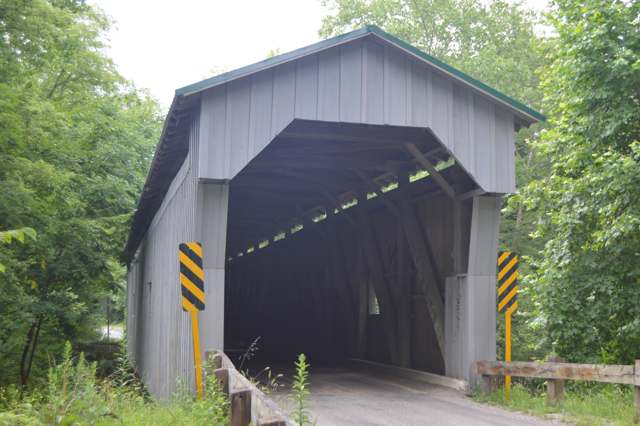
Photo: Nyttend, via Wikimedia Commons, public domain · Wikimedia Commons
Local history sources: archive.org · en.wikipedia.org · en.wikipedia.org · commons.wikimedia.org
Water
Mostly private wells The water here
- Frazeysburg91% of residentsGroundwater wells (2 wells)
- Utica Village6% of residentsGroundwater wells (2 wells)
- Country Hills MHP2% of residentsGroundwater wells (2 wells)
- St. Louisville Village1% of residentsGroundwater wells (2 wells)
- Martinsburg Village0% of residentsGroundwater wells (3 wells)
Its ZIP codes
Each ZIP code that touches Fallsbury Township, Licking County, with the share of its residents who live here and the same headline figures as the ZIP page.
| ZIP | Share | Water | Radon | Home value | Schools | Flood |
|---|---|---|---|---|---|---|
| 43822 Frazeysburg | 17% | Mostly private wells | 9.2 pCi/L average radon | Appraisal records without year built | Tri-Valley Local · 4 stars overall | 5.6% of residents in the 1% floodplain |
| 43071 Eden Township and Saint Louisville | 1% | Mostly private wells | 14.8 pCi/L average radon | Median year built 1974 | North Fork Local · 3 stars overall | 0.9% of residents in the 1% floodplain |
| 43080 Utica | 1% | Mostly private wells | 16.1 pCi/L average radon | Median year built 1972 | North Fork Local · 3 stars overall | 6.9% of residents in the 1% floodplain |
The county
Muskingum County: 17 ZIP codes, 38 cities, villages and townships, 91,875 people.
Nearby places
Cite this page
Cite this page as:
Cracked Buckeye (Open Shower Co), "Fallsbury Township, Licking County", https://crackedbuckeye.com/place/fallsbury-township-licking-county/, built 2026-09-16, accessed [date].
Machine-readable: /api/place/fallsbury-township-licking-county.json (open JSON, CC BY 4.0 for the compilation; the underlying records keep their own terms) · How to cite · Report a correction · Built 2026-09-16