How Norwich Township, Franklin County began
Norwich Township was carved out of Franklin Township in 1809 as part of the newly formed Washington Township, then set off under its own name in 1813 and named for Norwich, Connecticut, the birthplace of an early resident. Settlement began along the Scioto River and Hayden Run in 1807, and the township grew slowly until John R. Hilliard platted a village around a new railroad station in 1853, a place that incorporated in 1869 and became the city of Hilliard in 1960. Columbus's and Hilliard's later annexations have left Norwich Township as a set of separated unincorporated islands, though a large population, about 37,900 at the 2020 census, still lives within them.
Settled 1807 (Daniel Brunk and family, half a mile south of Hayden Run; Rev. Benjamin Britton settled immediately alongside them the same year), incorporated 1813, by Franklin County; the area had been part of Franklin Township and then, from 1809, part of the newly organized Washington Township before Norwich was set off under its own name.
Where the name comes from
The township was named by Thomas Davis, a prominent early resident who was a native of Norwich, Connecticut.
Before the town
No mound, earthwork, village, trail or treaty specific to Norwich Township was found in the sources checked. The 1880 county history's settler biographies mention encounters with Native people only outside Ohio (a Pennsylvania flight from a raiding party recalled by early settler Peter Latimer, and Kentucky captivity and scouting recalled by early settler Samuel Davis), not within the township itself. Broader Franklin County Native American context, including the treaties and land districts that opened this part of Ohio to survey and settlement, belongs in the county file.
Timeline
- — Daniel Brunk and family settle half a mile south of Hayden Run, the first settlers in what becomes Norwich Township; Rev. Benjamin Britton, a "New Light" preacher, settles immediately south of them the same year.
- — The area becomes part of the newly organized Washington Township; William Armistead, who had emigrated from Virginia in 1808, settles a mile below Hayden Run and buys 300 acres.
- — Peter Latimer emigrates from Pennsylvania and settles on land later owned by William Armistead; he goes on to carry the mail between Columbus and Zanesville, and later Columbus and Bellefontaine, on horseback.
- — Norwich Township is laid out and organized under its own name, separating from Washington Township; it at first includes what becomes the south part of Perry Township.
- — Samuel Davis, a Revolutionary War veteran and former frontier scout, settles in the township with 380 acres bought from a Mr. Terry of Highland County; the township's first school opens the same year in a log building at Smiley's Corners.
- — Ephraim Fisher builds a 12-by-14-foot cabin with no floor near Hilliard, on land he had bought with his father and Elias Pegg in 1814.
- — Perry Township is set off from Norwich Township's northern portion.
- — Wesley Methodist Church organizes as a class, its earliest preaching held in William Armistead's barn.
- — St. Jacob Evangelical Lutheran Church organizes in the township's south part to serve German-speaking families, among them Matthias Fladt, Matthias Spindler and John Koener.
- — Samuel Davis dies a Revolutionary War pensioner, having run a blacksmith and gunsmith shop from his farm for over three decades.
- — The township's first post office opens at Smiley's Corners with David Smiley as postmaster; it is discontinued two years later when a new office opens at Hilliard.
- — John R. Hilliard's farm is officially platted into village lots as "Hilliard's Station," laid out around the new route of the Columbus, Piqua and Indiana Railroad.
- — Hilliard incorporates as a village with about 280 residents; John R. L. Seegur serves as its first mayor.
- — A special school district is cut off at Hilliard, though schools had already been kept in the area for years.
- — Hilliard, grown from the township's former railroad-station village, becomes a city as its population reaches 5,633.
Stories
Samuel Davis, frontier scout
Samuel Davis was born in Connecticut and moved to Kentucky around 1785, where Major Simon Kenton hired him as one of twelve men who took turns scouting for Native raiding parties to warn settlers. Trapping along the Big Sandy River with a companion named Campbell, Davis was captured; bound tightly enough to keep him from sleeping, he told his captor so, and the Indian in charge ordered his bonds loosened. Davis waited for his chance, leaped across a small stream into a thicket, and got away with barely any clothing, living on wild roots for six days in cold March weather before reaching a settlement; Campbell was taken to Detroit and sold to a Frenchman before eventually winning his freedom. After the war, Davis worked as a camp hunter for General Nathaniel Massie's party laying out Chillicothe alongside Duncan McArthur, later a governor of Ohio. Davis eventually settled in Norwich Township in 1814 on 380 acres, ran a blacksmith and gunsmith shop from his farm, served briefly again in the War of 1812, and died in 1849 a Revolutionary War pensioner. His son Asa was, by 1880, remembered as the township's oldest living settler, and his granddaughter Electa married the township's own Dr. R. Zenas Seeds.
The church that kept blowing down
Wesley Methodist Church organized as a class around 1832, holding its early services wherever it could, including William Armistead's barn, until a small frame church went up in 1836 on the river road a little south of where the Elliott family lived. In 1850 the congregation tore down the frame building and put up a brick one in its place. That building blew down after standing only two years. They rebuilt it, and it blew down again within a year. They rebuilt it a third time. By 1880 the congregation, whose early members included Abner Clapp's family, William Armistead, M. McCracken and others, numbered about forty-five, with a Sunday school of around seventy.
Rev. Benjamin Britton's vanished church
When Rev. Benjamin Britton settled south of Daniel Brunk in 1807, he was already a preacher of the "Christian," or New Light, faith, and he lost little time organizing a congregation on nearby land that belonged to Joseph Carr but stood unoccupied. Rev. Mr. Fisher of Worthington helped him. The congregation built a log structure to worship in, but kept it only a few years before the church died out entirely; the building was converted into an ordinary dwelling house, and the scattered members eventually joined the congregation at Dublin instead. No trace of the church's name or exact site survived into the county history beyond this account, an early township institution that simply did not last.
John R. Hilliard's village
In 1852, John Reed Hilliard bought ten acres of western Franklin County farmland from Hoseah High and Abraham Wendell. The next year, as the Columbus, Piqua and Indiana Railroad was being built through the area, he had his land surveyed into lots and officially platted the village of Hilliard's Station on September 1, 1853; the "Station" was dropped once a post office was established there in 1854. The village incorporated on July 13, 1869, with about 280 residents and John R. L. Seegur as its first mayor, the council meeting for years in a room at Columbia and Center streets before moving in 1878 to a room in a new business block built by Orange Sells, who by then had also taken over the post office and was serving as mayor. Under Sells the post office's business quadrupled within its first year and became a money-order office in July 1879. Hilliard kept growing around its rail depot long after Norwich Township itself stopped being mostly farmland, and became a city in its own right on December 12, 1960.
A doctor for three settler families
Dr. R. Zenas Seeds was born in neighboring Jackson Township in 1845 to Dr. John Seeds and Asenath Britton Seeds, and lost his father at age four, leaving his mother to raise seven children alone. He worked his way through the Union schools at Mechanicsburg and Antioch College before enrolling at Starling Medical College in Columbus, graduating second in a class of seventy-two in the winter of 1869-70. He served with General Sherman's army as a teenager during the Civil War, present through the capture of Kennesaw Mountain, while his older brother served as an assistant surgeon with the 13th Ohio Volunteer Infantry for the rest of the war. Back in Hilliard by the spring of 1870, the young doctor married Electa Davis, eldest daughter of Asa Davis and granddaughter of pioneer settler Samuel Davis, tying together three of the township's earliest settling families in one household as he built a medical practice in the village his patients' grandparents had helped clear.
Photographs
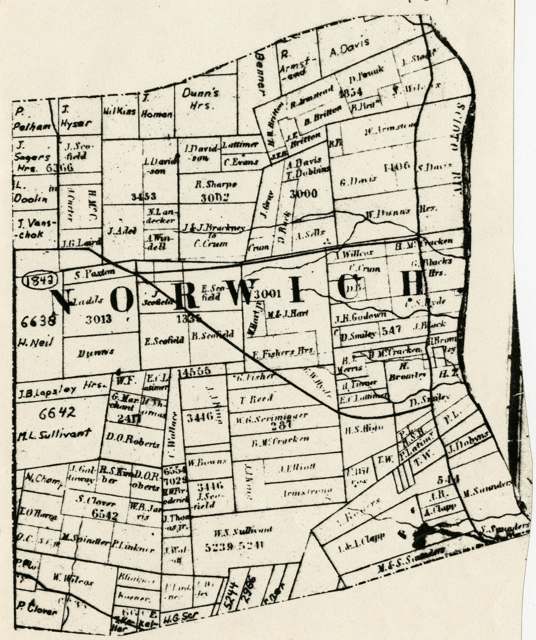
Photo: Columbus Metropolitan Library, via Digital Public Library of America / Ohio Digital Network, public domain · Wikimedia Commons
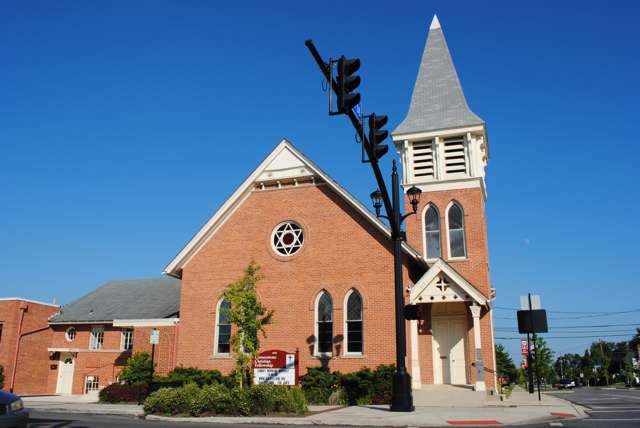
Photo: Wdzinc, via Wikimedia Commons, CC BY-SA 3.0 · Wikimedia Commons
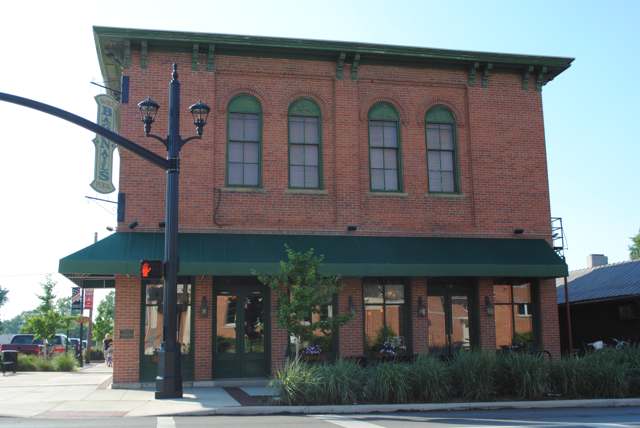
Photo: Wdzinc, via Wikimedia Commons, CC BY-SA 3.0 · Wikimedia Commons
Photo: Nyttend, via Wikimedia Commons, public domain · Wikimedia Commons
Local history sources: archive.org · en.wikipedia.org · en.wikipedia.org · en.wikipedia.org · commons.wikimedia.org · commons.wikimedia.org · commons.wikimedia.org · commons.wikimedia.org
Water
Scioto River intake at the plant on Dublin Rd, a few miles below Griggs Dam, opposite Marble Cliff The water here
- Columbus Public Water System99% of residentsScioto River (Griggs & O'Shaughnessy), Hoover Reservoir on Big Walnut Ck, plus wells
- Sanitary District #41% of residentsScioto River (Griggs & O'Shaughnessy), Hoover Reservoir on Big Walnut Ck, plus wells
- Aqua Ohio - Timberbrook Pw0% of residentsGroundwater wells (2 wells)
- Suburbans Community MHP0% of residentsGroundwater wells (2 wells)
Its ZIP codes
Each ZIP code that touches Norwich Township, Franklin County, with the share of its residents who live here and the same headline figures as the ZIP page.
| ZIP | Share | Water | Radon | Home value | Schools | Flood |
|---|---|---|---|---|---|---|
| 43026 Hilliard | 3% | Scioto River intake at the plant on Dublin Rd, a few miles below Griggs Dam, opposite Marble Cliff | 6.2 pCi/L average radon | Median year built 1995 | Hilliard City · 4 stars overall | 3.0% of residents in the 1% floodplain |
| 43221 Upper Arlington and Columbus | 3% | Scioto River intake at the plant on Dublin Rd, a few miles below Griggs Dam, opposite Marble Cliff | 7.0 pCi/L average radon | Median year built 1959 | Upper Arlington City · 5 stars overall | 1.6% of residents in the 1% floodplain |
| 43228 Columbus | 2% | Scioto River intake at the plant on Dublin Rd, a few miles below Griggs Dam, opposite Marble Cliff | 5.0 pCi/L average radon | Median year built 1988 | South-Western City · 3 stars overall | 1.4% of residents in the 1% floodplain |
The county
Franklin County: 45 ZIP codes, 42 cities, villages and townships, 1,356,733 people.
Nearby places
Cite this page
Cite this page as:
Cracked Buckeye (Open Shower Co), "Norwich Township, Franklin County", https://crackedbuckeye.com/place/norwich-township-franklin-county/, built 2026-09-16, accessed [date].
Machine-readable: /api/place/norwich-township-franklin-county.json (open JSON, CC BY 4.0 for the compilation; the underlying records keep their own terms) · How to cite · Report a correction · Built 2026-09-16