How Dublin began
Dublin began as a pioneer river settlement on the Scioto: Ludwick Sells and his sons made the first settlement in Washington Township on this site in 1801 or 1802, and Ludwick's son John Sells brought his own family in 1808 to claim the family's 400-acre tract. Around 1810 Sells had the land surveyed into village lots by his business partner John Shields, an Irish immigrant, who was given the honor of naming the town and chose Dublin after his own birthplace; the plat was advertised for sale in 1818. A few miles from the new settlement, the Wyandot leader Shateyaronyah, known to settlers as Leatherlips, was executed by fellow Wyandot in June 1810 for refusing to join Tecumseh's resistance movement, a killing remembered today by a sculpture in Dublin's Scioto Park. The village incorporated in 1855, let that lapse within a year, and incorporated again for good in 1881; it stayed a small farm town for another century until Interstate 270 and corporate offices turned it into a fast-growing Columbus suburb, officially a city from August 1987. Dublin's own water system is not municipal: the City of Columbus supplies water to all Dublin homes and businesses on the public system.
Settled 1801 (some sources say 1802), platted 1810, incorporated 1881 (first incorporated 1855, but that arrangement lapsed within a year), by Ludwick Sells and his sons made the district's first settlement; his son John Sells owned and platted the founding 400 acres; Sells's surveyor and business partner John Shields laid out and named the town.
Where the name comes from
Every source found in this research credits the name to John Shields, not to John Sells. Shields was an Irish immigrant, a surveyor, and John Sells's business partner; when Sells had his 400-acre tract surveyed into village lots around 1810, he gave Shields the honor of naming the new town, and Shields chose the name of his own birthplace, Dublin, Ireland. The flowery version of Shields's words often quoted today ('the beaming of the sun on the hills and dales surrounding this beautiful valley') traces to a 2011-era Ohio Magazine retelling, not a contemporary record, but the core claim is corroborated independently by the 1880 county history, which likewise says the village 'was platted by John Shields, an Irishman, and a good surveyor. He asked the privilege of naming the town, which was granted him, and he said he would name it after the city in Ireland in which he was born, Dublin.' No source opened in this research attributes the naming to John Sells himself or mentions a comparison between the Scioto and Ireland's River Liffey; that version, if it circulates locally, was not confirmed here.
Before the town
Native people were present in the Scioto valley around Dublin long before the Sells family arrived. Adena or Hopewell mound builders (roughly 800 BC to AD 500) left an earthwork recorded today as the Holder-Wright Works, on the east side of the Scioto off Bright Road. By the late 1700s the Wyandot held this stretch of the river; Wyandot families camped seasonally on Indian Run, just above the later village, and travelers on the trail between Upper Sandusky and the trading post at Franklinton passed along the Scioto with furs and maple sugar to trade. The Wyandot leader Shateyaronyah, known to settlers as Leatherlips, had signed the 1795 Treaty of Greenville and favored peace with the settlers pouring into Ohio; that stance put him at odds with the resistance movement led by Tecumseh and his brother Tenskwatawa, the Shawnee Prophet, and in June 1810 a Wyandot party executed him on a charge of witchcraft near the new Sells settlement, on ground close to present-day Dublin, despite John Sells's attempt to buy his life. The Wyandot were removed from Ohio to Kansas in 1843; a Dublin-area historical timeline states that one family, Bill Moose's, remained in the area near present-day Highbanks Park. Franklin County's fuller native history, including earlier cultures, other nations, and the treaties that ceded the county, is in the county file.
Nations recorded here: Wyandot, Shawnee, Lenape (Delaware), Hopewell culture, Adena culture.
- Holder-Wright Works (earthwork) — off Bright Road, east of the Scioto River, Dublin, Adena or Hopewell culture, roughly 800 BC to AD 500 (en.wikipedia.org)
- Wyandot camp on Indian Run (camp) — Indian Run, just above (north of) the village of Dublin, where it flows into the Scioto, early 1800s until Wyandot removal in 1843 (archive.org)
- Leatherlips execution and burial site (burial) — near the Scioto River at the Sells settlement, present-day Dublin; the Wyandot Club's 1889 memorial stood at the southeast corner of Riverside Drive and Stratford Avenue, and a 1990 monument stands in Scioto Park, June 1810 (memorial 1889; monument dedicated 1990) (dublinohiousa.gov)
Timeline
- — Wyandot leader Shateyaronyah (Leatherlips) signs the Treaty of Greenville, ceding most Wyandot land in Ohio and pledging peace with the United States.
- — Ludwick Sells and his sons Samuel, Peter, Benjamin and William make the first settlement in Washington Township at the site later platted as Dublin (some sources say 1802).
- — John Sells brings his own family to the settlement to claim the 400 acres his brothers Peter and Benjamin had bought in his name in 1801-02.
- — Fletcher Sells, son of John Sells, is born in March, recorded as the first child born in the township.
- — Leatherlips (Shateyaronyah) is tried on a charge of witchcraft and executed by a Wyandot party near the Sells settlement, on the Scioto close to present-day Dublin.
- — John Sells has his land surveyed into village lots by his business partner John Shields, an Irish immigrant, who is given the honor of naming the town and chooses Dublin, after his own birthplace.
- — John Sells and George Ebey build Dublin's first flour mill, with an attached sawmill, on the Scioto River.
- — Sells advertises two hundred lots for sale in Dublin in the Columbus Gazette on three years' credit; the 1880 county history likewise dates the village's formal laying-out to this year.
- — The Wyandot are removed from Ohio to Kansas; a Dublin-area historical account states that the family of Bill Moose remained in the area, near present-day Highbanks Park.
- — Dublin incorporates as a village for the first time, electing Z. Hutchinson mayor and William Graham recorder; the arrangement proves unpopular and lapses within a year.
- — Dublin incorporates as a village a second time, an arrangement that lasts.
- — The Wyandot Club erects a memorial to Leatherlips near the traditional site of his execution, at the southeast corner of Riverside Drive and Stratford Avenue.
- — Dublin, grown rapidly after Interstate 270 and the arrival of corporate headquarters, is declared a city in August after passing 5,000 residents.
- — The Dublin Arts Council dedicates Ralph Helmick's twelve-foot limestone Leatherlips monument in Scioto Park on July 1.
- — Malcolm Cochran's sculpture 'Field of Corn (with Osage Orange Trees)' is dedicated on former Frantz family farmland, commemorating Sam Frantz's hybrid seed-corn research rather than the Sells family's founding of the town.
Stories
The execution of Leatherlips
Shateyaronyah, a Wyandot leader of the Porcupine Clan whom settlers called Leatherlips because his word was said to be as reliable as leather, signed the Treaty of Greenville on August 3, 1795, and spent his later years urging peace with the settlers pouring into the Scioto valley. That accommodation put him at odds with the pan-Indian resistance that Tecumseh and his brother Tenskwatawa, the Shawnee Prophet, were building against American expansion, and in June 1810 a party of Wyandot tried him near the young Sells settlement on a charge of witchcraft that his own biographers, and the frontier missionary John Heckewelder, called false. John Sells and other settlers pleaded for his life and offered a horse worth about $150 to buy his freedom; the offer was refused. Leatherlips washed, dressed in his finest clothes, sang his death song, prayed alongside his executioner, and was killed with a tomahawk, then buried in a grave dug just steps from his own cabin. Accounts differ on exactly who struck the blow: Roundhead and Tarhe, both his clan relatives, are traditionally blamed, but a Wyandot source instead names a Michigan Wyandot named Peter Gould, and historians doubt Roundhead and Tarhe were involved at all. The Wyandot Club placed a memorial near the traditional execution site in 1889, and in 1990 the Dublin Arts Council dedicated a twelve-foot limestone portrait of the chief by Boston sculptor Ralph Helmick in Scioto Park, where it still stands.
The Sells settlement, and the 'field of corn'
Ludwick Sells and his sons Samuel, Peter, Benjamin and William, recently arrived from Huntingdon County, Pennsylvania, made what an 1880 county history calls 'the first settlement in Washington township... at the present village of Dublin, in 1801 or 1802,' camping near a spring by what is now the Dublin bridge until they could raise cabins on ground high enough to escape the Scioto's floods. A sixth brother, John Sells, followed with his own family in the fall of 1808 to claim the 400 acres his brothers had bought in his name; around 1810 he had the tract surveyed into village lots. Dublin is popularly associated with corn today because of 'Field of Corn (with Osage Orange Trees),' 109 six-foot concrete ears standing in rows in a Dublin park, but that landmark has nothing to do with the Sells family or any Native American cornfield. Sculptor Malcolm Cochran created it in 1994 for the Dublin Arts Council on land that had belonged to Sam and Eulalia Frantz, whose mid-twentieth-century farm there was a pioneering site for hybrid seed-corn research; Cochran meant it to mark the passing of that recent farmland, not the town's 1801 founding. No source opened in this research documents an older legend of the Sells family finding, or being shown, a Native American cornfield along the Scioto; if such a story circulates locally, it was not confirmed here and should not be confused with the 1994 artwork.
The Sells brothers run away to the circus
Around 1870, according to the City of Dublin's own history page, four great-grandsons of Ludwick Sells went into the circus business. Ephraim, Lewis, Peter and Allen Sells launched their show as a wagon circus in 1871 and gave their first performance in Columbus on April 27, 1872. Based at 'Sellsville,' their winter quarters along the Olentangy River near King Avenue in Columbus, the Sells Brothers Circus grew through the 1870s and 1880s into, for a time, one of the largest circuses in the country. Peter Sells served as the show's advance man, handling railroad contracts, routing and advertising ahead of each stop. The City of Dublin's history page says the family operated 'the largest circus in the world for a time, finally closing in 1905'; other accounts place the circus's merger into Adam Forepaugh's show closer to 1900, after which the Sells name lived on through the later Sells-Floto Circus.
A false alarm on Indian Run
Wyandot families regularly camped along Indian Run, just above Dublin, for part of the year in the early 1800s, and parties travelling the trail between Upper Sandusky and Franklinton often passed through with furs and maple sugar to trade. Despite that steady Native presence, 'no Indian massacre ever occurred here,' the 1880 county history states, though fear of one nearly emptied the settlement once, around the time of the War of 1812. A young woman named Susan Sells, staying at the King family's cabin on Indian Run, asked Jacob Ebey to load a gun for her so she could learn to shoot. Mrs. Samuel Sells heard the shot near evening and, certain the Kings were being murdered, sent her stepson Daniel Sells racing to spread the alarm while she hurried her own family toward safety. The alarm spread through the township and settlers started for Franklinton before Jacob Ebey, fresh from the plowing he had been doing when Susan borrowed his gun, arrived to explain the misunderstanding and calm the panic.
Incorporated twice
Dublin first incorporated as a village in 1855, electing Z. Hutchinson mayor and William Graham recorder. 'The municipal organization did not become popular, and after a year's trial it was given up,' the 1880 county history reports, and Dublin reverted to plain Washington Township governance. The village incorporated again in 1881, this time for good, and remained a small farm town, just 681 residents as late as 1970, for another century. Interstate 270 and the arrival of corporate headquarters such as Ashland Inc. and Wendy's International, along with the Muirfield Village golf community, then drove rapid growth through the 1970s and 1980s. Dublin annexed parts of four townships across three counties during that boom and was declared a city in August 1987, after passing 5,000 residents.
Photographs
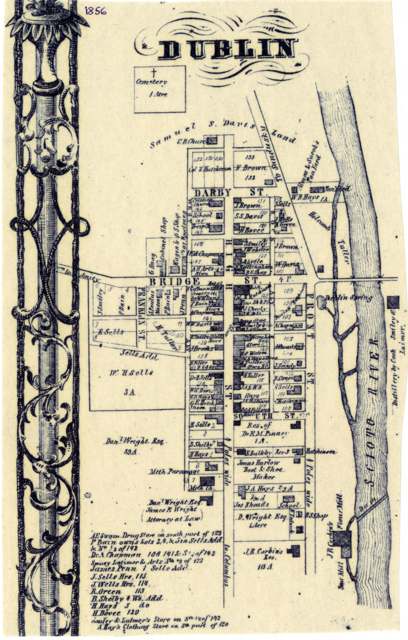
Photo: John Graham, Esq. (surveyor), published by R. C. Roots Jr.; contributed to Wikimedia Commons by the Columbus Metropolitan Library via the Digital Public Library of America, public domain · Wikimedia Commons
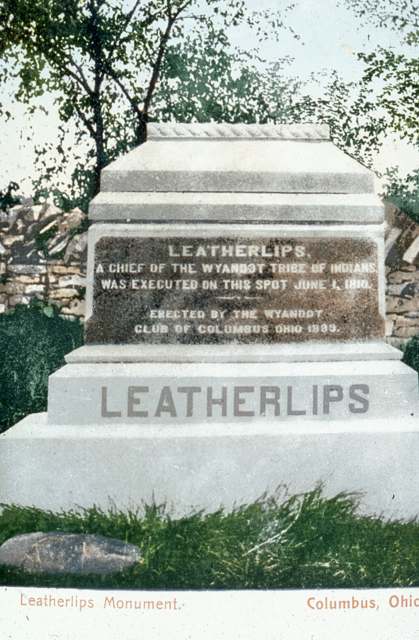
Photo: Contributed to Wikimedia Commons by the Columbus Metropolitan Library via the Digital Public Library of America, public domain · Wikimedia Commons
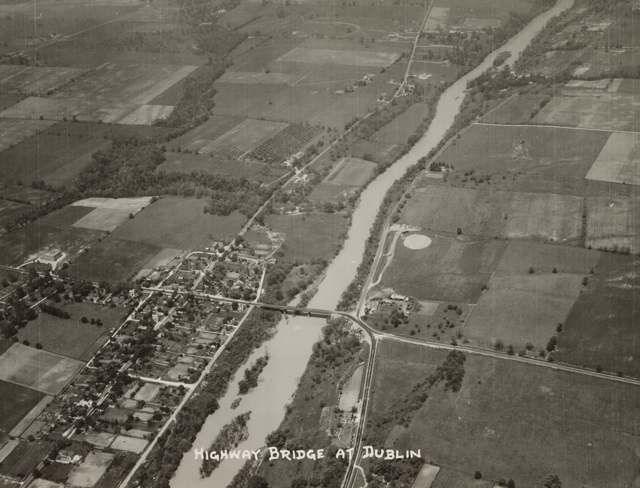
Photo: U.S. National Archives and Records Administration, public domain · Wikimedia Commons
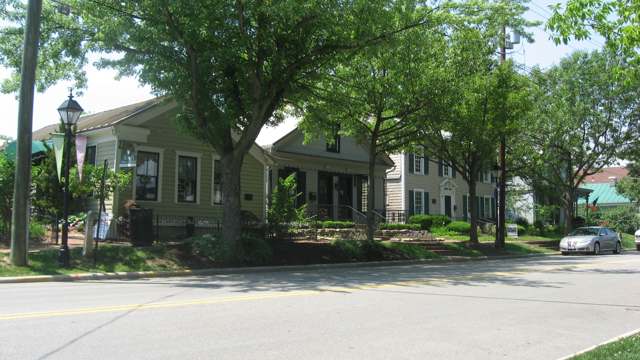
Photo: Nyttend, public domain · Wikimedia Commons
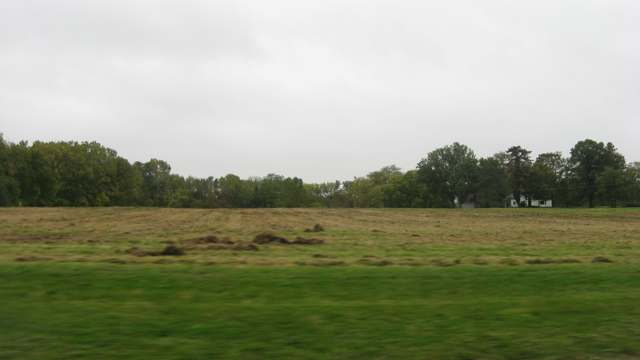
Photo: Nyttend, public domain · Wikimedia Commons
Local history sources: en.wikipedia.org · en.wikipedia.org · en.wikipedia.org · en.wikipedia.org · en.wikipedia.org · en.wikipedia.org · dublinohiousa.gov · dublinohiousa.gov · dublinohiousa.gov · dublinchamber.org · visitdublinohio.com · dublinohiohistory.org · columbusneighborhoods.org · sites.google.com · archive.org · wosu.org · commons.wikimedia.org · commons.wikimedia.org · commons.wikimedia.org · commons.wikimedia.org · commons.wikimedia.org
Water
Big Walnut Creek at the plant's low-head dam and screen house on Morse Rd, below Hoover Dam The water here
- Columbus Public Water System96% of residentsScioto River (Griggs & O'Shaughnessy), Hoover Reservoir on Big Walnut Ck, plus wells
- Del-co Water Company, Inc.4% of residentsOlentangy River, O'Shaughnessy and Alum Creek reservoirs, plus Knox County wells
- Hayden Heights MHP0% of residentsGroundwater wells (2 wells)
- Marysville City0% of residentsMill Creek via Marysville Reservoir (Raymond Rd) + wells
- Country Side Mobile Home0% of residentsGroundwater wells
Its ZIP codes
Each ZIP code that touches Dublin, with the share of its residents who live here and the same headline figures as the ZIP page.
| ZIP | Share | Water | Radon | Home value | Schools | Flood |
|---|---|---|---|---|---|---|
| 43017 Dublin | 65% | Big Walnut Creek at the plant's low-head dam and screen house on Morse Rd, below Hoover Dam | 6.7 pCi/L average radon | Median year built 1988 | Dublin City · 4.5 stars overall | 1.1% of residents in the 1% floodplain |
| 43016 Columbus and Dublin | 47% | Big Walnut Creek at the plant's low-head dam and screen house on Morse Rd, below Hoover Dam | 5.8 pCi/L average radon | Median year built 2002 | Dublin City · 4.5 stars overall | 0.3% of residents in the 1% floodplain |
The county
Franklin County: 45 ZIP codes, 42 cities, villages and townships, 1,356,733 people.
Nearby places
Cite this page
Cite this page as:
Ohio Hometown Atlas (Open Shower Co), "Dublin, Franklin County", https://hometownatlas.openshowerco.com/place/dublin/, built 2026-09-15, accessed [date].
Machine-readable: /api/place/dublin.json (open JSON, CC BY 4.0 for the compilation; the underlying records keep their own terms) · How to cite · Report a correction · Built 2026-09-15