How Kirkersville began
Kirkersville was platted in 1832 by Dr. William C. Kirker on land he owned at the mouth of Bloody Run on the South Fork of the Licking, along the newly built National Road in Harrison Township, which itself was set off from Union Township in 1816. Like other towns along the National Road, it boomed briefly on construction traffic and tavern trade before railroads pulled commerce away, and it grew to a settled village of a few hundred people supporting Presbyterian, Methodist Episcopal and Baptist congregations by 1880. Two centuries after its founding, the village became known nationally for a tragedy rather than its history: on May 12, 2017, a gunman killed the village's police chief and two nursing-home employees before killing himself at the Pine Kirk Care Center, a nursing facility inside the village. The surrounding countryside once hosted the largest organized hunt in county memory, a single-day 1823 drive that killed a bear, three wolves, forty-nine deer and sixty or seventy wild turkeys on land just north of the village.
Platted 1832, by Dr. William C. Kirker.
Where the name comes from
The village was named for its founder, Dr. William C. Kirker, who platted it on land he owned at the mouth of Bloody Run on the National Road.
Before the town
The 1881 county history records that Mound Builders left a few surviving works near Kirkersville, including two small mounds on the "Refugee road" about half a mile north of the village, one later plowed away and one still visible in 1880. Indians occupied the surrounding territory only in limited numbers by the time of white settlement, using it for hunting, fishing and trapping rather than permanent residence; the county history attributes this hunting traffic to Indians it says had a permanent camp at Raccoon Town, near the headwaters of Raccoon Creek in what is now Monroe Township, and notes an Indian trail, not heavily used, crossing the township along South Fork toward "Little" and "Big" Lake, the body of water later dammed to become the Licking Reservoir (Buckeye Lake). No source found names a specific historic nation for this trail or camp, and no county-level file yet exists for Licking to point to for the wider regional and treaty history.
- Mounds on the Refugee road (mound) — about half a mile north of Kirkersville, unspecified Mound Builder era (archive.org)
- Indian trail toward Raccoon Town and the Reservoir lakes (trail) — crossing Harrison Township along South Fork of the Licking, pre-settlement, used by hunters based at Raccoon Town (Monroe Township) (archive.org)
Timeline
- — Harrison Township is organized out of the territory of Union Township, with an added strip of Refugee tract land giving it an outlet into Fairfield County; this addition contains the future site of Kirkersville.
- — The county's largest organized wolf hunt drives a four-mile-square tract just north of the future village, ending with a bear, three wolves, forty-nine deer, sixty or seventy turkeys and one owl killed.
- — Dr. William C. Kirker plats the village of Kirkersville on the newly built National Road, at the mouth of Bloody Run.
- — In the fall, a subscription is raised to build Kirkersville's Presbyterian church; the building is not used until 1842 and not finished and dedicated until March 1845.
- — Forty-four members living near Kirkersville organize the First Presbyterian Church of Kirkersville as a separate congregation.
- — The village's census population reaches three hundred and forty-nine; it supports three churches, three or four stores, a hotel and a planing mill.
- — Thomas Hartless shoots and kills police chief Steven Eric Disario, then enters the Pine Kirk Care Center nursing home and kills two employees, Marlina Medrano and Cindy Krantz, before killing himself.
Stories
The Great Wolf Hunt of 1823
Fed up with wolves raiding their sheep folds and pig pens, the people of Licking County organized a single coordinated hunt in 1823 across a four-mile-square tract just north of the future site of Kirkersville, most of it inside "Gibbon's deadening," fifteen hundred acres of standing dead timber left from an early land-clearing contract and grown up into the thickest possible cover. County surveyor James Holmes laid out and blazed the lines, posted trumpeters at intervals to signal when the ring was complete, and gave the county's hunters one instruction above all others: bring your dinner, but "no whiskey is to be allowed on the ground." At sunrise a huge crowd formed the outer lines and began marching inward, deer breaking from the brush almost immediately and drawing continuous rifle fire, while the more cautious wolves hung back and were rarely hit until the ring tightened. When the lines finally closed on a quarter-mile square centered on Grass Lick Run, the best marksmen went in alone to finish the work, and the day's kill, piled up at the center for all to see, came to one large black bear, three wolves, forty-nine deer, sixty or seventy wild turkeys and a single owl, divided among the participants by lot. Not a man on the ground, the county historian noted with evident satisfaction, was seen intoxicated all day, itself considered remarkable for the times.
May 12, 2017
Just before dawn, Kirkersville police chief Steven Eric Disario responded alone to a report of an armed man near the village's Pine Kirk Care Center nursing home. He exchanged gunfire with Thomas Hartless, a forty-three-year-old man with a criminal record dating back to 1992 and an active civil protection order against him sought by a nursing-home employee, Marlina Medrano. Disario was fatally wounded. Hartless then entered the facility and shot and killed Medrano and fellow employee Cindy Krantz before turning the gun on himself. Governor John Kasich called the shooting "horrific" and ordered state flags flown at half-staff through May 16; the village's elementary school, a short distance away, was placed on lockdown as the situation unfolded. Disario, a father of six with a seventh child on the way, and Krantz, a mother of five, were among the four people who died in a village whose entire population, per the 2020 census, numbers only in the low hundreds.
Photographs
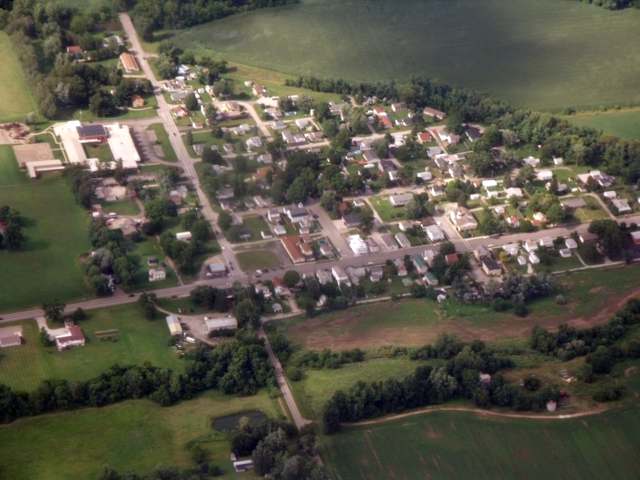
Photo: Ibagli, via Wikimedia Commons, public domain · Wikimedia Commons
Local history sources: archive.org · en.wikipedia.org · en.wikipedia.org · en.wikipedia.org · commons.wikimedia.org
Water
Wells drawing from the Raccoon Creek Valley buried aquifer serving Etna, Pataskala, and Reynoldsburg-area customers The water here
- Licking Regional Water District86% of residentsRaccoon Creek Valley aquifer (local wells)
- Millersport Village14% of residentsGroundwater wells (4 wells)
- Buckeye Lake, Village Of1% of residentsGroundwater wells (4 wells)
Its ZIP codes
Each ZIP code that touches Kirkersville, with the share of its residents who live here and the same headline figures as the ZIP page.
| ZIP | Share | Water | Radon | Home value | Schools | Flood |
|---|---|---|---|---|---|---|
| 43033 Kirkersville | 92% | Wells drawing from the Raccoon Creek Valley buried aquifer serving Etna, Pataskala, and Reynoldsburg-area customers | 11.8 pCi/L average radon | Median year built 1930 | Southwest Licking Local · 4 stars overall | 20% of residents in the 1% floodplain |
| 43046 Walnut Township and Millersport | 4% | Mostly private wells | 4.7 pCi/L average radon | Median year built 1960 | Walnut Township Local · 2.5 stars overall | 18% of residents in the 1% floodplain |
The county
Licking County: 17 ZIP codes, 38 cities, villages and townships, 160,939 people.
Nearby places
Cite this page
Cite this page as:
Cracked Buckeye (Open Shower Co), "Kirkersville, Licking County", https://crackedbuckeye.com/place/kirkersville/, built 2026-09-16, accessed [date].
Machine-readable: /api/place/kirkersville.json (open JSON, CC BY 4.0 for the compilation; the underlying records keep their own terms) · How to cite · Report a correction · Built 2026-09-16