Notable people · Native Leader · Military
Blue Jacket (Weyapiersenwah)
Shawnee war leader who, with the Miami leader Little Turtle, led the Native confederacy that destroyed Arthur St. Clair's army in 1791 and commanded it at Fallen Timbers in 1794.
Born c. 1743, Unknown. Wikipedia's infobox gives present-day Ross County, Ohio, but the Dictionary of Canadian Biography gives no birthplace and only 'the mid 18th century'.
Died c. 1810, Probably the Detroit River region
At a glance
- Born
- c. 1743, Unknown. Wikipedia's infobox gives present-day Ross County, Ohio, but the Dictionary of Canadian Biography gives no birthplace and only 'the mid 18th century'. source
- Died
- c. 1810, Probably the Detroit River region source
- Also known as
- Weyapiersenwah, Weyapiersenwaw, Weyapurseawaw, Wawayapiersenwaw
- Known as
- Native Leader, Military
Life story
Blue Jacket, or Weyapiersenwah, was a Shawnee war chief who lived at a town on Deer Creek in what is now Ross County, Ohio. He first appears in the records in the 1770s.
He fought in Dunmore's War in 1774 and on the British side in the Revolution. In 1790 and 1791 he helped lead the confederacy that beat Harmar and then St. Clair on the Wabash.
He lost to Anthony Wayne at Fallen Timbers on August 20, 1794, signed the Treaty of Greenville in 1795, and signed the Fort Industry treaty in 1805.
A legend says he was a captured white man named Marmaduke Van Swearingen, but a 2006 DNA study rejected it. A long-running outdoor drama about him played in Xenia from 1981 to 2007. His burial place is not known.
Ohio ties
- Deer Creek near Williamsport (1773)
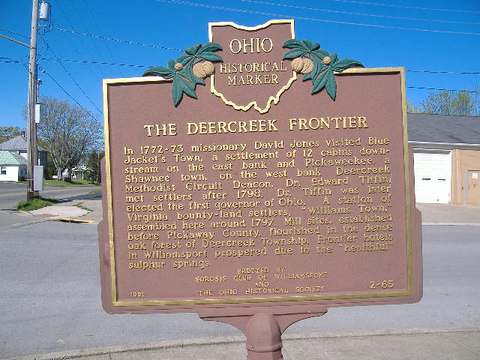
missionary David Jones visited Blue Jacket's Town, 12 cabins on the east bank of Deer Creek, downstream of present Williamsport Pickaway County · source - Bellefontaine (c. 1777-1786)
built Blue Jacket's Town on the site of the present city; Benjamin Logan's Kentucky militia burned it in 1786 Logan County · source - Upper Mad River towns, West Liberty area (1770s-1780s)
one of the ten Shawnee villages of the upper Mad River that included the homes of Moluntha, Black Hoof and Blue Jacket Logan County · source - Fort Recovery (1791, 1794)
led warriors with Little Turtle at St. Clair's defeat; took overall command after the failed attack on Fort Recovery in June 1794 Mercer County · source - The Glaize (mouth of the Auglaize, present Defiance) (1792-1794)
kept a village on the Maumee just below the mouth of the Auglaize Defiance County · source - Fallen Timbers, Maumee (1794)
led the confederacy defeated by Anthony Wayne's Legion on August 20 Lucas County · source - Greenville (1795; c. 1806)
signed the Treaty of Greenville; later lived for a time with Tecumseh and Tenskwatawa at their Greenville town Darke County · source - Auglaize River near Wapakoneta (after 1795)
moved there after living for a time near Fort Wayne Auglaize County · source - Fort Industry, present Toledo (1805)
signed the July 4 treaty ceding lands in northern Ohio Lucas County · source - Chillicothe (1807)
one of the Native emissaries who visited the Ohio government Ross County · source - Xenia (1981-2007)
site of the outdoor drama 'Blue Jacket', built on the Van Swearingen legend Greene County · source
Timeline
- 1773 In January the missionary David Jones visited 'Blue Jackets Town' near the Scioto, one of the earliest mentions of him in colonial records. source
- 1774 Was one of the Native leaders at the Battle of Point Pleasant in Dunmore's War. source
- 1778 By this year his Scioto town was deserted and he had a new town on the site of present Bellefontaine. source
- 1786 Benjamin Logan's Kentucky militia burned his Bellefontaine town, and he moved northwest toward the Maumee. source
- 1787 Negotiated with Kentuckians at Limestone (Maysville, Kentucky), though he was raiding Kentucky again by 1788. source
- 1790 With Little Turtle, led the warriors who defeated Josiah Harmar's army near the Miami towns at present Fort Wayne. source
- 1791 On November 4, warriors led by Little Turtle and Blue Jacket killed or wounded nearly three-quarters of St. Clair's army at present Fort Recovery. source
- 1792 Kept a village on the Maumee just below the mouth of the Auglaize, at the multi-nation settlement known as the Glaize. source
- 1794 Took over general command from Little Turtle after the failed attack on Fort Recovery in June, and led the confederacy at Fallen Timbers on August 20. source
- 1795 Signed preliminary articles with Anthony Wayne in February and the Treaty of Greenville on August 3, as 'Weyapiersenwaw, or Blue Jacket', telling the council he was giving up his role as war chief. source
- 1796 In November, at Philadelphia, addressed the President, renouncing the British alliance and asking for an American commission to replace his British one. source
- 1801 By this year he had a home on the Detroit River. source
- 1805 Signed the Treaty of Fort Industry on July 4 at present Toledo, ceding land in the Firelands and the Western Reserve. source
- 1807 Visited Chillicothe as one of the Native emissaries to the Ohio government. source
- 1810 Died about this year, probably in the Detroit River region. source
- 1877 An account published decades after his death first claimed he was the white captive Marmaduke Van Swearingen. source
- 1981 The outdoor drama 'Blue Jacket', based on the Van Swearingen story, opened at Xenia; it ran until 2007. source
- 2006 The Ohio Journal of Science published a Y-chromosome study finding that Blue Jacket's descendants and the Swearingen family are not related in the male line. source
What Blue is known for
- Led Shawnee warriors in the Northwest Indian War
- Signed Treaty of Greenville 1795
Stories
Six towns in thirty years
Blue Jacket's life can be traced through the towns he built as settlers pushed north. In January 1773 David Jones found Blue Jacket's Town, 12 cabins on Deer Creek below present Williamsport, with the Shawnee town of Pickaweekee across the creek. By 1778 he had moved to the upper Mad River country and built a town on the site of present Bellefontaine. Benjamin Logan's Kentucky militia burned it in 1786, and he moved to the Maumee; in 1792 his village stood just below the mouth of the Auglaize at the Glaize, present Defiance. After the Treaty of Greenville he lived near Fort Wayne and then on the Auglaize near Wapakoneta, and by 1801 he had a home on the Detroit River. Each move pushed him further from the Scioto valley where colonial records first name him.
A speech at Philadelphia, 1796
In November 1796, fifteen months after he signed at Greenville, Blue Jacket was in Philadelphia addressing the President as the 'great Father of the Fifteen Fires'. He said he had fought for the British at their urging but now saw their deceit, and that the British agent Alexander McKee had told him not to trust the Americans and invited him to Quebec, which he refused. He had a testimonial of loyalty from Sir John Johnson, the British superintendent of Indian affairs, and offered to give it up for a similar paper from the President. He promised to teach his young men to keep the peace treaty. The letter survives in the John Adams papers at the Massachusetts Historical Society.
The white-captive legend on stage
In 1877, decades after Blue Jacket died, an account claimed he had been born Marmaduke Van Swearingen, a white boy captured by the Shawnee in the 1770s. The novelist Allan W. Eckert spread the story in the late 1960s, and from 1981 to 2007 the outdoor drama 'Blue Jacket' told it each summer near Xenia. Historians starting with Helen Hornbeck Tanner in 1978 pointed out that Blue Jacket was older than Van Swearingen and was already an established leader before the supposed capture, and his biographer John Sugden concluded he was Shawnee by birth. In 2006 a team of researchers compared the Y chromosomes of six male-line descendants of Blue Jacket's son George with four men from the Swearingen family and found no match.
Inventions and firsts
- Fort Recovery holds against the Western Confederacy (1794) credit is disputed
Honors and things named for them
- Blue Jacket outdoor drama, Xenia, OH (1981-2007)
- Blue Jacket's Town memorial, Ross County, OH
Named for Blue Jacket (Weyapiersenwah)
- Blue Jacket (outdoor drama, 1981-2007) (Xenia, Greene County) source
Family
- brother: Red Pole
- son: George Blue Jacket
- son: Charles Blue Jacket
Sites to know
Homes, graves, markers, museums and monuments; the numbered ones are on the map.
- 1 Ohio Historical Marker 2-65, The Deercreek Frontier
Mill St. (US 22) and Main St., Williamsport Pickaway County · source - 2 Ohio Historical Marker 11-46, Shawnee Nation in Logan County
US 68 and County Road 189, West Liberty Logan County · source - Blue Jacket's Town historical marker
Downtown Bellefontaine Logan County · source - 3 Ohio Historical Marker 4-54, St. Clair's Defeat, 1791 / Wayne's Victory, 1794
Across from 1 Fort Site Street, Fort Recovery Mercer County · source - 4 Fallen Timbers Battlefield (Ohio Historical Marker 46-48)
4949 N. Jerome Road, Maumee Lucas County · source - 5 Ohio Historical Marker 4-19, Treaty of Greene Ville 1795
Public Square, W. Main and S. Broadway, Greenville Darke County · source - 6 Ohio Historical Marker 10-48, Port Lawrence / Fort Industry, 1805
N. Summit Street and Jefferson Avenue, Toledo Lucas County · source
Ohio places
Where Blue Jacket (Weyapiersenwah) was born, lived, worked and is remembered, with the ZIP code, town and county pages for each.
- Lived: Chillicothe, Ross County (Blue Jacket's Town on Deer Creek (stand-in)) ZIP 45601 (approximate) · Chillicothe · Ross County
- Worked: Maumee, Lucas County (Fallen Timbers battle area) ZIP 43537 · Maumee · Lucas County
Myths and corrections
Things often said about Blue Jacket (Weyapiersenwah), and what the record shows.
Often said Blue Jacket was a white man, Marmaduke Van Swearingen, captured and adopted by the Shawnee.
The record The claim first appeared in an 1877 account, decades after his death, and was spread by Allan Eckert's novels and the Xenia outdoor drama. Historians from Helen Hornbeck Tanner (1978) to John Sugden (2000) note Blue Jacket was older than Van Swearingen and already a chief before the supposed capture. A 2006 Y-chromosome study of six male-line descendants of Blue Jacket and four Swearingen relatives found no match, and concluded the white-roots story is not based on reality unless the paternity of his son George is in doubt. source
Often said Blue Jacket was born in Ross County, Ohio (as Wikipedia's infobox says).
The record Neither the Dictionary of Canadian Biography nor the text of Wikipedia's own article gives a sourced birthplace; the DCB says only that he was born in the mid-18th century. The 1773 Deer Creek town is the earliest place he is recorded, which is not the same as a birthplace. source
- Legend: Blue Jacket was a captured white man, Marmaduke Van Swearingen. A 2006 DNA study reported in the Wikipedia article rejects this.
- Disputed: His birth year is given as about 1743 by Wikipedia and as 1740 in other accounts.
Documents
Primary records: patents, letters, court and government files, nominations and old county histories, each at the archive that holds it.
- Treaty of Greenville, August 3, 1795 (text, with Blue Jacket's mark as 'Weyapiersenwaw') 1795, Avalon Project, Yale Law School
- Treaty of Greenville, presidential copy sent to the Governor of Virginia, page 1 scan 1795, Library of Virginia, via Papers of the War Department
- Blue Jacket to the President, 'On Breaking Alliance with British, and Establishing Friendship with United States', page 1 scan 1796, Massachusetts Historical Society (John Adams Papers), via Papers of the War Department
- Treaty with the Wyandot, etc. (Fort Industry), July 4, 1805, signed by 'Weyapurseawaw, or Blue Jacket' 1805, Oklahoma State University Libraries (Kappler's Indian Affairs: Laws and Treaties)
- Rowland et al., 'Was the Shawnee War Chief Blue Jacket a Caucasian?', Ohio Journal of Science 106(4):126-129 2006, Ohio State University Knowledge Bank
Pictures
Free to use with the credit shown. Select a picture for the original and its license.
Public domain 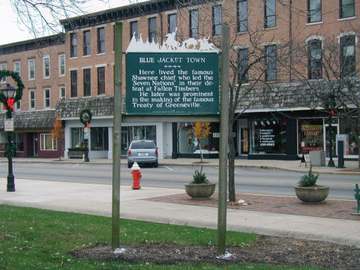
Unknown author / CC BY-SA 3.0 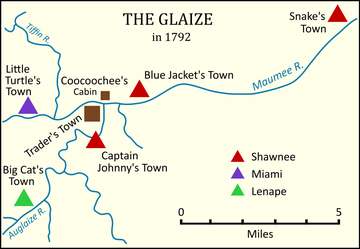
Native American towns at the Glaize in the Ohio Country in 1792. Based on Tanner, Helen Hornbeck. "The Glaize ...
Kevin1776 / CC BY-SA 4.0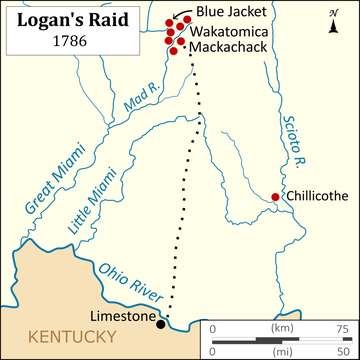
Map of Logan's Raid in 1786 in the Ohio Country.
Kevin1776 / CC BY-SA 4.0


Further reading
Sources
Confidence. Medium: the main facts were confirmed, but some details (often an address or ZIP code) were not.
- Wikipedia: Blue Jacket born c.1738-1743 Ross Co., died c.1810, Deer Creek town, Shawnee by birth, 2006 DNA study
- biographi.ca: weyapiersenwah 5E
- remarkableohio.org: 2 65 the deercreek frontier williamsport and deercreek twp
- remarkableohio.org: 11 46 shawnee nation in logan county shawnee villages in logan county
- remarkableohio.org: 4 54 st clairs defeat 1791 waynes victory 1794
- remarkableohio.org: 46 48 battle of fallen timbers
- remarkableohio.org: 4 19 treaty of greene ville 1795
- remarkableohio.org: 10 48 port lawrence fort industry 1805
- Wikipedia: Bellefontaine, Ohio
- corescholar.libraries.wright.edu
- wardepartmentpapers.org
- wardepartmentpapers.org
- avalon.law.yale.edu: greenvil
- treaties.okstate.edu: treaty with the wyandot etc 1805 0077
- nps.gov: index
- Wikimedia Commons: Blue Jackets Town Historical Marker
Every link goes to the original source. Profile researched 2026-10-15.