Notable people · Native Leader · Military
Little Turtle (Michikiniqua)
Miami war leader who, with the Shawnee Blue Jacket, destroyed Arthur St. Clair's army at present Fort Recovery in 1791, then spoke for the Miami at the Treaty of Greenville and argued for peace for the rest of his life.
Born c. 1747-1752, Miami village on the Eel River (Kineepikwameekwa Siipiiwi), about 5 miles east of present Columbia City, Whitley County, Indiana
Died July 14, 1812, Home of his son-in-law William Wells (Eepiihkaanita) at Fort Wayne (Kiihkayonki), Indiana
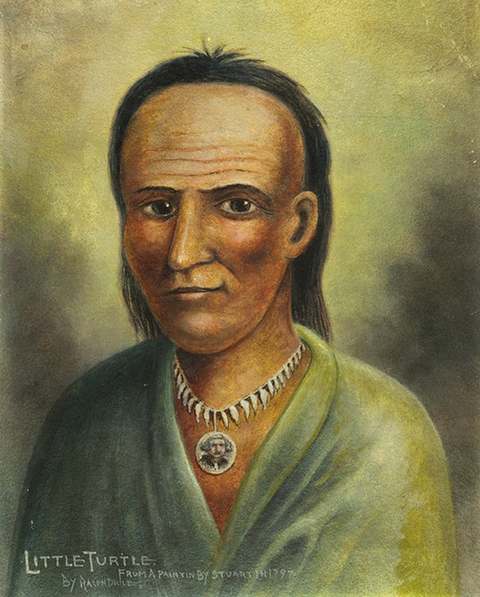
At a glance
- Born
- c. 1747-1752, Miami village on the Eel River (Kineepikwameekwa Siipiiwi), about 5 miles east of present Columbia City, Whitley County, Indiana source
- Died
- July 14, 1812, Home of his son-in-law William Wells (Eepiihkaanita) at Fort Wayne (Kiihkayonki), Indiana source
- Buried
- Kiihkayonki village burial ground near Spy Run, now the Little Turtle Memorial, Lawton Place, Fort Wayne source
- Also known as
- Mihšihkinaahkwa, Akima Mihšihkinaahkwa, Michikinakoua, Meshekunnoghquoh
- Known as
- Native Leader, Military
Life story
Little Turtle, Mihsihkinaahkwa, was a Miami war chief born near present Columbia City in Whitley County, Indiana. The Miami towns he led were centered on Kekionga, now Fort Wayne.
He led the Miami force that killed French officer Augustin de La Balme in 1780, helped defeat Harmar in 1790, and in November 1791 routed St. Clair's army near Fort Recovery, Ohio; about 623 soldiers were killed in what is called the worst loss by the US Army against Native forces.
After Fallen Timbers in 1794 he argued for peace and signed the Treaty of Greenville in 1795; his wife died during the negotiations. He later met Presidents Washington, Adams and Jefferson.
He asked Jefferson in 1802 to ban the liquor trade in Native communities. He died at Fort Wayne in 1812. A statue stands at Defiance College, and a town in Ohio carries his name.
Ohio ties
- Fort Recovery (1791, 1794)
led warriors with Blue Jacket in St. Clair's defeat on November 4, 1791; the confederacy's June 1794 attack on Fort Recovery failed Mercer County · source - Fort Jefferson (1791)
survivors of St. Clair's army fled back to this fort after the defeat by forces under Little Turtle Darke County · source - Fort St. Clair, Eaton (1792)
with about 200 warriors attacked Maj. John Adair's Kentucky militia camped outside the fort Preble County · source - The Glaize (present Defiance) (1793-1794)
moved to the multi-nation settlement at the Glaize during the 1793 campaign Defiance County · source - Fallen Timbers, Maumee (1794)
led his Miami warriors in the confederacy defeated on August 20 Lucas County · source - Greenville (1795)
Miami council speaker at the treaty; signed on August 3 as 'Meshekunnoghquoh, or Little Turtle' Darke County · source
Timeline
- 1747 Born about 1747-1752 at a Miami village on the Eel River in present Whitley County, Indiana; the exact year is unknown. source
- 1780 On November 5 destroyed Augustin Mottin de La Balme's Franco-American force after it plundered Kiihkayonki (Fort Wayne), killing La Balme and about 40 men. source
- 1790 In October ambushed Col. John Hardin near the Eel River towns and Capt. John Wyllys at a Maumee ford, defeating Josiah Harmar's expedition. source
- 1791 In August, James Wilkinson's raid captured Little Turtle's daughter. source
- 1791 On November 4, about 1,000 warriors led by Little Turtle and Blue Jacket routed St. Clair's army; U.S. losses were about 623 killed and 258 wounded. source
- 1792 On November 6, he and about 200 warriors attacked Maj. John Adair's Kentucky militia outside Fort St. Clair near present Eaton; six Kentuckians died. source
- 1793 Moved to the Glaize, at present Defiance, during the campaign. source
- 1794 After the failed attack on Fort Recovery in June he urged talks, calling Wayne 'the chief that never sleeps', and gave overall command to Blue Jacket while still leading the Miami warriors. source
- 1794 The confederacy was defeated at Fallen Timbers on August 20, and the British at Fort Miamis refused the warriors shelter. source
- 1795 As Miami council speaker at Greenville he challenged earlier treaties made without the Miami, then signed on August 3; his wife died in camp the next day. source
- 1797 Gilbert Stuart painted his portrait in Philadelphia; the painting is now lost. source
- 1798 Met the French writer the Comte de Volney in Philadelphia. source
- 1802 In a January speech to Jefferson in Washington he asked for a ban on selling liquor to Native people; Congress revised the Indian Nonintercourse Act that March. source
- 1809 After the Treaty of Fort Wayne, where he pushed to include Delaware and Potawatomi leaders in a land sale most Myaamia opposed, he was removed from civil leadership. source
- 1812 Died July 14 at William Wells's home at Fort Wayne after an army doctor treated him for gout; that September American troops burned his Eel River village. source
- 1912 Workers digging a cellar on Lawton Place in Fort Wayne disturbed his grave; the remains were reburied and the grave goods scattered. source
- 1960 A plaque was dedicated at the grave site, given to Fort Wayne as a park by Mary Catherine and Eleanor Smeltzly in 1959. source
What Little is known for
- Victory over St. Clair 1791 (Wabash, near Fort Recovery)
- Signed Treaty of Greenville 1795
Stories
Four versions of one speech at Greenville
In the summer of 1795 Mihšihkinaahkwa spoke for the Miami at Greenville, challenging earlier treaties made without the Miami and Shawnee and describing Miami lands by their rivers. In 2021 staff of the Myaamia Center compared four records of one of these speeches: the diary of army surgeon John Carmichael, the official version in the American State Papers (probably interpreted by his son-in-law William Wells), a short paraphrase sent to the British by John Askin Jr., and a translation back into the Miami language made for Jacob Piatt Dunn about 1890 by Gabriel Godfroy. Carmichael and the State Papers both record his complaint that some nations would sell their lands 'to any white man who wore a hat'. The Myaamia discussion found that Godfroy's Miami text had no word for 'nation' and used 'draw a line' for boundary, and asked whether Little Turtle was already adapting to European ideas of land and borders.
The fight at Fort St. Clair
Fort St. Clair, a 120-foot-square stockade near a spring just west of present Eaton, was built in March 1792 as a supply post for the next campaign; the future president William Henry Harrison served in the detachment that built it. On November 6, 1792, Little Turtle and about 200 warriors attacked Maj. John Adair's Kentucky militia, who were camped outside the fort. Six Kentuckians and an unknown number of warriors died. The soldiers were buried fifty paces west of the fort beneath a tree later called the Whispering Oak. The site is now Fort St. Clair State Park.
From war leader to peace speaker
The Myaamia Center's biography stresses that Mihšihkinaahkwa was first a war leader and became a civil leader only after the defeat of 1794. Before Fallen Timbers he had already concluded that the Myaamia should seek peace but could not persuade his community. His son-in-law Eepiihkaanita, William Wells, had negotiated at Fort Washington for the release of captives including his own wife and child, then scouted for the American army, and the two men worked privately toward peace. After Greenville he travelled east, met Washington, Adams and Jefferson, and in 1802 asked for an end to liquor sales to Native people. His backing of the 1809 Treaty of Fort Wayne, which shared a Miami land sale with Delaware and Potawatomi leaders, cost him his place in Miami councils.
Inventions and firsts
- Fort Recovery holds against the Western Confederacy (1794) credit is disputed
Honors and things named for them
- Statue at Defiance College, OH
- Little Turtle, Ohio (founded 1968)
- Little Turtle Memorial, Fort Wayne, IN
Named for Little Turtle (Michikiniqua)
- Turtle Creek and Turtlecreek Township (Turtlecreek Township, Warren County) source
Family
- son-in-law: William Wells
Sites to know
Homes, graves, markers, museums and monuments; the numbered ones are on the map.
- 1 Ohio Historical Marker 4-54, St. Clair's Defeat, 1791 / Wayne's Victory, 1794 (Fort Recovery State Museum)
Across from 1 Fort Site Street, Fort Recovery Mercer County · source - 2 Fort Jefferson State Memorial (Ohio Historical Marker 5-19)
121 Weavers-Fort Jefferson Road, Greenville Darke County · source - 3 Fort St. Clair State Park (Ohio Historical Marker 2-68)
135 Camden Road, Eaton Preble County · source - 4 Fallen Timbers Battlefield (Ohio Historical Marker 46-48)
4949 N. Jerome Road, Maumee Lucas County · source - 5 Ohio Historical Marker 4-19, Treaty of Greene Ville 1795
Public Square, W. Main and S. Broadway, Greenville Darke County · source - Little Turtle Memorial (grave)
634 Lawton Place, Fort Wayne, Indiana source - Indiana Historical Marker 92.1966.2, Site of Little Turtle's Miami Village
E. Old Trail Road (CR 450 E), 5 miles east of Columbia City, Whitley County, Indiana source
Ohio places
Where Little Turtle (Michikiniqua) was born, lived, worked and is remembered, with the ZIP code, town and county pages for each.
- Worked: Fort Recovery, Mercer County (St. Clair's Defeat battlefield area) ZIP 45846 · Fort Recovery · Mercer County
- Worked: Greenville, Darke County (Treaty of Greenville 1795) ZIP 45331 · Greenville · Darke County
Myths and corrections
Things often said about Little Turtle (Michikiniqua), and what the record shows.
Often said Little Turtle commanded the confederacy that destroyed St. Clair's army in 1791.
The record Little Turtle and Blue Jacket both claimed overall command, which caused tension between them; Ohio's Fort Recovery marker credits warriors 'led by Little Turtle and Blue Jacket', while the Fort Jefferson marker names only Little Turtle. The sources support joint leadership, not a single commander. source
Often said Little Turtle was the son of the older Miami leader of the same name (or of 'Aquenackwe'), and his mother was Mahican.
The record The Myaamia Center's biography rejects the claim that the elder Mihšihkinaahkwa, an adult in 1747, was his father, citing Myaamia naming practice and the lack of any primary source, and criticizes Harvey Carter's biography for accepting it. The Dictionary of Canadian Biography calls Mahican or French ancestry only a rumour, though the American Battlefield Trust states the Mahican mother as fact. source
Often said The familiar portrait of Little Turtle is Gilbert Stuart's painting of him.
The record Stuart did paint him in Philadelphia in 1797, but that painting is lost. The common image is a lithograph only 'reputedly' based on it, and sources disagree on whether the original burned with Washington in 1813 or 1814. No surviving likeness is confirmed as made from life. source
Often said Little Turtle was the head chief of the Miami.
The record He was war chief of the Atchatchakangouen division and never held the hereditary Miami head chieftainship; after 1794 he acted as a civil leader and council speaker. source
- Disputed: St. Clair's Defeat is placed at the headwaters of the Wabash River just across the line in Indiana by one source, and at Fort Recovery, Ohio, by Ohio sources.
Documents
Primary records: patents, letters, court and government files, nominations and old county histories, each at the archive that holds it.
- Treaty of Greenville, August 3, 1795 (text, with Little Turtle's mark as 'Meshekunnoghquoh') 1795, Avalon Project, Yale Law School
- Treaty of Greenville, presidential copy sent to the Governor of Virginia, page 1 scan 1795, Library of Virginia, via Papers of the War Department
- Calvin M. Young, 'Little Turtle (Me-she-kin-no-quah), the great chief of the Miami Indian nation' (Internet Archive scan) 1917, Internet Archive, via Wikimedia Commons
Pictures
Free to use with the credit shown. Select a picture for the original and its license.
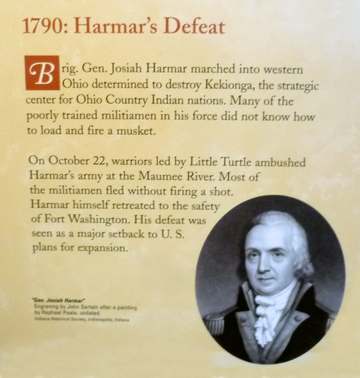
Brigadier General Josiah Harmar, Fort Pitt Museum Display
Public domain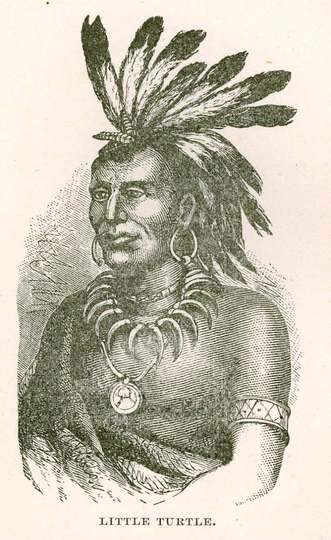
Chief Little Turtle
Public domain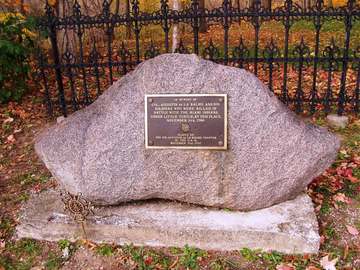
Marker commemorating LaBalme's Defeat, on Dela Balme Road in Whitley County, Indiana.
Public domain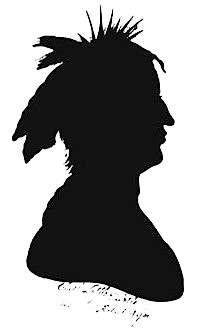
Silhouette of Little Turtle by Robert Wyer
Public domain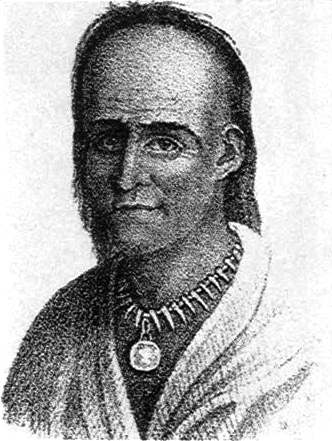
Little Turtle
Public domain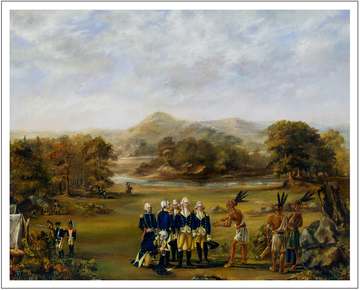
Description in the source: "Painting depicting negotiations for the Treaty of Greenville in 1795, including Ge...
Public domain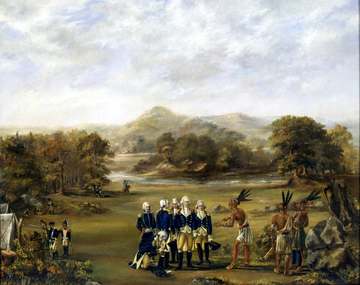
Painting of Indian Treaty of Greenville, 1795, done around the time. Note: Oil on canvas depiction of the Trea...
Public domain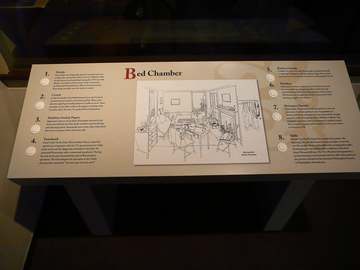
Thaddeus Kosciuszko National Memorial
User:Piotrus / CC BY 3.0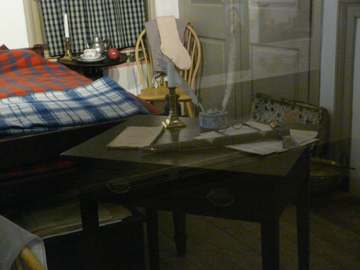
Thaddeus Kosciuszko National Memorial
User:Piotrus / CC BY 3.0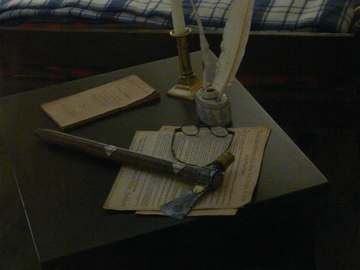
Thaddeus Kosciuszko National Memorial
User:Piotrus / CC BY 3.0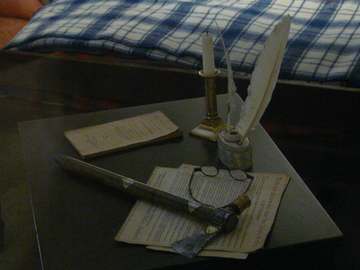
Thaddeus Kosciuszko National Memorial
User:Piotrus / CC BY 3.0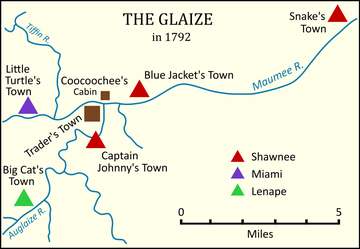
Native American towns at the Glaize in the Ohio Country in 1792. Based on Tanner, Helen Hornbeck. "The Glaize ...
Kevin1776 / CC BY-SA 4.0


Further reading
Sources
Confidence. Medium: the main facts were confirmed, but some details (often an address or ZIP code) were not.
- Wikipedia: Little Turtle birth c.1747-1752 Indiana, death July 14 1812, burial Fort Wayne, Ohio battles and treaty
- biographi.ca: michikinakoua 5E
- aacimotaatiiyankwi.org: biography of little turtle
- aacimotaatiiyankwi.org: four versions of a little turtle speech at greenville 1795
- battlefields.org: little turtle
- in.gov: site of little turtles miami village
- remarkableohio.org: 4 54 st clairs defeat 1791 waynes victory 1794
- remarkableohio.org: 5 19 fort jefferson st clairs defeat 2
- remarkableohio.org: 2 68 site of fort st clair
- remarkableohio.org: 46 48 battle of fallen timbers
- remarkableohio.org: 4 19 treaty of greene ville 1795
- avalon.law.yale.edu: greenvil
- wardepartmentpapers.org
- Wikipedia: Turtlecreek Township, Warren County, Ohio
- Wikimedia Commons: Little Turtle
- Wikimedia Commons: Little Turtle silhouette
- Wikimedia Commons: Category:Little Turtle
Every link goes to the original source. Profile researched 2026-10-15.