Notable people · Native Leader · Military
Tecumseh
Shawnee leader born in the Ohio country who organized a confederation of nations to stop U.S. expansion past the Greenville treaty line and died fighting alongside the British in 1813.
Born 1768, Shawnee country in present-day Ohio; most likely near Chillicothe (Chalahgawtha) on the Little Miami, the present Oldtown area near Xenia, though some sources say near present Springfield (Old Piqua)
Died October 5, 1813, Battle of the Thames (Moraviantown), near present Thamesville, Ontario
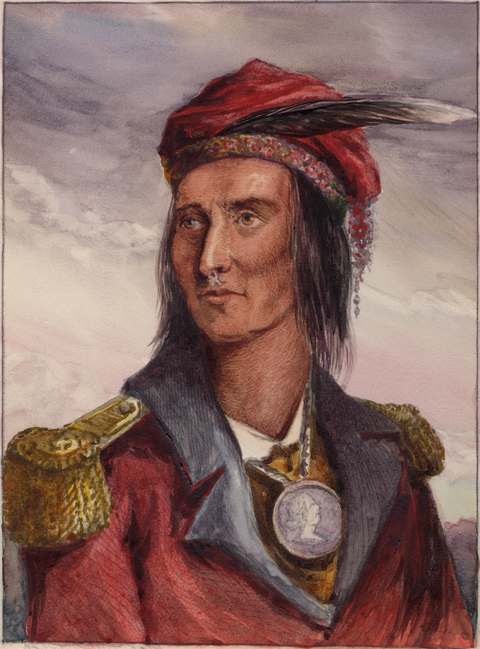
At a glance
- Born
- 1768, Shawnee country in present-day Ohio; most likely near Chillicothe (Chalahgawtha) on the Little Miami, the present Oldtown area near Xenia, though some sources say near present Springfield (Old Piqua) (Greene County) source
- Died
- October 5, 1813, Battle of the Thames (Moraviantown), near present Thamesville, Ontario source
- Buried
- Unknown; probably on or near the Thames battlefield, remains lost source
- Also known as
- Tekámthi, Tecumtha, Tecumthé, Tech-kum-thai
- Known as
- Native Leader, Military
Life story
Tecumseh was born in 1768, most likely at a Shawnee town near Chillicothe on the Scioto, though another tradition places his birth on the Mad River. His father Puckeshinwau died at the Battle of Point Pleasant in 1774, and the family moved to the Mad River near Springfield in 1777.
He fought in the Northwest Indian War, including Fallen Timbers in 1794, and watched the Treaty of Greenville give up most of Ohio. He then worked to unite Native nations so that no single group could sell land.
With his brother Tenskwatawa he set up Prophetstown in Indiana in 1808. He met William Henry Harrison at Vincennes in 1810 to protest land treaties. Harrison's forces destroyed Prophetstown at Tippecanoe in 1811 while Tecumseh was recruiting in the South.
In the War of 1812 he joined the British, helped take Detroit and fought at Fort Meigs in Ohio, and was killed at the Battle of the Thames in Upper Canada on October 5, 1813. His burial place is not known.
Ohio ties
- Oldtown (Chalahgawtha), near Xenia (1768-1780)
traditional birthplace, near the Shawnee town of Chalahgawth; site of one of Ohio's largest Shawnee settlements, now Great Council State Park Greene County · source - Fallen Timbers, Maumee (1794)
led a small Shawnee party in the battle Lucas County · source - Urbana (1799)
spoke at a council with settlers Champaign County · source - Chillicothe (1803, 1807)
councils with Ohio officials to keep the peace Ross County · source - Greenville (1805-1808)
town founded with Tenskwatawa near the Greenville treaty line Darke County · source - Fort Meigs, Perrysburg (1813)
led warriors in the British sieges of the American fort Wood County · source
Timeline
- 1768 Born, by tradition beside a spring near the Shawnee town of Chalahgawtha, as his parents travelled to a council there. source
- 1774 His father Puckeshinwau was killed at the Battle of Point Pleasant. source
- 1780 He may have witnessed the Battle of Piqua on August 8, when George Rogers Clark's army attacked the Shawnee town near present Springfield. source
- 1794 Led a small Shawnee party at Fallen Timbers, charging an American unit with a field gun and cutting loose its horses. source
- 1795 Stayed away from the Treaty of Greenville, under which the nations ceded about two-thirds of present Ohio. source
- 1799 Spoke at a council near Urbana with a force the interpreter struggled to translate. source
- 1803 At Chillicothe, repeated assurances of peace after the murder of a settler. source
- 1805 Settled with his band at Greenville at the urging of his brother Tenskwatawa, the Prophet. source
- 1806 Tenskwatawa correctly predicted the solar eclipse of June 16, after William Henry Harrison dared him to make the sun stand still. source
- 1807 Travelled with Blue Jacket to Chillicothe, then the state capital, to reassure the governor that the Greenville town posed no threat (dated 1806-1807). source
- 1808 The brothers moved to Prophetstown on the Tippecanoe River in Indiana. source
- 1813 During the first siege of Fort Meigs, arrived to stop the killing of American prisoners after Dudley's defeat. source
- 1813 Killed at the Battle of the Thames, near Moraviantown in Upper Canada, on October 5. source
- 1826 Tenskwatawa left Ohio with about 500 Shawnee from the Wapakoneta reservation for Kansas. source
- 1973 Allan Eckert's outdoor drama Tecumseh! began its run near Chillicothe. source
- 2024 Great Council State Park opened at Oldtown on June 7, built with the Eastern Shawnee Tribe of Oklahoma, the Shawnee Tribe and the Absentee Shawnee. source
What Tecumseh is known for
- Organized a pan-Indian confederacy against US expansion
- Allied with the British in the War of 1812
Stories
The Chillicothe council of 1807
In 1806 Tecumseh and his brother, then still called Lalawéthika, built a new town near the ruins of Fort Greenville, where the 1795 treaty had been signed. People from many nations came to hear the Prophet, and Ohio settlers grew alarmed. In 1806-1807 Tecumseh and the older Shawnee leader Blue Jacket travelled to Chillicothe, then the state capital, to reassure the governor that Greenville posed no threat. It was not his first such council: he had spoken at Urbana in 1799 with a force the interpreter struggled to put into English, and at Chillicothe in 1803 he repeated assurances of peace after a settler was murdered. In 1808 the brothers moved west to Prophetstown in Indiana.
Stopping the killing at Fort Meigs
On May 5, 1813, Col. William Dudley's Kentucky detachment landed on the north bank of the Maumee opposite Fort Meigs, spiked British guns, then chased retreating troops into the woods, where Tecumseh's warriors cut them up. About 550 were captured, and only 150 of Dudley's 866 men made it back to the fort. At the British camp, warriors began killing prisoners while the British commander Henry Procter did nothing. The killing stopped only when Tecumseh arrived. The Dictionary of Canadian Biography notes that his humanity that day was long remembered.
A state park at Chalahgawtha
Oldtown, in Xenia Township, stands where one of Ohio's largest Shawnee settlements once was; white settlers called the place Old Chillicothe and platted a village under that name in 1839. A 1992 state marker nearby records the tradition that Tecumseh was born beside a spring 'two arrow flights' from Chalahgawth, as his parents travelled to a council there. On June 7, 2024 Ohio opened Great Council State Park at Oldtown as its 76th state park. The Ohio Department of Natural Resources developed it with the Ohio History Connection and three Shawnee nations, the Eastern Shawnee Tribe of Oklahoma, the Shawnee Tribe and the Absentee Shawnee, to tell the story of Tecumseh and the Shawnee.
Honors and things named for them
- Tecumseh, Ontario and New Tecumseth, Ontario
- HMCS Tecumseh
- Person of national historic significance, Canada (1931)
Named for Tecumseh
- Tecumseh! outdoor drama (near Chillicothe, Ross County) source
Family
- father: Puckeshinwau
- mother: Methoataaskee
- brother: Tenskwatawa
- brother: Cheeseekau
Sites to know
Homes, graves, markers, museums and monuments; the numbered ones are on the map.
- 1 Great Council State Park
Oldtown, Xenia Township Greene County · source - 2 Ohio Historical Marker 3-29, Birthplace of Tecumseh
Old Town Reserve Park, Old Springfield Pike and US 68, Xenia Greene County · source - 3 Fallen Timbers Battlefield and Fort Miamis National Historic Site
Maumee Lucas County · source - 4 Fort Meigs
Perrysburg Wood County · source
Ohio places
Where Tecumseh was born, lived, worked and is remembered, with the ZIP code, town and county pages for each.
- Born: Springfield, Clark County (Old Piqua area on the Mad River (stand-in)) ZIP 45502 (approximate) · Springfield · Clark County
In their words
Where today are the Pequots? Where are the Narragansetts, the Mohawks, the Pocanets...?
Myths and corrections
Things often said about Tecumseh, and what the record shows.
Often said Tecumseh loved Rebecca Galloway, a settler's daughter near Xenia, and proposed to her.
The record Historian R. David Edmunds says the story first appears in the 1850s, about 35 years after Tecumseh's death, probably from the Galloway family itself, and that there is no historical evidence of any relationship. The Chillicothe pageant still uses it. source
Often said The familiar portrait of Tecumseh in a British officer's coat shows what he looked like.
The record No authenticated portrait exists. Lossing's 1868 engraving was a composite based on sketches he dated to 1808, and Lossing added a British general's uniform. Sugden still calls it the nearest thing to a likeness. source
Often said Tecumseh was born at Piqua, Ohio (the Miami County city).
The record The Old Piqua that some sources name was a Shawnee town near present Springfield in Clark County. The state marker places his birth near Chalahgawtha at Oldtown in Greene County. Wikipedia adds that an early-1900s birthplace marker at Chillicothe on the Scioto is about 50 miles off, since that town was founded after his birth. source
Often said Richard Mentor Johnson killed Tecumseh at the Thames.
The record Johnson was the first claimed killer and used the claim in politics, but other soldiers were named too. Sugden judged Johnson's claim the strongest but not conclusive, and the Dictionary of Canadian Biography says the slayer is unknown. source
Often said Tecumseh led a confederation of 50,000 warriors (as the 1992 Oldtown marker says).
The record Wikipedia, drawing on modern biographies, puts his allies across the Northwest at about 3,500 warriors by June 1812, with about 2,500 at the July 1813 Fort Meigs campaign. source
- Speeches attributed to Tecumseh were written down by others, often years later; exact wording is uncertain.
- Disputed: One tradition places his birth at Old Piqua on the Mad River near Springfield, in Clark County. Wikipedia names the Shawnee town of Chillicothe on the Scioto River, in Ross County, as the likely place.
Pictures
Free to use with the credit shown. Select a picture for the original and its license.
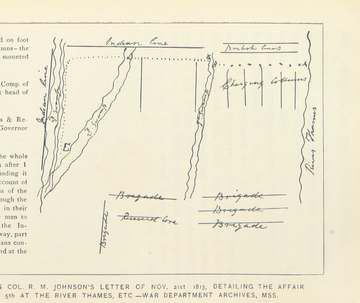
View this map on the BL Georeferencer service. Image taken from: Title: "A History of the United States for sc...
No known restrictions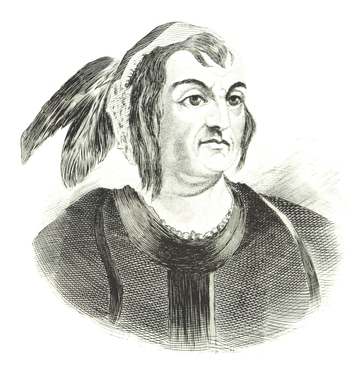
Public domain 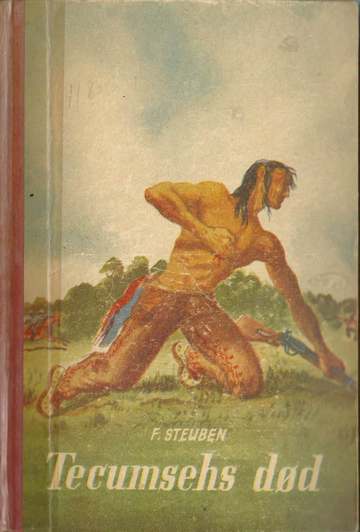
Original Book Cover scanned by Adobe Acrobat Pro and converted into .jpg.
CC0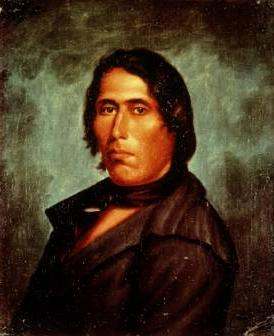
Purportedly Tecumseh, while this is not fully established.[1]
Public domain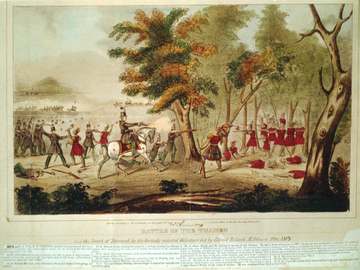
Battle of the Thames and the death of Tecumseh, by the Kentucky mounted volunteers led by Colonel Richard M. J...
Public domain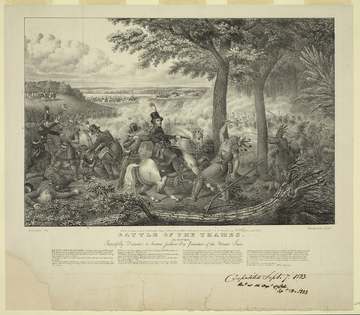
Title: Battle of the Thames. Respectfully dedicated to Andrew Jackson Esq. President of the United States / Cl...
Public domain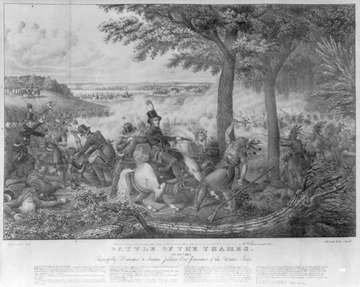
Title: Battle of the Thames. Respectfully dedicated to Andrew Jackson Esq. President of the United States Abst...
Public domain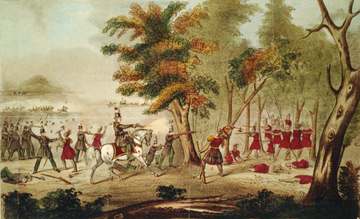
Battle of the Thames and the death of Tecumseh, by the Kentucky mounted volunteers led by Colonel Richard M. J...
Public domain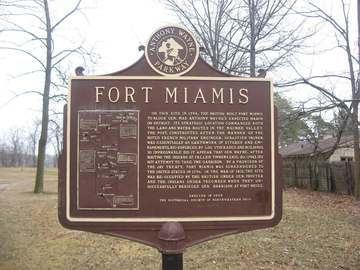
A historical marker at the site of Fort Miamis, located off River Road along the Maumee River in Maumee, Ohio,...
Public domain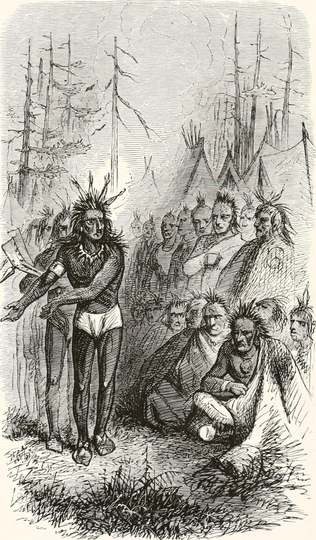
No known restrictions 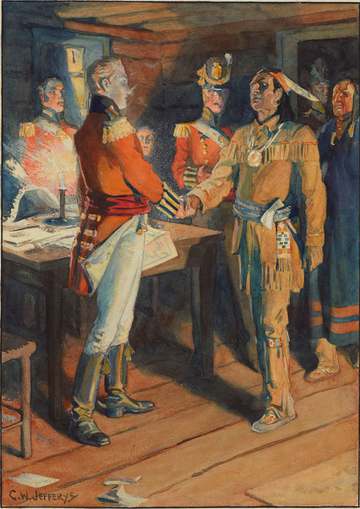
"Meeting of Brock and Tecumseh, 1812" by Charles William Jefferys (1915) depicts Tecumseh and General Sir Isaa...
Public domain
No known restrictions


Further reading
Sources
Confidence. Medium: the main facts were confirmed, but some details (often an address or ZIP code) were not.
- Wikipedia: Tecumseh birth c. March 9 1768, death Oct 5 1813 at Thames, family moved to Mad River 1777, siblings
- biographi.ca: tecumseh 5E
- remarkableohio.org: 3 29 birthplace of tecumseh
- Wikipedia: Great Council State Park
- Wikipedia: Oldtown, Ohio
- Wikipedia: Tenskwatawa
- digcoll.newberry.org: tecumseh
- Wikipedia: Fallen Timbers Battlefield and Fort Miamis National Historic Site
- Wikipedia: Fort Meigs
- Wikimedia Commons: Tecumseh02
Every link goes to the original source. Profile researched 2026-10-14.

