How Minerva Park began
Minerva Park began in 1895 as an electric-railway amusement park, built by the Columbus Central Railway Company to draw riders onto its new Columbus-to-Westerville interurban line. Conceived by company secretary-treasurer Garry Waldo Meeker and named for Minerva Shipherd, wife of company president John Shipherd, the 150-acre park drew crowds for seven seasons before closing in 1902 when the newer, closer Olentangy Park took its business. The abandoned grounds became a dumping ground for old streetcars until residential subdivision began in 1927, and homeowners incorporated the site as the Village of Minerva Park in 1940 to preserve the neighborhood's character. The lake at the park's center survives today as the village's namesake centerpiece.
Settled 1895, platted 1927, incorporated 1940, by homeowners of the former amusement-park subdivision.
Where the name comes from
The village takes its name from the amusement park that once stood on the site. The Columbus Central Railway Company named the park Minerva for Minerva Shipherd, wife of company president John Shipherd, when it opened in 1895.
Before the town
Minerva Park's own ground has no recorded pre-1895 history beyond farmland; the site did not exist as a distinct place until the railway company built its amusement park there. The surrounding area was historically part of Blendon Township, which lies within the U.S. Military District survey: the 1880 county history describes Blendon as 'one of the regularly surveyed townships of the United States military lands, ... township number two, in range of seventeen.' That chapter's account of the township's early settlement, by Connecticut and Virginia families arriving between 1806 and 1814, does not record any Native American mounds, earthworks, villages, or trails within the township. The land was opened to settlement by the Treaty of Greenville, signed August 3, 1795, in which the Wyandot, Shawnee, Lenape (Delaware), Miami, Ottawa and other nations ceded most of what is now Ohio to the United States; central Ohio's Wyandot population was concentrated well to the north, around Upper Sandusky, before removal in the 1840s.
Nations recorded here: Wyandot, Shawnee, Lenape (Delaware), Miami, Ottawa.
Timeline
- — The Treaty of Greenville cedes most of what becomes Ohio, including the future Blendon Township, to the United States.
- — Edward Phelps and Isaac Griswold's families and Ethan Palmer, arriving from Connecticut, become among the first settlers of Blendon Township, the area that later includes Minerva Park.
- — The Minerva Amusement Park opens on July 13, built by the Columbus Central Railway Company on its new Columbus-Westerville interurban line and named for Minerva Shipherd, wife of company president John Shipherd.
- — A surviving photograph documents the park's jail and water tower, lake, and dance pavilion.
- — A published photograph shows the park's Casino, built in four weeks for $50,000 with a 2,500-seat auditorium described as larger than any theater in Columbus.
- — A photograph documents the park's Scenic Railway roller coaster carrying riders along the lake to the two-story dance pavilion; the same year, rival Olentangy Park opens closer to downtown Columbus.
- — Minerva Amusement Park closes on July 27 after seven seasons, unable to compete with the newer, more accessible Olentangy Park.
- — Garry Waldo Meeker, the park's originator, dies after unsuccessfully urging Columbus officials to preserve the abandoned grounds as public parkland.
- — Construction begins on the Minerva Park residential subdivision, built over the former amusement-park grounds.
- — Homeowners incorporate the Village of Minerva Park to preserve the character of the new neighborhood.
- — The Jonathan Noble House, a log house built around 1830 and described at the time as the only known log house left in Blendon Township, is listed on the National Register of Historic Places on December 3.
Stories
An Amusement Park to Sell Streetcar Tickets
Minerva Park did not start as a place to live; it started as a way to sell train tickets. Garry Waldo Meeker, secretary and treasurer of the Columbus Central Railway Company, wanted more riders on the company's new interurban line running from Columbus to Westerville, so he built a destination at the end of it. The 150-acre amusement park opened July 13, 1895, named for Minerva Shipherd, wife of company president John Shipherd. Visitors paid fifteen cents, which included a round-trip train ticket, to reach a roller coaster called the Scenic Railway, a bowling alley, a merry-go-round, a small zoo, a nature museum, and a pony track. The centerpiece was a Casino built in just four weeks for $50,000, whose 2,500-seat auditorium was said to be larger than any theater in Columbus at the time — despite the name, no gambling or alcohol was allowed inside, and the hall was used for vaudeville shows.
Seven Summers and a Rival Park
Minerva Park's run as an amusement destination lasted only seven seasons. In 1900, Olentangy Park opened along the interurban line closer to downtown Columbus, offering an easier trip for the same kind of entertainment, and Minerva Park's attendance fell away. It closed for good on July 27, 1902. Garry Waldo Meeker, who had built the park in the first place, spent his later years trying to convince the city of Columbus to take over the site and preserve it as public parkland; the effort failed, and Meeker died in 1917 without seeing the grounds protected.
The Streetcar Graveyard
For roughly a quarter century after the rides stopped running, the old amusement park grounds served an odder purpose: a dumping ground for worn-out streetcars. Retired railway equipment was left to rust among the former midway and pavilions, an informal graveyard for the very technology that had built the park in the first place. The site sat this way, unused for any real purpose, until residential development finally reached it in the late 1920s.
From Amusement Park to Village
Construction of the Minerva Park residential subdivision began in 1927, turning the former midway into curving streets of houses built around the surviving lake. By 1940, enough homes had gone up that residents incorporated their own village government, choosing to keep the Minerva Park name and, with it, a direct link back to the vanished amusement park. The lake that had once reflected the lights of the Casino and the Scenic Railway became simply the neighborhood's centerpiece, and remains so today.
The Only Log House Left in Blendon Township
Predating the amusement park by six decades or more, the Jonathan Noble House at 5030 Westerville Road is a hand-built log structure raised around 1830, joined with half-dovetail notching in the style of the earliest Ohio farm cabins. By the time it was nominated to the National Register of Historic Places in 1975, alterations made around 1915 had changed its appearance, but the original log construction underneath was still sound — and it was, by then, the only known log house left standing in the whole of Blendon Township. It was listed on the National Register on December 3, 1975.
Photographs
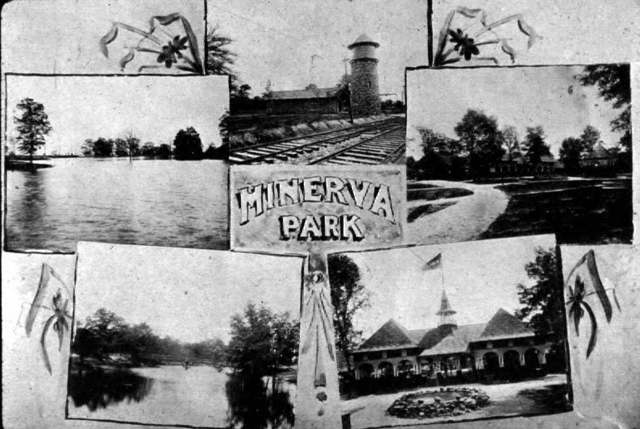
Photo: Columbus Metropolitan Library, via DPLA/Ohio Digital Network, no known copyright restrictions · Wikimedia Commons
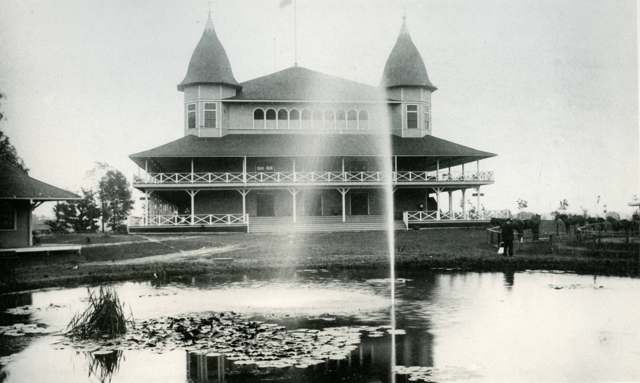
Photo: The W. H. Parish Publishing Company, 1897, via Columbus Metropolitan Library, public domain · Wikimedia Commons
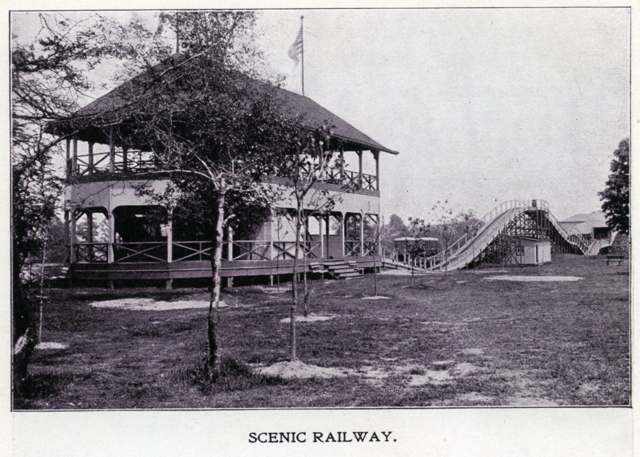
Photo: Columbus Metropolitan Library, via DPLA/Ohio Digital Network, no known copyright restrictions · Wikimedia Commons
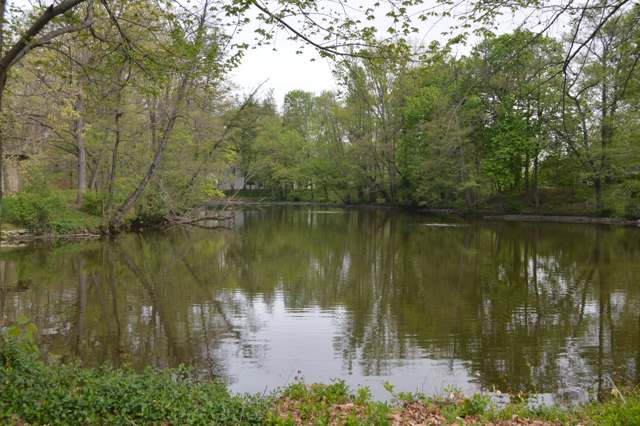
Photo: Nyttend, public domain · Wikimedia Commons
Local history sources: en.wikipedia.org · wosu.org · remarkableohio.org · ohiogenealogyexpress.com · en.wikipedia.org · en.wikipedia.org · en.wikipedia.org · commons.wikimedia.org · commons.wikimedia.org · commons.wikimedia.org · commons.wikimedia.org
Water
Big Walnut Creek at the plant's low-head dam and screen house on Morse Rd, below Hoover Dam The water here
- Columbus Public Water System100% of residentsScioto River (Griggs & O'Shaughnessy), Hoover Reservoir on Big Walnut Ck, plus wells
Its ZIP codes
Each ZIP code that touches Minerva Park, with the share of its residents who live here and the same headline figures as the ZIP page.
| ZIP | Share | Water | Radon | Home value | Schools | Flood |
|---|---|---|---|---|---|---|
| 43231 Columbus | 9% | Big Walnut Creek at the plant's low-head dam and screen house on Morse Rd, below Hoover Dam | 5.1 pCi/L average radon | Median year built 1980 | Westerville City · 3.5 stars overall | 2.3% of residents in the 1% floodplain |
The county
Franklin County: 45 ZIP codes, 42 cities, villages and townships, 1,356,733 people.
Nearby places
Cite this page
Cite this page as:
Cracked Buckeye (Open Shower Co), "Minerva Park, Franklin County", https://crackedbuckeye.com/place/minerva-park/, built 2026-09-16, accessed [date].
Machine-readable: /api/place/minerva-park.json (open JSON, CC BY 4.0 for the compilation; the underlying records keep their own terms) · How to cite · Report a correction · Built 2026-09-16