Local events in Alexandria
Nothing is posted for Alexandria itself yet; here is what is on within 10 miles. All local events in Alexandria
Know a calendar we should watch? Send the link
Checked October 20; the events page is refreshed daily.
How Alexandria began
Alexandria was laid out in the spring of 1830 by Alexander Devilbiss (rendered "Devilblis" in the 1881 county history), inside St. Albans Township, which had itself been organized in 1813 out of Granville Township. The village grew up along the Worthington and Delaware roads a mile or so from four documented Mound Builder earthworks, on ground first cleared by New England and Pennsylvania settlers beginning in 1807. Its most distinctive early industry was a clock factory, built in 1825 by Knowles Linnell and staffed at various times by itinerant clockmakers from Delaware County, which turned out some eleven hundred clocks sold across the region before closing in 1828. The village played a role in the Underground Railroad, sheltering escaped freedom seekers on their way north, and a century after its founding the village marked the occasion with a monument to Devilbiss that still stands at Main Street and Maple Drive. In 2018, residents voted overwhelmingly, by a nine-to-one margin, against a proposal to dissolve the village and merge it into the surrounding township.
Settled 1807 (John Cooke Herron, who married and built the township's first cabin the same year), platted spring of 1830, by Alexander Devilbiss.
Where the name comes from
No source found states directly whom the village was named for; the 1881 county history simply records that "Alexander Devilblis laid out the village of Alexandria" in 1830, and a monument placed in the village in 1930, on the occasion of its centennial, commemorates him by the name Devilbiss. It is plausible the village took its name from its founder's own first name, but no source confirms this explicitly, and the name "Alexander Devenport," which has also been given for the founder, is not found in the 1881 county history, on the 1930 centennial monument, or in any other source consulted.
Before the town
No source found records a Native village, camp or named site inside the platted village of Alexandria itself. The surrounding township, organized as St. Albans in 1813 out of Granville Township's territory, holds four recorded Mound Builder mounds and two earthwork enclosures: mounds on the Gailor/Jones farm near the Kirkersville road, on a hill east of Alexandria on the J. Davis place, on the Reed ("Thrall") farm, and, the largest, on the E. R. Cornell farm south of the Delaware road, once eighteen feet high, in which an 1830 excavation by Dr. Fassett, Archibald Cornell and Israel Peck turned up human bones from more than one skeleton and some polished stones. Two enclosures, one egg-shaped and enclosing about six acres on the Lyman/Phillips/Follett farm, the other on the Thrall farm between the wall and the Cornell mound, complete the record, along with a third earthwork on the D. W. Lewis farm three miles south of the village. No historic-era Native nation, trail or encounter is named for St. Albans Township in the sources consulted; the Licking County history covers the wider regional and treaty record.
- Cornell mound (mound) — E. R. Cornell farm, about twenty rods south of the Delaware road, unspecified Mound Builder era; excavated c. 1830 (archive.org)
- Egg-shaped enclosure, Lyman/Phillips/Follett farm (earthwork) — Lyman farm, bisected by the Delaware road, unspecified Mound Builder era (archive.org)
- Mound near Alexandria, J. Davis farm (mound) — on a hill half a mile east of Alexandria, north of the road to Newark, unspecified Mound Builder era (archive.org)
Timeline
- — John Cooke Herron and his wife Catharine Ward build the first cabin in what becomes St. Albans Township, in its southern part.
- — St. Albans Township is organized, its first clerk Noble Landon naming it after his own native Vermont town in exchange for furnishing four gallons of whiskey to the seventeen electors present.
- — Knowles Linnell builds a clock factory on his farm near the township's brick school-house; roughly eleven hundred clocks are produced there before the works close in 1828.
- — Alexander Devilbiss lays out the village of Alexandria; Riley Parker puts up the first frame dwelling the same year.
- — The Methodist Episcopal congregation, already meeting since about 1811-12, erects the first building built expressly for church purposes, the Gaffield meeting-house, two miles southeast of the village.
- — The village's Baptist church builds its present house of worship and the Congregationalists erect the house they still occupy at the time of the 1881 history.
- — A centennial monument to founder Alexander Devilbiss is placed at the northwest corner of Main Street and Maple Drive.
- — Village residents vote by a roughly nine-to-one margin against a proposal to dissolve Alexandria and merge it into St. Albans Township.
Stories
Eleven Hundred Clocks in a Farmhouse Factory
In 1825, Knowles Linnell, a Granville man then living in St. Albans Township, built a clock factory on his own farm near the brick school-house that stood a mile south of the future village. His first hired clockmaker, Charles Lewis, proved unequal to the work and was soon dismissed; Linnell's neighbor William Munsell then rode to Delaware County to fetch Charles French, a working clockmaker, who moved to the township in the spring of 1826 and spent that year and part of the next turning out cases and works. French's brother-in-law William H. Brace joined him from the east that fall, and the two men, both sons-in-law of the Baptist elder who organized St. Albans's Baptist church in 1826, worked the factory through 1827 before moving on to Granville to continue the trade. In its short life the shop produced about eleven hundred clocks, sold across Licking and the surrounding counties by Munsell himself, working as a traveling clock peddler. The building itself outlived the business: still standing east of Lyman Carter's residence decades later, it had become, by the time the county history was written, nothing grander than a hay and sheep barn.
A Century, Then a Vote
Alexander Devilbiss laid out sixty-nine acres of farmland into village lots in the spring of 1830, and the settlement grew slowly around the crossing of the Worthington and Delaware roads through the nineteenth century, gathering a Methodist Episcopal church, a Congregational church and a Baptist church, along with the dry-goods trade of a small farm town. A century later, in 1930, the village marked the anniversary by placing a monument to its founder at Main Street and Maple Drive, a plaque that still stands. Nearly ninety years after that, in 2018, Alexandria's residents faced a different kind of anniversary question, a formal proposal to dissolve the village government and fold its territory back into St. Albans Township. They rejected it overwhelmingly, by roughly nine votes to one, choosing to remain, a century and a half after Devilbiss's original plat, a separately incorporated place.
Photographs
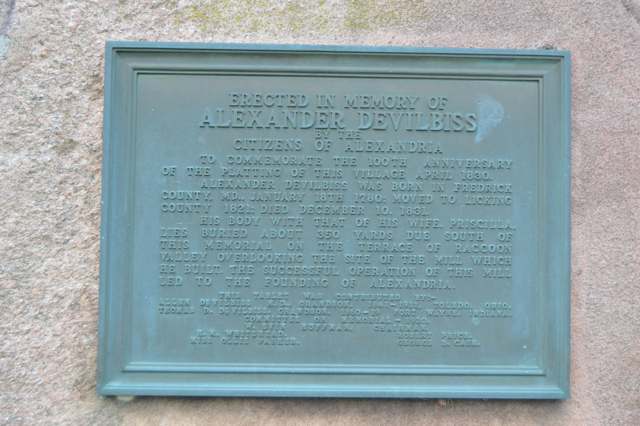
Photo: Nyttend, via Wikimedia Commons, public domain · Wikimedia Commons
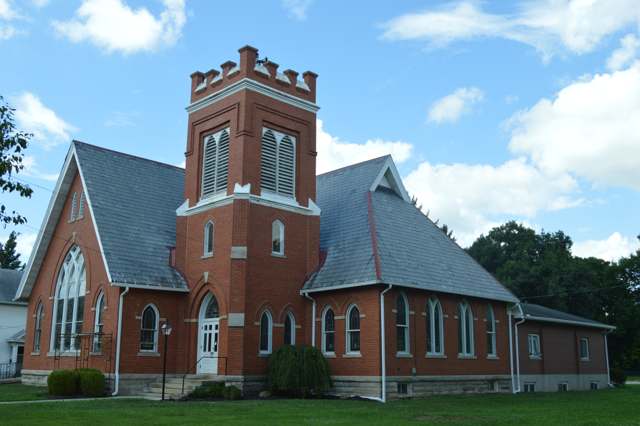
Photo: Nyttend, via Wikimedia Commons, public domain · Wikimedia Commons
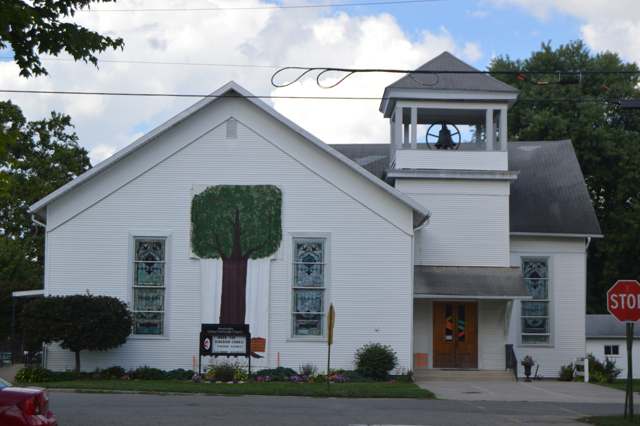
Photo: Nyttend, via Wikimedia Commons, public domain · Wikimedia Commons
Local history sources: archive.org · en.wikipedia.org · en.wikipedia.org · en.wikipedia.org · commons.wikimedia.org · commons.wikimedia.org · commons.wikimedia.org
Water
Mostly private wells The water here
- Alexandria Village100% of residentsGroundwater wells (3 wells)
Hospitals, fire stations and more
Inside Alexandria's boundary: 1 fire or EMS station and 1 library. Press a pin or a name for its whole record and its source.
Fire and EMS stations (1)
-
Saint Albans Township Fire DepartmentAlexandria
- Address
- 25 East Main Street, Alexandria, OH 43001
- Coordinates
- 40.08829, -82.61179
USGS National Map structures (source) ↗ Street map and directions ↗
Source: USGS National Map structures (most Ohio records last updated 2019 to 2022), checked against the Columbus and Cleveland station lists. The department that answers a call is set by jurisdiction and mutual aid, not by distance.
Public libraries (1)
-
Alexandria Public LibraryCentral library · Alexandria
- Address
- 10 Maple Dr., Alexandria, OH 43001
- What it is
- Central library
- Library system
- Alexandria Public Library
- Open
- 2,184 hours a year, 50 weeks
- Building
- 7,155 sq ft
- System's visits, FY2024
- 16,640
- System's loans, FY2024
- 47,834
- People the system serves
- 7,569
- Phone
- (740) 924-3561
IMLS Public Libraries Survey (source) ↗ Street map and directions ↗
Source: IMLS Public Libraries Survey FY2024 (outlets and their systems). Any Ohio resident can get a free card at any Ohio public library.
Its ZIP codes
Each ZIP code that touches Alexandria, with the share of its residents who live here and the same headline figures as the ZIP page.
| ZIP | Share | Water | Radon | Home value | Schools | Flood |
|---|---|---|---|---|---|---|
| 43001 Saint Albans Township and Alexandria | 18% | Mostly private wells | 8.9 pCi/L average radon | Median year built 1978 | Northridge Local · 4 stars overall | 3.3% of residents in the 1% floodplain |
Local government
Who holds office in Alexandria, how its elections and ballot issues came out, and the state auditor's record.
Money issues on the ballot since 2024: 0 of 1 passed; of those asking for new or higher taxes, 0 of 1.
Ballot issues
| Date | Issue | For | Against | Result |
|---|---|---|---|---|
| 2024-11-05 | Issue: Village of Alexandria - Proposed Tax Levy, Replacement, 4 Mills, 5 Years (4.0 mills, replacement) | 129 | 142 | Failed (47.6% for) |
| 2022-05-03 | Issue: Village of Alexandria - Electric Aggregation | 55 | 28 | Passed (66.27% for) |
| 2022-05-03 | Issue: Village of Alexandria - Gas Aggregation | 55 | 27 | Passed (67.07% for) |
Elections for office
| Date | Office | Candidates and votes |
|---|---|---|
| 2021-11-02 | Member of Council (unofficial count) | William H. Lower 46, 47.42%; Jean Morgan 38, 39.18%; Write-In: Andrew Bottar-Dillen 5, 5.15% |
Winners in bold. Results from the county board of elections' official canvass unless marked.
Auditor of State record
- No fiscal caution, watch or emergency on the Auditor of State's lists.
- Financial Audit, 2022 to 2023, released 2026-03-17
The county
Licking County: 17 ZIP codes, 38 cities, villages and townships, 160,939 people.
Nearby places
Rain and snow
How much has actually fallen on Alexandria, day by day, from 1893 to now. Daily totals, not averages.
- rain, last 30 days
- 1.08 in
- 2026-09-30 to 2026-10-29
- rain so far in 2026
- 47.8 in
- 11.2 in above normal for the date
- snow so far in 2026
- 18.2 in
- a normal year brings 20.7 in
- a normal year
- 43.0 in
- average of 30 years, 1991-2020
| Month | Rain (in) | Snow (in) | Days counted |
|---|---|---|---|
| October 2026 | 1.08 | — | 29 |
| September 2026 | 6.24 | — | 30 |
| August 2026 | 10.68 | — | 31 |
| July 2026 | 3.83 | — | 31 |
| June 2026 | 4.48 | — | 30 |
| May 2026 | 7.66 | — | 31 |
| April 2026 | 3.38 | — | 30 |
| March 2026 | 6.43 | 1.5 | 31 |
| February 2026 | 2.33 | 3.2 | 28 |
| January 2026 | 1.63 | 13.5 | 31 |
| December 2025 | 2.58 | 10.4 | 31 |
| November 2025 | 2.39 | 0.9 | 30 |
| Wettest year | 2018 — 54.8 in |
|---|---|
| Driest year | 1963 — 23.1 in |
| Snowiest year | 1910 — 65.9 in |
| Wettest day on record | 14 September 1979 — 4.47 in |
| Heaviest snowfall in a day | 6 January 1910 — 12.34 in |
| Deepest snow on the ground | 28 January 1918 — 20.00 in |
Estimated, not measured. No rain gauge has ever stood inside Alexandria, so every figure here is worked out from the gauges around it - the nearest ones weighted most. Treat them as close estimates rather than readings.
48,777 days of records, 1893-01-01 to 2026-10-29. Source: NOAA NCEI GHCN-Daily, 3,240 gauges in and around Ohio. A day is "gauged" when a gauge standing inside the boundary reported it, and the value is the mean of those gauges. Otherwise it is interpolated by inverse distance from every gauge reporting within 50 miles. Nothing is carried forward, back-filled or smoothed. Against NOAA nClimDiv county monthly precipitation over 136,848 complete county-months (checked 2026-10-31): correlation 0.9515, median absolute difference 0.217 in a month. Built 2026-10-31 from the Cracked Buckeye precipitation archive. Snow is the softer number — snowfall is measured by hand with a ruler, no agency publishes a gridded county snowfall series, and blowing snow defeats every observer.
Environmental permits and filings
What Ohio EPA has on file for Alexandria: permits, inspections, violations, cleanups and the state loans behind sewer and water work. Every line links to the agency's own document.
- facilities and sites on file
- 2
- those placed on the map inside Alexandria
| Program | Facilities and sites |
|---|---|
| Public drinking water | 1 |
| State water loans | 1 |
| Date | Facility or site | What |
|---|---|---|
| ALEXANDRIA VILLAGE PWS | Public drinking water notice of violation | |
| ALEXANDRIA VILLAGE PWS | Public drinking water report | |
| ALEXANDRIA VILLAGE PWS | Public drinking water plan | |
| ALEXANDRIA VILLAGE PWS | Public drinking water inspection | |
| ALEXANDRIA VILLAGE PWS | Public drinking water report | |
| ALEXANDRIA VILLAGE PWS | Public drinking water violation resolved | |
| ALEXANDRIA VILLAGE PWS | Public drinking water violation resolved | |
| ALEXANDRIA VILLAGE PWS | Public drinking water notice of violation | |
| ALEXANDRIA VILLAGE PWS | Public drinking water compliance letter | |
| ALEXANDRIA VILLAGE PWS | Public drinking water inspection | |
| ALEXANDRIA VILLAGE PWS | Public drinking water report | |
| ALEXANDRIA VILLAGE PWS | Public drinking water inspection | |
| ALEXANDRIA VILLAGE PWS | Public drinking water inspection | |
| ALEXANDRIA VILLAGE PWS | Public drinking water notice of violation | |
| ALEXANDRIA VILLAGE PWS | Public drinking water compliance letter | |
| ALEXANDRIA VILLAGE PWS | Public drinking water report | |
| ALEXANDRIA VILLAGE PWS | Public drinking water violation resolved | |
| ALEXANDRIA VILLAGE PWS | Public drinking water notice of violation | |
| ALEXANDRIA VILLAGE PWS | Public drinking water compliance letter | |
| ALEXANDRIA VILLAGE PWS | Public drinking water permit | |
| ALEXANDRIA VILLAGE PWS | Public drinking water report | |
| ALEXANDRIA VILLAGE PWS | Public drinking water notice of violation | |
| ALEXANDRIA VILLAGE PWS | Public drinking water report | |
| ALEXANDRIA VILLAGE PWS | Public drinking water notice of violation | |
| ALEXANDRIA VILLAGE PWS | Public drinking water report |
Source: Ohio EPA eDocument portal (edocpub.epa.ohio.gov), indexed 2026-10-14. Facilities are placed on the map from Ohio EPA's own map layers, EPA's Facility Registry, coordinates written in the filings, or a geocoded street address. A permit filed under a private person's name (most are household septic systems) is counted but never named, placed or linked; licenses for individual workers and open-burning notices are left out entirely.
Quick answers
What county is Alexandria, Ohio in?
Alexandria is a village in Licking County, Ohio, with 483 residents.
When was Alexandria, Ohio founded?
Alexandria was settled 1807 (John Cooke Herron, who married and built the township's first cabin the same year); laid out spring of 1830. Founders on record: Alexander Devilbiss. Source
What ZIP code is Alexandria, Ohio?
Most of Alexandria is in ZIP code 43001.
Where does Alexandria, Ohio get its water?
The main water source for Alexandria (Alexandria Village): Mostly private wells.
Cite this page
Cite this page as:
Cracked Buckeye, "Alexandria, Licking County", https://crackedbuckeye.com/place/alexandria/, built 2026-10-31, accessed [date].
How to cite · Report a correction · Built 2026-10-31
