Notable people · Native Leader · Religious Leader
Tenskwatawa
Shawnee prophet, born in the Mad River country, whose 1805 religious movement at Greenville and later Prophetstown drew followers from many nations and became the base of his brother Tecumseh's confederacy.
Born 1775 (early in the year), Probably Old Piqua, a Shawnee town on the Mad River near present Springfield
Died November 1836, His home at White Feather Spring, Argentine district, present Kansas City, Kansas
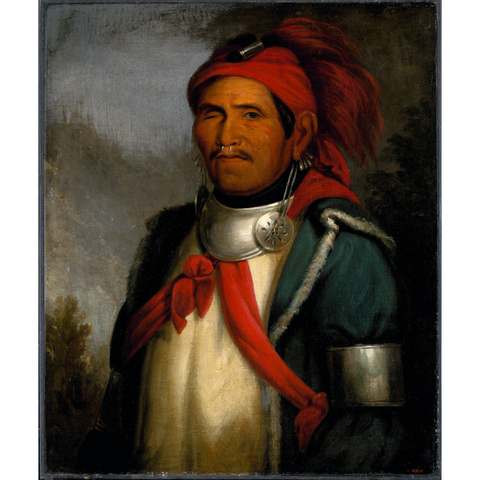
At a glance
- Born
- 1775 (early in the year), Probably Old Piqua, a Shawnee town on the Mad River near present Springfield (Clark County) source
- Died
- November 1836, His home at White Feather Spring, Argentine district, present Kansas City, Kansas source
- Buried
- About 75-100 yards northwest of his home near White Feather Spring; exact grave location unknown, KS source
- Also known as
- The Shawnee Prophet, The Prophet, Lalawethika, Elskwatawa
- Known as
- Native Leader, Religious Leader
- Organizations
- Shawnee, Shawnee confederacy
Life story
Tenskwatawa, born Lalawethika in January 1775 along the Mad River, was the younger brother of Tecumseh. His father died before his birth and he grew up in the shadow of his warrior brothers.
In 1805, after a series of visions, he took the name Tenskwatawa, 'the open door,' and began urging Native people to give up trade goods and alcohol and return to older ways. He founded a settlement near Greenville, Ohio.
In June 1806 he correctly predicted a solar eclipse, which added to his influence. In 1808 he and Tecumseh moved to Prophetstown in Indiana.
After Tippecanoe in 1811 his authority fell. He lived in Canada until 1824, then moved to Kansas, arriving in 1828, and died in 1836 in what is now Kansas City, Kansas.
Ohio ties
- Old Piqua, Mad River near Springfield (1775)
probable birthplace Clark County · source - Prophet's Town near Greenville (Shawnee Prairie Preserve) (1805-1808, 1826)
founded the town in 1805; on the way west in 1826 he asked the army for a few days there to honour his ancestors Darke County · source - Scioto River camp near present Dublin (1810)
Wyandot followers who came from his Prophetstown executed Leatherlips; Harrison believed the Prophet ordered it Franklin County · source - Greentown, near Perrysville (before 1812)
listed among visitors to the Delaware village Ashland County · source - Fort Meigs, Perrysburg (1813)
present at the British siege in May but did not fight Wood County · source - Wapakoneta (1825-1826)
returned from Canada at Lewis Cass's invitation to help persuade the Shawnee to move west Auglaize County · source
Timeline
- 1775 Born early in the year, probably at Old Piqua near Springfield, months after his father Puckeshinwa was killed at Point Pleasant; he was one of triplets. source
- 1805 In the spring, after a trance in which he said he visited heaven and hell, gave up alcohol and took the name Tenskwatawa, 'the open door'. source
- 1805 Founded a village near Greenville with Tecumseh, south of the Greenville treaty line. source
- 1806 In March, at Woapikamunk on the White River in Indiana, helped Delaware judge accused witches, four of whom were burned; in May attempted a similar purge among the Wyandot on the Sandusky, where pro-American chiefs saved the accused. source
- 1806 After Harrison tried to discredit him, correctly predicted the near-total solar eclipse of June 16, which raised his standing. source
- 1808 In the spring moved his followers from Greenville to Prophetstown at the mouth of the Tippecanoe in Indiana, under pressure from Harrison and settlers. source
- 1810 Wyandot followers sent from Prophetstown executed the Wyandot chief Leatherlips on the Scioto north of Columbus on a charge of witchcraft. source
- 1811 With Tecumseh away, ordered the dawn attack on Harrison's camp at Tippecanoe on November 7; the warriors withdrew after about three hours and Prophetstown was abandoned. source
- 1812 Fled to Upper Canada in December after a failed attack on Fort Harrison. source
- 1813 Was at the siege of Fort Meigs in May and at Moraviantown on October 5, where Tecumseh was killed, but fought in neither. source
- 1825 Returned to Wapakoneta in the summer after Lewis Cass invited him to help persuade the Shawnee to move west. source
- 1826 In October left Ohio with a party of Shawnee for the west (about 250 by the DCB's count, about 500 by Wikipedia's), stopping at Greenville to honour their ancestors. source
- 1828 Reached the Shawnee reservation in eastern Kansas on May 14 and founded a village there also called Prophetstown. source
- 1832 Posed for the painter George Catlin. source
- 1836 Died in November at his home near White Feather Spring, in present Kansas City, Kansas. source
- 1897 Charles Bluejacket, who had attended the burial as a young man, pointed out the grave site for a newspaper editor; a temporary marker was later removed. source
What Tenskwatawa is known for
- Shawnee Prophet; religious revival from 1805
- Founded Greenville, Ohio settlement 1805 and Prophetstown 1808
- Started a religious revival movement, c.1805
- Co-founded Prophetstown, Indiana, 1808
- Founded 1805 Greenville settlement
- Co-founded Prophetstown 1808
Stories
A town south of the treaty line
In 1805 Tenskwatawa and Tecumseh set up a village near Greenville, on the American side of the line drawn in the 1795 treaty. The Prophet preached a return to the foods, tools, dress and ceremonies of the ancestors and an end to alcohol, and people from many nations came to hear him in 1807 and 1808. Settlers were alarmed by so many warriors living south of the treaty line, and under pressure from William Henry Harrison the brothers moved west to the Tippecanoe in 1808. Eighteen years later, as Tenskwatawa led Ohio Shawnee west during removal, he asked the U.S. Army for leave to spend a few days at Greenville to honour their ancestors. The site is now Darke County's Shawnee Prairie Preserve, where a state marker tells the story.
The witch hunts
Tenskwatawa's movement taught that some of its enemies were witches. In March 1806, at Woapikamunk on the White River in Indiana, he helped the Delaware judge accused witches, and four were burned at the stake. In May he tried a similar purge among the Wyandot on the Sandusky in Ohio, but chiefs friendly to the Americans stepped in to save the accused. The best-known victim was the Wyandot Leatherlips, who had signed at Greenville and refused to join the Prophet. In June 1810 a party of Wyandots who came from Prophetstown killed him with a tomahawk at his camp on the Scioto north of Columbus, in front of white neighbours who had tried to buy his life. Harrison believed the order came from the Prophet, and the City of Dublin's 2023 profile calls the witchcraft charge a cover for politics.
Leading the Ohio Shawnee west
After the War of 1812 Tenskwatawa lived in exile in Upper Canada, near Amherstburg and then on Cedar Creek in Essex County, with a following that shrank to about two dozen relatives. In 1824 Lewis Cass invited him back to help persuade the Ohio Shawnee to move west, and in the summer of 1825 he returned to Wapakoneta. In October 1826 he set out with a party of Shawnee, about 250 by Edmunds's count, and they reached the Shawnee lands in eastern Kansas in the spring of 1828. The Absentee Shawnee Tribe's history records that by 1832 the United States had removed the remaining Shawnee from the Ohio valley to Kansas. Tenskwatawa spent his last years in obscurity there, sat for George Catlin in 1832, and died in 1836.
Family
- brother: Tecumseh
- brother: Cheeseekau
- father: Puckeshinwa
- mother: Methoataske
Sites to know
Homes, graves, markers, museums and monuments; the numbered ones are on the map.
- 1 Ohio Historical Marker 6-19, Tecumseh / Shawnee Prophet's Town (Shawnee Prairie Preserve)
4267 OH 502, Greenville Darke County · source - 2 Ohio Historical Marker 4-3, Greentown Delaware Village
2488 OH 39, Perrysville Ashland County · source - White Feather Spring (NRHP 75000728), site of his last home and grave (private)
3818 Ruby Avenue, Kansas City, Kansas (private property) source
Ohio places
Where Tenskwatawa was born, lived, worked and is remembered, with the ZIP code, town and county pages for each.
- Born: Mad River valley (stand-in: Springfield), Clark County (Exact birthplace unknown; Ohio Country along the Mad River) ZIP 45502 (approximate) · Clark County
- Lived: Greenville, Darke County (1805-1808 settlement near present-day Greenville) ZIP 45331 (approximate) · Greenville · Darke County
Myths and corrections
Things often said about Tenskwatawa, and what the record shows.
Often said Tecumseh led the warriors at the Battle of Tippecanoe in 1811.
The record Tecumseh was away. Tenskwatawa, believing his medicine would protect his followers, ordered the dawn attack on Harrison's camp on November 7; the defeat ended his religious leadership. source
Often said The Prophet's 1805 town was on the White River in Indiana (as Wikipedia states).
The record The Dictionary of Canadian Biography and Ohio's state marker place the 1805-1808 town near Greenville in western Ohio, at today's Shawnee Prairie Preserve in Darke County. The White River in Indiana was where the Delaware held the 1806 witch trials he took part in. source
Often said Tenskwatawa's grave is marked at White Feather Spring.
The record Wikipedia's Tenskwatawa article mentions a 1978 marker, but the White Feather Spring article says the grave went unmarked for about sixty years, a temporary marker placed after 1897 was removed, and the exact grave location is unknown. Ohio's marker says only that he is buried somewhere under modern Kansas City. source
Documents
Primary records: patents, letters, court and government files, nominations and old county histories, each at the archive that holds it.
- Edward Eggleston and Lillie Eggleston Seelye, Tecumseh and the Shawnee Prophet (Internet Archive scan) 1878, Cornell University Library, via Internet Archive and Wikimedia Commons
Pictures
Free to use with the credit shown. Select a picture for the original and its license.
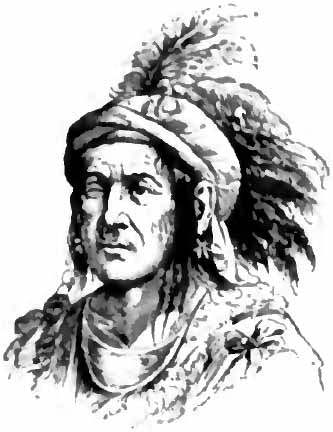
Portrait drawing of the Shawnee prophet Tenskwatawa (1911 Britannica) or Ellskwatawa (Appletons').
Public domain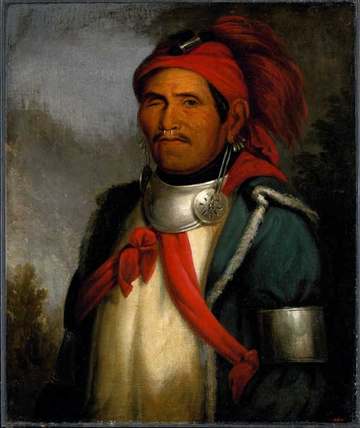
Public domain 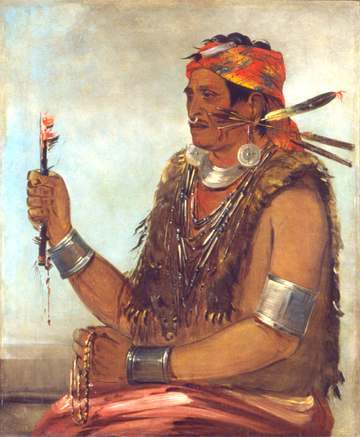
Ten-sqúat-a-way, The Open Door, Known as The Prophet, Brother of Tecumseh. “The ‘Shawnee Prophet,’ is perhaps ...
Public domain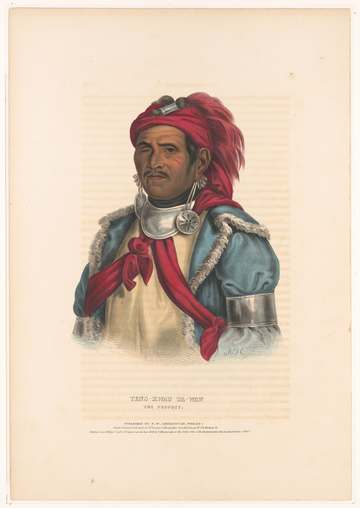
Title: Tens-Kwau-Ta-Waw, the prophet / A.H. ; drawn, printed & coloured at I.T. Bowen's Lithographic Estab...
Public domain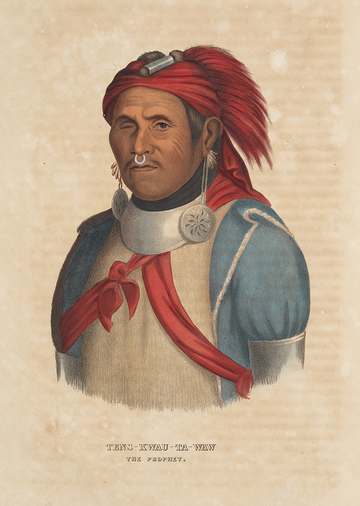
Title: Tens-Kwau-Ta-Waw, The Prophet. Creator: Unknown Date: 1842 Part Of: http://digitalcollections.smu.edu/c...
No known restrictions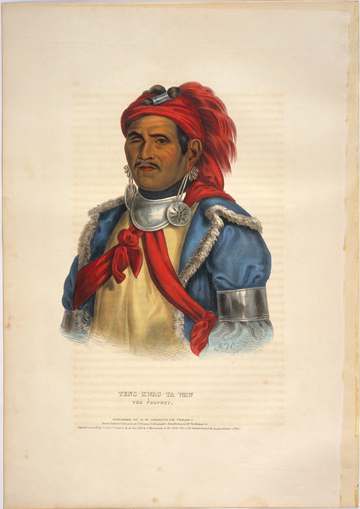
Tens-kwau-ta-waw, the prophet. McKenney, Thomas Loraine, 1785-1859 & Hall, James, 1793-1868. History of th...
Public domain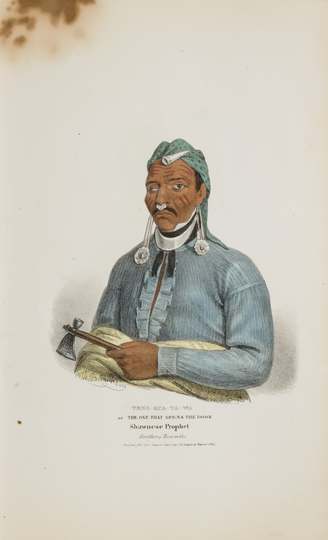
Public domain 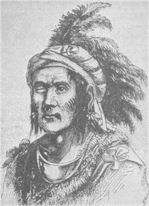
Public domain 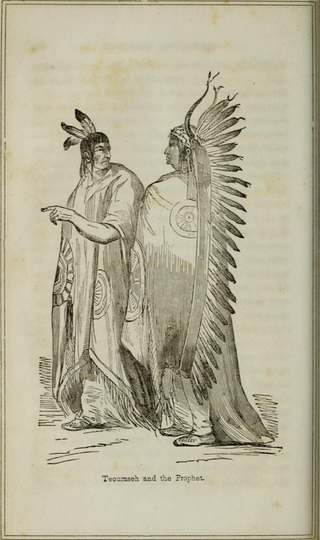
No known restrictions 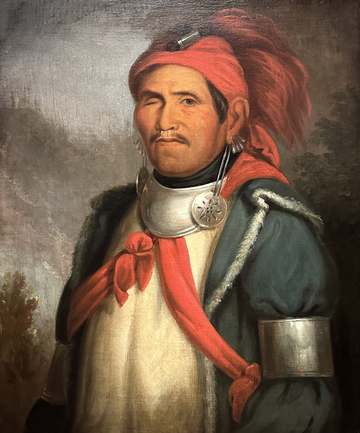
Portrait of Tenskwatawa by Charles Bird King, on display in the National Portrait Gallery, Washington, D.C.
APK / CC BY 4.0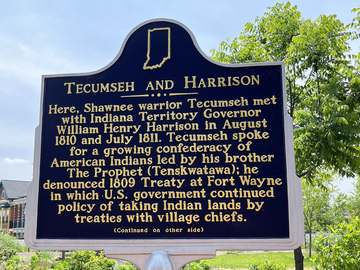
Vincennes, Grouseland.
Riis2602 / CC BY-SA 4.0


Further reading
Sources
Confidence. Medium: the main facts were confirmed, but some details (often an address or ZIP code) were not.
- Wikipedia: Tenskwatawa dates, Mad River birth region, Greenville 1805, Prophetstown 1808, death near Kansas City KS
- Wikipedia: Tecumseh brother relationship, Prophetstown, Tecumseh birthplace dispute
- biographi.ca: tenskwatawa 7E
- remarkableohio.org: 6 19 tecumseh shawnee prophets town
- remarkableohio.org: 4 3 greentown delaware village
- Wikipedia: White Feather Spring
- Wikipedia: Wapakoneta, Ohio
- astribe.com: about us
- dublinohiousa.gov: Saʔteyarǫnyes
- archive.org: historyoffrankli00mart djvu.txt
- Wikimedia Commons: Ten sqúat a way
- Wikimedia Commons: Category:Tenskwatawa
- Wikimedia Commons: Tecumseh and the Shawnee prophet (IA cu31924098139904)
Every link goes to the original source. Profile researched 2026-10-15.
