How Ostrander began
Ostrander sits in Scioto Township, whose own name is a corruption of "Scionto," the Wyandot word for the river that forms its eastern edge. The village itself is much younger than the township's first settlements on Boke's Creek, laid out only in 1852 by surveyor I. C. Buck on a bare clay hill once the railroad's engineer, a Mr. Ostrander, ran his line through it, drawing trade away from the older hamlets of Fairview (Edinburg) and Millville. Incorporated in 1875, it grew slowly around its depot, a Presbyterian congregation that moved in from the countryside in 1862, and a scattering of mills and stores, and it has since become a fast-growing Columbus-area bedroom village, its population rising 70 percent between the 2010 and 2020 censuses.
Platted 1852, by surveyor I. C. Buck, originally 104 lots, incorporated May 18, 1875, by I. C. Buck.
Where the name comes from
The village takes its name from a Mr. Ostrander, who surveyed the route of the Springfield, Mount Vernon & Pittsburgh Railroad (later the Short Line branch of the Cleveland, Columbus, Cincinnati & Indianapolis) through the township as its civil engineer. Wikipedia gives a fuller identification, Shelemiah Ostrander, a railroad official, which is consistent with the 1880 county history's account that the railroad's chosen route, rather than the wishes of the older settlements of Fairview and Millville, decided where the new town would stand.
Before the town
No source found records a Native village or named site on the ground occupied by Ostrander itself, which was empty land until 1852. But the wider township carries Wyandot place-names and memory throughout: Scioto Township, and the Scioto River that bounds it, take their name from "Scionto," the Wyandot word the 1880 county history says was corrupted into the modern spelling, and Boke's Creek, one of the township's main streams, was named for a Wyandot chief. The same history records that the first white settlers on Boke's Creek around 1806, including Richard Hoskins and Zachariah Stephens, found the Wyandot in the area friendly, and learned from them the location of salt licks, river fords and the best hunting grounds for deer and waterfowl; it goes on, in the language of its time, to describe the Wyandot as gone from the country by 1880, their canoes no longer seen on the Scioto. This is testimony to an assumed and largely completed removal rather than a documented date for this specific township; the Wyandot as a nation did not leave Ohio until 1843, under the terms described in the Delaware County file, and individual families and other nations remained in the state longer still.
Nations recorded here: Wyandot.
Timeline
- — Richard Hoskins and his family arrive from Wales and settle at the mouth of Boke's Creek, followed within weeks by Zachariah Stephens, who builds the first log cabin in what becomes Scioto Township.
- — Phillip Horshaw builds the township's first gristmill at the site later called Millville; he switches to distilling liquor there in 1815.
- — Scioto Township is formed as a separate township on December 7, taking in all the land west of the Scioto River previously governed as part of Radnor Township.
- — William Cratty, John Lawrence and Andrew Dodds settle along Little Mill Creek, founding the hamlet of Fairview (later renamed Edinburg), for a time the township's most promising village.
- — Surveyor I. C. Buck lays out the village of Ostrander, 104 lots on a bare clay hill, after the new railroad is routed through the spot instead of through Fairview or Millville.
- — W. C. Winget opens the first store in Ostrander, in a town that at the time holds fewer than half a dozen houses.
- — The Little Mill Creek Presbyterian Church, organized in 1834 at Edinburg, moves its congregation to Ostrander and is renamed the Ostrander Presbyterian Church.
- — Ostrander is incorporated as a village on May 18, and holds its first council meeting the following April with D. G. Cratty as mayor.
- — The brick post office building at 420 W. North Street, still standing, is constructed.
- — The CCC&I Railroad through Ostrander is decommissioned, though the railroad bridge over Blues Creek survives as a landmark.
- — Ostrander's population jumps from 643 to 1,094, a 70.1 percent increase, as Columbus-area growth reaches the village.
Stories
A Railroad Made This Town, and Killed Two Others
Before there was an Ostrander, there were two other candidates for the township's central village. Fairview, later called Edinburg, was settled in 1815-16 by Presbyterian families along Little Mill Creek and grew on the strength of its pleasant site. Millville grew up around Phillip Horshaw's gristmill, built in 1809, and for a time was the largest hamlet in the township. Both places lobbied hard when a new railroad line was surveyed through the area, each hoping to be chosen as its station. The engineer, a Mr. Ostrander, instead ran the route about a mile from either place, over what the 1880 county history calls "a once bare clay hill." Surveyor I. C. Buck platted a village there in 1852 and gave it the engineer's name. Fairview and Millville withered as their merchants and shippers moved to be near the depot, and Ostrander grew into the township's principal village in their place.
A Church That Moved to Follow Its People
The congregation now known as Ostrander Presbyterian Church did not start in Ostrander at all. Three Presbyterian families, William Cratty, John Lawrence and Andrew Dodds, settled near Little Mill Creek around 1815-16 and at first traveled all the way to Delaware to worship, fording the Scioto River when it was low enough to cross. In 1834 their growing numbers were organized into the separate Little Mill Creek Presbyterian Church, meeting in a hewn-log building at Edinburg with twenty-four founding members, none of them provided even with fixed pews; congregants brought the chairs from their own wagons. Only in 1862, after the railroad had already pulled the township's center of gravity toward the new village, did the congregation formally relocate to Ostrander and take its present name.
Photographs
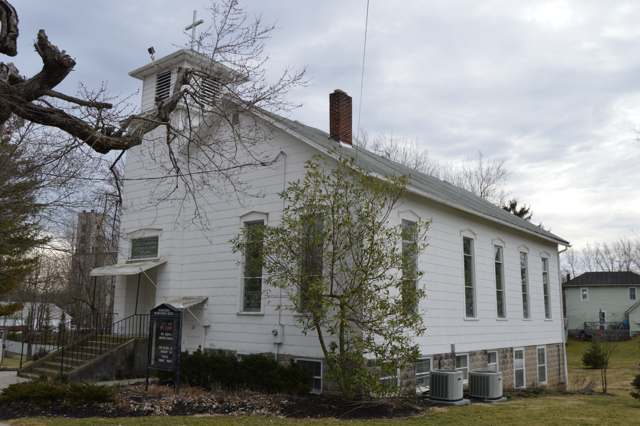
Photo: Nyttend, via Wikimedia Commons, public domain · Wikimedia Commons
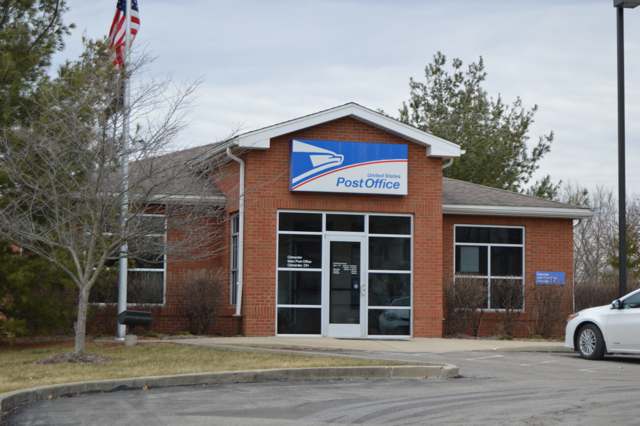
Photo: Nyttend, via Wikimedia Commons, public domain · Wikimedia Commons
Local history sources: archive.org · en.wikipedia.org · commons.wikimedia.org · commons.wikimedia.org
Water
Olentangy River intake at Del-Co's plant on Olentangy River Rd, Liberty Twp, south of the city of Delaware The water here
- Del-co Water Company, Inc.100% of residentsOlentangy River, O'Shaughnessy and Alum Creek reservoirs, plus Knox County wells
Its ZIP codes
Each ZIP code that touches Ostrander, with the share of its residents who live here and the same headline figures as the ZIP page.
| ZIP | Share | Water | Radon | Home value | Schools | Flood |
|---|---|---|---|---|---|---|
| 43061 Scioto Township and Ostrander | 24% | Olentangy River intake at Del-Co's plant on Olentangy River Rd, Liberty Twp, south of the city of Delaware | 6.6 pCi/L average radon | Parcel list only | Buckeye Valley Local · 5 stars overall | 2.8% of residents in the 1% floodplain |
The county
Delaware County: 11 ZIP codes, 26 cities, villages and townships, 214,126 people.
Nearby places
Cite this page
Cite this page as:
Cracked Buckeye (Open Shower Co), "Ostrander, Delaware County", https://crackedbuckeye.com/place/ostrander/, built 2026-09-16, accessed [date].
Machine-readable: /api/place/ostrander.json (open JSON, CC BY 4.0 for the compilation; the underlying records keep their own terms) · How to cite · Report a correction · Built 2026-09-16