Local events in Monroe Township, Logan County
Nothing is posted for Monroe Township itself yet; here is what is on within 20 miles. All local events in Monroe Township, Logan County
Know a calendar we should watch? Send the link
Checked October 20; the events page is refreshed daily.
How Monroe Township, Logan County began
Monroe Township, in the southeastern corner of Logan County, was organized in 1822 and takes in part of the village of West Liberty. Its ground had been the heart of the Shawnee homeland for more than sixty years before that: the town of Mackachack (Mac-a-cheek), one of the Upper Mad River towns, stood about a mile east of present West Liberty until it was burned by General Benjamin Logan's Kentucky militia in October 1786. In the 1860s and 1870s brothers Donn and Abram Sanders Piatt, whose family had settled the valley in 1828, built two Gothic-style houses, Mac-O-Chee and Mac-A-Cheek, naming them for the destroyed Shawnee towns; both still stand as museums known as the Piatt Castles. The township today is a mix of farmland and the West Liberty area, still identified locally with the Mac-a-Cheek valley.
Incorporated 1822, by Logan County commissioners, organizing the township from earlier-settled territory.
Where the name comes from
Monroe Township was named for President James Monroe, in keeping with the common early-19th-century Ohio practice of naming new townships for presidents; it is one of twenty-two townships named Monroe in the state.
Before the town
Monroe Township holds a well-documented Native American site. The Shawnee town of Mackachack (recorded in sources under many spellings: Maccacheek, Mackacheck, Mac-a-cheek, Mequashake, Maquachake) stood roughly a mile east of present-day West Liberty and was one of about ten 'Upper Mad River towns' of the Shawnee Nation that filled this part of Logan County from the 1770s until Logan's raid in 1786, alongside Wapatomica, Moluntha's Town, Blue Jacket's Town, Pigeon Town and others. In the fall of 1778 the British-allied Shawnee marched their prisoner Simon Kenton, a Kentucky scout captured after a failed horse-raid, from town to town toward Wapatomica for execution, forcing him to run nine gauntlets along the way; one of those gauntlets was run at Mackachack. Mackachack was destroyed on October 6, 1786 when Benjamin Logan's roughly 800 Kentucky militiamen, part of a coordinated strike with George Rogers Clark's larger force against the upper Wabash towns, rode into the village at midday. Lieutenant Ebenezer Denny, present with the militia, wrote that the Shawnee 'made no resistance; the men were literally murdered,' and Daniel Boone and Simon Kenton — the same Kenton who had run the gauntlet there eight years before — led cavalry charges into the town. During the raid the elderly Shawnee chief Moluntha, who had signed the 1786 Treaty of Fort Finney, was killed with a hatchet by militia officer Hugh McGary while surrendering under a flag of truce, an atrocity Logan could not prevent. Logan's force went on to burn Wapatomica, Wapakoneta and six other towns in what is remembered as the Mac-o-chee Valley campaign, killing 22 Shawnee including ten chiefs before withdrawing to Kentucky. The Piatt brothers built their houses on and near the Mackachack site in the 1860s-1870s and named them for the destroyed town in acknowledgment of that history, though the houses themselves are European-inspired and not built on excavated Shawnee foundations. No mounds or earthworks are recorded specifically within the township in the sources consulted.
Nations recorded here: Shawnee.
- Mackachack (Mac-a-cheek) (village) — about one mile east of West Liberty, Monroe Township, 1700s until destroyed October 6, 1786 (hmdb.org)
Timeline
- — The Piatt family, French Huguenot descendants whose grandfather Jacob Piatt had received Kentucky land for Revolutionary War service, relocated to Logan County; sons Donn (age 9) and Abram Sanders Piatt (age 7) grew up on the land that had been the Mackachack town site.
- — General Benjamin Logan's Kentucky militia destroyed the Shawnee town of Mackachack, the first of eight Shawnee towns burned in the Mac-o-chee Valley campaign; Chief Moluntha was killed during the raid.
- — Monroe Township was organized within Logan County.
- — Donn and Abram Sanders Piatt began building their two houses, Mac-O-Chee and Mac-A-Cheek, on the family land about three-quarters of a mile apart.
- — Mac-A-Cheek, Abram Piatt's house, was completed.
- — Public tours of Mac-A-Cheek began, four years after Abram Piatt's death.
- — The Piatt family sold Mac-O-Chee Castle to help fund restoration of Mac-A-Cheek, which the family continues to operate as a museum.
Stories
Simon Kenton's gauntlet at Mackachack
In the fall of 1778, Kentucky scout Simon Kenton and a companion crossed into Shawnee country to steal horses from the town of Chalahgawtha near present Xenia. A Shawnee party ran them down, killed his companion, and took Kenton prisoner. Because Kenton was a well-known enemy of the Shawnee, his captors decided he should be marched to Wapatomica, the political center of the Shawnee Nation in what is now Logan County, and put to death there. Along the way the Shawnee stopped at village after village and forced Kenton to run the gauntlet — a double line of people armed with clubs, switches and fists — at nearly every one; by the time he reached Wapatomica he had run nine gauntlets and suffered repeated broken bones. One of those runs took place at Mackachack, the town that stood on what is now the Piatt family's land in Monroe Township. Kenton survived Wapatomica too, was ultimately spared execution, through the intervention of the trader-turned-Shawnee-ally Simon Girty, and was later saved again by the British Indian department interpreter Pierre Drouillard; the Shawnee are said to have called him Cut-ta-ho-tha, 'the condemned man,' in grudging respect for his endurance.
The destruction of Mackachack and the killing of Moluntha
On October 6, 1786, roughly 800 Kentucky militiamen under General Benjamin Logan rode into Mackachack at midday as part of a coordinated two-pronged offensive with George Rogers Clark against Shawnee and Miami towns. According to militia lieutenant Ebenezer Denny, the town's people 'made no resistance; the men were literally murdered,' and Daniel Boone and Simon Kenton led mounted charges into the village. During the fighting the aged Shawnee chief Moluntha — who earlier that year had signed the Treaty of Fort Finney and who came forward under a white flag with an American flag of his own — was struck down with a hatchet by militia officer Hugh McGary, an act Logan was unable to stop and that was condemned even by many of his own men. Logan's force burned Mackachack and seven other towns -- eight in the Mac-o-chee Valley by the count on the Logan County Historical Society's marker at the site, though another account's eight includes Wapakoneta, thirty miles away -- over the following two days, killing 22 Shawnee people including ten chiefs, before withdrawing to Kentucky with only three men lost. The raid, launched in retaliation for Shawnee attacks on Kentucky settlements, scattered the Shawnee towns of the upper Mad River country and pushed many of their people further north and west in the years that followed.
Building castles on a burned town
When Benjamin Piatt moved his family from Cincinnati to Logan County in 1828, they settled on land that, forty-two years earlier, had been the Shawnee town of Mackachack. His sons Donn and Abram Sanders Piatt grew up there, went on to careers as a journalist-diplomat and a Civil War general respectively, and by the 1860s had money enough to build. Starting in 1864 they raised two Gothic Revival houses about three-quarters of a mile apart: Donn's Mac-O-Chee, finished in 1879, and Abram's Mac-A-Cheek, finished in 1871, each named for the Shawnee towns that had once stood in the valley. The choice of names was deliberate acknowledgment of what had been there before. Mac-A-Cheek opened to public tours in 1912, four years after Abram's death, and the family kept both houses as museums for more than a century; Mac-O-Chee was sold out of the family in 2019 to help pay for Mac-A-Cheek's restoration, and Mac-A-Cheek remains open today as the Piatt Castles.
Photographs
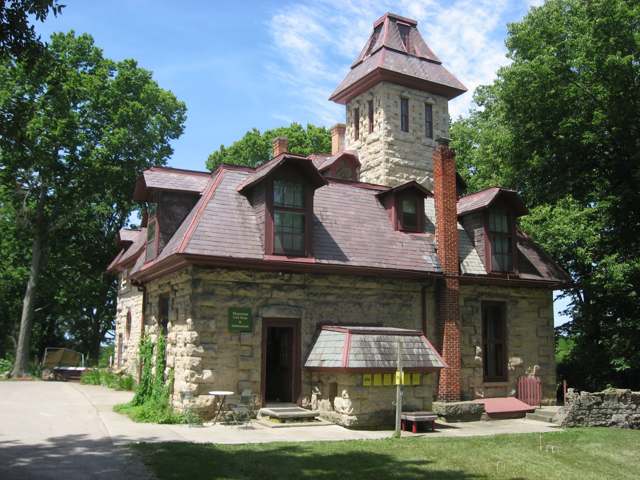
Photo: Nyttend, public domain · Wikimedia Commons
Local history sources: en.wikipedia.org · en.wikipedia.org · en.wikipedia.org · americanhistorycentral.com · hmdb.org · fortamanda1812.blogspot.com · commons.wikimedia.org · en.wikipedia.org
Water
Mostly private wells The water here
- West Liberty Village67% of residentsGroundwater wells (2 wells)
- Bellefontaine City31% of residentslocal wells (shallow carbonate aquifer)
- Mountainview Mobile Village2% of residentsGroundwater wells (2 wells)
Hospitals, fire stations and more
Inside Monroe Township, Logan County's boundary: 1 spill case. Press a pin or a name for its whole record and its source.
Spills reported since 2021 (1)
-
Nitrogen Fertilizer 28%2025-06-04 · Monroe Twp
- Reported
- 2025-06-04
- What spilled
- Nitrogen Fertilizer 28%
- Largest amount reported
- 200 gallons
- Where
- Monroe Twp, Logan County
- Ohio EPA district office
- SWDO
- Ohio EPA case number
- 2506EPA0000908
Ohio EPA spill reports (source) ↗ Street map and directions ↗
Source: Ohio EPA emergency response spill reports, 2021 to September 2026, one point per case where Ohio EPA placed it. A report is what the caller or responder recorded; amounts are often blank or estimated.
Its ZIP codes
Each ZIP code that touches Monroe Township, Logan County, with the share of its residents who live here and the same headline figures as the ZIP page.
| ZIP | Share | Water | Radon | Home value | Schools | Flood |
|---|---|---|---|---|---|---|
| 43357 West Liberty | 25% | Mostly private wells | 10.1 pCi/L average radon | Median year built 1964 | West Liberty-Salem Local · 4.5 stars overall | 11% of residents in the 1% floodplain |
| 43360 Jefferson Township and Zanesfield | 9% | Mostly private wells | 13.2 pCi/L average radon | Median year built 1988 | Benjamin Logan Local · 4 stars overall | 3.1% of residents in the 1% floodplain |
| 43311 Bellefontaine | 1% | local wells (shallow carbonate aquifer) | 6.9 pCi/L average radon | Median year built 1963 | Bellefontaine City · 3.5 stars overall | 2.7% of residents in the 1% floodplain |
Local government
Who holds office in Monroe Township, Logan County, how its elections and ballot issues came out, and the state auditor's record.
Money issues on the ballot since 2019: 2 of 2 passed.
Ballot issues
| Date | Issue | For | Against | Result |
|---|---|---|---|---|
| 2023-11-07 | Issue: Monroe Township Roads Renewal | 388 | 315 | Passed (55.19% for), unofficial |
| 2019-05-07 | Issue: Monroe Township Tax Levy (Renewal) | 133 | 55 | Passed (70.74% for) |
Elections for office
| Date | Office | Candidates and votes |
|---|---|---|
| 2023-11-07 | Township Trustee (unofficial count) | Dale D. Barns 530, 100.0% |
| 2023-11-07 | Township Fiscal Officer (unofficial count) | Jenny Stanford 509, 100.0% |
| 2021-11-02 | Township Trustee | Donald E. Bradley 184, 51.98%; Eric B. Yoder 170, 48.02% |
| 2021-11-02 | Township Fiscal Officer | Jenny Stanford 218, 100.0% |
| 2019-11-05 | Township Trustee | Dale D. Barns 342, 100.0% |
| 2019-11-05 | Township Fiscal Officer | Abigail Miller 335, 100.0% |
Winners in bold. Results from the county board of elections' official canvass unless marked.
Auditor of State record
- No fiscal caution, watch or emergency on the Auditor of State's lists.
- Agreed Upon Procedures, 2022 to 2023, released 2024-12-03
The county
Logan County: 14 ZIP codes, 33 cities, villages and townships, 49,613 people.
Nearby places
Quick answers
What county is Monroe Township, Ohio in?
Monroe Township, Logan County is a township in Logan County, Ohio, with 1,625 residents.
When was Monroe Township, Ohio founded?
Monroe Township, Logan County was incorporated 1822. Founders on record: Logan County commissioners, organizing the township from earlier-settled territory. Source
How did Monroe Township, Ohio get its name?
Monroe Township was named for President James Monroe, in keeping with the common early-19th-century Ohio practice of naming new townships for presidents; it is one of twenty-two townships named Monroe in the state. Source
What ZIP code is Monroe Township, Ohio?
Monroe Township, Logan County is served by ZIP codes 43357 and 43360; 43357 holds the largest share of its residents.
Where does Monroe Township, Ohio get its water?
The main water source for Monroe Township, Logan County (West Liberty Village): Mostly private wells.
Cite this page
Cite this page as:
Cracked Buckeye, "Monroe Township, Logan County", https://crackedbuckeye.com/place/monroe-township-logan-county/, built 2026-10-31, accessed [date].
How to cite · Report a correction · Built 2026-10-31
