Local events in Harrison Township, Champaign County
Nothing is posted for Harrison Township itself yet; here is what is on within 20 miles. All local events in Harrison Township, Champaign County
Know a calendar we should watch? Send the link
Checked October 20; the events page is refreshed daily.
How Harrison Township, Champaign County began
Harrison Township, the smallest in Champaign County at about 24 square miles, lies in the northwest corner against Logan County. A Virginian named Fuson, said to have brought white seed corn on horseback, entered land in section 24 in 1808 and was the first settler; Ralph Robinson followed in 1809. Its village of Spring Hills was laid out as Middleburg in 1832 by Joseph Woods and renamed when the post office found the name taken by a town in Logan County. Spring Hills had a mayor and council from at least 1849; Beers's 1881 history prints a list of corporation officers through 1880 and counted about 150 inhabitants. The township had 882 people in 2020.
Settled 1808 (Fuson entered land in section 24), platted 1832 (Spring Hills, as Middleburg), incorporated by 1849 (Spring Hills village corporation), by Joseph Woods (village plat).
Where the name comes from
Beers's 1881 history does not say how Harrison Township got its name. It is one of nineteen Harrison Townships in Ohio, and General William Henry Harrison, who used a road through the neighboring township in 1812, is the likely namesake, but no source consulted says so.
Before the town
Champaign County lay inside the core homeland of the Mad River Shawnee in the second half of the 1700s, and the Shawnee, Mingo and Wyandot hunted and traveled here before the Treaty of Greenville (1795). Beers's 1881 history says that when the first white settlers reached Harrison Township they found a number of Indian families in assumed possession of some of the lands, belonging to the Miamis (Myaamia), scattered mainly on the sections with natural springs; Joseph Fuson remembered three or four families camped on his father's land on Glady Creek, now Robert Polk's. They were peaceful, given to begging, and fond of crowding the fire in winter and pushing white children away from it. The history says every vestige of Indian habitation was gone by 1830. These are pioneer recollections of the 1880s; no site, date or treaty is attached to them. Another recollection, from nearby Salem Township, tells of two settlers murdered by Indians near Bellefontaine in August 1813, which sent settlers on the frontier back to safer quarters. The Mac-a-cheek towns of the Shawnee, at the head of the Mad River in Logan County just to the north, were burned by Gen. Benjamin Logan's Kentuckians in 1786, and the GNIS names Mackachack and Old Pimtown, which the water-system data ties to this township through ZIP 43357, sit near West Liberty in Logan County, not in Harrison Township.
Nations recorded here: Miami, Shawnee, Mingo (Seneca-Cayuga), Wyandot.
- Miami (Myaamia) family camps on Glady Creek (camp) — Glady Creek, on the Fuson land later owned by Robert Polk, before 1830, by pioneer recollection (archive.org)
Timeline
- — A Virginian named Fuson, who had ridden north with white seed corn in his saddlebags, comes to Champaign County; he enters part of section 24 in Harrison Township in 1808 and is the township's first settler and a trustee at its first election.
- — Ralph Robinson, a Virginian, enters part of section 25 and soon marries Hannah Conklin, probably the township's first wedding.
- — William Wilson, born in County Tyrone in 1780, moves to section 12 after a first stop near Springfield; during the War of 1812 he is detailed to guard the block-house on Ralph Robinson's land.
- — Jeptha Terrell moves to section 32, where he later operates a mill and distillery on the site of the Spring Hills flour mill.
- — Settlers build Fort Robinson, a stockade of split logs set upright in a three-foot trench, on Ralph Robinson's land; news of Hull's surrender sends the neighborhood into the fort in a stampede.
- — The first schoolhouse is built on the farm later owned by Joseph Brencher; the Fuson family and Elijah Davis, from Kentucky, are settled in the township by this year.
- — The Presbyterian Church of Spring Hills is organized at Newall's mill with twelve members; Joseph Stephenson is first minister and Joseph Wilson, John Travers and John Taylor the first elders.
- — Joseph Woods lays out Middleburg (now Spring Hills) with 47 lots and one for a church, surveyed by J. L. Morgan; John Vance builds the first house, a store, and becomes the first postmaster.
- — Joseph Irvin builds the first blacksmith shop of any importance in the village.
- — The Presbyterian society, grown to 41 members, resolves to replace its log Stony Creek Church of about 1831 and builds a frame church of 35 by 60 feet.
- — The Christian (Newlight) Church, organized in 1842 at James Fuson's house, builds Glady Creek Church; it burns in 1860 and is rebuilt.
- — The Wesleyan Chapel, a Methodist Episcopal congregation organized in 1845, builds its house of worship.
- — Spring Hills's corporation officers appear in the record for the first time: William Perren, mayor, G. Mayne, clerk, and a council of five; the list runs to 1880.
- — Jacob Sarver, Joseph Hoffman and Roster Robinson reorganize the Salem United Brethren Church with six members and build its house.
- — Spring Hills has about 150 inhabitants, two stores, a hotel and three blacksmith shops, and its people hope for the Bellefontaine, Troy and Evansville Railroad; the township has seven sub-districts and a graded two-room school at Spring Hills.
- — The census counts 882 people in Harrison Township on 24.4 square miles.
Stories
Fuson corn
About 1803 a young Virginian left home 'purely through a spirit of adventure', rode across the Ohio into the Buckeye State, and dropped white seed corn from his saddlebags along the blazed trail as he went. To him is attributed the introduction of white corn into the western soil, and the name 'Fuson corn' became a household word in every western state, according to Beers's 1881 history. He came to Champaign County in 1804, entered part of section 24 of what became Harrison Township in 1808, and the history records him as the first white man to settle there. He was elected a trustee at the first township election and continued in office for years, a zealous worker, enterprising citizen and kind neighbor. Beers could not learn the date of his first marriage or his wife's maiden name; he married Jane Johnson after her death, and the Fusons' many children scattered to Missouri, California, Iowa and Indiana. The family's name stayed in the township: Joseph Fuson helped organize the Christian church, and James Fuson was the first Sunday-school superintendent.
Two Middleburgs and a name that had to change
Joseph Woods laid out the town now called Spring Hills in 1832, with J. L. Morgan as surveyor and forty-seven lots, and sold them at $7 to $40 each; one more was reserved for a church. John Vance built the first house and kept the first store, and George Shaw, a log house a year later. The town was first called Middleburg, but when application was made for a post office it turned out that there was already a town of that name in Logan County, so a bill providing for a change of name was introduced by Hon. J. C. Phillips, 'to whom belongs the honor of re-christening the town'. It took the name Spring Hills from the many natural springs around its base; John Vance became the first postmaster, and mail came three times a week in 1880. The crossing of the Urbana and Wapakoneta road with the West Liberty and Sidney pike made the main streets.
Fort Robinson and the stampede of 1812
In 1812 the settlers of the neighborhood built a 'fort' on Ralph Robinson's land: logs the length of a rail, split and set upright in a trench about three feet deep, enough to take in all the families of the neighborhood if the colony were invaded. William Wilson was one of those detailed to guard it. When news came of General Hull's surrender at Detroit, there was a general stampede toward the fort, since it was feared the soldiers on the frontier had been captured. Jacob Sarver rode to Fort Piqua to learn the truth and returned with the joyful news that all danger of invasion was over. On another day a party of rangers at Jeptha Terrell's house fired their guns together in the evening; the neighbors, thinking Indians had attacked the Terrells, were alarmed, and the mystery was explained next day. Beers noted that no actual encounters took place in this settlement.
Photographs
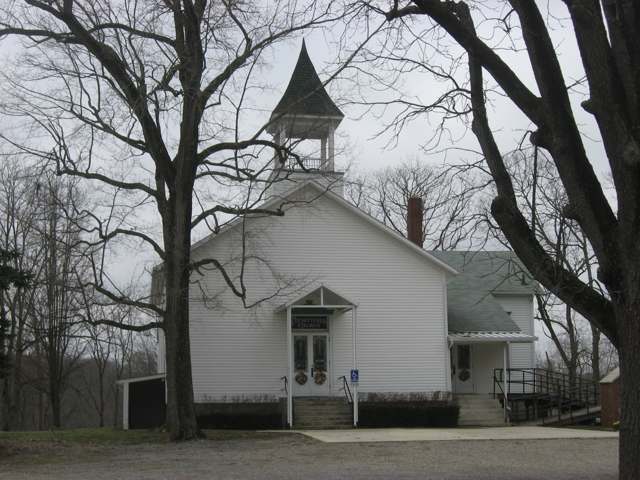
Photo: Nyttend, own work, via Wikimedia Commons, public domain · Wikimedia Commons
Local history sources: archive.org · en.wikipedia.org · en.wikipedia.org · commons.wikimedia.org · commons.wikimedia.org
Water
Mostly private wells The water here
- West Liberty Village64% of residentsGroundwater wells (2 wells)
- Degraff Village36% of residentsGroundwater wells (2 wells)
Its ZIP codes
Each ZIP code that touches Harrison Township, Champaign County, with the share of its residents who live here and the same headline figures as the ZIP page.
| ZIP | Share | Water | Radon | Home value | Schools | Flood |
|---|---|---|---|---|---|---|
| 43357 West Liberty | 10% | Mostly private wells | 10.1 pCi/L average radon | Median year built 1964 | West Liberty-Salem Local · 4.5 stars overall | 11% of residents in the 1% floodplain |
| 43318 Degraff and De Graff | 8% | Mostly private wells | 7.4 pCi/L average radon | Median year built 1965 | Riverside Local · 3.5 stars overall | 6.3% of residents in the 1% floodplain |
Local government
Who holds office in Harrison Township, Champaign County, how its elections and ballot issues came out, and the state auditor's record.
Elections for office
| Date | Office | Candidates and votes |
|---|---|---|
| 2023-11-07 | Township Trustee (unofficial count) | Gary W. Ginter 549, 100.0% |
| 2023-11-07 | Township Fiscal Officer (unofficial count) | Judy Hartzler 557, 100.0% |
| 2021-11-02 | Township Trustee | David Jackson 262, 59.14%; Jerold E. Wiford II 181, 40.86% |
| 2019-11-05 | Township Trustee | Gary L. Campbell II 215, 100.0% |
| 2019-11-05 | Township Fiscal Officer | Judy Hartzler 218, 100.0% |
Winners in bold. Results from the county board of elections' official canvass unless marked.
Auditor of State record
- No fiscal caution, watch or emergency on the Auditor of State's lists.
- Financial Audit, 2023 to 2024, released 2025-10-16
The county
Logan County: 14 ZIP codes, 33 cities, villages and townships, 49,613 people.
Nearby places
Quick answers
What county is Harrison Township, Ohio in?
Harrison Township, Champaign County is a township in Logan County, Ohio, with 882 residents.
When was Harrison Township, Ohio founded?
Harrison Township, Champaign County was settled 1808 (Fuson entered land in section 24); laid out 1832 (Spring Hills, as Middleburg); incorporated by 1849 (Spring Hills village corporation). Founders on record: Joseph Woods (village plat). Source
How did Harrison Township, Ohio get its name?
Beers's 1881 history does not say how Harrison Township got its name. Source
What ZIP code is Harrison Township, Ohio?
Harrison Township, Champaign County is served by ZIP codes 43357 and 43318; 43357 holds the largest share of its residents.
Where does Harrison Township, Ohio get its water?
The main water source for Harrison Township, Champaign County (West Liberty Village): Mostly private wells.
Cite this page
Cite this page as:
Cracked Buckeye, "Harrison Township, Champaign County", https://crackedbuckeye.com/place/harrison-township-champaign-county/, built 2026-10-31, accessed [date].
How to cite · Report a correction · Built 2026-10-31
