Local events in Miami Township, Logan County
Nothing is posted for Miami Township itself yet; here is what is on within 20 miles. All local events in Miami Township, Logan County
Know a calendar we should watch? Send the link
Checked October 20; the events page is refreshed daily.
How Miami Township, Logan County began
Miami Township occupies the southwestern corner of Logan County and is named for the Great Miami River, which crosses its northern part. It was one of the county's four original townships in 1818, reaching at first from the Champaign County line to the northern border, and reached its present size, about seven miles by three, when Pleasant Township was taken off in 1841. Jeremiah Stansbury made the first settlement on Stony Creek in 1805, near a Shawnee village the settlers called Oldtown, and families from Kentucky, Virginia and Pennsylvania followed from 1808. The villages of Quincy, laid out in 1830 and named for John Quincy Adams, and DeGraff, whose eastern part lies in the township, grew on the river and the later railroad; the township remains agricultural, with 2,110 residents at the 2020 census.
Settled 1805 (Jeremiah Stansbury), platted 1830 (Quincy), incorporated 1818, by Logan County commissioners, organizing the township.
Where the name comes from
Miami Township is named for the Great Miami River, which flows through it; the river in turn is named for the Miami (Myaamia) nation, whose traditional homeland extended into this part of west-central Ohio.
Before the town
A Shawnee village the settlers called Oldtown stood on the bank of Stony Creek about a mile and a half southwest of DeGraff, near the creek's junction with the Great Miami; the 1880 county history says many of its people left as settlers arrived, so that few remained by 1812, and a bronze plaque now marks the site, known locally as Indian Old Town. When Jeremiah Stansbury and George McCulloch began building cabins in 1805, Native leaders called a council at which Tecumseh urged action against the settlers; influenced by Simon Kenton and others, the council chose peace and held a feast lit by torches. During the War of 1812 the settlers had Hiram Curry build a blockhouse across Stony Creek from Oldtown, which was never needed. After the war Native families returned only to hunt, and women sold beadwork and baskets of cranberries gathered in the marshes to the north. Bokengehalas (Buckongehelas) Creek, which joins the Great Miami at DeGraff, is named for a Lenape (Delaware) chief. The Logan County History Center describes the wider area as hunting ground shared by Shawnee, Wyandot, Lenape, Ottawa, Mingo, Seneca and Cherokee people.
Nations recorded here: Shawnee, Lenape (Delaware), Miami.
- Indian Old Town (village) — on Stony Creek near its confluence with the Great Miami River, about 1.5 miles southwest of DeGraff, Miami Township, pre-1812 (quincyohio.com)
- Oldtown (Shawnee village) (village) — bank of Stony Creek, about a mile and a half southwest of DeGraff; a settlers' blockhouse stood across the creek, before and during the War of 1812 (archive.org)
Timeline
- — Jeremiah Stansbury came from Chillicothe with his sons Jesse and Isaac and entered a quarter section on Stony Creek, the first settlement in or near the township; George McCulloch came from Urbana the same year to build a cabin for his uncle.
- — Benjamin Schooler and the three Makenson brothers, neighbors from near Lexington, Kentucky, built cabins on Stony Creek; Samuel Black settled beside the lake later named for him and lived at first almost entirely on its fish.
- — Philip Matthews came with his four sons, and Robert Moore came from Pennsylvania.
- — Jeremiah Stansbury put his mill on Stony Creek, begun in 1806, into operation behind a brush-and-log dam; it was leased to John Provolt and burned a few months later, and suspicion fell on Stansbury.
- — James Shaw, a native of Ireland, arrived in December from Clarke County with his family, having come from Berkeley County, Virginia, in 1807.
- — James Sutton, a Baptist preacher of about eighty, moved into the settlement, and the first schoolhouse, a round-log building roofed with logs, leaves and dirt, was built about a mile north of Shaw's.
- — Miami Township was organized within Logan County.
- — On August 19 the county commissioners divided the new county into four townships, Miami, Lake, Jefferson and Zane; Miami, the westernmost, included the later Pleasant, Bloomfield, Stokes and Washington townships.
- — Dr. James Canby came from Lebanon and settled near the later DeGraff, the first physician in this part of the county.
- — Canby built a grist mill on the Miami behind a brush dam raised by the whole neighborhood, expecting slack-water navigation to reach the spot.
- — The Methodists built a log church in the Newman neighborhood in the east of the township, the first organized church in Miami; a frame building replaced it about 1840.
- — The village of Quincy, in the western part of the township, was platted by James Baldwin and Manlove Chambers.
- — James R. Baldwin laid out thirty-four lots on either side of Main Street and named the village Quincy for John Quincy Adams.
- — The northern half of the original township was set off as Bloomfield Township; Stokes followed in 1838 and Washington in 1839.
- — Pleasant Township was taken off the northern part of Miami, leaving Miami a rectangle about seven miles long and three wide.
- — The Cincinnati, Cleveland, Columbus and Indianapolis railroad was graded through the township to reach Quincy, work completed largely by Irish immigrant laborers.
- — The DeGraff special school district was organized; a four-room brick school followed in 1867 and a six-room building costing $14,000 in 1877.
- — Quincy's special school district, organized in 1865, built a brick school at a cost of $7,000 for grounds and building.
Stories
A council in the woods, 1805
In 1805 Jeremiah Stansbury left Chillicothe for the Mad River country and entered land on Stony Creek, and George McCulloch came up from Urbana with a Black man to build a cabin for his uncle. The Native people still held the land and watched the advance of settlement with distrust. According to the 1880 county history, they suddenly called a council, at which Tecumseh urged a collision with the settlers. Under the influence of Simon Kenton and others, and from fear of the power of the whites, the council chose peace and marked the decision with a feast, the woods lit by torches made from the fat of game. The settlers were slow to trust the outcome, and for a year or two the Stansburys were the only family in the wilderness of Miami.
A jug, a cask and a justice of the peace
When the Miami settlement first chose a justice of the peace, it was hard to find the fifteen voters required, but they finally gathered at James Shaw's house. The candidates, Robert Dickson and Benjamin Schooler, stood on either side of the wide fireplace, one with a two-gallon jug and the other with a small cask of whiskey, and each voter took a drink of his candidate's whiskey. Each man had seven votes when only Shaw was left; after wavering he voted for Schooler, and Dickson contested the result on the ground that Shaw had voted after the polls closed, and it was set aside. At the second election the same procedure was followed, and Shaw again cast the last vote, this time for Dickson; having declined the whiskey before, he was made to drink from both jug and cask.
Photographs
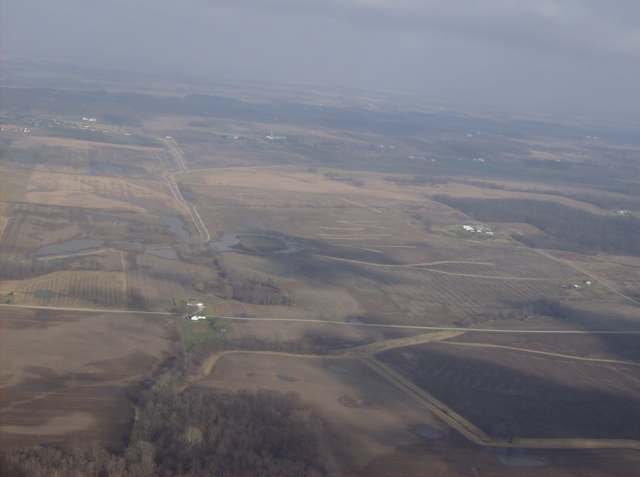
Photo: Nyttend, public domain · Wikimedia Commons
Local history sources: en.wikipedia.org · quincyohio.com · en.wikipedia.org · loganhistory.org · en.wikipedia.org · commons.wikimedia.org · commons.wikimedia.org · en.wikipedia.org · en.wikipedia.org · loganhistory.org · archive.org · archive.org · archive.org · archive.org · archive.org · archive.org · archive.org · archive.org · archive.org · archive.org · archive.org · archive.org
Water
Mostly private wells The water here
- Quincy Village59% of residentsGroundwater wells (3 wells)
- Degraff Village41% of residentsGroundwater wells (2 wells)
Hospitals, fire stations and more
Inside Miami Township, Logan County's boundary: 1 poor-rated bridge. Press a pin or a name for its whole record and its source.
Bridges rated poor (1)
-
TR 30 over Stony CreekPoor · built 1922
- Condition
- Poor: a deck, superstructure, substructure or culvert rated 4 or below on the 0 to 9 scale
- What it is
- Bridge
- Built
- 1922
- Length
- 16 ft
- Owner
- County
- Vehicles a day
- 150
- Coordinates
- 40.29667, -83.89333
National Bridge Inventory (source) ↗ Street map and directions ↗
Source: FHWA National Bridge Inventory 2025. "Poor" means one major part rated 4 or below on the 0 to 9 scale; it calls for repair, not closing, unless the state posts or closes the bridge.
Its ZIP codes
Each ZIP code that touches Miami Township, Logan County, with the share of its residents who live here and the same headline figures as the ZIP page.
| ZIP | Share | Water | Radon | Home value | Schools | Flood |
|---|---|---|---|---|---|---|
| 43343 Quincy | 24% | Mostly private wells | 4.9 pCi/L average radon | Median year built 1956 | Riverside Local · 3.5 stars overall | 3.4% of residents in the 1% floodplain |
| 43318 Degraff and De Graff | 7% | Mostly private wells | 7.4 pCi/L average radon | Median year built 1965 | Riverside Local · 3.5 stars overall | 6.3% of residents in the 1% floodplain |
Local government
Who holds office in Miami Township, Logan County, how its elections and ballot issues came out, and the state auditor's record.
Elections for office
| Date | Office | Candidates and votes |
|---|---|---|
| 2023-11-07 | Township Trustee (unofficial count) | Ronald E. Pope 444, 100.0% |
| 2023-11-07 | Township Trustee (unofficial count) | Marvin W. McCully 417, 100.0% |
| 2023-11-07 | Township Fiscal Officer (unofficial count) | Kaitlyn Bailey 421, 100.0% |
| 2021-11-02 | Township Trustee | David Cavinder 102, 20.44%; Ron Furrow 139, 27.86%; Ronald E. Pope 108, 21.64%; G. Ed Stevenson 150, 30.06% |
| 2021-11-02 | Township Trustee | Philip C. Weeks 231, 100.0% |
| 2019-11-05 | Township Trustee | Philip C. Weeks 276, 100.0% |
Winners in bold. Results from the county board of elections' official canvass unless marked.
Auditor of State record
- No fiscal caution, watch or emergency on the Auditor of State's lists.
- Financial Audit, 2023 to 2024, released 2026-06-23
The county
Logan County: 14 ZIP codes, 33 cities, villages and townships, 49,613 people.
Nearby places
Quick answers
What county is Miami Township, Ohio in?
Miami Township, Logan County is a township in Logan County, Ohio, with 545 residents.
When was Miami Township, Ohio founded?
Miami Township, Logan County was settled 1805 (Jeremiah Stansbury); laid out 1830 (Quincy); incorporated 1818. Founders on record: Logan County commissioners, organizing the township. Source
How did Miami Township, Ohio get its name?
Miami Township is named for the Great Miami River, which flows through it; the river in turn is named for the Miami (Myaamia) nation, whose traditional homeland extended into this part of west-central Ohio. Source
What ZIP code is Miami Township, Ohio?
Miami Township, Logan County is served by ZIP codes 43343 and 43318; 43343 holds the largest share of its residents.
Where does Miami Township, Ohio get its water?
The main water source for Miami Township, Logan County (Quincy Village): Mostly private wells.
Cite this page
Cite this page as:
Cracked Buckeye, "Miami Township, Logan County", https://crackedbuckeye.com/place/miami-township-logan-county/, built 2026-10-31, accessed [date].
How to cite · Report a correction · Built 2026-10-31
