Notable people · Pioneer · Nurseryman
John Chapman (Johnny Appleseed)
Itinerant nurseryman and Swedenborgian missionary who planted apple-seedling nurseries across north-central Ohio and Indiana and became the folk hero Johnny Appleseed.
Born September 26, 1774, Leominster, Massachusetts
Died March 18, 1845, Fort Wayne, Indiana
At a glance
Life story
John Chapman was born in 1774 in Leominster, Massachusetts. His mother died in 1776 and his father later remarried. By his late teens he was moving west.
By 1800 he was working in the Licking River area of Ohio. From 1806 he made canoe trips down the Ohio, Muskingum and Walhonding rivers, and he worked mainly in north-central Ohio around Mansfield, Lisbon, Lucas, Perrysville and Loudonville.
He did not scatter seeds at random. He planted nurseries, fenced them, left them with a neighbor to look after, and sold the trees to settlers. By the end of his life he held about 1,200 acres across three states.
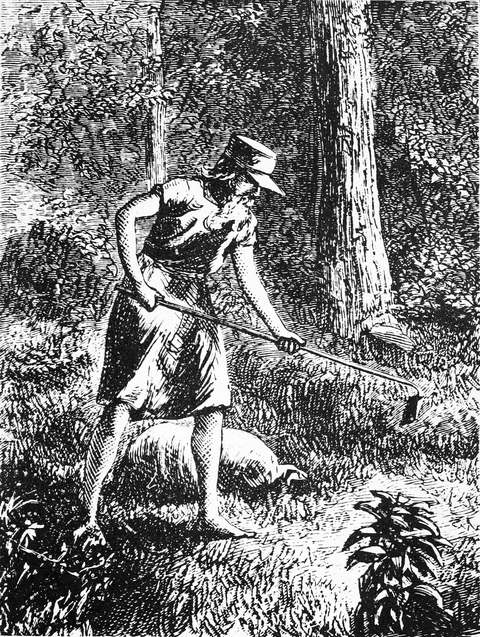
He wore rough clothes by choice. The first known use of the name 'John Appleseed' is from 1822, and he died in Fort Wayne, Indiana, on March 18, 1845. The location of his grave there is disputed.
Ohio ties
- Licking County (Isaac Stadden's farm) (1800)
first Ohio orchard Licking County · source - Mansfield (1809-1818)
owned town lot 265; base for nurseries in the Mohican country Richland County · source - Mohican Township (early 1800s)
bought 160 acres (SW quarter of section 26) but never recorded the deed and lost it Ashland County · source - Perrysville and Loudonville (early 1800s)
nurseries in the Mohican River area Ashland County · source - Mount Vernon (early 1800s)
owned two town plots Knox County · source - Urbana (modern)
Johnny Appleseed Educational Center and Museum Champaign County · source
Timeline
- 1800 Was in the Licking River area of Ohio, aged 26, and planted his first Ohio orchard on Isaac Stadden's farm. source
- 1806 Travelled down the Ohio, Muskingum and Walhonding rivers in two canoes lashed together, carrying seeds. source
- 1809 Arrived near Mansfield as its first town lots went on sale and bought Lot 265 for $120. source
- 1813 On the evening of August 9 he is believed to have run from Mansfield to Clinton and Mount Vernon for reinforcements after shopkeeper Levi Jones was killed. source
- 1818 Sold his Mansfield lot to Jesse Edgington for $100. source
- 1819 Nearly died after catching his neck in a tree fork; eight-year-old John White cut the tree down to free him. source
- 1845 Died at Fort Wayne, Indiana, on March 18 (the most cited date), leaving over 1,200 acres of nursery land. source
- 1871 W. D. Haley's article in Harper's New Monthly Magazine launched the popular legend. source
- 1968 Lisbon, Ohio, held the first recorded Johnny Appleseed Festival. source
What John is known for
- Planted apple nurseries in Ohio and beyond
Stories
The night run from Mansfield
In the summer of 1813, with the War of 1812 on the Ohio frontier, Mansfield's settlers were frightened. The killing of local shopkeeper Levi Jones set off rumours of an attack. Two blockhouses then stood on the town square, one of hewn logs built by Col. Charles Williams of Coshocton that later served as the first county courthouse. On the evening of August 9, 1813, Chapman is believed to have set out from the square on an overnight trip to the Clinton and Mount Vernon settlements to bring back help. The state marker that tells the story, put up in 1999, is careful to say 'believed': the run rests on local tradition.
A town lot beside Greentown's removal
Chapman bought Mansfield town lot 265 from Henry H. Wilcoxen for $120 around 1809 and sold it to Jesse Edgington in 1818 for $100. The marker on the lot, at 98 South Diamond Street, records a darker history from the same years. During the War of 1812, Lenape (Delaware) people camped in a ravine about two blocks west, southwest of the public square. Militia forces removed them and burned their village of Greentown, and they were marched toward the council at Piqua under Col. Samuel Kratzer. The settler whose legend grew up around kindness to all creatures lived in the middle of that removal.
Here's your primitive Christian
Harper's Magazine in 1871 told a story set at an open-air sermon in Mansfield. A travelling preacher was condemning extravagance such as buying calico and imported tea, and kept asking where there was a man who, like the primitive Christians, travelled to heaven barefoot and in coarse clothes. Chapman walked up, put his bare foot on the preacher's stump pulpit, and said, 'Here's your primitive Christian!' He was a committed Swedenborgian; an 1817 New Church bulletin described a missionary who handed out the church's books while sowing apple seeds. The anecdote comes from the 1871 article that started the legend, so it is folklore as much as fact.
Honors and things named for them
- US postage stamp (1966)
- Bronze statue, Fort Wayne, IN (2020)
Named for John Chapman (Johnny Appleseed)
- Johnny Appleseed Festival (first recorded, 1968) (Lisbon, Columbiana County) source
Family
- father: Nathaniel Chapman
- half-brother: Nathaniel Cooley Chapman
- sister: Persis Broom
Sites to know
Homes, graves, markers, museums and monuments; the numbered ones are on the map.
- 1 Ohio Historical Marker 3-70, Johnny Appleseed's Run for Reinforcements
Mansfield (Mansfield Square, N. Main St.) Richland County · source - 2 Ohio Historical Marker 9-70, Johnny Appleseed's Town Lot
Mansfield (98 S. Diamond St.) Richland County · source - John Chapman monument, South Park
Mansfield Richland County · source - Johnny Appleseed Educational Center and Museum
Urbana (518 College Way) Champaign County · source - Apple tree attributed to Chapman, Algeo farm (private)
Nova Ashland County · source - Johnny Appleseed grave, Johnny Appleseed Memorial Park
Fort Wayne, Indiana source
Ohio places
Where John Chapman (Johnny Appleseed) was born, lived, worked and is remembered, with the ZIP code, town and county pages for each.
- Lived: Mansfield, Richland County ZIP 44902 · Mansfield · Richland County
- Lived: Loudonville, Ashland County ZIP 44842 · Loudonville · Ashland County
- Lived: Mount Vernon, Knox County ZIP 43050 · Mount Vernon · Knox County
Myths and corrections
Things often said about John Chapman (Johnny Appleseed), and what the record shows.
Often said Johnny Appleseed wandered the frontier scattering apple seeds at random.
The record He planted nurseries in chosen spots, fenced them against livestock and wildlife, left them with a neighbour who sold the trees on shares, and came back every year or two to tend them. source
Often said His trees gave frontier families sweet eating apples.
The record He grew trees from seed rather than grafting, and seedling apples are rarely good to eat. Most of the fruit went into hard cider, which settlers drank in quantity. source
Often said The gentle, pot-hatted Johnny Appleseed of story is the historical John Chapman.
The record The popular figure comes mostly from W. D. Haley's 1871 Harper's article and later retellings. Historian William Kerrigan notes the legend drops his Swedenborgian evangelism and the displacement of Native communities on the frontier he worked. Details like the tin pot worn as a hat come from 19th-century anecdotes, not from records. source
Often said His grave in Fort Wayne is precisely known.
The record Developers of the Canterbury Green complex say it lies on their land near the cabin where he died; historian Steven Fortriede places it in the Archer burying ground, now in Johnny Appleseed Park. A 1900 letter from John H. Archer said the grave could not be located with certainty. source
Often said The Nova, Ohio tree is a proven Johnny Appleseed tree and a Rambo apple.
The record It is attributed to him by tradition. Wikipedia notes that some marketers call it a Rambo but disputes the identification. source
- The image of a barefoot wanderer scattering seeds is mostly legend; he planted fenced nurseries and made money from them.
- Disputed: His grave in Fort Wayne, Indiana, is placed at two sites: Canterbury Green in some accounts and Johnny Appleseed Park near the Archer cemetery in others.
- Disputed: Some later publications give 1847 as his death year, while newspapers of the time support 1845.
Pictures
Free to use with the credit shown. Select a picture for the original and its license.
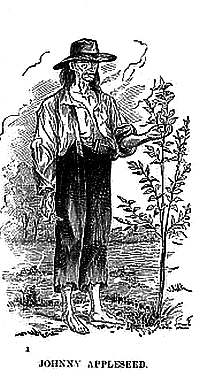
Howe's Historical Collections of Ohio, Ohio Centennial Edition, 1903
Public domain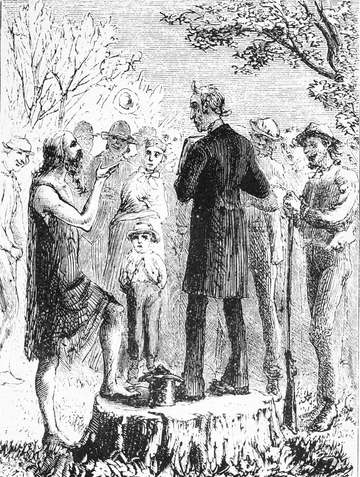
Published November 1871 in Harper's New Monthly Magazine
Public domain
Page 169 from the 1800 AD US Census in Irwin Township, Venango County, Pennsylvania. The original is from the ...
Public domain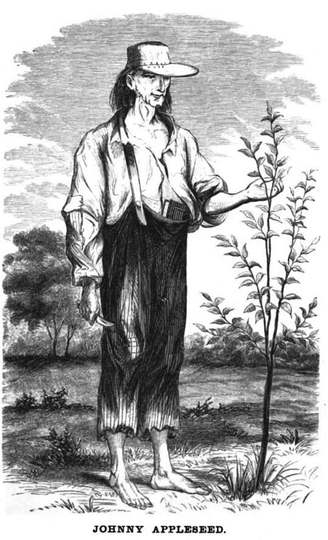
Drawing of Jonathan Chapman, aka Johnny Appleseed.
Public domain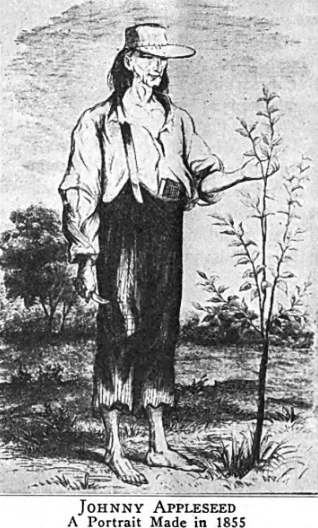
Portrait of Johnny Appleseed.
Public domain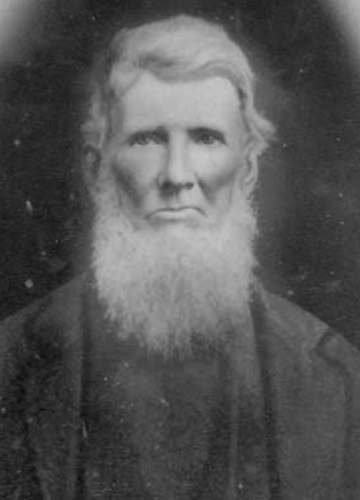
A claimed but dubious photograph of Johnny Appleseed
Public domain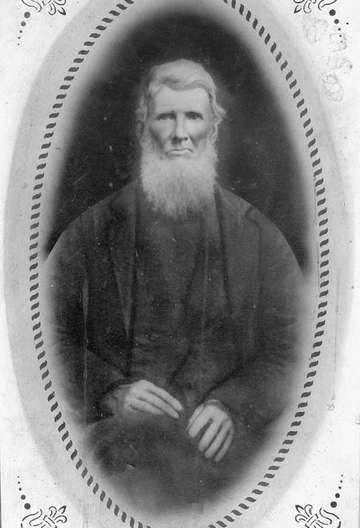
A dubious photograph claimed to be of Johnny Appleseed
Public domain
Sign M10-H3aw from the Ohio Sign Designs & Markings Manual for use with the Ohio Manual on Uniform Traffic...
Public domain
Sign M8-H4w “Ohio Byway – Johnny Appleseed Historic Byway” from the Sign Designs & Markings Manual (SDMM) ...
Public domain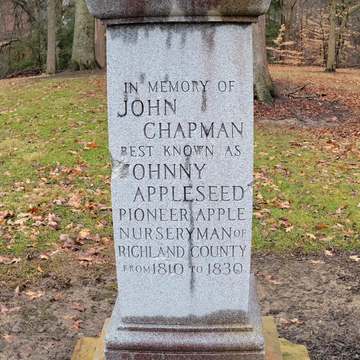
Monument to John Chapman in South Park, Mansfield, Ohio
Vaišvilkas / CC BY-SA 4.0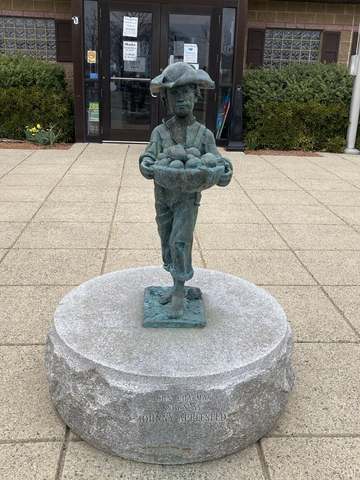
Johnny Appleseed Visitor Information Center
Researchabc / CC BY-SA 4.0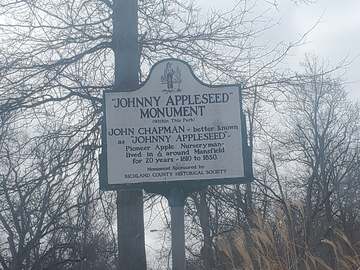
Sherman Heneman Park (park in the United States of America)
JBTHEMILKER / CC BY-SA 4.0


Further reading
Sources
Confidence. Medium: the main facts were confirmed, but some details (often an address or ZIP code) were not.
- Wikipedia: Johnny Appleseed dates, Leominster birth, Ohio nursery areas, death, grave dispute
- remarkableohio.org: 3 70 johnny appleseeds run for reinforcements
- remarkableohio.org
- johnnyappleseedmuseum.org
- daily.jstor.org: the real story behind johnny appleseed
- Wikipedia: Johnny Appleseed Park
- Wikimedia Commons: Johnny Appleseed.gif
- Wikimedia Commons: John Chapman Mansfield

Every link goes to the original source. Profile researched 2026-10-14.