Water system
Aqua Ohio - Struthers
EPA ID OH5001611 · Mahoning County · 58,551 people served
Aqua Ohio - Struthers treats its own water from Evans Lake (Yellow Creek impoundment).
The system's record
- Water bodies
- Evans Lake
- Raw intakes
- Aqua Ohio Struthers Evans Lake
- Serves
- 58,551 people · Mahoning County
- EPA ID
- OH5001611
About this area's water
Did you know
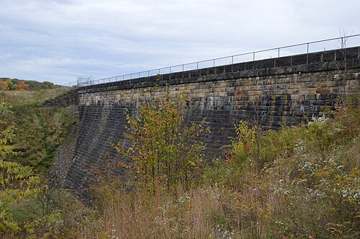
- The system's entire water source is a private lake: Aqua Ohio owns Evans Lake outright, 582 acres created by damming Yellow Creek in 1948.
- Neighboring Campbell is easy to confuse with Struthers but runs a completely separate water system drawing on Lake McKelvey and Lake Hamilton.
- Struthers' wastewater plant runs two mismatched treatment trains side by side — activated sludge on the West End, plastic-media trickling filters on the East End — off one shared headworks.
- Only about a third of the flow through the Struthers plant is actually Struthers': 64.5% arrives from Mahoning County territory outside the city.
History4
- 1948The Evans Lake dam on Yellow Creek in Poland Township was completed, creating the 582-acre reservoir that still supplies the Aqua Ohio Struthers system.
- 1961The City of Struthers Water Pollution Control Facility was constructed; it was last upgraded in 2011.
- 2004Ohio EPA's Mahoning River TMDL found bacteria impairment upstream and downstream of the Struthers plant, attributing it to unsewered areas, combined and sanitary sewer overflows, livestock and…
- 2025A new Aqua Ohio rate agreement was reported for the Struthers service area after the prior 2012 contract expired December 31, 2024, setting a 20.5% increase phased across 2026-2029.
Treatment & pressure
How it is treated
Raw water is drawn from Evans Lake, a Yellow Creek impoundment in Poland Township, and treated at Aqua Ohio's Poland plant before distribution to Struthers, New Middletown and neighboring parts of Mahoning County. Ohio EPA identifies the source and plant; the specific unit-process train was not…
Water pressure
Not published.
What it costs
$11.68 per 1,000 gallons
2026 residential rate under the reported Aqua Ohio agreement: $11.68 per 1,000 gallons plus a $16.90 monthly base charge on a 5/8" x 3/4" meter. Rising to $11.73 (2027), $12.35…
Water quality & impurities
EPA compliance record
Lead at the tap: 90th-percentile result 0 ppb in 2025 (action level 15 ppb).
EPA record: no health-based violations since 2015.
2 violations of any kind logged since 2020: 2 for a report, record or notice that was missing, late or incomplete (the yearly water quality report, a public notice, lead line records).
Projects & plans5
Recent and current work
- Struthers WPCF sanitary sewer overflow compliance schedule · 2023 · under construction
Ohio EPA included a compliance schedule in the renewed NPDES permit to address collection-system SSOs, plus SSO reporting special conditions. - Inflow and infiltration elimination program · under construction
City program to keep stormwater out of the sanitary sewers and eliminate system overflows, across roughly 50 miles of Struthers sanitary sewer. - Struthers WPCF upgrade · 2011 · completed
Most recent major upgrade to the 1961 facility, per the Ohio EPA NPDES fact sheet.
Planned or needed
- Aqua Ohio phased rate increases, 2026-2029 · planned
5% in 2026, 5% in 2027, 5.25% in 2028 and 5.25% in 2029 — about $2.98 more per month initially on a 3,900-gallon bill. - Industrial pretreatment program (contingent) · proposed
Struthers has not been required to run a pretreatment program, but Ohio EPA reserved the right to modify the permit to require one.
Supply stress
Evans Lake is a single, privately owned 582-acre impoundment, a smaller drought buffer than large regional reservoirs such as nearby Meander Creek. The Mahoning River downstream is listed as impaired for recreational-use bacteria, with combined and sanitary sewer overflows among the named sources.
Sewers
Sanitary
The City of Struthers operates its own Water Pollution Control Facility at 530 Lowellville Rd, discharging to the Mahoning River (then Beaver River and Ohio River). Average design flow is 6.0 MGD with a peak hydraulic capacity of 9.5 MGD, serving about 34,500 people in Struthers, the Village of Poland, and parts of Youngstown, Poland…
Storm
Sanitary sewer overflows are reported and under an Ohio EPA compliance schedule, and the Mahoning River corridor carries documented combined and sanitary sewer overflow contributions to bacteria impairment. No dedicated citywide stormwater utility fee was…
Sourcesverified
Compiled from the utility's own reports and public records, then independently re-checked against primary sources.
Main supplier in 4 ZIP codes
Serves
Main water supplier in 8 ZIP codes
- 44471 · Struthers98% of residents
- 44405 · Campbell98% of residents
- 44514 · Poland Township and Youngstown77% of residents
- 44442 · Springfield Township and New Middletown57% of residents
- 44436 · Poland Township and Lowellville31% of residents
- 44452 · Beaver Township and North Lima18% of residents
- 44454 · Springfield Township and Petersburg11% of residents
- 44443 · Springfield Township and New Springfield9% of residents
Also present in 6 more ZIP codes
- 44512 · Boardman Township and Youngstown19% of residents
- 44502 · Youngstown3% of residents
- 44406 · Canfield Township and Canfield2% of residents
- 44506 · Youngstown1% of residents
- 44408 · Columbiana1% of residents
- 44505 · Youngstown0% of residents
Population-weighted resident shares; a ZIP code can have more than one system on record. Recomputed from each ZIP's own system list, not from the map's cached footprint.
Buys from · Sells to
Aqua Ohio - Struthers does not buy water from another system on record; it treats its own source water.
No other system is on record buying water from Aqua Ohio - Struthers.
What the records show about Aqua Ohio - Struthers
Who runs it
EPA's record says Aqua Ohio - Struthers has 24,530 service connections and serves 58,551 people.
EPA classes it as a community water system, one that serves the same residents all year.
EPA's record says it has substantially implemented source water protection under Ohio's program, dating the program from 2025.
Source: EPA Safe Drinking Water Information System (SDWIS), water system record.
How the water is treated
EPA's treatment table registers these steps for Aqua Ohio - Struthers: chloramine disinfection, corrosion control, coagulation and settling, chlorine disinfection, fluoridation, lime softening, and sand or media filtration.
The list is what each system registered with EPA for treatment plants EPA still shows as active, and it can lag a plant upgrade.
Source: EPA Safe Drinking Water Information System (SDWIS) treatment table (EPA Envirofacts, pulled September 2026).
Violations
EPA's record shows no health-based violations for Aqua Ohio - Struthers since 2015.
EPA logs 2 violations of any kind since 2020: 2 for a report, record or notice that was missing, late or incomplete (the yearly water quality report, a public notice, lead line records).
Source: EPA Safe Drinking Water Information System (SDWIS) violation records: health-based violations with compliance periods beginning in 2015 or later, all violations from 2020 or later (EPA Envirofacts, pulled September 2026).
Lead and copper at the tap
In the sampling period ending December 2025, the 90th-percentile lead result at Aqua Ohio - Struthers was 0 ppb, under both the current 15 ppb action level and the 10 ppb level that applies from 2027. A result of 0 means at least nine in ten of the homes sampled had no lead detected.
EPA has 10 sampling periods on file for Aqua Ohio - Struthers since 2016, the first ending in 2017; no period was above 10 ppb.
Every water system has to inventory its service lines, the pipes from the main to each building. In the inventory Aqua Ohio - Struthers sent EPA, 24,427 lines are counted.
| Material | Lines |
|---|---|
| Lead | 88 |
| Galvanized, needing replacement | 388 |
| Unknown material | 9,655 |
| Not lead | 14,296 |
| All lines | 24,427 |
Systems sample taps in the homes most likely to have lead pipes or solder. The 90th-percentile result is the level nine in ten of the sampled homes were at or below. Lead comes mostly from service lines and house plumbing, not the source water, so a low result for the system does not clear an old house.
EPA's dashboard status for this inventory: reported all required service line types.
Source: EPA Safe Drinking Water Information System (SDWIS) lead and copper 90th-percentile results (EPA Envirofacts), sampling periods ending 2016 or later; EPA's service line inventory dashboard, Ohio's 2026 Q2 submission.
PFAS
EPA's fifth national round of testing (UCMR 5) took 4 samples of the water entering the pipes of Aqua Ohio - Struthers in 2023 and measured 29 PFAS.
PFOA and PFOS were not detected, against a federal limit of 4 ng/L each.
The highest PFAS result was PFBA 8.9 ng/L.
Ohio EPA's own statewide sampling tested 1 plant of Aqua Ohio - Struthers (latest sample September 2020). Not one of the six PFAS tested (PFOA, PFOS, PFHxS, PFNA, GenX and PFBS) was detected.
Ohio EPA's current sampling status map lists 1 plant of Aqua Ohio - Struthers as sampled, most recently July 2025.
| Compound | Highest result | Federal limit |
|---|---|---|
| PFOA | not detected | 4 ng/L |
| PFOS | not detected | 4 ng/L |
PFAS are the 'forever chemicals' from firefighting foam, plating shops and non-stick coatings. Results are for water leaving the plant, not your tap.
Source: EPA UCMR 5 occurrence data (final release, August 2026); Ohio EPA statewide PFAS sampling, 2019 to 2021, and its sampling status map.
Disinfection byproducts
Chlorine that disinfects water also reacts with organic matter to form byproducts. Two groups have federal limits: total trihalomethanes (TTHM, 80 µg/L) and five haloacetic acids (HAA5, 60 µg/L), judged on running yearly averages at each sampling site.
For TTHM, the average of Aqua Ohio - Struthers's samples in 2019, the last year it was sampled, was 38.7 µg/L. The worst yearly average was 49.2 µg/L and the highest single sample was 104.9 µg/L, from 144 samples taken from 2012 to 2019.
For HAA5, the average in the last year sampled was 21.9 µg/L. The worst yearly average was 27.5 µg/L and the highest single sample was 58.2 µg/L, from 147 samples.
| Byproduct | Limit | Latest yearly average | Worst yearly average | Highest sample | Samples |
|---|---|---|---|---|---|
| TTHM | 80 µg/L | 38.7 µg/L (2019) | 49.2 µg/L | 104.9 µg/L | 144 |
| HAA5 | 60 µg/L | 21.9 µg/L | 27.5 µg/L | 58.2 µg/L | 147 |
A yearly average of 0 means nothing was detected in that year's samples. EPA's file stops at 2019; Ohio EPA's Drinking Water Watch has newer results.
Source: EPA Six-Year Review 4 compliance monitoring data, 2012 to 2019, distribution-system samples (non-detects counted as zero).
Nitrate, arsenic and radioactivity
Nitrate was not detected in 96 samples through 2019 (limit 10 mg/L as nitrogen; above 10 is unsafe for infants).
Arsenic: the highest of 8 samples was 1 µg/L (limit 10); detections averaged 1; none over the limit.
| Contaminant | Samples | Highest result | Limit | Samples over limit |
|---|---|---|---|---|
| Nitrate (as nitrogen) | 96 | not detected | 10 mg/L | 0 |
| Arsenic | 8 | 1 µg/L | 10 µg/L | 0 |
| Combined radium | 2 | 2 pCi/L | 5 pCi/L | 0 |
Measured in finished water: at the plant's entry points and in the distribution system; raw well and intake samples are left out. Non-detects count as zero.
Source: EPA Six-Year Review 4 compliance monitoring data, 2012 to 2019, finished water.
Solvents and fuels
EPA's file holds results for all six solvent and fuel compounds it checked. Benzene, carbon tetrachloride, 1,2-dichloroethane, trichloroethylene, tetrachloroethylene, and vinyl chloride were not detected in 8 samples each.
| Compound | Limit | Samples | Detected in | Highest result | Samples over limit |
|---|---|---|---|---|---|
| Benzene | 5 µg/L | 8 | 0 of 8 | not detected | 0 |
| Carbon tetrachloride | 5 µg/L | 8 | 0 of 8 | not detected | 0 |
| 1,2-dichloroethane | 5 µg/L | 8 | 0 of 8 | not detected | 0 |
| Trichloroethylene (TCE) | 5 µg/L | 8 | 0 of 8 | not detected | 0 |
| Tetrachloroethylene (PCE) | 5 µg/L | 8 | 0 of 8 | not detected | 0 |
| Vinyl chloride | 2 µg/L | 8 | 0 of 8 | not detected | 0 |
"Not detected" means the lab's result was below what its method can measure, not that the compound is absent. Non-detects count as zero in the highest-result column.
Source: EPA Six-Year Review 4 compliance monitoring data, 2012 to 2019, finished water.
Farm chemicals and metals
EPA's file holds results for 8 of the nine herbicides and metals it checked. Detected: atrazine in 4 of 8 samples, highest 0.42 µg/L (limit 3); barium in 6 of 8 samples, highest 21 µg/L (limit 2,000). Not detected: alachlor, chromium, cadmium, mercury, selenium, and thallium, in 8 samples each.
| Substance | Kind | Limit | Samples | Detected in | Highest result | Samples over limit |
|---|---|---|---|---|---|---|
| Atrazine | Farm chemical | 3 µg/L | 8 | 4 of 8 | 0.42 µg/L | 0 |
| Alachlor | Farm chemical | 2 µg/L | 8 | 0 of 8 | not detected | 0 |
| Chromium | Metal | 100 µg/L | 8 | 0 of 8 | not detected | 0 |
| Cadmium | Metal | 5 µg/L | 8 | 0 of 8 | not detected | 0 |
| Barium | Metal | 2,000 µg/L | 8 | 6 of 8 | 21 µg/L | 0 |
| Mercury | Metal | 2 µg/L | 8 | 0 of 8 | not detected | 0 |
| Selenium | Metal | 50 µg/L | 8 | 0 of 8 | not detected | 0 |
| Thallium | Metal | 2 µg/L | 8 | 0 of 8 | not detected | 0 |
Non-detects count as zero in the highest-result column.
Source: EPA Six-Year Review 4 compliance monitoring data, 2012 to 2019, finished water.
Bacteria in the pipes
From 2012 to 2019, 3 of 5,054 routine total coliform samples taken in the distribution system at Aqua Ohio - Struthers tested positive (0.06%); in 2019, the last year on file, 0 of 622 did. E. coli was never found in the 4 samples tested for it.
A positive coliform test is a warning sign, not a violation by itself. E. coli is a sign that human or animal waste may have reached the water. Coliform counts are routine samples only; E. coli counts include repeat samples.
Source: EPA Six-Year Review 4 compliance monitoring data, 2012 to 2019, distribution-system presence/absence tests for total coliform and E. coli.
Fluoride
The Ohio Department of Health's report to the CDC (My Water's Fluoride) says Aqua Ohio - Struthers adjusts the fluoride level to the recommended level for preventing tooth decay.
EPA's treatment table lists fluoridation among the steps at Aqua Ohio - Struthers.
Measured fluoride: 0.83 mg/L on average at the plant's entry points in 2019 (in the range dentists aim for); samples ran from 0.64 to 1.1 mg/L across 8 samples in 2012 to 2019.
The recommended level for preventing tooth decay is 0.7 mg/L; the federal limit is 4 mg/L. The treatment list is what each system registered with EPA and can lag a plant upgrade.
Source: CDC My Water's Fluoride (fluoridation status as reported by the Ohio Department of Health, fetched September 2026); EPA Safe Drinking Water Information System (SDWIS) treatment table; EPA Six-Year Review 4 compliance monitoring data, 2012 to 2019, entry-point fluoride samples.
Lithium
Lithium was not detected in 4 UCMR 5 samples at Aqua Ohio - Struthers, last sampled in 2023 (the method reports from 9 µg/L).
Lithium is not regulated. EPA's draft health reference level is 10 µg/L, and it occurs naturally in deep groundwater, so well systems in the northwest run highest.
Source: EPA UCMR 5 occurrence data (final release, August 2026), samples from 2023 to 2025.
Algal toxins
Ohio EPA tests for microcystin, a toxin that harmful algal blooms can release, in raw water at the intake and in treated water.
At the intake, microcystin was detected 174 times in 398 raw-water samples, across 11 bloom seasons (2016 to 2026); the highest raw-water result was 10 µg/L on September 27, 2017. The highest raw-water result since 2024 was 6.656 µg/L.
In treated water, microcystin was detected 1 time; the highest result was 3.535 µg/L (September 2017), above the 1.6 µg/L do-not-drink level.
In all, 783 samples from 2016 to 2026, the latest on August 24, 2026.
| Water | Samples | Detections | Highest result |
|---|---|---|---|
| Raw water, at the intake | 398 | 174 | 10 µg/L |
| Treated water | 385 | 1 | 3.535 µg/L |
The ten-day advisory levels for treated water are 0.3 µg/L for children under six and 1.6 µg/L for everyone else. Any detection at the intake triggers more frequent testing until two clean weeks.
Source: Ohio EPA public water system harmful algal bloom monitoring, 2016 to present (HAB data, fetched September 2026).
How well the service area is mapped
The service area drawn on the map for Aqua Ohio - Struthers comes from the utility's own map.
Counting the people who live in the ZIP codes it overlaps, this atlas estimates 46,813 residents are inside the boundary, 80% of the 58,551 people Aqua Ohio - Struthers reports serving.
The resident count is an estimate from 2020 Census ZIP-code populations, not a count of customers.
Source: EPA Service Area Boundaries; resident estimate by this atlas from ZIP-code overlap.
Photograph
On the map
Show this system's territory on the map — 14 ZIP codes in all.
Sources
U.S. EPA SDWIS and Community Water System Service Area Boundaries (v3, 2026), Ohio EPA primacy data, 2020 census blocks: the system serving most residents, traced through purchases to the treating utility; Ohio EPA 2023 Sewer and Water Rate Survey (Ohio State, May 2025) for household bills; Ohio EPA DEFA loan awards since 2016 for the loans paragraph · EPA SDWIS · EPA service area boundaries · Ohio EPA drinking water · Ohio EPA rate survey
EPA's own record for this system: Enforcement and Compliance History report for OH5001611 (EPA ECHO).
Aqua Ohio - Struthers's own pages: data.epa.gov, dam.assets.ohio.gov, en.wikipedia.org