Local events in Rochester
Nothing is posted for Rochester itself yet; here is what is on within 10 miles. All local events in Rochester
Know a calendar we should watch? Send the link
Checked October 20; the events page is refreshed daily.
How Rochester began
Rochester is a small village on the West Branch of the Black River in southwestern Lorain County. It takes its name from Rochester, New York, whose proprietors Tillotson and Deming owned lands here and whose land agent Benjamin Perkins is called 'the father of the township.' Rochester Township was, in the 1879 county history's words, 'the latest settled of any of the townships' in the county: squatters named Dodge built the first cabin about 1827, Stephen Babcock arrived in 1831, the township was formed in March 1835, and the first post office opened in 1837. Around the railroad 'station' grew a hotel (1853), a Methodist church (1859), a mill, a cheese factory and, during the Civil War, a walnut gun-stock works; the Big Four depot burned in October 1900. The village's population peaked at 237 in 1880 and has fallen to 159 in 2020. See the township file (T67776-LOR) for the full pioneer narrative.
Settled c. 1827 (Dodge squatters); 1831-32 (Stephen Babcock, Elijah T. Banning, Luther Blair and others), by township formed by the Lorain County commissioners in March 1835; pioneers included Stephen Babcock, Elijah T. Banning, Luther Blair, Nehemiah Tinker and Benjamin Perkins (land agent).
Where the name comes from
The village derives its name from Rochester, New York, the native home of a land agent (Wikipedia, citing Overman's Ohio Town Names). The 1879 county history supports the link: Hiram Woodworth in 1831 chose lands in the township 'then owned by Messrs. Tillotson and Deming, of Rochester, New York,' and Benjamin Perkins, agent for much of the township's land, is called 'the father of the township.'
Before the town
No Native American village, trail or site specific to Rochester is documented. The 1879 county history's Rochester chapter tells of squatters, pioneers, churches and mills and does not mention Native people; its Brighton chapter, on the next township north, records Seneca and Wyandot camps. The township lies in the Western Reserve.
Timeline
- — A squatter family named Dodge, with wife Emeline and son Newell, builds a cabin on lot nine of tract three, the first white household in the township; a child born to them dies, the mother follows, and the survivors leave.
- — Stephen Babcock of Blandford, Massachusetts selects a farm about half a mile west of Rochester center and has Elijah T. Banning, living in Huntington Township, cut timber on thirty acres; the Babcock family moves into the new house in early spring 1832.
- — Amy Banning, daughter of Elijah T. and Patience Banning, is born, the first child of a permanent settler; Luther Blair arrives on December 31 with his wife and eleven children and builds the first log house near the center.
- — Rev. John Ferris begins Methodist meetings in Nehemiah Tinker's log house in the fall, and the winter school of 1833-34, taught by Miss Abigail Tinker to some twenty children, is the first in the township.
- — The county commissioners unite lots from tracts three, four, five and six of range nineteen into Rochester Township in March; at the first election on April 6, John Conant, Joseph Hadley and Nehemiah Tinker are elected trustees.
- — The township's first post office opens on condition that the government pay nothing for carrying the mail; Hiram Woodworth is postmaster, and John Clark carries the mail free. The same year Benjamin S. Perkins builds the first saw and grist mill, at the center (it later burns).
- — The Congregational society (formed 1838) completes the township's first meetinghouse at the center, a frame church costing $2,500.
- — George G. Ogden opens the first store and hotel at the center; Rufus Norton builds a hotel at the station in 1853.
- — The two Methodist societies join and build a church at the station, costing $2,500.
- — Daniel Franklin's 1844 flour and saw mill is moved to the station, where D. Lowrie & Son buy it in 1874 for $10,000; Conant & Shepard, at the station too, make walnut gun stocks for the U.S. government until the war ends.
- — A 'juvenile hurricane' from the northwest unroofs buildings and uproots forest trees across part of Rochester Township.
- — Village population peaks at 237.
- — The Rochester depot of the Big Four (C.C.C.& St.L.) railroad catches fire about 5:30 on a Sunday evening; the replacement station was built in 1900 or 1901 and now serves as a museum.
- — Population recorded at 226, the highest twentieth-century figure.
- — Population falls to 159, a 12.6 percent decline from 2010, the largest such drop in the village's recent history.
Stories
A family alone in the clearing
The first white household in Rochester Township was a squatter family named Dodge, who put up a small log cabin on lot nine of tract three, on what was later the Minus farm. They were the sort of people, the 1879 county historian wrote, 'known in all new countries as squatters.' A child was born to them, and soon died; the mother followed. Her husband and his son Newell made a rude coffin themselves and buried her on the brow of a hill near the river, with no hearse, no plume and no minister to say the service. 'All was dreary, all was desolate,' the historian wrote. The rest of the family soon left, and the township stayed empty of permanent settlers until Stephen Babcock arrived from Massachusetts in 1831.
A post office the government would not pay for
When the first post office was authorized for Rochester Township in 1837, the Post Office Department agreed only on the condition that it be at no expense in carrying the mails. Hiram Woodworth, the postmaster, kept the office at his house in the township's southeast corner, and John Clark volunteered to carry the mail for nothing, which he did as long as the office stayed there. The office moved to the center when Martin L. Blair became postmaster, and later to the station, where George Garrison had it in 1878.
Walnut for the army
The township's bottomlands along the West Branch of the Black River were heavily timbered when settled, with black walnut 'found in abundance.' The most extensive manufacturing establishment Rochester Township ever had was run by Conant & Shepard at the station, where they made walnut gun stocks for the United States government during the Civil War. In the historian's phrase, 'the close of the war and of this establishment was simultaneous.' The settlement then turned to butter and cheese: L. Beckley's cheese factory of 1870 and the Thomas & Noble factory of 1873 used the milk of 450 and 425 cows in 1878.
Photographs
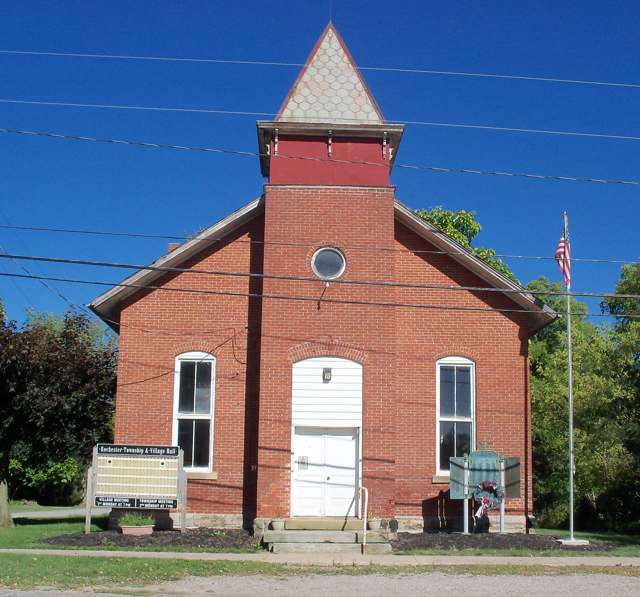
Photo: Roseohioresident, CC BY-SA 4.0 · Wikimedia Commons
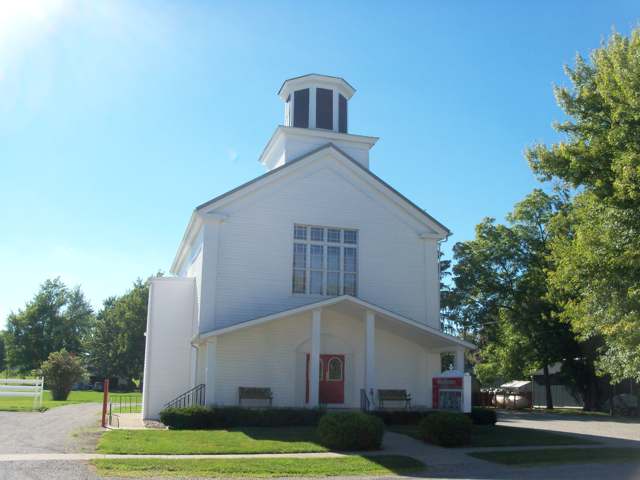
Photo: Roseohioresident, CC BY-SA 4.0 · Wikimedia Commons
Local history sources: en.wikipedia.org · archive.org · archive.org · west2k.com · commons.wikimedia.org · commons.wikimedia.org
Water
Lake Erie, drawn through two separate offshore intakes serving the Lake Road filtration plant The water here
- Rural Lorain Co. Water A52% of residentsMostly Lake Erie (bought from Avon Lake); some New London Reservoir and Ashland wells
- Wellington Village47% of residentsCharlemont Creek, via Wellington Upground Reservoir
- Pheasant Run Association1% of residentsLake Erie
Hospitals, fire stations and more
Inside Rochester's boundary: 1 fire or EMS station and 1 poor-rated bridge. Press a pin or a name for its whole record and its source.
Fire and EMS stations (1)
-
Rochester Volunteer Fire DepartmentRochester
- Address
- 200 Eagle Street, Rochester, OH 44090
- Coordinates
- 41.12353, -82.30483
USGS National Map structures (source) ↗ Street map and directions ↗
Source: USGS National Map structures (most Ohio records last updated 2019 to 2022), checked against the Columbus and Cleveland station lists. The department that answers a call is set by jurisdiction and mutual aid, not by distance.
Bridges rated poor (1)
-
Griggs Rd. over W.b.black Rv GriggsPoor · built 1970
- Condition
- Poor: a deck, superstructure, substructure or culvert rated 4 or below on the 0 to 9 scale
- What it is
- Bridge
- Built
- 1970
- Length
- 12 ft
- Owner
- County
- Vehicles a day
- 333
- Coordinates
- 41.12852, -82.30114
National Bridge Inventory (source) ↗ Street map and directions ↗
Source: FHWA National Bridge Inventory 2025. "Poor" means one major part rated 4 or below on the 0 to 9 scale; it calls for repair, not closing, unless the state posts or closes the bridge.
Its ZIP codes
Each ZIP code that touches Rochester, with the share of its residents who live here and the same headline figures as the ZIP page.
| ZIP | Share | Water | Radon | Home value | Schools | Flood |
|---|---|---|---|---|---|---|
| 44090 Wellington | 1% | Lake Erie, drawn through two separate offshore intakes serving the Lake Road filtration plant | 4.1 pCi/L average radon | Median year built 1974 | Wellington Exempted Village · 3 stars overall | 3.4% of residents in the 1% floodplain |
Local government
Who holds office in Rochester, how its elections and ballot issues came out, and the state auditor's record.
Elections for office
| Date | Office | Candidates and votes |
|---|---|---|
| 2025-11-04 | Member of Council | Andy Kurpely 26, 100.0%; No Other Valid Petition Filed 0 |
Winners in bold. Results from the county board of elections' official canvass unless marked.
The county
Lorain County: 15 ZIP codes, 32 cities, villages and townships, 304,042 people.
Nearby places
Rain and snow
How much has actually fallen on Rochester, day by day, from 1893 to now. Daily totals, not averages.
- rain, last 30 days
- 2.94 in
- 2026-10-01 to 2026-10-30
- rain so far in 2026
- 35.6 in
- 2.3 in above normal for the date
- snow so far in 2026
- 22.2 in
- a normal year brings 43.8 in
- a normal year
- 39.1 in
- average of 30 years, 1991-2020
| Month | Rain (in) | Snow (in) | Days counted |
|---|---|---|---|
| October 2026 | 2.94 | — | 30 |
| September 2026 | 4.74 | — | 30 |
| August 2026 | 3.48 | — | 31 |
| July 2026 | 3.33 | — | 31 |
| June 2026 | 4.50 | — | 30 |
| May 2026 | 4.90 | — | 31 |
| April 2026 | 6.86 | — | 30 |
| March 2026 | 3.21 | 0.0 | 31 |
| February 2026 | 0.46 | 5.0 | 28 |
| January 2026 | 1.18 | 17.2 | 31 |
| December 2025 | 2.00 | 8.6 | 31 |
| November 2025 | 1.32 | 2.9 | 30 |
| Wettest year | 2011 — 54.8 in |
|---|---|
| Driest year | 1963 — 20.2 in |
| Snowiest year | 2014 — 73.5 in |
| Wettest day on record | 5 July 1969 — 5.67 in |
| Heaviest snowfall in a day | 9 November 1913 — 13.44 in |
| Deepest snow on the ground | 27 March 1896 — 19.02 in |
Estimated, not measured. No rain gauge has ever stood inside Rochester, so every figure here is worked out from the gauges around it - the nearest ones weighted most. Treat them as close estimates rather than readings.
48,663 days of records, 1893-01-01 to 2026-10-30. Source: NOAA NCEI GHCN-Daily, 3,240 gauges in and around Ohio. A day is "gauged" when a gauge standing inside the boundary reported it, and the value is the mean of those gauges. Otherwise it is interpolated by inverse distance from every gauge reporting within 50 miles. Nothing is carried forward, back-filled or smoothed. Against NOAA nClimDiv county monthly precipitation over 136,848 complete county-months (checked 2026-11-01): correlation 0.9515, median absolute difference 0.217 in a month. Built 2026-11-01 from the Cracked Buckeye precipitation archive. Snow is the softer number — snowfall is measured by hand with a ruler, no agency publishes a gridded county snowfall series, and blowing snow defeats every observer.
Quick answers
What county is Rochester, Ohio in?
Rochester is a village in Lorain County, Ohio, with 159 residents.
When was Rochester, Ohio founded?
Rochester was settled c. 1827 (Dodge squatters); 1831-32 (Stephen Babcock, Elijah T. Banning, Luther Blair and others). Founders on record: township formed by the Lorain County commissioners in March 1835; pioneers included Stephen Babcock, Elijah T. Banning, Luther Blair, Nehemiah Tinker and Benjamin Perkins (land agent). Source
How did Rochester, Ohio get its name?
The village derives its name from Rochester, New York, the native home of a land agent (Wikipedia, citing Overman's Ohio Town Names). Source
Where does Rochester, Ohio get its water?
The main water source for Rochester (Rural Lorain Co. Water A): Lake Erie, drawn through two separate offshore intakes serving the Lake Road filtration plant.
Cite this page
Cite this page as:
Cracked Buckeye, "Rochester, Lorain County", https://crackedbuckeye.com/place/rochester/, built 2026-10-31, accessed [date].
How to cite · Report a correction · Built 2026-10-31