How Hartford began
Hartford was laid out in 1824 at the center of Hartford Township, in Licking County's northwestern corner, named for Hartford, Connecticut, home to a share of its early New England settlers. Its post office, however, has always gone by a different name, Croton, so the village is known interchangeably as Hartford and Croton to this day. The village was the scene of Licking County's most notorious pro-slavery riot, in March 1837, when a mob dragged a visiting abolitionist lecturer from the Congregational church's pulpit and paraded another through the streets on a wooden horse. It has been home to the Hartford Fair since 1858, an agricultural society originally organized during the Civil War years that grew from twenty-five acres to over two hundred and, after the old county fairgrounds in Newark closed in the early twentieth century, became known as the de facto Licking County Fair, still drawing exhibitors from Licking, Delaware and Knox counties as "the Biggest Little Fair in the World."
Platted 1824.
Where the name comes from
"Hartford was laid out in 1824," Wikipedia records, "named after Hartford, Connecticut, the native home of a share of the early settlers." The village's post office, however, was established under a separate name, Croton, and the two names have been used interchangeably for the same place ever since; no source found explains why the post office took a different name than the village itself.
Before the town
No source found records a Native village, camp, mound or trail specifically inside the platted village of Hartford. The 1881 county history's chapter on Hartford Township states plainly that "there is little or no Indian history connected with the township," noting only that flint arrowheads, stone hatchets and other relics turn up in the area, without any site-specific find tied to the village itself. No county-level file yet exists for Licking to point to for the wider regional and treaty history; see the separate Hartford Township unit file for the fuller (and equally thin) township-level record.
Timeline
- — Village residents build a log building used both as a schoolhouse and as the township's only public building, where the Congregational church is organized on August 8.
- — The village of Hartford is formally laid out at the center of the township.
- — The village's first post office is established under the name Croton.
- — A mob drags visiting abolitionist Rev. Mr. R. Robinson from the Congregational church's pulpit and, separately, parades Samuel White on a wooden horse through the village streets, beating resident William Spencer the same day.
- — Halcyon Academy is incorporated by village and township stockholders, providing secondary education beyond the common schools.
- — The Hartford Independent Fair is organized in the village, with agriculture as its focus from the start.
- — The fair's first permanent building goes up, delayed a decade by wartime scarcity of money.
- — The fair is formally incorporated as the Hartford Independent Agricultural Society.
Stories
A Pulpit, a Wooden Horse and a Riot
In March 1837, when word spread that a visiting minister, the Rev. Mr. R. Robinson, would deliver an anti-slavery lecture from the Congregational church's pulpit, a crowd of township men assembled, seized him mid-sermon, and dragged him bodily through Hartford's streets. The same month, learning that the Hon. Samuel White intended a similar lecture, the mob tracked him to a farm outside the village where he was hiding, marched him back to town, forced him to straddle a wooden sawhorse hoisted onto men's shoulders, and paraded him up and down the main street; a dish of lampblack and oil, prepared for blacking his face, was set aside only after White flatly warned that no one would apply it to him while he lived. William Spencer, beaten bloody in the same disturbance, kept shouting "I am an abolitionist" throughout his beating, according to a written account by a former resident who declined to name any of the participants when he set the story down more than forty years later, noting that many of the men involved had long since come to regret it.
From Wartime Scarcity to the Biggest Little Fair
The Hartford Independent Fair traces its founding to 1858, in a village that would soon be consumed, like the rest of the country, by the Civil War. Money was too scarce during the war years for the young agricultural society to put up a permanent building, and its first structure did not go up until 1868, three years after Appomattox. The society formally incorporated as the Hartford Independent Agricultural Society in January 1870, and growth followed steadily rather than suddenly: a first amphitheater in 1883, a sheep barn in 1901, and a slow expansion of the fairgrounds from an original twenty-five acres to more than two hundred. When Licking County's own fairgrounds in Newark closed in the early twentieth century, the Hartford Fair effectively inherited the county's fair tradition, and it continues to draw entries from Licking, Delaware and Knox counties alike under a nickname that has outlasted every one of its early buildings: the Biggest Little Fair in the World.
Photographs
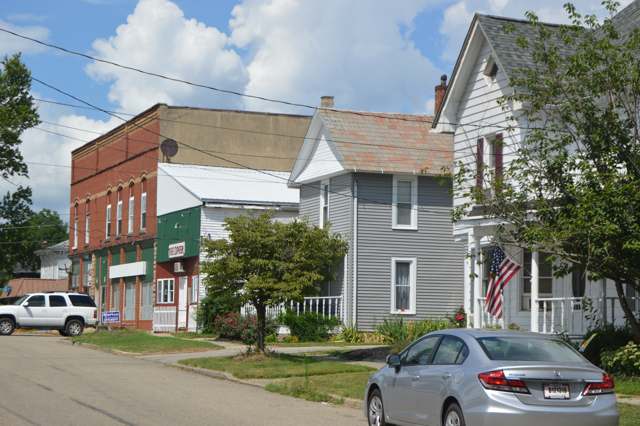
Photo: Nyttend, via Wikimedia Commons, public domain · Wikimedia Commons
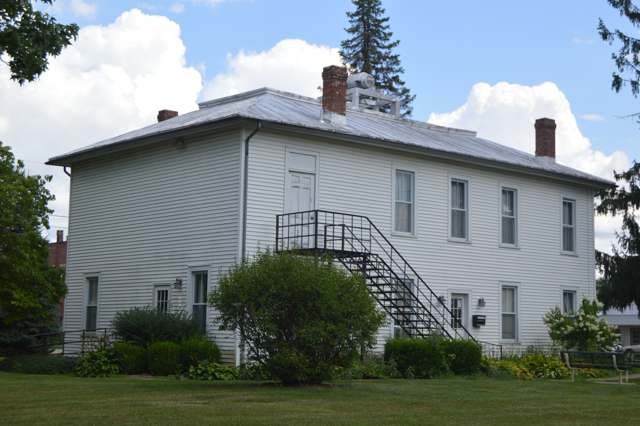
Photo: Nyttend, via Wikimedia Commons, public domain · Wikimedia Commons
Local history sources: archive.org · en.wikipedia.org · en.wikipedia.org · columbusonthecheap.com · fairsandexpos.com · commons.wikimedia.org · commons.wikimedia.org
Water
Mostly private wells The water here
- Del-co Water Company, Inc.100% of residentsOlentangy River, O'Shaughnessy and Alum Creek reservoirs, plus Knox County wells
Its ZIP codes
Each ZIP code that touches Hartford, with the share of its residents who live here and the same headline figures as the ZIP page.
| ZIP | Share | Water | Radon | Home value | Schools | Flood |
|---|---|---|---|---|---|---|
| 43013 Hartford Township and Croton | 33% | Mostly private wells | 11.1 pCi/L average radon | Median year built 1974 | Northridge Local · 4 stars overall | 4.0% of residents in the 1% floodplain |
The county
Licking County: 17 ZIP codes, 38 cities, villages and townships, 160,939 people.
Nearby places
Cite this page
Cite this page as:
Cracked Buckeye (Open Shower Co), "Hartford, Licking County", https://crackedbuckeye.com/place/hartford/, built 2026-09-16, accessed [date].
Machine-readable: /api/place/hartford.json (open JSON, CC BY 4.0 for the compilation; the underlying records keep their own terms) · How to cite · Report a correction · Built 2026-09-16