Local events in Bloom Township, Morgan County
Nothing is posted for Bloom Township itself yet; here is what is on within 20 miles. All local events in Bloom Township, Morgan County
Know a calendar we should watch? Send the link
Checked October 20; the events page is refreshed daily.
How Bloom Township, Morgan County began
Bloom Township lies in the northern part of Morgan County along the Muskingum River, bordering Muskingum County, and has never contained an incorporated village. The first cabins went up on the river side near the county line around 1800, but the township was not set off until the Morgan County commissioners created it in 1819 and settlers filled in the heavily timbered uplands after Congress cut the price of public land in 1820. Its small places were Airington (begun 1836 and nearly empty by 1886), Eagleport (laid out 1837 above the Muskingum dam) and Rokeby (platted beside the lock). Pioneers split rails, boiled salt, imported Durham cattle and fulled their wool by foot at 'kickings'; an Episcopal church at Eagleport is one of the few surviving landmarks. The township covers 25.6 square miles and had 962 residents at the 2020 census.
Settled c. 1800 on the river side near the Muskingum County line (James Larrison, Abraham Larrison); main settlement from 1818-1821, by township set off by the Morgan County commissioners and recognized by the court of common pleas on July 7, 1819; settlers of 1818-21 included the Briggs, McCune, Talley and Nicholas families.
Where the name comes from
Not established. The 1886 county history says only that the commissioners "set off a new township by the name of Bloom" in 1819 and gives no reason for the name.
Before the town
No Native American village, mound or trail specific to Bloom Township was found. The 1886 county history's Bloom chapter, which tells of pioneer hunters, bears and a squirrel migration, does not mention Native people. The township lies within the Ohio Company purchase and the land ceded by the 1795 Treaty of Greenville; Lenape (Delaware) people occupied the Muskingum valley before settlement according to the county history's general statement.
Nations recorded here: Lenape (Delaware).
Timeline
- — James Larrison lives just across the county line in Muskingum County, and his son Abraham soon moves to the Siler farm in Bloom: the first known settlement on the township's river side.
- — Morgan County is created by the General Assembly; James Briggs, the township's first blacksmith, and the McCune and Lawrence families arrive in Bloom this year.
- — Early settlers begin improving land in what becomes Bloom Township; the small communities of Eagleport, Airington, and Rokeby develop gradually over the following decades.
- — The court of common pleas notes that the county commissioners have 'set off a new township by the name of Bloom' and orders an election of two justices for July 24 at the house of Edward Nicholas.
- — Thirty-six electors vote at Edward Nicholas's house; Jonathan Frisby, John N. Gibson and Zurial Sherwood act as judges, and only James Smith of the justices elected qualifies.
- — Thomas Thornburg teaches the first school, in a schoolhouse built near the State Road on land later owned by Eli Barr; Congress cuts the price of public land from two dollars to $1.25 an acre and Bloom's land is quickly taken.
- — John F. Talley takes up his farm on January 1, Caleb Osborn sets out the township's first peach orchard, and in April the first elected trustees (Edward Nicholas, William Montgomery, David Smith) take office.
- — A blight called 'sick wheat' ruins part of the crop in the east of the township, and James Whitaker builds Bloom's first brick house of brick made on the river near Island Run by James Camp.
- — Black and gray squirrels migrating east swarm across the Muskingum and strip the cornfields; one farmer saves only enough corn for one horse and one cow.
- — The first Methodist Protestant church, called Pisgah, is built near the State Road, with Rev. Galbraith on the circuit.
- — John F. Talley builds houses for a blacksmith and a wagon-maker and begins the village of Airington in the east of the township.
- — S. Ramey lays out Eagleport on the west bank above the Muskingum dam: seventy-two lots on two streets parallel to the river, with Baughman's twenty-four-lot addition the same year.
- — Eagleport has fifteen or twenty families, two dry-goods stores, three warehouses, a Methodist Protestant church, a school, a physician and a post office; Rokeby has one store and a post office; Airington is 'in ruins' with two families.
- — The census counts 962 residents in the township's 25.6 square miles; no village has ever been incorporated here.
Stories
Four hundred and sixty-seven rails in a day
John F. Talley, born in Chester County, Pennsylvania in 1799, came to his Bloom Township farm on January 1, 1821 and lived on it for fifty-one years. The 1886 county history calls him 'one, if not the greatest rail-splitter of his time': he chopped the timber and split 467 rails in one day, where 400 was a good day's work in good timber. In a chopping contest at Dr. Martin's salt works against Thomas Carlin the two men took sixteen and a half cords from the stumps; Talley cut eight, and Carlin won by half a cord. Talley was also county surveyor for eight years, justice of the peace for fifteen, and the merchant at Airington. In 1846-47 he bought wool and shipped it to John Brown and Sons at Springfield, Massachusetts, and recalled that 'John Brown was the best judge of wool I ever dealt with'; he had been with Brown twenty-one days there. He was a lifelong Democrat who thought the Browns the most honorable dealers he ever met.
The road was a line of blazes
In 1820 the only way from the McCune farm in Bloom to McConnelsville, nine miles off, was a blazed bridle path through woods. Sallie McCune rode in to trade butter at five cents a pound for calico at twenty-five cents a yard, and Jacob Adams, the storekeeper on the public square, asked her to guide a visiting Presbyterian minister, Rev. Baker, back to her father's. As the sun went down Baker asked where the road was; she pointed to the ax-marks on the trees and told him, 'this is our road and we are on the right track.' He feared they were lost until they reached the McCune house, where he told her father that his daughter was a heroine. The Bloom settlers had no church building yet and heard preaching in cabins from Baptist 'Father' Russell, Rev. Henry Pringle and the first Methodist circuit riders, Levi Reeves and Alvin Fuller.
Sick wheat and the squirrel year
Two seasons tested Bloom's first farmers. In 1822 Ohio grew an excellent wheat crop, but several farmers in the east of the township raised wheat that looked perfect, made white flour that rose well in baking, and made every person or animal that ate it violently sick; the cause, the county historian wrote, 'has never been satisfactorily explained.' The next year countless black and gray squirrels traveling east crossed the Muskingum and attacked the corn. Neighbors who could not watch their fields lost the whole crop, and one man who guarded nine acres saved only enough for a horse and a cow. William and James White killed enough at one crossing to fill two three-bushel bags. Beef cattle of 1,000 to 1,200 pounds were selling for seven and eight dollars at the time.
Photographs
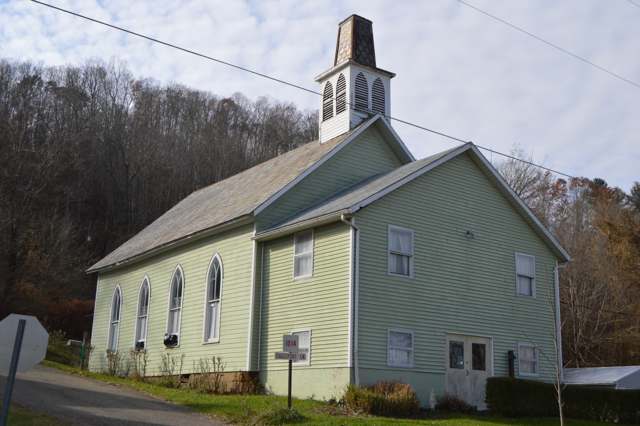
Photo: Nyttend, public domain · Wikimedia Commons
Local history sources: en.wikipedia.org · archive.org · commons.wikimedia.org
Water
Mostly private wells The water here
- Mcconnelsville Village78% of residentsGroundwater wells (4 wells)
- Morgan Meigsville - Sr 37612% of residentsGroundwater wells (4 wells)
- Malta Village8% of residentsGroundwater wells (4 wells)
- Morgan Meigsville Rural1% of residentsGroundwater wells (4 wells)
- Muskingum County Water - Se1% of residentsMuskingum River buried valley aquifer (wells near Duncan Falls)
Hospitals, fire stations and more
Inside Bloom Township, Morgan County's boundary: 1 shale or injection well. Press a pin or a name for its whole record and its source.
Shale and injection wells (1)
-
Apperson {Swiw#8} 2 InjectionInjection well (Class II)
- What it is
- Injection well (Class II)
- Operator
- Eco Power Crypto Llc
- County
- Morgan County
- API well number
- 34115227960000
- Coordinates
- 39.71212, -81.84390
ODNR oil and gas wells (source) ↗ Street map and directions ↗
Source: ODNR Division of Oil and Gas Resources well inventory (September 2026): drilled Utica, Marcellus and horizontal wells and Class II injection wells not plugged. Older vertical wells are on the full map.
Its ZIP codes
Each ZIP code that touches Bloom Township, Morgan County, with the share of its residents who live here and the same headline figures as the ZIP page.
| ZIP | Share | Water | Radon | Home value | Schools | Flood |
|---|---|---|---|---|---|---|
| 43756 Mcconnelsville and Mc Connelsville | 19% | Mostly private wells | 2.4 pCi/L average radon | Median year built 1969 | Morgan Local · 3 stars overall | 7.5% of residents in the 1% floodplain |
| 43720 Blue Rock Township and Blue Rock | 2% | Mostly private wells | Too few radon tests | Appraisal records without year built | Franklin Local · 3.5 stars overall | 11% of residents in the 1% floodplain |
Local government
Who holds office in Bloom Township, Morgan County, how its elections and ballot issues came out, and the state auditor's record.
Money issues on the ballot since 2020: 1 of 1 passed.
Ballot issues
| Date | Issue | For | Against | Result |
|---|---|---|---|---|
| 2020-11-03 | Issue: Bloom Twp 1.5 Mill Fire Renewal (1.5 mills, renewal) | 321 | 122 | Passed (72.46% for) |
| 2015-11-03 | Issue: Bloom Twp Fire Protection | 194 | 87 | Passed (69.04% for) |
Elections for office
| Date | Office | Candidates and votes |
|---|---|---|
| 2023-11-07 | Township Trustee | Stephen R. Work 224, 100.0% |
| 2023-11-07 | Township Fiscal Officer | Amy Jo Roberts 221, 100.0% |
| 2021-11-02 | Township Trustee | Michael L. Gibeaut 161, 51.11%; Stanley L. Hopkins 154, 48.89% |
| 2019-11-05 | Township Trustee | Stephen R. Work 125, 100.0% |
| 2015-11-03 | Township Trustee | Stephen R. Work 229, 100.0% |
| 2015-11-03 | Township Fiscal Officer | Amy Jo Roberts 219, 100.0% |
Winners in bold. Results from the county board of elections' official canvass unless marked.
Auditor of State record
- No fiscal caution, watch or emergency on the Auditor of State's lists.
- Financial Audit, 2023 to 2024, released 2025-12-04
The county
Morgan County: 4 ZIP codes, 15 cities, villages and townships, 11,796 people.
Nearby places
Quick answers
What county is Bloom Township, Ohio in?
Bloom Township, Morgan County is a township in Morgan County, Ohio, with 962 residents.
When was Bloom Township, Ohio founded?
Bloom Township, Morgan County was settled c. 1800 on the river side near the Muskingum County line (James Larrison, Abraham Larrison); main settlement from 1818-1821. Founders on record: township set off by the Morgan County commissioners and recognized by the court of common pleas on July 7, 1819; settlers of 1818-21 included the Briggs, McCune, Talley and Nicholas families. Source
How did Bloom Township, Ohio get its name?
Not established. Source
What ZIP code is Bloom Township, Ohio?
Bloom Township, Morgan County is served by ZIP codes 43756 and 43720; 43756 holds the largest share of its residents.
Where does Bloom Township, Ohio get its water?
The main water source for Bloom Township, Morgan County (Mcconnelsville Village): Mostly private wells.
Cite this page
Cite this page as:
Cracked Buckeye, "Bloom Township, Morgan County", https://crackedbuckeye.com/place/bloom-township-morgan-county/, built 2026-10-31, accessed [date].
How to cite · Report a correction · Built 2026-10-31
