Notable people · Sports · African American History · Invention
Moses Fleetwood Walker
Steubenville-raised Oberlin student who caught for the 1884 Toledo Blue Stockings, the first man to play major league baseball openly as a Black man, and later an inventor, theater manager and author.
Born October 7, 1856, Mount Pleasant
Died May 11, 1924, Cleveland
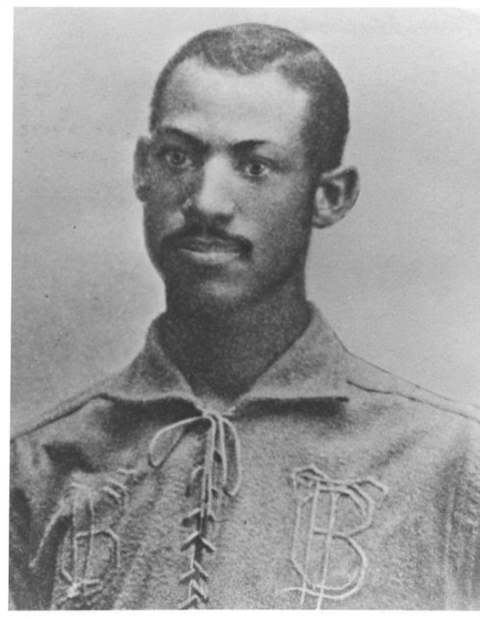
At a glance
- Born
- October 7, 1856, Mount Pleasant (Jefferson County) source
- Died
- May 11, 1924, Cleveland (Cuyahoga County) source
- Buried
- Union Cemetery (Union Cemetery-Beatty Park), Steubenville; Section P, Lot V (Jefferson County) source
- Also known as
- Fleet Walker, Fleetwood Walker, M. F. Walker
- Known as
- Sports, African American History, Invention
Life story
Moses Fleetwood Walker was born in 1856 in Mount Pleasant, a Quaker and antislavery town in Jefferson County, and grew up in Steubenville, where his father became one of Ohio's first Black physicians. He starred as a catcher at Oberlin College, where he helped form the first varsity intercollegiate team in 1881, and at the University of Michigan. In 1883 he joined the Toledo Blue Stockings, and when Toledo entered the major-league American Association in 1884 he became the first openly Black major league player, catching barehanded or in thin gloves until injuries ended his season. He played in the minors until 1889, then was acquitted of murder in Syracuse in 1891, patented an artillery cartridge, served a year for mail robbery, ran hotels and theaters in Steubenville and Cadiz, patented film-reel devices, and published the emigrationist book Our Home Colony in 1908. Ohio claims him from birth to burial: he died in Cleveland in 1924 and lies in Steubenville's Union Cemetery, and Toledo honors him with a square and a state historical marker at Fifth Third Field.
Ohio ties
- Mount Pleasant (1856-about 1860)
birthplace Jefferson County · source - Steubenville (about 1860-1877, 1891-1904)
boyhood home and Steubenville High School; later railway mail clerk and co-owner of the Union Hotel with his brother Weldy Jefferson County · source - Oberlin College, Oberlin (1877-1881)
preparatory and college student; catcher on Oberlin's first varsity intercollegiate team (1881) Lorain County · source - Cleveland (1881, 1885-1886, about 1920-1924)
caught for the White Sewing Machine Company club (1881); ran the LeGrande House hotel and opera house with Weldy; later managed the Temple Theater; died here Cuyahoga County · source - Toledo (1883-1884)
catcher for the Toledo Blue Stockings (Northwestern League champions 1883; American Association 1884) Lucas County · source - Cadiz (1904-about 1920)
managed the Cadiz Opera House with his wife Ednah; patented film-reel devices from here Harrison County · source
Timeline
- 1856 Born October 7 in Mount Pleasant, Jefferson County. source
- 1878 Entered Oberlin College's classical and scientific course after a year in its preparatory program. source
- 1881 Caught for Oberlin's first varsity intercollegiate baseball team; in August, playing for a Cleveland semipro club in Louisville, he was turned away from a hotel and opponents protested his presence on the field. source
- 1882 Transferred to the University of Michigan, where he studied law and caught for a 10-3 team, and married Arabella Taylor. source
- 1883 Signed with the Toledo Blue Stockings and caught 60 of their 84 games as they won the Northwestern League title; on August 10, Cap Anson's Chicago club threatened not to play if Walker took the field. source
- 1884 Made his major league debut for Toledo at Louisville on May 1, the first openly Black major leaguer. source
- 1884 Released by Toledo on September 22 after injuries limited him to 42 games, in which he hit .263; his brother Weldy also played six games for Toledo. source
- 1887 Caught George Stovey for Newark of the International League, the first Black battery in organized baseball. source
- 1889 Released by Syracuse on August 23, the last Black player in the International League until Jackie Robinson. source
- 1891 Stabbed and killed Patrick Murray in a street fight in Syracuse on April 9 and was found not guilty by an all-white jury on June 3. source
- 1891 Received U.S. Patent 458,026 for an exploding artillery cartridge on August 18, filed January 13 while he lived in Syracuse. source
- 1898 Was convicted of mail robbery in September and served a year as a federal prisoner. source
- 1904 Became manager of the Opera House in Cadiz, which he ran with his second wife, Ednah. source
- 1908 Published Our Home Colony, arguing for Black emigration to Africa, after co-editing the newspaper The Equator with Weldy. source
- 1920 Received three U.S. patents, filed from Cadiz in 1918, for motion-picture film reels: a film-end fastener (January 20), a reel (July 6) and a reel alarm (August 3). source
- 1924 Died of lobar pneumonia at his Cleveland home on May 11 and was buried in Union Cemetery, Steubenville, in a grave left unmarked until 1991. source
- 1990 Inducted into the Oberlin College Athletic Hall of Fame. source
- 1991 Elected to the Ohio Baseball Hall of Fame. source
- 2002 Toledo dedicated Moses Fleetwood Walker Square outside Fifth Third Field. source
Stories
Anson's ultimatum in Toledo
Before Walker had even played a game for Toledo in 1883, the Peoria club moved to bar Black players from the Northwestern League; the motion was dropped after a fierce argument. On August 10, 1883, Chicago's Cap Anson brought his White Stockings to Toledo for an exhibition and refused to play if Walker was in the lineup. Toledo manager Charlie Morton warned Anson he would forfeit his share of the gate and then put Walker in right field anyway. Chicago played and won 7-6 in extra innings. Anson's stand foreshadowed the color line that baseball drew by the end of the decade.
Catching barehanded
Walker caught in an era when catchers had almost no protection. Toledo's ball boy remembered that he sometimes wore ordinary lambskin gloves with slit fingers and a little padding, and more often caught barehanded. In 1884 he caught ace Tony Mullane, who called him the best catcher he ever worked with but admitted crossing him up with pitches he had not signaled. His major league debut at Louisville on May 1, 1884, was rough: four or five errors and a passed ball in a 5-1 loss, with the local paper calling him badly rattled. Injuries, including a broken hand and a rib injury, held him to 42 games, and Toledo released him on September 22.
A murder trial and a patent in the same year
On January 13, 1891, while living in Syracuse, Walker applied for a patent on an exploding artillery shell cartridge, an idea the Oberlin Heritage Center ties to a mechanics course he never missed at Oberlin. On April 9 a group of white men confronted him outside a saloon; one, Patrick Murray, struck him with a stone, and Walker fatally stabbed him. He claimed self-defense, and on June 3 an all-white jury acquitted him of second-degree murder. Patent 458,026 was granted on August 18, 1891, with two-thirds of it assigned to Syracuse backers. Walker then went home to Steubenville and took a job handling mail for the railroad.
The theater man of Cadiz
In 1904 Walker took over the Opera House in Cadiz, the Harrison County seat, running opera, drama, vaudeville and minstrel shows and later moving pictures with his wife Ednah. Working the projectors led him to three patents filed in 1918 and granted in 1920: a film-end fastener, a motion-picture film reel, and an alarm that rang a bell when a reel was nearly empty so the operator could start the second projector in time. Around the same years he and Weldy edited The Equator, and in 1908 he published Our Home Colony, which argued that Black Americans should emigrate to Africa. After Ednah died in 1920 he sold the Opera House and moved to Cleveland, where he died in 1924.
Named for Moses Fleetwood Walker
- Moses Fleetwood Walker Square (Toledo, Lucas County) source
Sites to know
Homes, graves, markers, museums and monuments; the numbered ones are on the map.
- 1 Ohio historical marker 47-48, Moses Fleetwood Walker, Fifth Third Field
Toledo (NE corner of N. Huron and Washington streets) Lucas County · source - Moses Fleetwood Walker Square, outside Fifth Third Field
Toledo Lucas County · source - 2 League Park, Toledo (Blue Stockings home field, 1883-1885) (demolished)
Toledo Lucas County · source - 3 Walker grave, Union Cemetery-Beatty Park (cemetery coordinates)
Steubenville (1720 W. Market St.) Jefferson County · source - 4 Oberlin College
Oberlin Lorain County · source - Birthplace town of Mount Pleasant (unknown)
Mount Pleasant Jefferson County · source
Ohio places
Where Moses Fleetwood Walker was born, lived, worked and is remembered, with the ZIP code, town and county pages for each.
- Born: Mount Pleasant, Jefferson County Mount Pleasant · Jefferson County
- Connected: Mount Pleasant, Jefferson County Mount Pleasant · Jefferson County
- Connected: Steubenville, Jefferson County Steubenville · Jefferson County
- Connected: Oberlin College, Lorain County Lorain County
- Connected: Cleveland, Cuyahoga County Cleveland · Cuyahoga County
- Connected: Toledo, Lucas County Toledo · Lucas County
- Connected: Cadiz, Harrison County Cadiz · Harrison County
- Buried: Union Cemetery, Jefferson County Jefferson County
Myths and corrections
Things often said about Moses Fleetwood Walker, and what the record shows.
Often said Jackie Robinson was the first Black player in the major leagues.
The record Robinson broke the 20th-century color line in 1947, but Walker caught for Toledo of the American Association, then a major league, in 1884, and his brother Weldy played six games for Toledo the same year. source
Often said Walker was the first African American to play in the major leagues, full stop.
The record In 2007 researcher Peter Morris found that William Edward White, who had been born enslaved, played one game for the Providence Grays in 1879, about five years before Walker. White lived and identified as a white man, so historians still credit Walker as the first to play openly as a Black man. source
Documents
Primary records: patents, letters, court and government files, nominations and old county histories, each at the archive that holds it.
- U.S. Patent 458,026, Cartridge, Moses F. Walker of Syracuse (granted August 18, 1891) 1891, Google Patents (USPTO)
- Canadian Patent 42,257, Cartridge, William O'Hara, Moses F. and Weldy Wilberforce Walker (1893) 1893, Google Patents (Canadian Intellectual Property Office)
- U.S. Patent 1,328,408, Film-end fastener for motion-picture-film reels, Moses F. Walker (granted January 20, 1920) 1920, Google Patents (USPTO)
- U.S. Patent 1,345,813, Motion-picture-film reel, Moses F. Walker (granted July 6, 1920) 1920, Google Patents (USPTO)
- U.S. Patent 1,348,609, Alarm for motion-picture-film reels, Moses F. Walker of Cadiz, Ohio (granted August 3, 1920) 1920, Google Patents (USPTO)
- Ohio historical marker 47-48, Moses Fleetwood Walker (inscription and location) Ohio History Connection (Remarkable Ohio)
Pictures
Free to use with the credit shown. Select a picture for the original and its license.
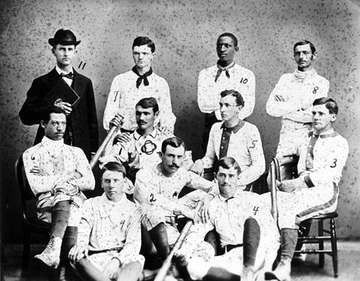
Photograph of 1881 Oberlin College baseball team, including Moses Fleetwood Walker (seated at left) and Weldy ...
Public domain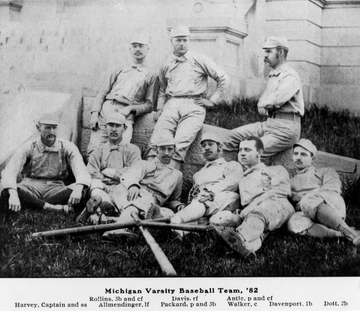
1882 University of Michigan baseball team.Top row: John Henry Rollins, Walter Davis, Thomas P. AntleFront row:...
Public domain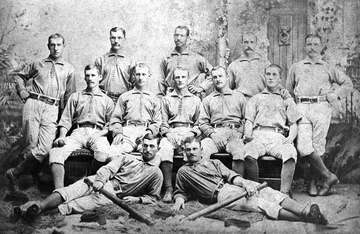
1883 Toledo Blue Stockings baseball team, Northwestern League champions. The team joined the American Associat...
Public domain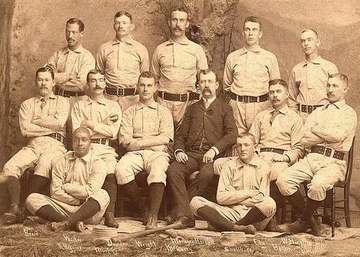
1888 Syracuse Stars baseball teamTop row, L-R: Moses Fleetwood Walker, Ed Dundon, Mox McQuery, Bones Ely, Bill...
Public domain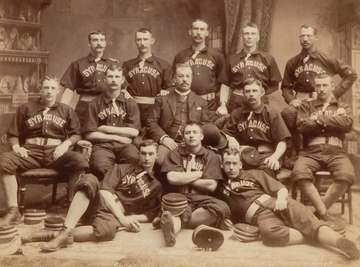
Photo of the 1889 Syracuse Stars baseball team. en:Moses Fleetwood Walker is at the upper right. According to ...
Public domain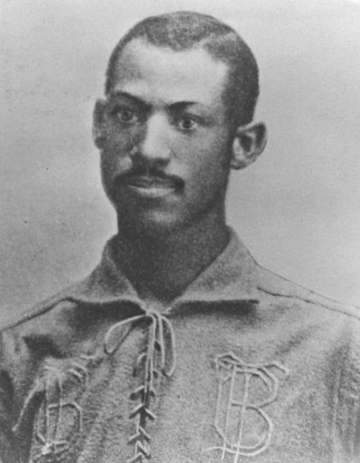
Moses Fleetwood Walker
Public domain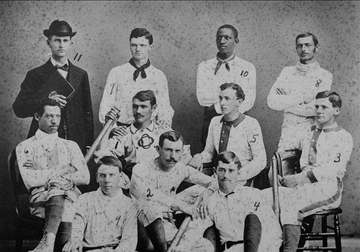
Photograph of 1881 Oberlin College baseball team, including Moses Fleetwood Walker (seated at left) and Weldy ...
Public domain


Sources
Confidence. High: the main facts were confirmed in sources we opened.
- https://en.wikipedia.org/wiki/Moses_Fleetwood_Walker
- https://sabr.org/bioproj/person/fleet-walker/
- https://sabr.org/gamesproj/game/may-1-1884-fleet-walker-s-major-league-debut
- https://www.findagrave.com/memorial/1565
- https://remarkableohio.org/marker/47-48-moses-fleetwood-walker/
- https://oberlinheritagecenter.org/moses-fleetwood/
- https://www2.oberlin.edu/external/EOG/OYTT-images/MFWalker.html
- https://patents.google.com/patent/US458026A/en
- https://patents.google.com/patent/CA42257A/en
- https://patents.google.com/patent/US1328408A/en
- https://patents.google.com/patent/US1345813A/en
- https://patents.google.com/patent/US1348609A/en
- https://en.wikipedia.org/wiki/League_Park_(Toledo)
- https://en.wikipedia.org/wiki/Union_Cemetery-Beatty_Park
- https://en.wikipedia.org/wiki/Oberlin_College
- https://npgallery.nps.gov/AssetDetail/NRIS/86003507
- https://commons.wikimedia.org/wiki/File:Moses_Fleetwood_Walker.jpg
- https://commons.wikimedia.org/wiki/File:1881_Oberlin_baseball_team.jpg
- https://commons.wikimedia.org/wiki/File:1882_University_of_Michigan_baseball_team.jpg
- https://commons.wikimedia.org/wiki/File:1884_Toledo_Blue_Stockings.jpeg
- https://commons.wikimedia.org/wiki/File:1888_Syracuse_Stars.jpg
- https://commons.wikimedia.org/wiki/File:Syracuse_Stars_1889.JPG

Every link goes to the original source. Profile researched 2026-10-15.