Notable people · Native Leader
Captain Pipe (Hopocan)
Lenape (Delaware) leader of the Wolf clan who signed the 1778 Treaty of Fort Pitt, turned against the United States after American militia killed his family, and was among the Lenape leaders at the 1782 execution of Col. William Crawford near Upper Sandusky.
Born c. 1725 (some accounts c. 1740), Probably near the Susquehanna River, Pennsylvania
Died c. 1818 (uncertain), Unknown; some accounts say near present Orestes, Indiana, others that he went to Canada
At a glance
Life story
Captain Pipe, Hopocan, was a Lenape (Delaware) leader of the Wolf clan, born around 1725. He first appears in 1759 at a Fort Pitt conference and in 1762 marked land for the Moravian missionary Christian Frederick Post on the Tuscarawas.
He succeeded his uncle Custaloga as chief of the Wolf clan in 1773. In 1778 American troops under General Hand killed his mother and brother, and in 1781 Colonel Brodhead destroyed his village on the Walhonding, ending his neutrality.
He sided with the British, helped defeat the Crawford expedition in 1782, and took part in St. Clair's Defeat in 1791.
He moved west to Indiana in 1812 and died around 1818. He lived in several Ohio towns, including villages around Cambridge and near Jeromesville, and a statue stands in Barberton.
Ohio ties
- Walhonding River village (to 1781)
his village until Col. Daniel Brodhead's troops destroyed it in 1781 Coshocton County · source - Pipe's Town near Upper Sandusky (1781-1780s)
town he founded on the upper Sandusky after 1781; site of the council that condemned Crawford Wyandot County · source - Tymochtee Creek, Crawford Township (1782)
Crawford was tortured and killed near the creek on June 11 after his capture by Delaware warriors Wyandot County · source - Marietta (1788)
settlers found him with about seventy warriors; Gen. Josiah Harmar described him favourably Washington County · source - Fort Recovery (1791)
took part in the confederacy's defeat of St. Clair's army Mercer County · source - Greentown, near Perrysville (1783-1812)
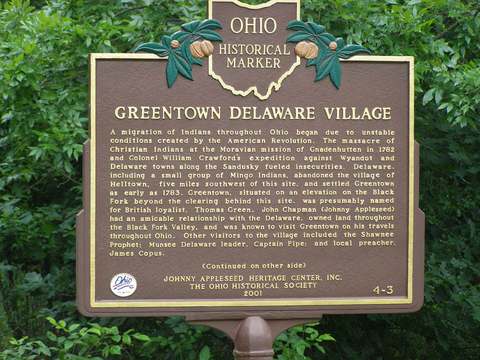
the state marker lists a 'Munsee Delaware leader, Captain Pipe' among visitors; a 1908 county history says the Greentown Pipe was probably his son Ashland County · source - New Portage Park, Barberton (1911)
site of a cast-iron 'Chief Hopocan' statue honouring early residents of New Portage Summit County · source
Timeline
- 1759 First recorded at a conference at Fort Pitt. source
- 1762 Marked out land on the Tuscarawas River for the Moravian missionary Christian Frederick Post. source
- 1773 By this year had succeeded his maternal uncle Custaloga as chief of the Wolf clan. source
- 1778 Gen. Edward Hand's militia campaign, later called the 'Squaw Campaign', killed his mother, a brother and some of his children. source
- 1778 On September 17 signed the Treaty of Fort Pitt as 'The Pipe', with White Eyes and John Killbuck. source
- 1779 By late spring had moved a large faction of the Lenape west, from where it made war on the Americans. source
- 1781 At Detroit, after delivering American prisoners, questioned British motives and their wish to be called 'Father' and asked for mercy for the prisoners. source
- 1781 Daniel Brodhead destroyed his Walhonding village, and he founded Pipe's Town near the Sandusky River. source
- 1782 On June 4-5 his Lenape warriors joined the Wyandot under Dunquat in defeating Crawford's army at 'Battle Island' between present Carey and Upper Sandusky. source
- 1782 On June 10 painted the faces of Crawford and other prisoners black; a council at Pipe's Town condemned Crawford, who was burned on June 11. source
- 1783 Hugh Henry Brackenridge published Dr. John Knight's narrative of the burning in Philadelphia, cutting the trial and the Gnadenhutten motive. source
- 1788 Settlers at Marietta found him with about seventy warriors; Josiah Harmar called him much more of a gentleman than most frontier people. source
- 1791 On March 8 Governor Arthur St. Clair wrote to 'Captain Pipe and the other Chiefs of the Delaware Nation', relying on their friendship to send an emissary to the Shawnee and Miami. source
- 1791 Took part in the defeat of St. Clair's army on November 4. source
- 1812 Moved west with his people into present Indiana about this year. source
- 1818 Died about this year, by some accounts near present Orestes, Indiana; the date and place are not documented. source
- 1829 A younger Captain Pipe, probably his son, signed the treaty at Little Sandusky on August 3 by which the Delaware ceded their last Ohio reserve on the Sandusky. source
- 1911 Barberton dedicated a cast-iron 'Chief Hopocan' statue in New Portage Park. source
What Captain is known for
- Delaware war leader in the Revolution
Stories
The council at Pipe's Town, June 1782
After the fighting near the Sandusky on June 4-5, 1782, Crawford and the surgeon John Knight were captured by Wingenund's Lenape band. On June 10 Captain Pipe arrived and painted the prisoners' faces black, the sign that they were to be executed. At a council at Pipe's Town, with Simon Girty interpreting, Crawford was accused of the Gnadenhutten massacre of March 1782 and denied it. Pipe's sister-in-law Micheykapeeci then testified that Crawford had led the 1778 campaign in which her husband and Pipe's mother were killed, and the council condemned him; Girty's offer to ransom him was refused. The historian Colin Calloway writes that 'Pipe and the Delawares knew Crawford, and they knew what he stood for': not Gnadenhutten, which he did not command, but years of fighting over Lenape land.
A speech at Detroit, 1781
In 1781 Captain Pipe brought several American prisoners and at least one scalp to the British at Detroit and then spoke to his hosts. Ohio University's Ping Institute, which counts him among 'Ohio's First Humanists', summarizes the speech: he questioned why the British wanted to be called 'Father' while leaving the fighting to their Native allies, lamented that Europeans kept turning to violence, asked for mercy for the prisoners, and predicted that the whites would again leave Native people out of the peace. Two years later the treaty ending the Revolution made no provision for Native land at all.
Two Captain Pipes
A younger man also called Captain Pipe, supposed to be the old leader's son, appears in Ohio records after 1800. The 1908 centennial history of Richland County describes him as a small, straight, affable young man at Greentown on the Black Fork, who later became a half-chief with Silas Armstrong on the reservation called Pipestown, six miles from Upper Sandusky, and died in Indian Territory in 1839. A Captain Pipe and an Eli Pipe signed the August 3, 1829 treaty at Little Sandusky, by which the Delaware gave up their three-mile-square reserve beside the Wyandot lands and agreed to move west for $3,000. The same county history says the elder Pipe never lived in Richland County and that his fate after 1812 was unknown.
Honors and things named for them
- Statue in Barberton, OH
Named for Captain Pipe (Hopocan)
- 'Chief Hopocan' statue (1911) (Barberton, Summit County) source
Family
- uncle: Custaloga
Sites to know
Homes, graves, markers, museums and monuments; the numbered ones are on the map.
- 1 Ohio Historical Marker 1-88, Colonel William Crawford / The 1782 Sandusky Campaign
Entrance to Ritchie Cemetery, Twp Roads 29 and 300, near Carey Wyandot County · source - 2 Colonel Crawford Burn Site Monument (erected 1877, NRHP 82003667)
Along Tymochtee Creek, Crawford Township, about a quarter mile north of marker 1-88 Wyandot County · source - Ohio Historical Marker 3-17, Crawford's Expedition, 1782 (unknown)
Bucyrus (marker in storage since 2024) Crawford County · source - 3 Ohio Historical Marker 4-3, Greentown Delaware Village
2488 OH 39, Perrysville Ashland County · source - 'Chief Hopocan' statue, New Portage Park
Wooster Road and Norton Avenue, Barberton Summit County · source
Ohio places
Where Captain Pipe (Hopocan) was born, lived, worked and is remembered, with the ZIP code, town and county pages for each.
- Lived: Coshocton, Coshocton County (Walhonding River / Goschachgunk area (stand-in)) ZIP 43812 (approximate) · Coshocton · Coshocton County
Myths and corrections
Things often said about Captain Pipe (Hopocan), and what the record shows.
Often said Knight's 1783 narrative shows Crawford was burned by Indians for no reason but cruelty.
The record Hugh Henry Brackenridge, who edited Dr. John Knight's account for publication in 1783, deleted the mentions of Crawford's trial and of the Gnadenhutten massacre as a motive. A historian cited by Wikipedia (Brown) called the result 'a piece of virulent anti-Indian, anti-British propaganda'. The Lenape council accused Crawford of Gnadenhutten and heard testimony that he led the 1778 campaign that killed Pipe's mother. source
Often said Captain Pipe was an enemy of the Americans from the start of the Revolution.
The record He signed the 1778 Treaty of Fort Pitt allying the Delaware with the United States, and Colin Calloway argues he supported Lenape neutrality until about 1779. He turned only after militia in Edward Hand's 1778 campaign killed his mother, a brother and some of his children. source
Often said The Captain Pipe at Greentown and on the 1829 Little Sandusky treaty was the famous Hopocan.
The record The 1908 Richland County history says the young Captain Pipe at Greentown was supposed to be the old chief's son, later a half-chief at Pipestown near Upper Sandusky who died in Indian Territory in 1839. Wikipedia also records a son of the same name who signed many treaties and moved to Kansas. The elder Pipe had left for Indiana about 1812. source
Often said The Barberton 'Chief Hopocan' statue shows what Captain Pipe looked like.
The record It is a 1911 cast-iron figure of a man with bow and arrow, made by J. L. Mott Iron Works of New York from a design by Samuel Anderson Robb and paid for by local subscription. It is a generic image, not a likeness. source
- Disputed: His birth is given as about 1725 by some sources and 1740 by others.
Documents
Primary records: patents, letters, court and government files, nominations and old county histories, each at the archive that holds it.
- Treaty with the Delawares (Treaty of Fort Pitt), September 17, 1778, signed by 'The Pipe' 1778, Oklahoma State University Libraries (Kappler)
- H. H. Brackenridge, ed., 'Narratives of a late expedition against the Indians' (Knight and Slover narratives), Philadelphia: Francis Bailey 1783, University of Pittsburgh Library System, via Internet Archive
- Arthur St. Clair, 'A Warning to the Delaware Nation', to Captain Pipe and the other Delaware chiefs, page 1 scan 1791, Northwest Territory Collection (M367), via Papers of the War Department
- C. W. Butterfield, 'An historical account of the expedition against Sandusky under Col. William Crawford in 1782' 1873, Internet Archive, via Wikimedia Commons
- Treaty with the Delawares, August 3, 1829, Little Sandusky (signed by a younger Captain Pipe) 1829, Oklahoma State University Libraries (Kappler)
Pictures
Free to use with the credit shown. Select a picture for the original and its license.
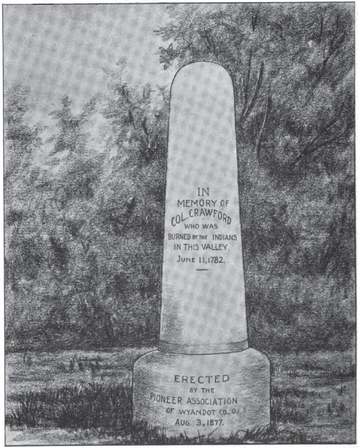
Artist's rendition of the Col. Crawford Burn Site Monument, located along Tymochtee Creek southeast of Crawfor...
Public domain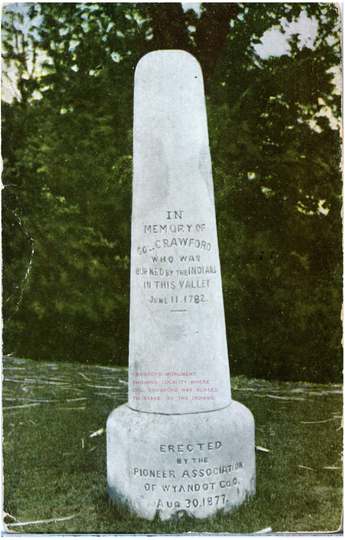
A view of the Crawford Monument erected in the locality where Colonel William Crawford was burned at the stake...
Public domain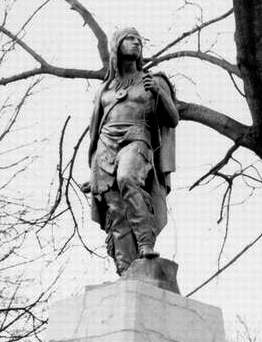
Unknown author / CC BY-SA 3.0


Further reading
Sources
Confidence. Medium: the main facts were confirmed, but some details (often an address or ZIP code) were not.
- Wikipedia: Hopocan (Captain Pipe) born c.1725-1740, died c.1818, Ohio towns, Crawford, 1812 move
- Wikipedia: Captain Pipe
- Wikipedia: Crawford expedition
- remarkableohio.org: 1 88 colonel william crawford the 1782 sandusky campaign
- remarkableohio.org: 3 17 crawfords expedition 1782
- remarkableohio.org: 4 3 greentown delaware village
- ohio.edu: kageshquanohel
- ebsco.com: konieschquanoheel hopocan
- treaties.okstate.edu: treaty with the delawares 1778 0003
- treaties.okstate.edu: treaty with the delawares 1829. (0303)
- allthingsliberty.com: the treaty of fort pitt 1778 the first u s american indian treaty
- heinzhistorycenter.org: delaware treaty 1778
- ldsgenealogy.com: A centennial biographical history of Richland county Ohio part 2
- sculpturecenter.org
- omeka.wardepartmentpapers.org
- pennstreaty.tricolib.brynmawr.edu: cpipe1
- archive.org: narrativesoflate00brac
- Wikimedia Commons: Hopocan
- Wikimedia Commons: Colonel Crawford Burn Site Monument drawing
- Wikimedia Commons: An historical account of the expedition against Sandusky under Col. William Craw
Every link goes to the original source. Profile researched 2026-10-15.