Notable people · Abolitionist
John Brown
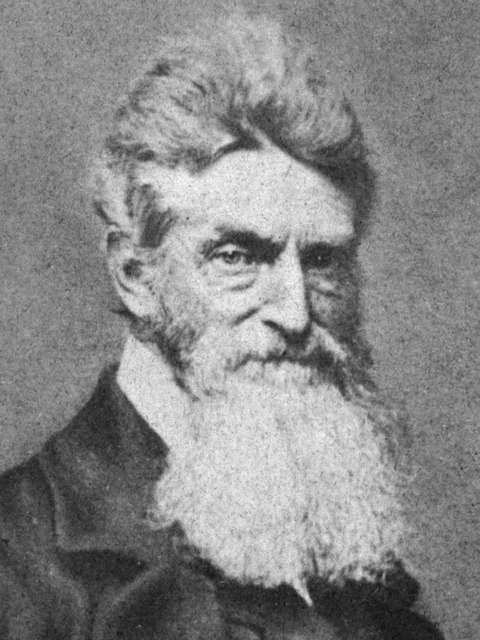
Abolitionist raised in Hudson, Summit County, who worked as a tanner and wool grower in Hudson, Kent and Akron before leading the Pottawatomie killings in Kansas and the 1859 raid on Harpers Ferry.
Born May 9, 1800, Torrington, Connecticut
Died December 2, 1859, Charles Town, Virginia (now West Virginia), by hanging
At a glance
Life story
John Brown was born in Torrington, Connecticut, in 1800, and in 1805 his family moved to Hudson, Ohio, where his father Owen ran a tannery. He grew up on the Western Reserve and learned the tanner's trade.
He married Dianthe Lusk in 1820 and, after her death in 1832, Mary Ann Day in 1833. They had twenty children. He ran tanneries and farms in Ohio and Pennsylvania and lost his money in the Panic of 1837, declaring bankruptcy in 1842.
After the murder of Elijah Lovejoy in 1837 he vowed to destroy slavery. In the 1840s he partnered with Simon Perkins of Akron in a wool business, and he moved to Massachusetts in 1846, where he founded the League of Gileadites in 1850.
He took part in the violence at Pottawatomie, Kansas, in 1856 and led the raid on Harpers Ferry on October 16, 1859. He was hanged on December 2, 1859, and buried at his farm in North Elba, New York. Historians still argue over him; to some he is a martyr, to others a man who used terror.
Ohio ties
- Hudson (1805-1825)
boyhood home; in the 1820s his own tannery and house on Hines Hill Road Summit County · source - Tallmadge (1810s)
attended the school of abolitionist Elizur Wright Summit County · source - Franklin Mills (now Kent) (1835-c. 1840)
land speculation and a tannery partnership with Zenas Kent; expelled from the Congregational church for seating Black worshippers in his pew Portage County · source - Richfield (early 1840s)
the family lived there before Akron; the Summit County Historical Society says four of his children died and were buried there within two weeks Summit County · source - Akron (Perkins Hill, 'Mutton Hill') (1844-1854)
partner of Col. Simon Perkins in sheep and wool; rented the cottage now called the John Brown House; sheltered freedom seekers Summit County · source - Hudson (1837; 1859)
first public vow against slavery at the Congregational church (1837); last appearance in Hudson in summer 1859; his brother Jeremiah stored weapons for him Summit County · source - Ashtabula County (1859)
his son John Brown Jr.'s house, where son Owen fled after the Harpers Ferry raid Ashtabula County · source
Timeline
- 1800 Born on 9 May in Torrington, Connecticut, to Owen Brown and Ruth Mills. source
- 1805 The Browns left Connecticut by ox team on 9 June and reached Hudson on 27 July, when John was five. source
- 1812 At about 12, while driving cattle, he saw an enslaved boy beaten with an iron shovel, which his family later called the start of his hatred of slavery. source
- 1820 Married Dianthe Lusk, who kept house at his tannery outside Hudson. source
- 1825 Finished the house at his tannery on Hines Hill Road, Hudson, then moved his family to Richmond Township, Pennsylvania. He sold the Hudson house to his brother Oliver in 1826. source
- 1835 Moved back to Ohio, to Franklin Mills (now Kent), and bought the old Haymaker farm along the new canal to divide into village lots. source
- 1837 In the Panic of 1837 he assigned all his property to creditors, losing the Franklin Mills land. source
- 1837 At a November prayer meeting in Hudson's Congregational church, after news of Elijah Lovejoy's murder, made his first public vow to destroy slavery. source
- 1842 Declared bankruptcy in federal court on 28 September. source
- 1843 Three of his children, Charles, Peter and Austin, died of dysentery. source
- 1844 On 9 January signed a partnership with Col. Simon Perkins of Akron to run Perkins's flocks, and rented Perkins's frame cottage for $30 a year. source
- 1846 Moved to Springfield, Massachusetts, as agent for Ohio wool growers. source
- 1852 The Perkins and Brown flock of Merino and Saxony sheep reached 1,300 head, among the best regarded in the country. source
- 1854 Brown and Perkins ended their partnership on good terms, and the family moved to North Elba, New York. source
- 1855 On his way to Kansas he collected arms in Akron, including short artillery swords from General Lucius Bierce. source
- 1856 In May, Brown and his sons killed five pro-slavery men at Pottawatomie Creek, Kansas, using the Akron swords. source
- 1859 In summer made his last appearance in Hudson, in front of the Free Congregational Church his father had built, on his way to Harpers Ferry. source
- 1859 Led the raid on the federal armory at Harpers Ferry on the night of 16 October; he was captured, convicted on 2 November, and hanged at Charles Town on 2 December. source
- 1943 May Perkins left the John Brown House in Akron to the Summit County Historical Society, with $10,000 for its upkeep. source
- 1973 The Brown-Kent Tannery in Kent was listed on the National Register on 2 October; it was demolished on 2 June 1976. source
- 1977 The John Brown Farmhouse (tannery house) on Hines Hill Road, Hudson, was listed on the National Register on 22 September. source
- 2000 An Ohio Underground Railroad historical marker, the first in northern Ohio, was placed on the Hudson green in May. source
What John is known for
- Raid on Harpers Ferry Oct. 16-18, 1859
- Provisional Constitution for a post-slavery state (1858)
- Harpers Ferry raid (1859)
Stories
The best arrangement he ever had
In 1844, after years of financial trouble, bankruptcy and the deaths of children buried in Richfield, Brown took an offer from Col. Simon Perkins, son of Akron's co-founder, to run the sheep on Perkins's hill farm. Their agreement of 9 January 1844 had Perkins furnish food and shelter for the flock, while Brown cared for the sheep, sheared them and shipped the wool. Perkins let Brown 'the frame dwelling house on his farm' for $30 a year, with garden and firewood. Brown, his wife Mary Ann and nine children moved into the two-room cottage. Brown wrote to John Jr. that it was 'the most comfortable and most favourable arrangement of my worldly concerns that I ever had'. Their first spring clip won gold medals in New York and Boston, and the Society says Brown also kept freedom seekers hidden at the cottage until they could be moved north.
A pew for a Black family
After the Panic of 1837 ruined him at Franklin Mills, Brown made a point of seating Black worshippers. According to his son-in-law Henry Thompson, Brown and his sons John, Jason and Owen were expelled from the Congregational church at Franklin (now Kent) for taking a Black man into their own pew. The deacons tried to persuade him he had erred. Thompson said Brown never joined another church.
Swords from an Akron armory
When Brown set out for Kansas in 1855 to join his sons, Akron sympathisers gave him weapons. General Lucius Bierce took six or eight short, straight artillery swords, like Roman short-swords, from an old armory of a disbanded artillery company and gave them to Brown with some guns and bayonets. The swords were ground sharp at John Brown Jr.'s camp. In May 1856 they were the weapons used in the Pottawatomie killings, which is why the bodies were said to have been mutilated.
A Hudson family business in freedom
Brown was one of several Browns in Hudson's antislavery network. His father Owen was the town's Underground Railroad 'stationmaster' and built the Free Congregational ('Oberlin') Church in 1842, whose members had to swear to fight slavery. His brother Oliver's house on North Main Street later passed to the abolitionist Ephraim Strong. His half-brother Jeremiah ran a station at his Streetsboro Street farmhouse and stored weapons for John. John Jr., born in 1821, later recalled watching his parents help fugitives at the Hines Hill Road tannery house when he was a small child.
Honors and things named for them
- John Brown Farm State Historic Site, North Elba, NY (National Historic Landmark)
- Song 'John Brown's Body'
Named for John Brown
- John Brown Road (crossing Harpers Ferry Road) near the route Owen Brown took to John Jr.'s house in Ashtabula County (northwestern Pennsylvania near the Ohio line) source
Family
- father: Owen Brown (1771-1856)
- mother: Ruth Mills
- wife: Dianthe Lusk
- wife: Mary Ann Day
- son: Owen Brown
Sites to know
Homes, graves, markers, museums and monuments; the numbered ones are on the map.
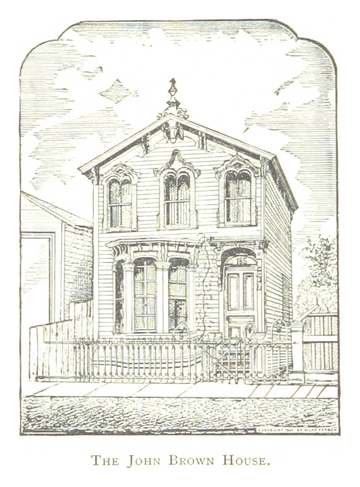
- 1 John Brown Farmhouse ('John Brown Tannery House'), built by 1825 at his Hudson tannery (NRHP 77001088) (private)
1842 Hines Hill Road, Hudson Summit County · source - John Brown House (Summit County Historical Society), the cottage he rented from Simon Perkins 1844-1854
Copley Road at Diagonal Road, Akron Summit County · source - 2 Perkins Stone Mansion (NRHP 74001624), home of his partner Col. Simon Perkins
550 Copley Road, Akron Summit County · source - Free Congregational Church, built by Owen Brown in 1842, where John Brown last appeared in Hudson in 1859 (unknown)
5 E. Main Street, Hudson Summit County · source - Site of the original Congregational church, where he made his 1837 vow (demolished)
27 E. Main Street, Hudson Summit County · source - Ohio Underground Railroad historical marker on the Hudson green (2000)
Hudson Green, near the clock tower, Hudson Summit County · source - Jeremiah Root Brown House, where his half-brother stored weapons for him (private)
204 E. Streetsboro Street, Hudson Summit County · source - Hudson Library & Historical Society (Clarence S. Gee and Brown family collections; Network to Freedom research facility)
96 Library Street, Hudson Summit County · source - Brown-Kent Tannery (NRHP 73002290), demolished 2 June 1976 (demolished)
Stow Street, Kent Portage County · source - John Brown's grave, John Brown Farm State Historic Site
North Elba, New York source
Places in Ohio to see
- John Brown House (home)
1842 Hines Hill Rd, Hudson, Summit County ZIP 44236 · Hudson · Summit County - John Brown Tannery Park (park)
300 Stow St, Kent, Portage County ZIP 44240 · Kent · Portage County - Perkins Stone Mansion (home)
550 Copley Rd, Akron, Summit County ZIP 44320 · Akron · Summit County
Ohio places
Where John Brown was born, lived, worked and is remembered, with the ZIP code, town and county pages for each.
- Lived: Hudson, Summit County (John Brown House, 1842 Hines Hill Rd) ZIP 44236 · Hudson · Summit County
- Worked: Kent, Portage County (John Brown Tannery Park, 300 Stow St) ZIP 44240 · Kent · Portage County
- Lived: Akron, Summit County (Perkins Stone Mansion, 550 Copley Rd) ZIP 44320 · Akron · Summit County
Myths and corrections
Things often said about John Brown, and what the record shows.
Often said John Brown lived in the Perkins Stone Mansion in Akron.
The record The stone mansion was the home of his partner, Col. Simon Perkins. Under their January 1844 agreement Brown rented 'the frame dwelling house on his farm (south of the house in which he now lives)' for $30 a year. That two-room cottage across the street, at Copley and Diagonal roads, is the John Brown House. source
Often said Brown made his 1837 vow after hearing William Lloyd Garrison speak in Hudson (as the Summit County Historical Society's page says).
The record The Hudson Library & Historical Society places Brown's first public antislavery speech at the wooden Congregational church at 27 E. Main Street, on news of Elijah Lovejoy's murder. The church's marker, as quoted by Wikipedia, calls it 'a November 1837 prayer meeting'. Neither mentions Garrison, and no source I opened puts Garrison in Hudson then. source
Often said Brown family houses in Hudson had hidden rooms and secret hiding places for fugitives.
The record Hudson's own historical society says runaways were likely hidden at the Brown-Strong House (built for John's brother Oliver) but that there is 'no physical evidence of hiding places'. The story of a dry cistern used as a hiding place at Jeremiah Root Brown's house is 'local tradition'. The tunnel traces mentioned in Hudson belong to a different abolitionist's house, John B. Clark's 'Thirty Acres'. source
Often said Brown collected the Akron arms, including General Bierce's swords, on 13 August 1854 (as the Summit County Historical Society dates it).
The record Brown did not leave for Kansas until later in 1855, after his sons went that spring. Sanborn's 1885 Life and Letters says the swords 'were brought from Akron in 1855 by John Brown'. source
- Historians dispute his role at Pottawatomie: some say he led the killings, while Brown denied taking direct part.
- Disputed: Historians disagree about his violent tactics: some see a hero of the fight against slavery, others a terrorist.
- Disputed: The Hudson house stands on land he developed around 1819, but the present house dates from about 1824, so he may not have built it.
Documents
Primary records: patents, letters, court and government files, nominations and old county histories, each at the archive that holds it.
- F. B. Sanborn, ed., The Life and Letters of John Brown, with Owen Brown's autobiography and John Brown's 1844 letter on the Perkins partnership 1885, University of California Libraries (Internet Archive)
- Hudson Library & Historical Society, 'The Anti-Slavery Movement and Underground Railroad' walking tour booklet 2026, Hudson Library & Historical Society
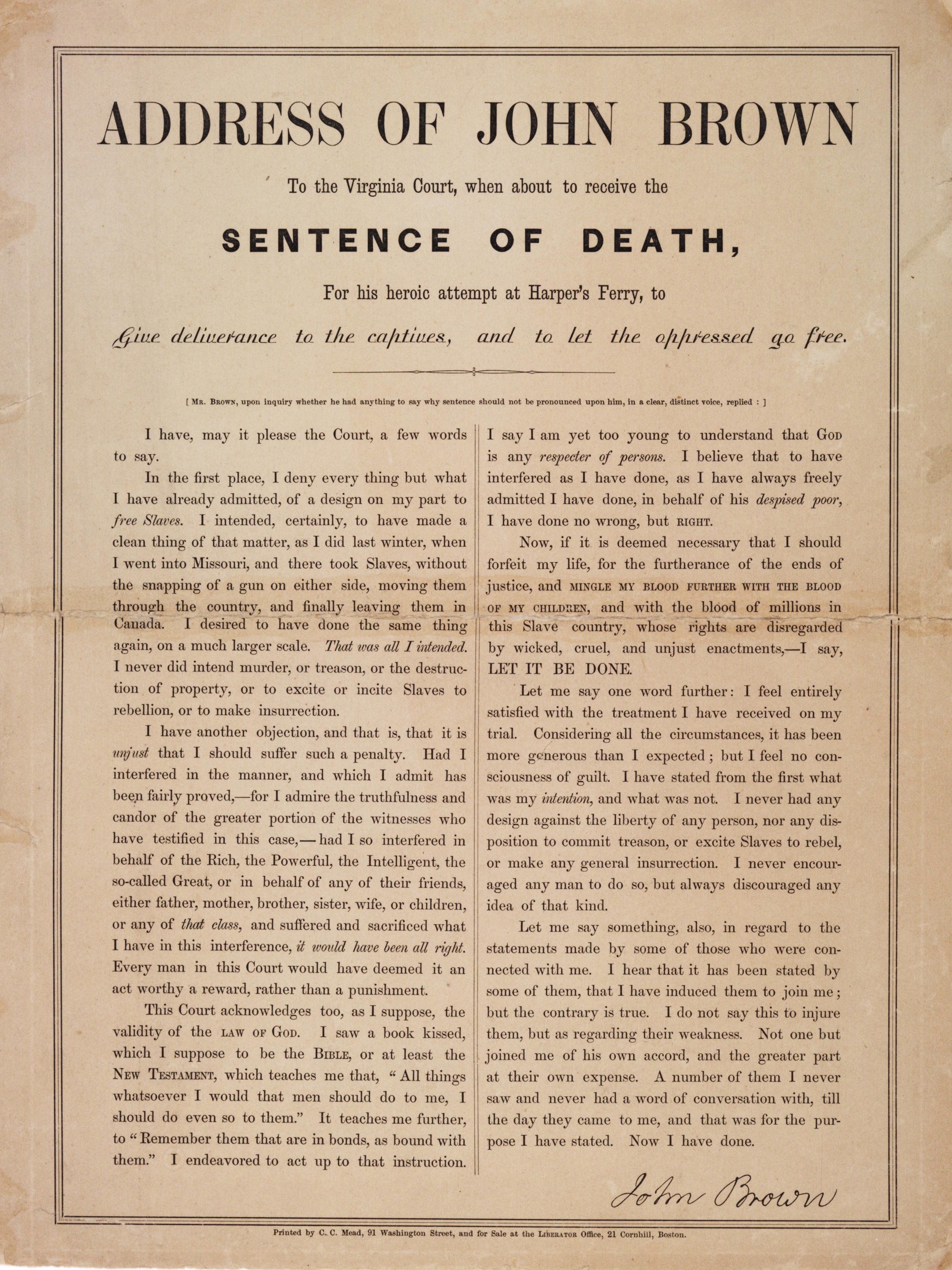
- Broadside: John Brown's last speech to the court, sold at The Liberator 1859, Gilder Lehrman Institute (via Wikimedia Commons)
Pictures
Free to use with the credit shown. Select a picture for the original and its license.
Public domain 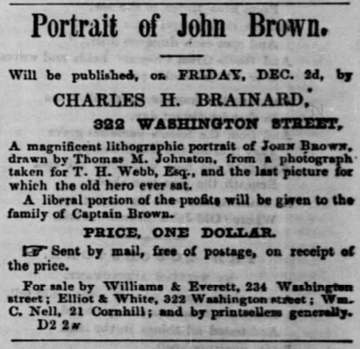
Advertisement for portrait of John Brown
Public domain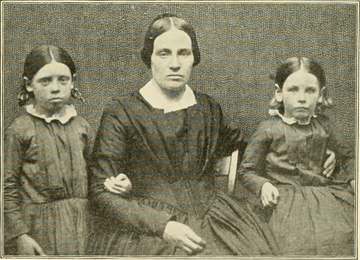
Mrs. John Brown and her two daughters Identifier: bookofroyalblue12balt (find matches) Title: Book of the Roya...
No known restrictions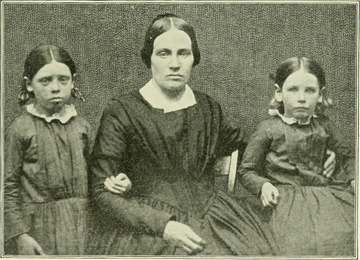
Mrs. John Brown and her two daughters Identifier: bookofroyalblue13balt (find matches) Title: Book of the Roya...
No known restrictions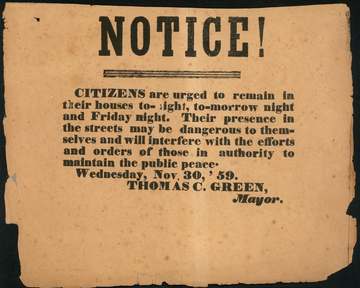
John Brown is to be hung and executed, December 2, 1859.
Public domain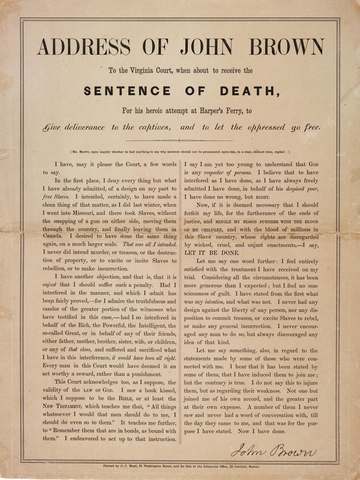
Abolitionist John Brown, about to be sentenced to death in 1859, addresses the court. Broadside sold at "The L...
Public domain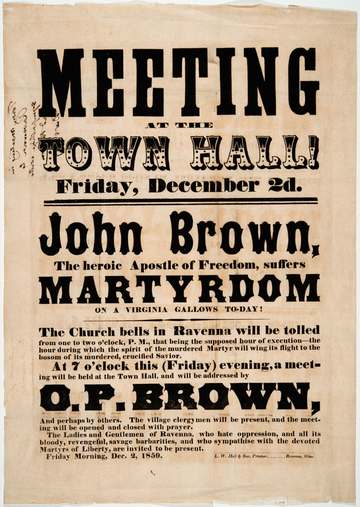
The trial and execution of John Brown was one of the events leading to the American Civil War. John Brown's ex...
Public domain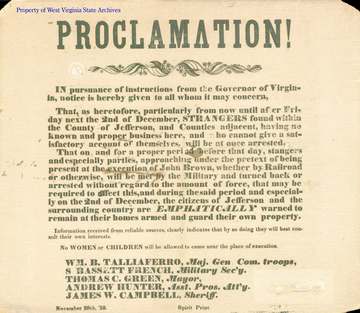
John Brown was convicted of murder, insurrection, and treason, and sentenced to be hanged December 2, 1859. Th...
Public domain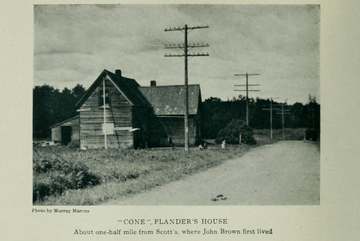
See https://archive.org/details/historyofadiron02dona/page/n31/mode/2up
Public domain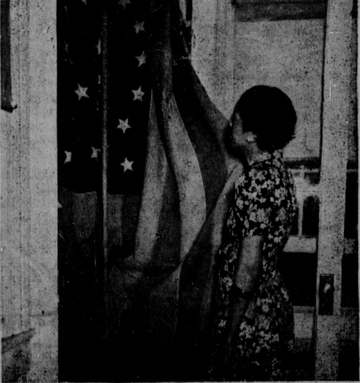
An old American Flag carried by John Brown during Harpers Ferry Raid in 1859. Source:(https://www.loc.gov/reso...
Public domain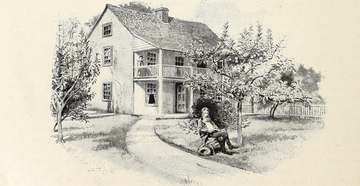
No known restrictions 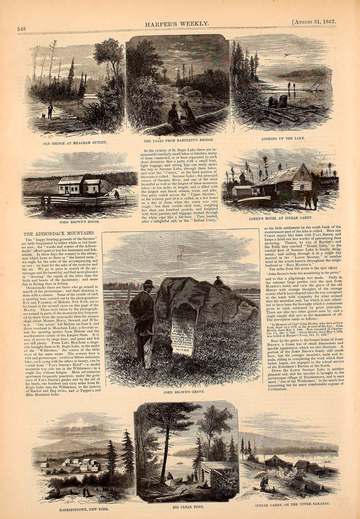
No known restrictions


Further reading
Sources
Confidence. Medium: the main facts were confirmed, but some details (often an address or ZIP code) were not.
- Wikipedia: John Brown dates, Ohio residences, burial (Wikipedia, opened; pointer-level source)
- Hudson Heritage: John Brown House or Old Tannery Farm 1842 Hines Hill Rd; Brown tannery and log house c. 1819
- Wikipedia: Perkins Stone Mansion
- Wikipedia: Summit County Historical Society of Akron, Ohio
- Wikipedia: National Register of Historic Places listings in Summit County, Ohio
- Wikipedia: National Register of Historic Places listings in Portage County, Ohio
- summithistory.org: abolitionist john brown
- summithistory.org: perkins brown partnership
- hudsonmemory.org: hudsonmemory underground railroad booklet
- hudsonmemory.org: john brown research
- hudsonmemory.org: walking tours
- hudsonlibrary.org: discover the hudson library on the ohio historical underground trail
- archive.org: lifeandlettersof00sanbrich
- findagrave.com: john brown
- Wikimedia Commons: John Brown by Augustus Washington, 1846 7
- Wikimedia Commons: John Brown portrait, 1859
- Wikimedia Commons: Brown, John, bust length, ca. 1856 NARA 531116
- Wikimedia Commons: John Brown, head and shoulders portrait, facing slightly right LCCN2004669223
- Wikimedia Commons: JOHN BROWN FARMHOUSE, HUDSON, SUMMIT COUNTY
- Wikimedia Commons: Owen Brown
- Wikimedia Commons: Broadside of John Brown's last speech
Every link goes to the original source. Profile researched 2026-10-15.