Water system
Celina, City Of
EPA ID OH5400011 · Mercer County · 11,682 people served · owned by a local government
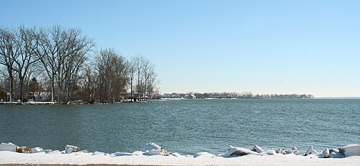
Celina, City Of treats its own water from Grand Lake St. Marys (surface water intake).
The system's record
- Water bodies
- Grand Lake St. Marys
- Raw intakes
- Grand Lake
- Serves
- 11,682 people · Mercer County
- EPA ID
- OH5400011
About this area's water
Did you know
- Celina drinks out of what was, when it was finished in 1845, the largest man-made lake on earth - dug entirely by hand by German and Irish laborers with shovels, picks and mule-drawn sleds for about 30 cents a day.
- The world's first offshore oil wells were drilled in Celina's drinking-water reservoir starting in 1891, on wooden cribs and pile platforms; more than 100 wells were pumping out on the lake by about 1913.
- Every Celina water bill carries a $2.00-per-1,000-gallon 'Water Treatment Chemical Cost Adjustment' that exists solely to pay for treatment chemicals and the granular activated carbon media used to strip algal toxins.…
- The city spent years hunting for another water source - wells, other surface water, anything - found nothing cost-effective, and decided to stay on an algae-plagued lake and buy better treatment instead.
- Celina's own municipal laboratory is Ohio EPA-certified to run total microcystin tests, which very few small-city water utilities do.
History6
- 1837-1845Grand Lake St. Marys was dug by hand as a feeder reservoir for the Miami and Erie Canal by German and Irish laborers using shovels, picks and mule-drawn sleds; at 13,500 acres it was the largest…
- 1891The world's first offshore oil wells were drilled out on the lake itself, on derricks built atop pile platforms and log-and-stone 'cribs'; more than 100 wells operated over the water through about…
- 1949Grand Lake St. Marys was among Ohio's canal-feeder lakes dedicated as the state's first state parks.
- 2009-2010Ohio EPA posted no-contact advisories after microcystin from Planktothrix-dominated blooms far exceeded recreational health thresholds; 2010 readings ran hundreds of times over the swimming advisory…
- 2010Effective January 1, 2010, city ordinance established the Water Treatment Chemical Cost Adjustment (WTCCA), a per-1,000-gallon surcharge to recover the cost of treatment chemicals and GAC media.
- 2011Ohio designated the Grand Lake St. Marys watershed as 'distressed' (January 18, 2011), the first such designation in the state.
Treatment & pressure
How it is treated
Celina's plant draws raw surface water straight out of Grand Lake, which is fed entirely by agricultural and residential runoff from a 190-square-mile watershed (Upper Beaver, Grass, Coldwater and Burntwood creeks). Treatment is conventional clarification and filtration with a granular activated…
Source: celinaohio.orgdailystandard.comdam.assets.ohio.gov
Water pressure
Not published. No distribution pressure figure or pressure-zone description appears in the city's CCR, rate ordinance or utility pages. The 2024 CCR discusses pressure only in the…
What it costs
$10.59 per 1,000 gallons
Typical household bill about $47 a month for water.
Inside-city residential, per the city rate sheet: $10.59 per 1,000 gal for the first 3,000 (minimum bill $31.77/month), $7.35 per 1,000 for the next 47,000, $6.14 per 1,000 over…
Source: celinaohio.orgcelinaohio.org
Water quality & impurities10
| Contaminant | Level | Limit | Year |
|---|---|---|---|
| Total trihalomethanes (TTHM) Running annual average; individual samples ranged 16.6 to 94.5 ppb, so single results did exceed 80 ppb, but the… | 64.25 ppb | 80 | 2024 |
| Haloacetic acids (HAA5) Range 0 to 41.4 ppb; no violation. | 19.05 ppb | 60 | 2024 |
| Total chlorine Range 1.85 to 2.32 ppm. | 2.09 ppm | 4 (MRDL) | 2024 |
| Nitrate Range <0.10 to 0.73 ppm - low despite the farm-dominated watershed. | 0.73 ppm | 10 | 2024 |
| Fluoride Well below the MCL. | 0.203 ppm | 4 | 2024 |
| Barium Trace. | 0.0130 ppm | 2 | 2024 |
| Turbidity Highest recorded result; 100% of monthly samples met the turbidity limits. | 0.14 NTU | TT | 2024 |
| Total organic carbon (removal ratio) Lowest monthly ratio of TOC actually removed to TOC required to be removed; range 2.18 to 3.29. | 2.65 ratio | TT (>1 =… | 2024 |
| Lead (90th percentile) 0 of 30 samples over the action level. | 0 ppb | 15 (AL) | 2024 |
| Copper (90th percentile) 0 of 30 samples over the action level. | 0 ppm | 1.3 (AL) | 2024 |
Source: celinaohio.org
EPA compliance record
Lead at the tap: 90th-percentile result 0 ppb in 2025 (action level 15 ppb).
EPA record: no health-based violations since 2015.
2 violations of any kind logged since 2020: 2 for a report, record or notice that was missing, late or incomplete (the yearly water quality report, a public notice, lead line records).
Projects & plans5
Recent and current work
- Ultraviolet advanced oxidation process at the water treatment plant · $531,000 · 2017 · completed
Approved as an emergency by City Council in April 2017 and targeted for service by that September, when dying lake algae releases toxins. Placed ahead of… - Ohio EPA Drinking Water Solutions Grant · $8 million · 2016 · completed
Grant award that funded the UV unit, engineering and subsequent plant upgrades; about $1.3 million had been spent on engineering and related work by mid-2018. - High-rate clarifier replacement at the water plant · 2018
Prototype tested in 2018 - a dissolved-air-flotation-like process using charged microbubbles to float solids off, promising far higher solids removal and lower… - Alternative water source study · 2018 · completed
Multiyear search for a groundwater or alternate surface supply found no cost-effective option; the city committed to staying on Grand Lake and investing in…
Source: dailystandard.comdailystandard.com
Planned or needed
- Wastewater treatment plant expansion and upgrade · $32 million · 2027-2029 · planned
Preliminary $32 million estimate to add a third oxidation ditch and two clarifiers and replace outdated equipment, in order to end bypasses to Beaver Creek and…
Source: dailystandard.com
Supply stress
High. Celina's only source is Grand Lake St. Marys, a 13,500-acre, roughly 1.5-metre-deep hypereutrophic reservoir whose 190-square-mile watershed is almost entirely agricultural and residential runoff. Persistent Planktothrix blooms have produced microcystin far above recreational and drinking-water advisory levels, and Ohio designated…
Sewers
Sanitary
City-owned Celina Wastewater Treatment Plant at 1125 S. Elm Street, design flow 3.0 MGD, discharging to Beaver Creek and serving the city plus East Jefferson Township. The current plant went online in 1991, replacing a 1940 plant that had been upgraded in 1962. It handles dry weather fine but not wet-weather infiltration and inflow…
Storm
Celina runs a dedicated stormwater utility. Residential properties pay a flat $3.27 per month (effective 12/15/2008); non-residential properties are charged by impervious area multiplied by the same $3.27 unit rate. The city prohibits sump pumps and…
Sourcesverified
Compiled from the utility's own reports and public records, then independently re-checked against primary sources.
Main supplier in 1 ZIP code
Serves
Main water supplier in 1 ZIP code
- 45822 · Celina59% of residents
Population-weighted resident shares; a ZIP code can have more than one system on record. Recomputed from each ZIP's own system list, not from the map's cached footprint.
Buys from · Sells to
Celina, City Of does not buy water from another system on record; it treats its own source water.
No other system is on record buying water from Celina, City Of.
What the records show about Celina, City Of
Who runs it
EPA's record describes Celina, City Of as owned by a local government. It has 5,370 service connections and serves 11,682 people.
EPA classes it as a community water system, one that serves the same residents all year.
EPA's record says it has substantially implemented source water protection under Ohio's program, dating the program from 2023. Its office telephone on EPA's record is 419-586-6464.
Source: EPA Safe Drinking Water Information System (SDWIS), water system record.
How the water is treated
EPA's treatment table registers these steps for Celina, City Of: corrosion control, coagulation and settling, chlorine disinfection, iron and manganese removal, granular activated carbon, lime softening, ozone, sand or media filtration, and ultraviolet disinfection.
The list is what each system registered with EPA for treatment plants EPA still shows as active, and it can lag a plant upgrade.
Source: EPA Safe Drinking Water Information System (SDWIS) treatment table (EPA Envirofacts, pulled September 2026).
Violations
EPA's record shows no health-based violations for Celina, City Of since 2015.
EPA logs 2 violations of any kind since 2020: 2 for a report, record or notice that was missing, late or incomplete (the yearly water quality report, a public notice, lead line records).
Source: EPA Safe Drinking Water Information System (SDWIS) violation records: health-based violations with compliance periods beginning in 2015 or later, all violations from 2020 or later (EPA Envirofacts, pulled September 2026).
Lead and copper at the tap
In the sampling period ending December 2025, the 90th-percentile lead result at Celina, City Of was 0 ppb, under both the current 15 ppb action level and the 10 ppb level that applies from 2027. A result of 0 means at least nine in ten of the homes sampled had no lead detected.
EPA has 11 sampling periods on file for Celina, City Of since 2016, the first ending in 2016; no period was above 10 ppb.
Every water system has to inventory its service lines, the pipes from the main to each building. In the inventory Celina, City Of sent EPA, 5,235 lines are counted.
| Material | Lines |
|---|---|
| Lead | 0 |
| Galvanized, needing replacement | 0 |
| Unknown material | 0 |
| Not lead | 5,235 |
| All lines | 5,235 |
Systems sample taps in the homes most likely to have lead pipes or solder. The 90th-percentile result is the level nine in ten of the sampled homes were at or below. Lead comes mostly from service lines and house plumbing, not the source water, so a low result for the system does not clear an old house.
EPA's dashboard status for this inventory: reported all required service line types.
Source: EPA Safe Drinking Water Information System (SDWIS) lead and copper 90th-percentile results (EPA Envirofacts), sampling periods ending 2016 or later; EPA's service line inventory dashboard, Ohio's 2026 Q2 submission.
PFAS
EPA's fifth national round of testing (UCMR 5) took 6 samples of the water entering the pipes of Celina, City Of in 2025 and measured 29 PFAS.
PFOA and PFOS were not detected, against a federal limit of 4 ng/L each.
The highest PFAS result was PFBA 10.2 ng/L.
Ohio EPA's own statewide sampling tested 1 plant of Celina, City Of (latest sample September 2020). Not one of the six PFAS tested (PFOA, PFOS, PFHxS, PFNA, GenX and PFBS) was detected.
Ohio EPA's current sampling status map lists 1 plant of Celina, City Of as sampled, most recently November 2025.
| Compound | Highest result | Federal limit |
|---|---|---|
| PFOA | not detected | 4 ng/L |
| PFOS | not detected | 4 ng/L |
PFAS are the 'forever chemicals' from firefighting foam, plating shops and non-stick coatings. Results are for water leaving the plant, not your tap.
Source: EPA UCMR 5 occurrence data (final release, August 2026); Ohio EPA statewide PFAS sampling, 2019 to 2021, and its sampling status map.
Disinfection byproducts
Chlorine that disinfects water also reacts with organic matter to form byproducts. Two groups have federal limits: total trihalomethanes (TTHM, 80 µg/L) and five haloacetic acids (HAA5, 60 µg/L), judged on running yearly averages at each sampling site.
For TTHM, the average of Celina, City Of's samples in 2019, the last year it was sampled, was 24 µg/L. The worst yearly average was 62.4 µg/L and the highest single sample was 151.6 µg/L, from 130 samples taken from 2012 to 2019.
For HAA5, the average in the last year sampled was 5.3 µg/L. The worst yearly average was 15 µg/L and the highest single sample was 40.2 µg/L, from 128 samples.
| Byproduct | Limit | Latest yearly average | Worst yearly average | Highest sample | Samples |
|---|---|---|---|---|---|
| TTHM | 80 µg/L | 24 µg/L (2019) | 62.4 µg/L | 151.6 µg/L | 130 |
| HAA5 | 60 µg/L | 5.3 µg/L | 15 µg/L | 40.2 µg/L | 128 |
A yearly average of 0 means nothing was detected in that year's samples. EPA's file stops at 2019; Ohio EPA's Drinking Water Watch has newer results.
Source: EPA Six-Year Review 4 compliance monitoring data, 2012 to 2019, distribution-system samples (non-detects counted as zero).
Nitrate, arsenic and radioactivity
Nitrate: the highest of 147 samples was 3.09 mg/L (as nitrogen) in 2013; in 2019, the last year sampled, the highest was 2.11 mg/L. No sample was over the limit of 10 mg/L. Nitrate above 10 is unsafe for infants.
Arsenic was not detected in 8 samples (limit 10 µg/L).
| Contaminant | Samples | Highest result | Limit | Samples over limit |
|---|---|---|---|---|
| Nitrate (as nitrogen) | 147 | 3.09 mg/L | 10 mg/L | 0 |
| Arsenic | 8 | not detected | 10 µg/L | 0 |
Measured in finished water: at the plant's entry points and in the distribution system; raw well and intake samples are left out. Non-detects count as zero.
Source: EPA Six-Year Review 4 compliance monitoring data, 2012 to 2019, finished water.
Solvents and fuels
EPA's file holds results for all six solvent and fuel compounds it checked. Benzene, carbon tetrachloride, 1,2-dichloroethane, trichloroethylene, tetrachloroethylene, and vinyl chloride were not detected in 8 samples each.
| Compound | Limit | Samples | Detected in | Highest result | Samples over limit |
|---|---|---|---|---|---|
| Benzene | 5 µg/L | 8 | 0 of 8 | not detected | 0 |
| Carbon tetrachloride | 5 µg/L | 8 | 0 of 8 | not detected | 0 |
| 1,2-dichloroethane | 5 µg/L | 8 | 0 of 8 | not detected | 0 |
| Trichloroethylene (TCE) | 5 µg/L | 8 | 0 of 8 | not detected | 0 |
| Tetrachloroethylene (PCE) | 5 µg/L | 8 | 0 of 8 | not detected | 0 |
| Vinyl chloride | 2 µg/L | 8 | 0 of 8 | not detected | 0 |
"Not detected" means the lab's result was below what its method can measure, not that the compound is absent. Non-detects count as zero in the highest-result column.
Source: EPA Six-Year Review 4 compliance monitoring data, 2012 to 2019, finished water.
Farm chemicals and metals
EPA's file holds results for 8 of the nine herbicides and metals it checked. Detected: barium in 5 of 8 samples, highest 14.7 µg/L (limit 2,000). Not detected: atrazine in 10 samples, alachlor in 10 samples, chromium in 10 samples, cadmium in 10 samples, mercury in 8 samples, selenium in 8 samples, thallium in 8 samples.
| Substance | Kind | Limit | Samples | Detected in | Highest result | Samples over limit |
|---|---|---|---|---|---|---|
| Atrazine | Farm chemical | 3 µg/L | 10 | 0 of 10 | not detected | 0 |
| Alachlor | Farm chemical | 2 µg/L | 10 | 0 of 10 | not detected | 0 |
| Chromium | Metal | 100 µg/L | 10 | 0 of 10 | not detected | 0 |
| Cadmium | Metal | 5 µg/L | 10 | 0 of 10 | not detected | 0 |
| Barium | Metal | 2,000 µg/L | 8 | 5 of 8 | 14.7 µg/L | 0 |
| Mercury | Metal | 2 µg/L | 8 | 0 of 8 | not detected | 0 |
| Selenium | Metal | 50 µg/L | 8 | 0 of 8 | not detected | 0 |
| Thallium | Metal | 2 µg/L | 8 | 0 of 8 | not detected | 0 |
Non-detects count as zero in the highest-result column.
Source: EPA Six-Year Review 4 compliance monitoring data, 2012 to 2019, finished water.
Bacteria in the pipes
From 2012 to 2019, 0 of 960 routine total coliform samples taken in the distribution system at Celina, City Of tested positive (0%); in 2019, the last year on file, 0 of 120 did.
A positive coliform test is a warning sign, not a violation by itself. E. coli is a sign that human or animal waste may have reached the water. Coliform counts are routine samples only; E. coli counts include repeat samples.
Source: EPA Six-Year Review 4 compliance monitoring data, 2012 to 2019, distribution-system presence/absence tests for total coliform and E. coli.
Fluoride
The Ohio Department of Health's report to the CDC (My Water's Fluoride) says Celina, City Of has fluoride from natural sources, but at a level below what is recommended for preventing tooth decay, and does not adjust it. The level it reports is 0.19 mg/L.
EPA's treatment table lists no fluoridation step at Celina, City Of.
Measured fluoride: none was detected in 8 samples at the plant's entry points in 2012 to 2019.
The recommended level for preventing tooth decay is 0.7 mg/L; the federal limit is 4 mg/L. The treatment list is what each system registered with EPA and can lag a plant upgrade.
Source: CDC My Water's Fluoride (fluoridation status as reported by the Ohio Department of Health, fetched September 2026); EPA Safe Drinking Water Information System (SDWIS) treatment table; EPA Six-Year Review 4 compliance monitoring data, 2012 to 2019, entry-point fluoride samples.
Lithium
Lithium was not detected in 4 UCMR 5 samples at Celina, City Of, last sampled in 2025 (the method reports from 9 µg/L).
Lithium is not regulated. EPA's draft health reference level is 10 µg/L, and it occurs naturally in deep groundwater, so well systems in the northwest run highest.
Source: EPA UCMR 5 occurrence data (final release, August 2026), samples from 2023 to 2025.
Algal toxins
Ohio EPA tests for microcystin, a toxin that harmful algal blooms can release, in raw water at the intake and in treated water.
At the intake, microcystin was detected 757 times in 767 raw-water samples, across 11 bloom seasons (2016 to 2026); the highest raw-water result was 193.9 µg/L on May 15, 2017. The highest raw-water result since 2024 was 73.6 µg/L.
Microcystin was never detected in treated water (765 samples).
In all, 1,532 samples from 2016 to 2026, the latest on August 25, 2026.
| Water | Samples | Detections | Highest result |
|---|---|---|---|
| Raw water, at the intake | 767 | 757 | 193.9 µg/L |
| Treated water | 765 | 0 | not detected |
The ten-day advisory levels for treated water are 0.3 µg/L for children under six and 1.6 µg/L for everyone else. Any detection at the intake triggers more frequent testing until two clean weeks.
Source: Ohio EPA public water system harmful algal bloom monitoring, 2016 to present (HAB data, fetched September 2026).
Water and sewer bills
Ohio EPA's 2023 rate survey puts the water bill at Celina, City Of for a household using 5,000 gallons a month at $558 a year, about $47 a month.
The sewer bill in the same survey is $460 a year at 5,000 gallons a month.
| Use | Water, per year | Sewer, per year |
|---|---|---|
| 2,500 gallons a month | $381 | $234 |
| 5,000 gallons a month | $558 | $460 |
| 8,000 gallons a month | $822 | $728 |
The survey lists it as “Celina”. These are inside-city rates and annual bills at the use shown.
Source: Ohio EPA 2023 Sewer and Water Rate Survey (Ohio State University, May 2025).
How well the service area is mapped
EPA estimated the service area of Celina, City Of with a computer model rather than drawing it from the utility's map, so its edges are approximate.
Counting the people who live in the ZIP codes it overlaps, this atlas estimates 11,767 residents are inside the boundary, 101% of the 11,682 people Celina, City Of reports serving.
The resident count is an estimate from 2020 Census ZIP-code populations, not a count of customers.
Source: EPA Service Area Boundaries; resident estimate by this atlas from ZIP-code overlap.
Photograph
On the map
Show this system's territory on the map — 1 ZIP code in all.
Sources
U.S. EPA SDWIS and Community Water System Service Area Boundaries (v3, 2026), Ohio EPA primacy data, 2020 census blocks: the system serving most residents, traced through purchases to the treating utility; Ohio EPA 2023 Sewer and Water Rate Survey (Ohio State, May 2025) for household bills; Ohio EPA DEFA loan awards since 2016 for the loans paragraph · EPA SDWIS · EPA service area boundaries · Ohio EPA drinking water · Ohio EPA rate survey
EPA's own record for this system: Enforcement and Compliance History report for OH5400011 (EPA ECHO).
Celina, City Of's own pages: discovergrandlake.com
Notable facts: lakeimprovement.com, aoghs.org, celinaohio.org, dailystandard.com
History: celinaohio.org, lakeimprovement.com, en.wikipedia.org, aoghs.org
Water quality: celinaohio.org
Planned work: dailystandard.com
Capital projects: dailystandard.com, dailystandard.com
Rates: celinaohio.org, celinaohio.org
Sewers: dam.assets.ohio.gov, dailystandard.com, celinaohio.org, celinaohio.org
Treatment: celinaohio.org, dailystandard.com, dam.assets.ohio.gov
Supply stress: celinaohio.org, dam.assets.ohio.gov, dailystandard.com
