Water system
Greene County - Kitridge
EPA ID OH2905003 · Greene County · 184 people served
Greene County - Kitridge buys its water from Dayton Public Water System.
The system's record
- Aquifer
- Great Miami Buried Valley Aquifer
- Water bodies
- Great Miami River, Mad River
- Raw intakes
- Dayton Miami
Dayton Mad River - Active wells
- 105
- Serves
- 141,407 people · Montgomery County
- EPA ID
- OH5703512
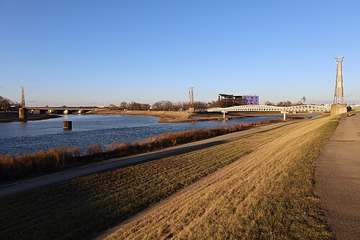
Dayton draws groundwater via 105 wells in the Miami Wellfield and Mad River Wellfield (Great Miami Buried Valley Aquifer), which are recharged by and hydraulically connected to the Great Miami and Mad Rivers.
About this area's water Dayton Public Water System
Did you know
- The Great Miami Buried Valley Aquifer holds more than a trillion gallons and is the principal water source for an estimated 1.5 million people in southwest Ohio.
- Dayton recycles its own softening waste: a Lime Recovery Facility recalcines lime sludge from both plants back into usable lime, 36,533 tons of it in 2021.
- Each of Dayton's two plants is rated at 96 million gallons a day, yet the city pumped about 24.35 billion gallons in all of 2025, roughly a third of that capacity.
- Dayton's 1870 waterworks used a Holly system, an early direct-pumping fire-and-water design; it started up March 31, 1870, after voters approved it in 1869.
History5
- 1869-1870Dayton voters approved a municipal waterworks in 1869; a Holly direct-pumping system began operating March 31, 1870.
- 1929Dayton's Division of Water Reclamation began continuous operation, treating sewage before discharge to the Great Miami River.
- 1988U.S. EPA designated the Great Miami Buried Valley Aquifer, Dayton's sole water source, a Sole Source Aquifer in May 1988.
- 2016In April 2016 Dayton took production wells near Tait's Hill out of service over PFAS suspected from the city's own Fire Training Center.
- 2021The city sued Wright-Patterson Air Force Base and the Pentagon over PFAS contamination of its groundwater.
Treatment & pressure
How it is treated
Conventional lime (calcium oxide) softening, then pH adjustment with carbon dioxide, fluoridation, chlorine disinfection, and rapid sand filtration as the final step. A Lime Recovery Facility recalcines softening sludge from both plants back into usable lime.
Water pressure
Not published. Dayton runs 2 main and 11 booster pump stations and 16 storage facilities holding 88 million gallons, implying several zones, but no psi figure.
What it costs
$5.97 per 1,000 gallons
Effective Jan 1, 2026: $44.67 per 1,000 cubic feet on the first block, which is $5.97/1,000 gal, plus an $18.60 monthly minimum for a 5/8-inch meter.
Water quality & impurities7
| Contaminant | Level | Limit | Year |
|---|---|---|---|
| PFOS (finished water, Ottawa plant) Average of monthly finished-water samples; range 5.45-13.67 ppt, above the 4 ppt MCL. | 8.81 ppt | 4 | 2025 |
| PFHxS (finished water, Ottawa plant) Range 6.70-23.32 ppt at Ottawa, above the 10 ppt MCL; Miami plant was below 2 ppt. | 13.53 ppt | 10 | 2025 |
| PFOA (finished water, Ottawa plant) Range under 2.0 to 4.5 ppt; average below the MCL. Miami plant non-detect. | 2.97 ppt | 4 | 2025 |
| Lead (90th percentile) 0 of 54 samples above the action level; lead was not detected in most samples. | <3.0 ppb | 15 | 2023 |
| Copper (90th percentile) 0 of 54 samples above the 1.3 ppm action level. | 0.044 ppm | 1.3 | 2023 |
| Total trihalomethanes (TTHM) Highest running annual average in the distribution system; range 17.9-41.5 ppb. | 28.83 ppb | 80 | 2025 |
| Nitrate Highest at the Miami plant; Ottawa reached 1.44 ppm. Well under the limit. | 1.71 ppm | 10 | 2025 |
EPA compliance record · Greene County - Kitridge
Lead at the tap: 90th-percentile result 0 ppb in 2024 (action level 15 ppb).
EPA record: no health-based violations since 2015.
EPA compliance record · Dayton Public Water System (treats the water)
Lead at the tap: 90th-percentile result 0 ppb in 2023 (action level 15 ppb).
EPA record: no health-based violations since 2015.
Projects & plans6
Recent and current work
- Lime Recovery Facility recalcination · 2021 · completed
Reclaims lime from softening residuals at both plants; produced 36,533 tons of recovered lime in 2021. - Tait's Hill production well removal · 2016 · completed
City proactively took wells near its Fire Training Center out of service over suspected PFAS contamination. - Renewable natural gas from digester biogas · 2024 · completed
Since November 2024 biogas from the Water Reclamation Plant's anaerobic digesters is cleaned and injected into gas pipelines.
Planned or needed
- PFAS removal facility and treatment plant retrofit · 2024 · planned
City estimates $300M-$500M for PFAS remediation and management; a reported ~$350M Shook contract could not be verified from a primary source. - PFAS treatment pilot and plant upgrades · planned
EPA pilot treatment project underway; part-funded by 0% Ohio EPA loans with principal forgiveness the city says will not raise water rates. - Wright-Patterson AFB remediation request · 2024 · proposed
An October 2024 letter asked the base to remediate PFAS; the city had already sued the base and the Pentagon in 2021.
Supply stress
PFAS from firefighting foam is the binding constraint: Ottawa plant finished water averaged 8.81 ppt PFOS and 13.53 ppt PFHxS in 2025, over the 4 and 10 ppt MCLs. Quantity is not a concern - the aquifer holds over a trillion gallons and is river-recharged - but treatment will cost hundreds of millions.
Sewers
Sanitary
Dayton's Division of Water Reclamation has run continuously since 1929; the plant is rated 72 MGD and discharges to the Great Miami River at river mile 76.1, serving about 340,000 people including parts of Greene County and Wright-Patterson AFB. About 765 miles of sanitary sewer.
Storm
A separate MS4 storm system of over 400 miles of storm sewers, run by the city's Sewer Maintenance Bureau alongside 28 pumping stations. No stormwater utility fee was found published.
Sourcesverified
Compiled from the utility's own reports and public records, then independently re-checked against primary sources.
Present in 0 ZIP codes
Serves
No ZIP code has Greene County - Kitridge on record as its main water supplier.
Population-weighted resident shares; a ZIP code can have more than one system on record. Recomputed from each ZIP's own system list, not from the map's cached footprint.
Buys from · Sells to
Greene County - Kitridge buys its water from Dayton Public Water System.
No other system is on record buying water from Greene County - Kitridge.
On the map
Show this system's territory on the map — 0 ZIP codes in all.
Sources
U.S. EPA SDWIS and Community Water System Service Area Boundaries (v3, 2026), Ohio EPA primacy data, 2020 census blocks: the system serving most residents, traced through purchases to the treating utility; Ohio EPA 2023 Sewer and Water Rate Survey (Ohio State, May 2025) for household bills; Ohio EPA DEFA loan awards since 2016 for the loans paragraph · EPA SDWIS · EPA service area boundaries · Ohio EPA drinking water · Ohio EPA rate survey