Water system
Athens
EPA ID OH0500212 · Athens County · 32,725 people served
Athens treats its own water from Hocking River Valley aquifer (wells).
The system's record
- Aquifer
- Hocking River Valley aquifer
- Water bodies
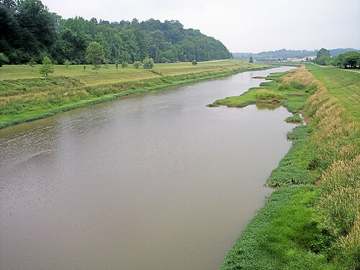
- Hocking River
- Active wells
- 16
- Serves
- 32,725 people · Athens County
- EPA ID
- OH0500212
16-17 wells in a shallow sand-and-gravel aquifer along the Hocking River, serving Athens and The Plains; no purchased water.
About this area's water
Did you know
- Athens water had a hardness of 142 mg/L in 2025 — about 8.3 grains per gallon, softening slightly from 148 in 2019.
- The city has been on groundwater continuously since 1894; the first well sat about 4,400 feet west of the courthouse, near today's West State Street well field.
- A parts-per-billion measurement is described in the city's own report as equivalent to one second in 31.7 years.
- In 2025 Athens sealed two retired wells with an Ohio EPA grant and began drilling a new production well, number 24.
History5
- 1894Athens began relying on groundwater; the first well was about 4,400 ft west of the Court House and 2,000 ft north of the Hocking River, near today's West State St. well field.
- 1954The well system had expanded to supply about 1.3 million gallons per day.
- 2003Ohio EPA and the city's groundwater consultant studied sporadic volatile organic compound detections and rated the aquifer highly susceptible to contamination.
- 2017In June, Ohio EPA required Athens to obtain a Municipal Separate Storm Sewer System (MS4) permit, triggering a formal stormwater management program.
- 2019A large water treatment plant upgrade was completed and ODNR's contractor plugged an orphaned brine well in the Armitage well field.
Treatment & pressure
How it is treated
Wells in the shallow sand-and-gravel Hocking River valley aquifer (West State St. well field) feed the plant, which chlorinates (1.03 ppm free chlorine average in 2025) and fluoridates, supplying about 2.5 MGD to Athens, The Plains and some rural customers.
Water pressure
Not published as a psi figure; the CCR cites Ohio EPA's rule that a boil advisory follows any drop below 20 psi, so normal pressure is kept above that.
What it costs
Not substantiated. No Athens rate schedule was reachable this session and neither CCR carries one; the previously cited rates page returned unrelated content.
Water quality & impurities8
| Contaminant | Level | Limit | Year |
|---|---|---|---|
| Total Trihalomethanes (TTHM) Disinfection byproduct; range 12.8-67.2 ppb, no violation | 36.2 ppb | 80 | 2024 |
| Total Haloacetic Acids (HAA5) Disinfection byproduct; range 6.0-13.5 ppb, no violation | 8.6 ppb | 60 | 2024 |
| Lead (90th percentile) 0 of 30 home samples exceeded the action level; range <2.0-2.8 ppb | <2.0 ppb | AL=15 | 2024 |
| Copper (90th percentile) 0 of 30 home samples exceeded the action level; range >0.01-0.45 ppm | 0.084 ppm | AL=1.3 | 2024 |
| Nitrate/Nitrate-N Well below the MCL | 0.33 ppm | 10 | 2024 |
| Fluoride Water additive plus erosion of natural deposits; range 0.99-1.05 ppm | 1.03 ppm | 4 | 2025 |
| PFOA (perfluorooctanoic acid) UCMR5; about 1.6 ppt, well under the 4 ppt federal MCL. Four other PFAS also detected in trace amounts | 0.0016 ppb | 0.004 | 2024 |
| Iron Approaching the non-enforceable secondary (aesthetic) standard; was <0.04 ppm in 2019 | 0.26 ppm | 0.3 | 2025 |
EPA compliance record
Lead at the tap: 90th-percentile result 0 ppb in 2024 (action level 15 ppb).
EPA record: no health-based violations since 2015.
1 violation of any kind logged since 2020, 1 of them paperwork (monitoring, reporting, public notice or consumer report).
Projects & plans9
Recent and current work
- Abandonment and sealing of Wells 22 and 23 · 2025 · completed
Two retired production wells sealed under an Ohio EPA grant award - New production well 24 · 2025 · under construction
Project began in 2025; the city also installed three new valves associated with Well 9 - Water treatment plant window and door replacement · 2025 · completed
Energy efficiency upgrade; annual groundwater monitoring in 2025 included a baseline PFAS assay - Risk and Resiliency study · 2021 · completed
Emergency preparedness assessment completed and updated in 2021 - Water treatment plant upgrade · 2019 · completed
Described as a 'large' plant upgrade in the 2019 CCR; cost not published - Armitage well field raw water line isolation · 2019 · completed
The unused upper portion was excavated, cut and capped as a precaution against the Hocking River changing course - Orphaned brine well plugging, Armitage well field · 2019 · completed
ODNR hired a contractor to plug a historic orphaned brine well; confirmation samples collected in March - 16-inch valve installation, 3 Ring Street · 2019 · completed
Installed during a large system outage
Planned or needed
- Well 6 abandonment · planned
The city applied for and received a Well Abandonment grant from Ohio EPA to abandon Well 6
Supply stress
Athens draws from a shallow (under 20 ft), unconfined sand-and-gravel aquifer along the Hocking River with no protective clay cap; Ohio EPA rates it highly susceptible and VOCs have been detected sporadically. Five PFAS compounds were detected at trace levels in 2024, all far below federal limits.
Sewers
Sanitary
Not covered by the water-focused CCRs. The MS4 program maps residences on private sewage systems inside the city limits, implying some homes are on septic even within Athens; the municipal wastewater plant and its receiving stream were not confirmed in sources reviewed.
Storm
Separate MS4-permitted system under Ordinance 0-52-11 (Title 5.07). In 2025 the city reviewed 36 stormwater permit applications, ran a Hocking Riversweep that removed 1,230 lbs of trash, and closed an Ohio EPA chloride reduction grant.
Sourcesverified
Compiled from the utility's own reports and public records, then independently re-checked against primary sources.
Main supplier in 1 ZIP code
Serves
Main water supplier in 1 ZIP code
- 45701 · Athens60% of residents
Population-weighted resident shares; a ZIP code can have more than one system on record. Recomputed from each ZIP's own system list, not from the map's cached footprint.
Buys from · Sells to
Athens does not buy water from another system on record; it treats its own source water.
1 system on record buys water from Athens: Athens Co., the Plains S.d. 1.
Photograph
On the map
Show this system's territory on the map — 1 ZIP code in all.
Sources
U.S. EPA SDWIS and Community Water System Service Area Boundaries (v3, 2026), Ohio EPA primacy data, 2020 census blocks: the system serving most residents, traced through purchases to the treating utility; Ohio EPA 2023 Sewer and Water Rate Survey (Ohio State, May 2025) for household bills; Ohio EPA DEFA loan awards since 2016 for the loans paragraph · EPA SDWIS · EPA service area boundaries · Ohio EPA drinking water · Ohio EPA rate survey
Athens's own pages: ci.athens.oh.us, athensmessenger.com