How Brice began
Brice is a tiny village in southeastern Franklin County, on the Madison-Truro township line, that grew from a rural Methodist congregation known through most of the nineteenth century as 'Powell's' -- for early members of the Powell family -- into a station on the Columbus and Hocking Valley Railroad. The village's own historical account dates its founding to 1880; the name 'Brice' is attested in print by 1899, though no source found explains its origin, and its popular attribution to Ohio railroad financier and U.S. Senator Calvin S. Brice is unconfirmed. With well under a hundred residents today, the village is better known in modern Columbus-area news coverage for aggressive traffic and speed-camera enforcement than for its nineteenth-century church-and-depot origins.
Settled 1850 (Powell's Methodist class organized at the site), platted 1880.
Where the name comes from
Not confirmed. By 1899 a federal elevation survey and by 1901 the local telephone exchange both recorded 'Brice' as an established place name in Madison and Truro townships, and the Methodist congregation there -- organized in 1850 around the Powell family and still known locally as 'Powell's' -- was itself described in a 1902 township history as belonging to 'Brice (Powell's).' No deed, post-office record, or township history located here explains why the name 'Brice' was chosen. It is popularly linked, including in some modern local accounts, to Calvin S. Brice (1845-1898), the Lima-born railroad financier, Democratic National Committee chairman, and one-term U.S. Senator from Ohio who built and refinanced numerous American rail lines; a Tennessee mining town, Briceville, is confirmed to be named for him. No primary source found ties the Franklin County village to him specifically, so the connection should be treated as an unproven local tradition.
Before the town
The most locally specific source found, an 1902 history of Madison Township (which borders Brice on the north and west, with Truro Township on the other side), states plainly: 'As far as we are able to learn no Indian villages were located in this township.' The same chapter records a flint-worker's site, identified only by a large number of flint chips found in the ground, near Asbury Church a few miles from Brice, and a Native trail linking 'To-be-town' (near Royalton, Fairfield County) and 'Cranetown' (near Upper Sandusky) that crossed the Irvin E. Stevenson farm elsewhere in the township. Early settlers of neighboring Violet Township, Fairfield County, also remembered a village of twenty to thirty wigwams on Little Walnut Creek about a mile east of Winchester -- just across the county line, not in Franklin County. No mound, earthwork, treaty line, or named village specific to Brice or Truro Township was found. Franklin County generally was, by the eve of white settlement, mostly Wyandot territory with some overlap of other nations, per the 1880 Franklin and Pickaway county history; that broader, county-level picture -- including the historic nations, the treaties that ceded this land, and removal -- is in the Franklin County file, not repeated here since no source connects it specifically to this site.
Nations recorded here: Wyandot.
- Native trail, To-be-town to Cranetown (trail) — crossing the Irvin E. Stevenson farm, Madison Township, Franklin County, pre-1800s (archive.org)
- Flint-working site near Asbury Church (other) — near Asbury Church, Madison Township, Franklin County, a few miles from Brice, precontact, undated (archive.org)
Timeline
- — Charles Rarey, a German-descended settler by way of Virginia, settles about two miles south of the future Groveport in Madison Township, part of the wave of settlement that filled in the township around what became Brice.
- — Local Methodists contract with Edward Hathaway to build a frame church near the Vandemark graveyard; the project is abandoned when several members die or fall ill, and the unfinished frame rots down.
- — Congressman John Chaney of this district introduces an unsuccessful resolution in Congress to aid construction of a Hocking Valley railroad from Lancaster to the Ohio River, two years before Ohio has a mile of track.
- — Rev. E. B. Chase organizes a new Methodist Episcopal class at the site, remembered as 'Powell's' for founding members Archibald, Jacob, and George Powell.
- — The Powell's Methodist Episcopal chapel is built and dedicated in October.
- — On July 16 the first engine and car of the Columbus and Hocking Valley Railroad (chartered 1864 as the 'Mineral Railroad') run from Columbus to within about a mile of Winchester; daily Columbus-Lancaster service begins January 18, 1869.
- — The village of Brice is founded, per the village's own historical account -- the earliest specific founding date found for the place under that name.
- — A U.S. Geological Survey elevation marker set near Winchester lists 'Brice 765 feet' among rail-corridor elevations, one of the earliest dated appearances in print of 'Brice' as a place name.
- — The Powell's congregation dedicates its present church building on December 3, built that summer for about $2,500 under a committee including J. B. Powell.
- — The Franklin Telephone Company extends its Winchester exchange to Reynoldsburg, Brice, Groveport, and Lithopolis.
- — Brice's mayor's court handles 555 traffic cases in a single year, a scale of enforcement that draws state attention to the village.
- — Ohio bans mayor's courts in villages of under 200 residents, removing the financial incentive behind Brice's ticket revenue.
- — Brice's photo speed-camera enforcement program is suspended.
- — The village resumes speed-camera enforcement after a three-year hiatus.
Stories
Powell's Chapel Becomes Brice
Long before there was a village called Brice, there was a small Methodist class meeting in members' houses near the Vandemark graveyard. An 1823 attempt to build it a proper church failed when sickness and death among the congregation left a half-built frame to rot in the weather. It was not until 1850, under Rev. E. B. Chase, that the class reorganized in earnest, its first members Archibald Powell and wife, Jacob Powell and wife, George Powell and wife, Edward Long and wife, and Elizabeth J. Peters. A chapel went up in 1852, replaced by a $7,000 brick church in 1872 and, in turn, by the $2,500 building dedicated December 3, 1899. For decades the congregation and the Methodist circuit it belonged to carried the double name 'Brice (Powell's)' -- the family's name for the older identity of the place, the newer name for what the railroad and the post office were already calling it.
A Church Recycled into a House
When the Asbury congregation a few miles away replaced its 1842-43 wood-frame meeting house, known as White Chapel, with a brick building in 1872, the old frame structure did not go to waste. It was sold to a man named W. Leasure, who moved it to Brice and built his residence out of its timbers. It is a small story, but a telling one: in a farm township without much cash to spare, a retired church could still become someone's home, and pieces of one settlement's religious life ended up as literal building blocks of the next.
The Railroad That Made Brice
Getting a railroad through this part of Franklin County took decades. Congressman John Chaney's 1834 resolution to aid a Hocking Valley line went nowhere, reportedly opposed by salt-boiling interests who preferred the existing canal trade. Public meetings and subscription drives in the early 1850s also failed. Only after the 'Mineral Railroad' was incorporated in 1864, and Winchester and Groveport residents subscribed a combined $55,000 toward construction, did track-laying begin in 1867. The first engine reached within a mile of Winchester on July 16, 1868, and daily service between Columbus and Lancaster started January 18, 1869, under the new name Columbus and Hocking Valley Railroad. Brice, a few miles up the line from Groveport and Winchester, owed its existence as a place on the map to this line.
Whose Name?
Nobody who wrote Madison Township's history in 1902 explained where 'Brice' came from. By then the name was already fixed in federal survey records (1899) and the telephone company's exchange list (1901), and the local church was routinely called 'Brice (Powell's).' A natural guess, made by some modern local accounts, points to Calvin S. Brice, the Lima-born Ohio railroad man who built and refinanced lines across the country and served one term as a U.S. senator -- a figure prominent enough that a Tennessee mining town, Briceville, is confirmed to carry his name. But no plat, post-office order, or company charter found here makes that connection for the Franklin County village, so it remains an open question rather than a settled fact.
The Best-Known Speed Trap in Franklin County
With roughly ninety residents and a footprint under a tenth of a square mile, Brice built a reputation far out of proportion to its size: in 2011 alone its mayor's court handled 555 traffic cases, a volume more typical of a Columbus suburb many times larger. Ohio's 2012 ban on mayor's courts in villages under 200 people cut off that revenue stream, but the village later turned to automated speed cameras, prompting Ohio Auditor Keith Faber to remark that Brice had 'no other reason for it to exist.' The camera program was suspended in 2021 and resumed in 2024, keeping Brice's name in Columbus news coverage a century and a half after its Methodist founders would have recognized it mainly as Powell's.
Photographs
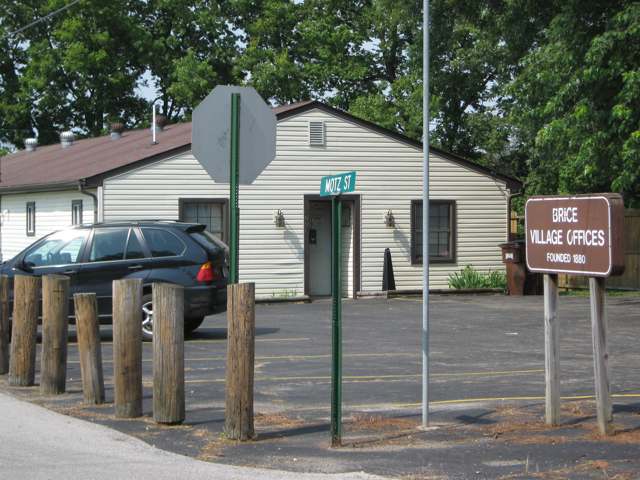
Photo: Lexator, CC BY-SA 3.0 · Wikimedia Commons
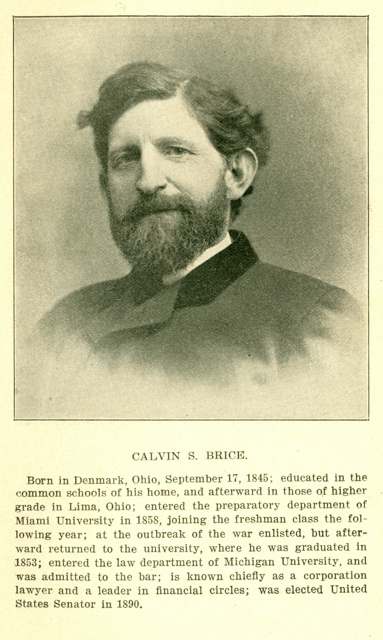
Photo: Flickr Commons via The Political Graveyard, CC BY 2.0 · Wikimedia Commons
Local history sources: en.wikipedia.org · briceohio.com · madisontownship.org · genealogybug.net · archive.org · archive.org · en.wikipedia.org · en.wikipedia.org · commons.wikimedia.org · commons.wikimedia.org
Water
South Well Field wells in Scioto valley sand and gravel, off Parsons Ave near Shadeville and Lockbourne The water here
- Columbus Public Water System100% of residentsScioto River (Griggs & O'Shaughnessy), Hoover Reservoir on Big Walnut Ck, plus wells
Its ZIP codes
Each ZIP code that touches Brice, with the share of its residents who live here and the same headline figures as the ZIP page.
| ZIP | Share | Water | Radon | Home value | Schools | Flood |
|---|---|---|---|---|---|---|
| 43109 Brice | 88% | South Well Field wells in Scioto valley sand and gravel, off Parsons Ave near Shadeville and Lockbourne | 9.8 pCi/L average radon | Median year built 1900 | Groveport Madison Local · 3.5 stars overall | 0.0% of residents in the 1% floodplain |
The county
Franklin County: 45 ZIP codes, 42 cities, villages and townships, 1,356,733 people.
Nearby places
Cite this page
Cite this page as:
Cracked Buckeye (Open Shower Co), "Brice, Franklin County", https://crackedbuckeye.com/place/brice/, built 2026-09-16, accessed [date].
Machine-readable: /api/place/brice.json (open JSON, CC BY 4.0 for the compilation; the underlying records keep their own terms) · How to cite · Report a correction · Built 2026-09-16