How Bremen began
Bremen was platted in 1834 by George Beery on the school lands at the center of Rush Creek Township, in the far southeastern corner of Fairfield County, and took its name from Bremen, Germany, reflecting the heritage of the German settlers who founded it. For its first seventy years it stayed a quiet crossroads of about two hundred people, reached by a weekly horseback mail rider and, after 1855, a single rail line; the county historian, writing in 1912, said flatly that 'the commercial history of Bremen did not begin till 1907.' That year a well on the Weingartner farm and another on the Kittle farm in Rush Creek Township struck oil, opening the Bremen oil field, and one persistent local promoter, J. E. Purvis, after twenty years of failed attempts, finally raised the capital to drill successfully; the resulting boom nearly quadrupled the village's population within two decades. Bremen still marks that history each September with its Oil Derrick Days festival.
Platted 1834, incorporated 1894, by George Beery.
Where the name comes from
Bremen was platted by George Beery in 1834 on the southeast corner of Section 16, the township's school lands. No source consulted from the period explains why Beery chose the name; a modern secondary source states it was drawn from Bremen, Germany, reflecting the German heritage common among the area's settlers, which is consistent with German family names -- Beery, Rhodabaver, Stemen, Kagay -- recorded among Bremen's early households, though this specific naming reasoning was not independently confirmed in an 1880s source.
Before the town
No source consulted names a specific Native village or camp at the site of Bremen itself. The 1883 county history's Archaeology chapter, however, records 'three or four mounds on the Raccoon, in Rush Creek township, that present interesting features' -- Raccoon Creek joins Rush Creek near Bremen, and Casper Hufford's early gristmill on the Raccoon was built just west of the village -- though the chapter states no examination of these mounds had taken place as of 1883 and does not identify their builders' culture. The whole of Rush Creek Township, like the rest of Fairfield County, was ceded at the 1795 Treaty of Greenville, after which the Hocking Valley's Wyandot mostly withdrew to the Sandusky country, with hunting parties recorded returning to the county as late as 1812.
Nations recorded here: Wyandot.
- Raccoon Creek mounds (mound) — on the Raccoon (Raccoon Creek), Rush Creek Township, near Bremen, pre-contact, culture undetermined; unexcavated as of 1883 (archive.org)
Timeline
- — The Treaty of Greenville cedes most of Ohio, including the future Rush Creek Township, to the United States.
- — John Ashbaugh, from Redstone, Pennsylvania, settles on Raccoon Creek, apparently the first settler in what becomes Rush Creek Township.
- — Rush Creek Township is organized and surveyed by Elnathan Schofield, an early Lancaster citizen.
- — Samuel Hammel builds the first water grist-mill on Rush Creek.
- — George Beery plats the village of Bremen on the southeast corner of Section 16, the school lands, at the center of the township.
- — The first train passes through Bremen on the Cincinnati and Muskingum Valley Railroad, July 4, the village's first rail connection.
- — John Beery lays out a ten-acre addition to Bremen just south of the original plat.
- — Bremen is incorporated as a village; L. O. Binkley serves as its first mayor.
- — In early spring a well on the Weingartner farm between Pleasantville and Rushville begins flowing oil; in July a well on the Frank Kittle farm in Rush Creek Township succeeds, opening the Bremen oil field.
- — The Bremen Gas & Oil Company is organized May 17 by J. E. Purvis and six other Bremen men, after nearly twenty years of Purvis's earlier failed attempts to raise drilling capital.
- — The census records Bremen's population at 925, up from 244 in 1890 and 466 in 1900, driven by the oil boom.
- — The Bremen oil boom, which began in 1907, tapers off in the early part of the decade.
Stories
Twenty Years Underground
J. E. Purvis spent nearly two decades convinced there was oil under Bremen before anyone else believed him enough to pay for the drilling. He first secured options on some five thousand acres around the village and tried to organize a drilling company, reasoning that the great natural-gas reservoirs a few miles west meant fuel was present underground; the options lapsed when he could not raise the capital. A company he helped found in 1895, the Rush Creek Oil & Gas Company, drilled three unsuccessful wells and went into receivership. A second partnership in 1896 also came up short. Only in 1907, after gas turned up on three sides of the village in other people's wells, did Purvis manage to organize the Bremen Gas & Oil Company and get real backing; its first well was a disappointment, but its third, on the Huston farm, began flowing 140 barrels a day in October 1907. Stock that had once struggled to sell rose as high as $625 a share by 1909, and by January 1910 the company had paid twelve dividends of fifty percent each -- a reward, the county historian noted, for a man who had waited most of his adult life for it.
The Town the Oil Well Woke Up
For most of the nineteenth century, Bremen was the kind of place where, as one old resident recalled, mail arrived once a week by horseback from McConnellsville, and the biggest excitement in living memory had been the first train through town on July 4, 1855. The 1912 county history put the matter plainly: 'the commercial history of Bremen did not begin till 1907.' That year changed everything. Within three years of the first successful well, the county's oil field had drawn in over 150 stock companies, nearly all of them controlled by local farmers who bought shares with whatever money they had, some profitable and some not; Bremen's population, static at a few hundred for fifty years, nearly quadrupled between 1890 and 1910. The town still keeps the memory alive every September with its Oil Derrick Days festival, marking the year a sleepy platted village of two hundred people became, however briefly, one of the better oil fields in Ohio.
Photographs
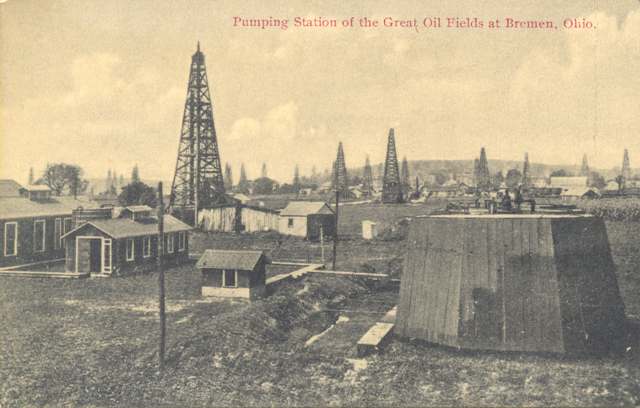
Photo: Miami University Libraries, Bowden Postcard Collection, via Flickr Commons, no known copyright restrictions · Wikimedia Commons
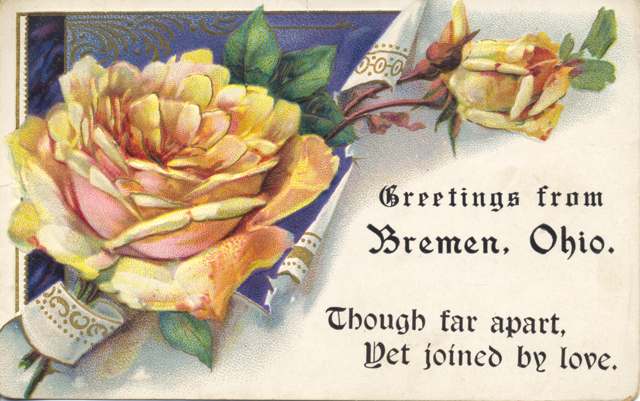
Photo: Miami University Libraries, Bowden Postcard Collection, via Flickr Commons, no known copyright restrictions · Wikimedia Commons
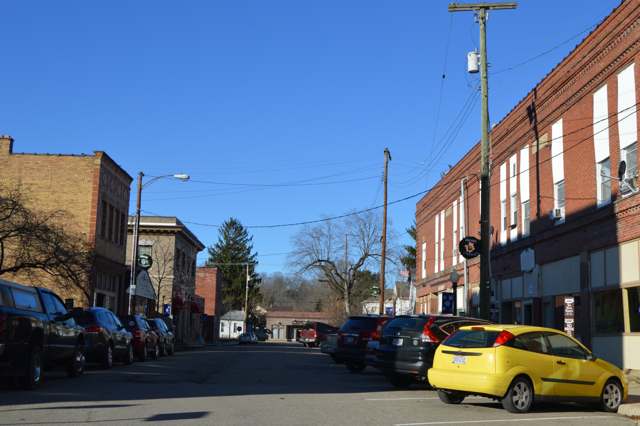
Photo: Nyttend, via Wikimedia Commons, public domain · Wikimedia Commons
Local history sources: archive.org · archive.org · en.wikipedia.org · en.wikipedia.org · commons.wikimedia.org · commons.wikimedia.org · commons.wikimedia.org
Water
Mostly private wells The water here
- Bremen Village100% of residentsGroundwater wells (4 wells)
Its ZIP codes
Each ZIP code that touches Bremen, with the share of its residents who live here and the same headline figures as the ZIP page.
| ZIP | Share | Water | Radon | Home value | Schools | Flood |
|---|---|---|---|---|---|---|
| 43107 Rushcreek Township and Bremen | 46% | Mostly private wells | 12.3 pCi/L average radon | Median year built 1966 | Fairfield Union Local · 4 stars overall | 4.7% of residents in the 1% floodplain |
The county
Fairfield County: 13 ZIP codes, 27 cities, villages and townships, 144,692 people.
Nearby places
Cite this page
Cite this page as:
Cracked Buckeye (Open Shower Co), "Bremen, Fairfield County", https://crackedbuckeye.com/place/bremen/, built 2026-09-16, accessed [date].
Machine-readable: /api/place/bremen.json (open JSON, CC BY 4.0 for the compilation; the underlying records keep their own terms) · How to cite · Report a correction · Built 2026-09-16