Notable people · Abolitionist · Inventor · Businessman
John P. Parker
Formerly enslaved iron founder in Ripley who crossed into Kentucky again and again to lead freedom seekers over the Ohio River, and who held three U.S. patents.
Born 1827, Norfolk, VA
Died January 30, 1900, Ripley
At a glance
- Born
- 1827, Norfolk, VA source
- Died
- January 30, 1900, Ripley (Brown County) source
- Also known as
- John Percival Parker, John Parker
- Education
- Self-taught with help of a physician's family, Mobile, AL
- Known as
- Abolitionist, Inventor, Businessman
- Organizations
- Ripley Foundry and Machine Company
Life story
John Parker was born around 1827 in Norfolk, Virginia, to an enslaved mother and a white father. As a boy he was marched to Richmond and sold. He learned to read in Mobile, Alabama, despite the law.
Working in iron foundries, he bought his freedom for $1,800 in 1845 and moved to Cincinnati, where he married Miranda Boulden in 1848.
Settling in Ripley, Ohio, in the 1850s, he guided hundreds of people across the Ohio River while running a foundry. He is remembered as one of the most active conductors on that stretch of the river.
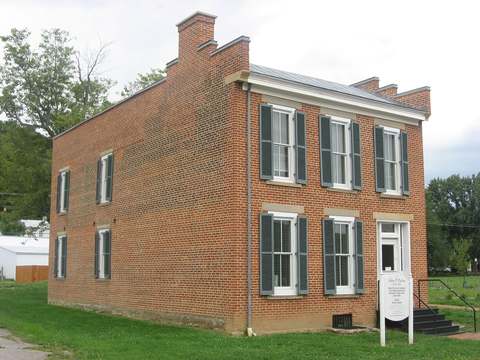
He invented a clod-crushing machine and received patents in 1884 and 1885 for a tobacco press and a harrow. He built the Phoenix Foundry in 1890, the largest between Cincinnati and Portsmouth, and died in 1900. His Ripley house is a National Historic Landmark.
Ohio ties
- Cincinnati (c. 1845-1849)
iron moulder; married Miranda Boulden in 1848; first drawn into rescue work by a Cincinnati freeman Hamilton County · source - Ripley, 300 N. Front Street (c. 1849-1900)
home, foundry and machine shop; Underground Railroad conductor until the end of the Civil War Brown County · source - Ripley, Sycamore and Front streets (1889-1900)
foundry moved here after the August 1889 fire Brown County · source
Timeline
- 1827 Born enslaved in Norfolk, Virginia, to an enslaved Black mother and a white father. source
- 1835 Aged eight, sold at the Richmond slave market and forced to walk in chains to Mobile, Alabama, where a doctor bought him. source
- 1845 Made his last payment to a Mobile widow who had bought him on his promise to repay $1,800 from his wages as a moulder, and became free at 18. source
- 1848 Married Miranda Boulden, a free-born woman, in Cincinnati, where he worked as an iron moulder. source
- 1849 After rescuing two girls from near Maysville, Kentucky, on his first venture, he settled in Ripley about 1849 or 1850. source
- 1853 A mortgage deed to William McCague for lot 67 in Ripley lists the steam engine, foundry and blacksmith shop at the site where Parker lived and worked. source
- 1858 A Ripley Bee advertisement named John P. Parker and William Hood as proprietors of the Phoenix Foundry and Finishing Shop. source
- 1863 Became a recruiter for the 27th U.S. Colored Troops, one of Ohio's two Black regiments. source
- 1865 Bought the foundry property from William McCague in partnership with William Hood. source
- 1884 Granted U.S. Patent 304,552 on 2 September for a follower-screw for tobacco presses. source
- 1885 Granted U.S. Patent 318,285 on 19 May for a portable screw press, used to pack tobacco into hogsheads. source
- 1889 A fire in August destroyed the foundry behind his house; he moved the foundry to Sycamore and Front streets rather than rebuild. source
- 1890 Granted U.S. Patent 442,538 on 9 December for a soil pulverizer, a machine he had first modelled while enslaved in Mobile. source
- 1900 Died on 30 January, still running the foundry, whose main product was then tobacco screws. source
- 1980 The John P. Parker House was listed on the National Register of Historic Places. source
- 1996 The John P. Parker Historical Society was formed, and his dictated memoir was published as His Promised Land, edited by Stuart Seely Sprague. source
- 1997 The house was designated a National Historic Landmark. source
- 2003 The house became part of the National Park Service's Underground Railroad Network to Freedom. source
- 2022 The National Park Service testified in support of S. 3685, the John P. Parker House Study Act, on 11 May. source
- 2024 The Park Service took public comment from 11 July to 8 September on a special resource study, ordered by Public Law 117-328, of whether the house should join the national park system. source
What John is known for
- Underground Railroad conductor
- Patents: tobacco press (1884), soil pulverizer (1885)
- Phoenix Foundry 1890
- National Historic Landmark house 1997
- Pulverizer/clod-crusher (1840s)
- Tobacco press and harrow (patents 1884-85; numbers not given on fetched page)
- Phoenix Foundry (1890)
Stories
Two men on the roof
Parker said he hid freedom seekers in his own house only once. Two men had been seized by a paid spy and freed by a group of Black Ripley men, who brought them to Parker's door too late to move them on before daylight, so he put them in his attic. An armed crowd from Kentucky forced its way in and searched the house. Parker shouted at the top of the stairs that the men could search 'even on the roof', to warn the two upstairs. When the searchers reached the attic, Parker briefly saw the two figures in a corner, then they were gone. They had climbed out to the roof and pulled the ladder up after them, and the search found nothing.
The diary in the furnace
Parker kept a diary of the names, dates and circumstances of the people he helped escape, and by 1850 it held 315 names. After the Fugitive Slave Act of 1850 made aiding a freedom seeker punishable by fines, jail and seizure of property, he threw it into his iron furnace. He said he did it for safety, because he owned considerable property by then and feared the diary might fall into other hands. It is a large part of why no one can say how many people he actually helped.
An invention taken and won back
While still enslaved in Mobile and working in a foundry, Parker built a model of a circular harrow or 'clod smasher' for breaking new ground. He showed it to the shop superintendent, who kept it and told the owner the idea was his own. Parker grabbed him by the throat, and later said he had hoped the invention would pay his way out of slavery. He built and sold the machine in his own Ripley shop for years before he patented it in December 1890 as a soil pulverizer, signing the patent from Ripley, Brown County.
The first rescue
Parker was a reluctant conductor at first. In Cincinnati, a barber kept asking him to help rescue two girls hiding near Maysville, Kentucky. The plan was for the barber to take a skiff at Ripley while Parker went into Maysville for the girls. After several failures the barber went home to Cincinnati, but Parker crossed into Kentucky alone and brought the girls over the river. He then moved to Ripley and kept at the work for the next decade and a half.
Honors and things named for them
- John P. Parker House, National Historic Landmark (1997)
- John P. Parker School, Cincinnati
- John Parker Historical Society (1996)
- Opera 'Rise for Freedom: The John P. Parker Story'
Named for John P. Parker
- John P. Parker School (pre-K to grade 6) (Cincinnati, Hamilton County) source
Family
- wife: Miranda Boulden
Sites to know
Homes, graves, markers, museums and monuments; the numbered ones are on the map.
- 1 John P. Parker House and Museum (NRHP 80002944; National Historic Landmark 1997)
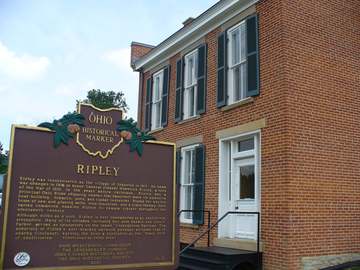
300 N. Front Street, Ripley Brown County · source - 2 Ohio Historical Marker 4-8, Ripley / The John P. Parker House
300 N. Front Street, Ripley Brown County · source - Later Parker foundry site after the 1889 fire (north side of Sycamore Street at Front Street; later buildings of the Ripley Corporation) (unknown)
Ripley Brown County · source - Liberty Monument (1912), foot of Main Street, which names John Parker among Ripley's abolitionists (unknown)
Main Street at the Ohio River, Ripley Brown County · source
Places in Ohio to see
- John P. Parker House (home)
300 N Front St, Ripley, Brown County ZIP 45167 · Ripley · Brown County
Ohio places
Where John P. Parker was born, lived, worked and is remembered, with the ZIP code, town and county pages for each.
- Lived: Ripley, Brown County (John P. Parker House, 300 N Front St) ZIP 45167 · Ripley · Brown County
Myths and corrections
Things often said about John P. Parker, and what the record shows.
Often said Parker's riverfront house was a regular hiding place for freedom seekers.
The record By Parker's own account he hid fugitives in his house only once, and called it a mistake. His usual work was to cross into Kentucky, bring people over the river and move them on quickly to the Collins and McCague houses, the Rankin house or the Red Oak church. His isolated house on the riverbank was as easy for slave catchers to reach as for fugitives. source
Often said Parker built the Phoenix Foundry in 1890 after a fire destroyed his first works (as Wikipedia states).
The record A Ripley Bee advertisement already names Parker and William Hood as proprietors of the 'Phoenix Foundry and Finishing Shop' in 1858. The fire was in August 1889, reported in the People's Defender, and afterwards he moved the foundry half a block to Sycamore and Front streets. source
Often said His tobacco press and his harrow or pulverizer were patented in 1884 and 1885.
The record The 1884 and 1885 patents (304,552 and 318,285) are both for tobacco-press equipment. The soil pulverizer was patented on 9 December 1890 as U.S. Patent 442,538. The 2018 NPS survey also misprints the 1885 patent number as 318,215. source
Often said Parker personally rescued more than 900 (or more than 1,000) people.
The record These are estimates. The Ohio marker says more than 900 and the NHL nomination says he 'may have helped' more than 1,000. The only count from Parker himself is the 315 names in the diary he burned around 1850, which is why most federal sources just say 'hundreds'. source
- Disputed: One account dates his pulverizer to the 1840s, when he lived in Mobile, Alabama. Others say he was taking out patents in Ripley, Ohio.
Documents
Primary records: patents, letters, court and government files, nominations and old county histories, each at the archive that holds it.
- National Historic Landmark nomination: John P. Parker House (NRIS 97000340), with extracts from Parker's dictated memoir 1997, National Park Service, NPGallery
- U.S. Patent 304,552, Follower-screw for tobacco-presses (John P. Parker, Ripley) 1884, Google Patents
- U.S. Patent 318,285, Portable screw-press (John P. Parker, Ripley) 1885, Google Patents
- U.S. Patent 442,538, Soil-pulverizer (John Percial [Percival] Parker, Ripley) 1890, Google Patents
- The John P. Parker House and Museum Reconnaissance Survey, National Park Service Midwest Region 2018, National Park Service (copy on NPS History eLibrary)
- Statement of Michael A. Caldwell, NPS, on S. 3685, the John P. Parker House Study Act 2022, U.S. Department of the Interior
Pictures
Free to use with the credit shown. Select a picture for the original and its license.
Taken by me.
The original uploader was Kevin Myers at English Wikipedia. / CC BY-SA 3.0

Further reading
Sources
Confidence. Medium: the main facts were confirmed, but some details (often an address or ZIP code) were not.
- Wikipedia: John P. Parker birth, freedom, foundry, patents, house (Wikipedia, opened; pointer-level source)
- Wikipedia: John Parker (abolitionist)
- Wikipedia: John P. Parker House
- npgallery.nps.gov: 97000340 text
- npgallery.nps.gov
- npgallery.nps.gov
- npshistory.com: john parker house rs 2018
- remarkableohio.org: 4 8 ripley the john p parker house
- patents.google.com
- patents.google.com
- patents.google.com
- findagrave.com: john percival parker
- doi.gov: s 3685
- parkplanning.nps.gov: parkerhousesrs
- wcpo.com: historic john p parker house in ripley under consideration to become part of nat
- housedivided.dickinson.edu: parker john
- Wikimedia Commons: John P. Parker House from northwest
- Wikimedia Commons: Parker house

Every link goes to the original source. Profile researched 2026-10-15.